Whitehot Magazine
October 2026
"The Best Art In The World"
"The Best Art In The World"
October 2026
Memories of the Present: The Painting of Dustin Emory
By MANUELA ANNAMARIA ACCINNO December 26th, 2025
Dustin Emory's art stems from the idea that a painting is a “memory of the present”: not a simple evocation of the past, but a form that freezes and at the same time problematizes the moment that has just passed. His paintings function as mnemonic registers, devices that retain fragments of everyday life and reproduce them in recursive patterns capable of revealing the repetitive and at the same time mutable nature of human experience. The rigorous formal limitation—a grey-scale palette, constant clothing, repeated figures—is not an exercise in austerity but a methodological choice: by removing color and surface variation, Emory focuses attention on the micro-differences that memory preserves. Every tonal variation, every fold in the clothing, every slight tilt of the head becomes a clue; grey acts as a liminal space in which reality breaks down into reflection and memory, in which the moment becomes layered.
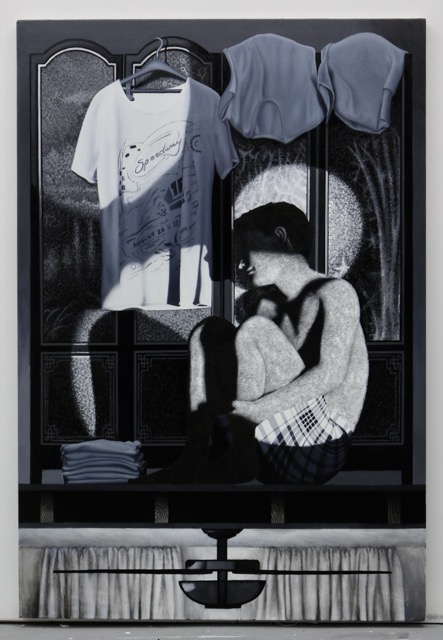
"They Even Watch me Change", 2023, Oil, acrylic, and pumice stone on canvas, 72x49 INCHES,
The interiors that house the figures are chambers of memory, architectures that suspend time. The rooms not only circumscribe physical space but also structure a fragmented temporality: reduced perspectives, meditative voids and minimal details transform the scene into a palimpsest of overlapping presents. The figures appear both present and already distant, as if the painting captured not only the action but also its echo. This dual quality—the intimacy of the portrait and the estrangement of the residue—defines the emotional tone of the works. Repetition is the true narrative organism of his practice. Rather than reproducing identities, Emory constructs rhythms: multiplied figures that repeat similar postures and clothes, but differ in infinitesimal details. This procedure highlights how life is made up of recurring patterns: habits, gestures, domestic rituals that memory records in variations. Each canvas thus becomes a tile in a larger mosaic, an archive in which the present is recalled and rewritten through iterations.

"Surveillance", 2024, Oil, acrylic, gouache and pumice stone on canvas, 84x60x21/2 INCHES
This formal economy generates an emotional paradox: psychological precision and illogical suspense coexist. The care taken in the portrait and posture induces empathy and recognition; at the same time, the composition and repetition create a sense of bewilderment, a suspense that cannot be resolved by causal explanations. It is a suspense of a mnemonic nature: the viewer is forced to fill in the gaps, to piece together stories from cold clues. Thus, painting becomes a participatory act, a place where individual memory is activated to give meaning. The isolation depicted by Emory is not mere visual solitude but an existential condition: figures that brush past each other without meeting, presences that cohabit the same space and time but remain misaligned. The void surrounding the subjects is a field of resonance, not absence: it allows the image to transform into an echo, the present to prolong itself as a memory.
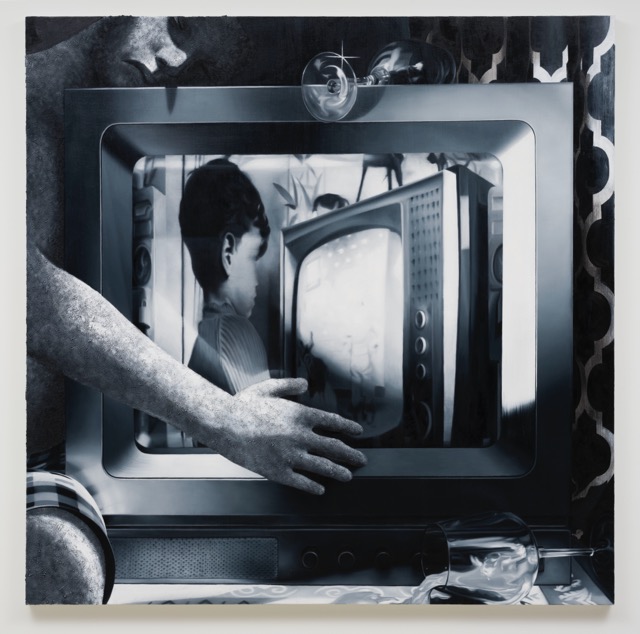 "Days Before Remembering", 2023, Oil, acrylic and pumice stone on canvas, 72x72 INCHES
From this perspective, art does not comfort: it questions and restrains, offering the viewer the responsibility of an active memory. Finally, Emory's practice has an ethical and aesthetic value in its discipline: limiting the means is here a choice of lucidity. By reducing sensory short-circuiting, painting lays bare the emotional structure of everyday life, forcing the gaze to seek out subtle differences and recognize repetitiveness as a constituent factor of identity. The canvases thus become reminders of the present, archives of moments which, repeated and reworked, reveal the complexity of memory and the fragile persistence of being in time.

Manuela Annamaria Accinno
Manuela Annamaria Accinno, born and raised in Milan, is an art historian and critic with a degree from the University of Milan. She has been actively collaborating for several years with radio stations and magazines specializing in the field of art.
view all articles from this author