Whitehot Magazine
October 2026
"The Best Art In The World"
"The Best Art In The World"
October 2026
The Prereflective at Harper’s Gallery
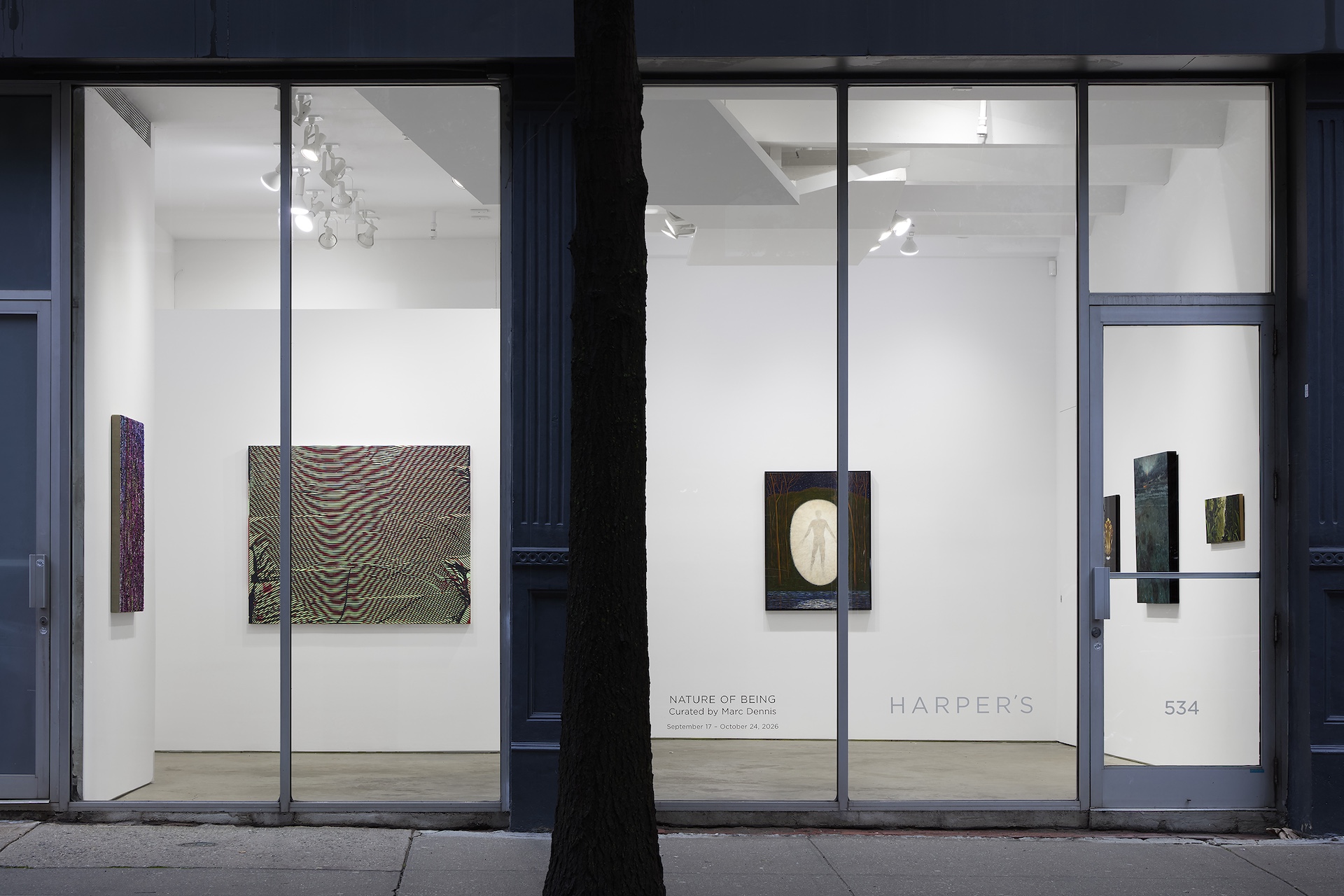
Installation view of Nature of Being at Harper’s Chelsea 534. Courtesy of Harper’s, New York.
By RAPHY SARKISSIAN | October 5, 2026
Experience anticipates a philosophy and philosophy is merely an elucidated experience.
—Maurice Merleau-Ponty, Phenomenology of Perception
In Charles and Ray Eames’s canonical 1977 film Powers of Ten, the camera zooms past the threshold of human vision, showing that the closer we get to a material entity, the more its apparent logic dissolves into an overarching cosmic system. Douglas Melini’s painting Tree (white oak in purples) sits on that same threshold. At a distance, it appears largely abstract, prompting the question: does it represent a trunk or a nebula? Most likely both, as a process of reflection rather than a final conclusion. Tree is part of Nature of Being, an eight-painting group exhibition Marc Dennis has imaginatively arranged at Harper’s Chelsea 534 while his much larger solo show titled Sugar on My Tongue is running a few doors east at Harper’s Chelsea 512.
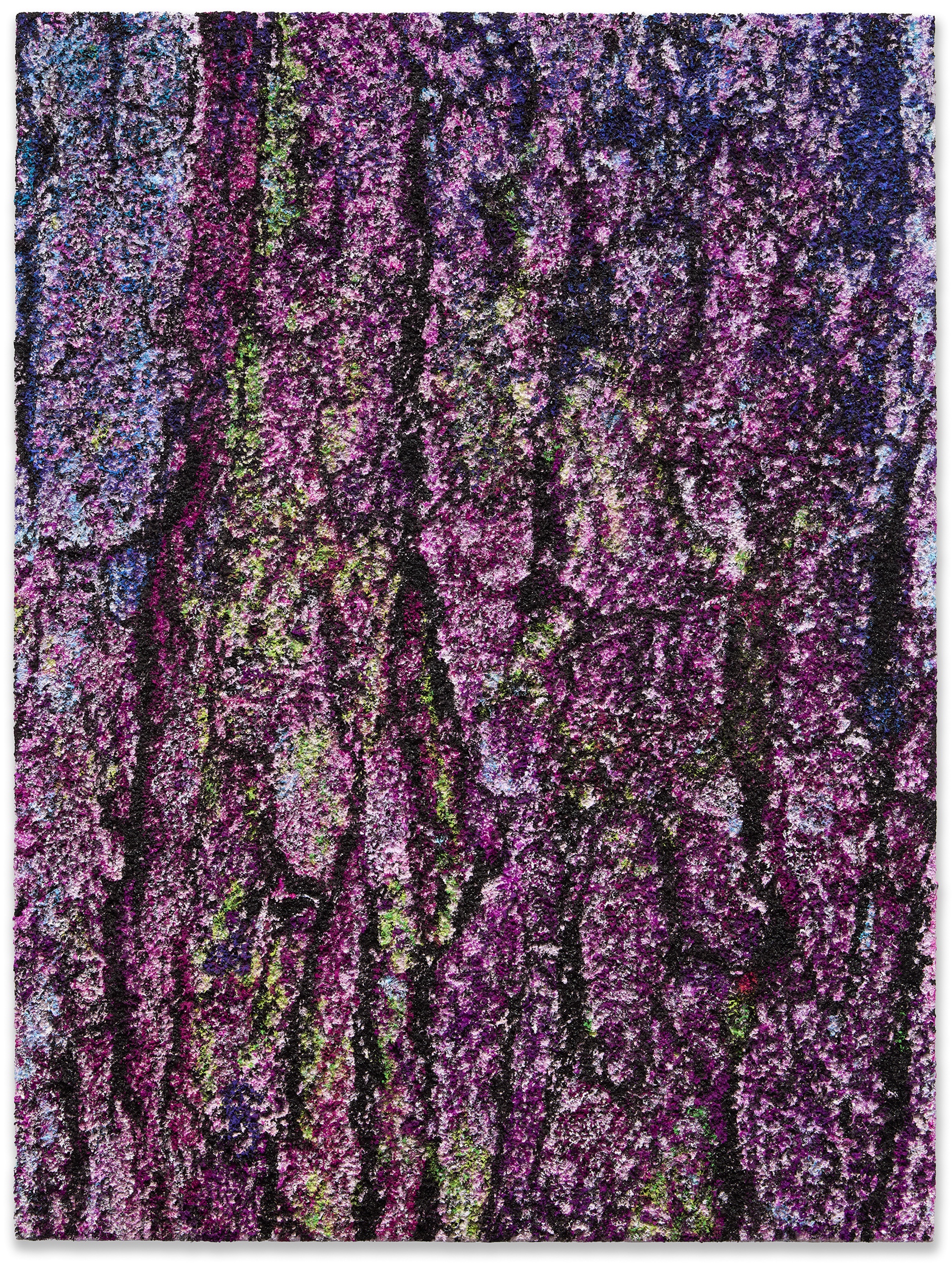 Douglas Melini, Tree (white oak in purples), 2026. Oil on linen, 40 by 30 inches. Courtesy of Harper’s, New York.
Examined in proximity, Melini’s abstraction gives way to the appearance of bark. Black furrows branch and rejoin across the picture plane, through a granular field of magenta and violet, lit with lilac and threaded with streaks of green. He builds the surface over weeks, if not months, particle by particle, into a micro-relief of peaks and hollows, until it becomes exceedingly dense and haptic. Image and matter are inseparable here. Bright and dark in minute accumulation, the colors convey a sense of iridescence, while the painting carries the weight and sheen of freshly sealed asphalt. Such a method of image-making recalls Paul Signac’s The Town Beach, Collioure, Opus 165 (1887) at the Metropolitan Museum of Art, a tranquil coastal scene built from short touches of the brush. In Signac, each touch still reads as a touch. In Melini, the units are so minute and so tightly packed that they stop reading as marks and become masses coated in pigment, literally three-dimensional. The surface has thus constructed its own uncanny bark through accretions of color.
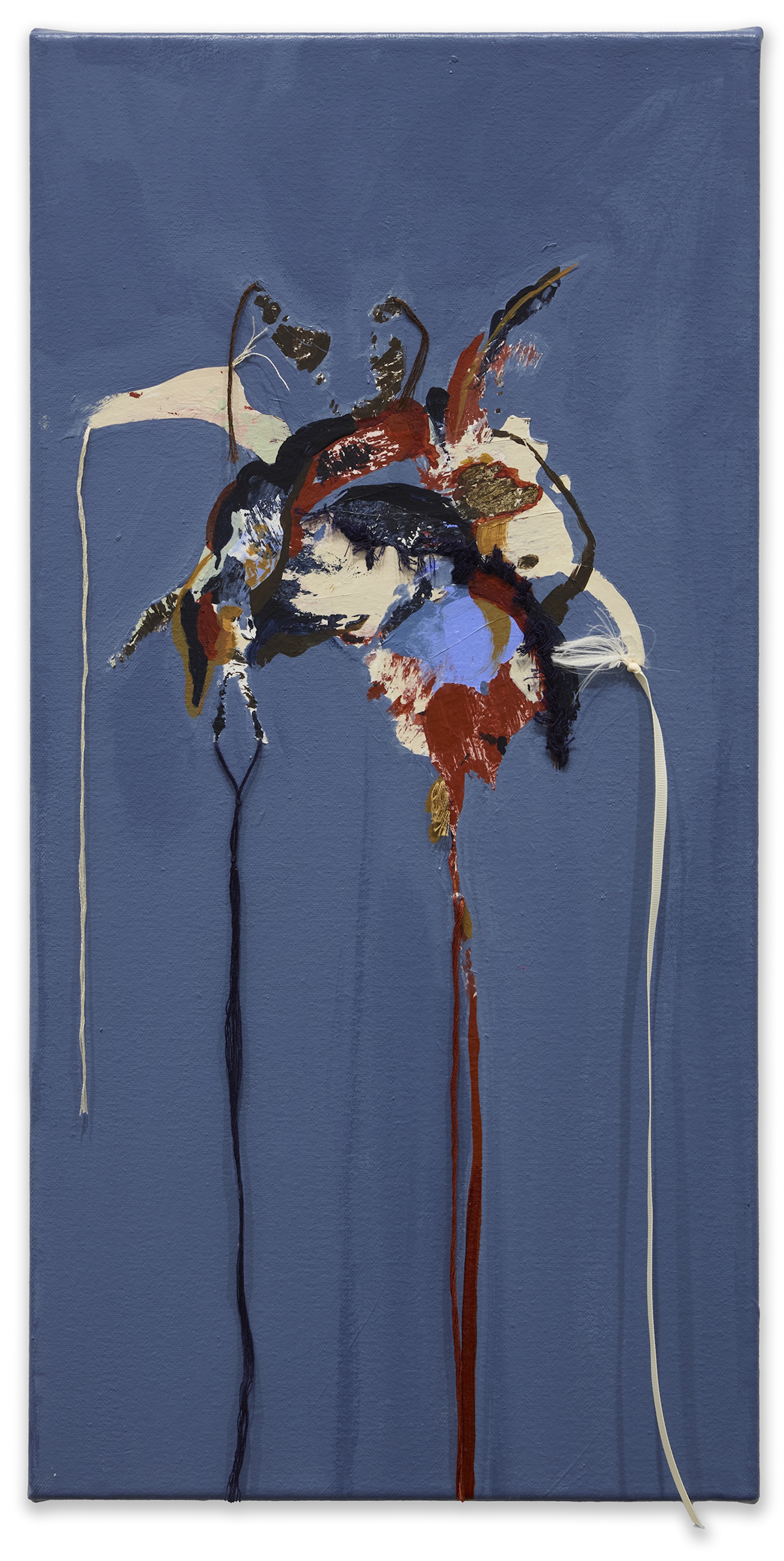 Renelle White Buffalo, Iktomi 4, 2026. Acrylic, collage, ribbon, and embroidery thread on canvas, 24 by 12 inches. Courtesy of Harper’s, New York.
Melini builds his surface from paint. Renelle White Buffalo builds hers partly from thread. Iktomi 4 is a small canvas in acrylic, collage, ribbon, and embroidery thread. Its title names Iktomi, a trickster spirit from Lakota oral tradition. White Buffalo, who is Sičáŋǧu Lakota, has long carried that tradition into abstraction. Against a flat slate-blue ground, a gestural cluster of cream, rust red, black, and ochre gathers in the upper half around a pale blue center, with twisted thread and curling dark shapes reaching out from it. Below it hang long strands of ribbon and thread, cream, dark, and rust red, some splitting and others joining as they fall. The canvas becomes a relief, with material laid on its surface and hanging from it. Where Anni Albers made thread a pictorial medium in her weavings, White Buffalo brings thread into painting and lets it spill back out. The cluster it hangs from reads as a spider on its silk, then as a flower on drooping stems. Through the threads, painting reaches into the space of the room, the material realm of the beholder.
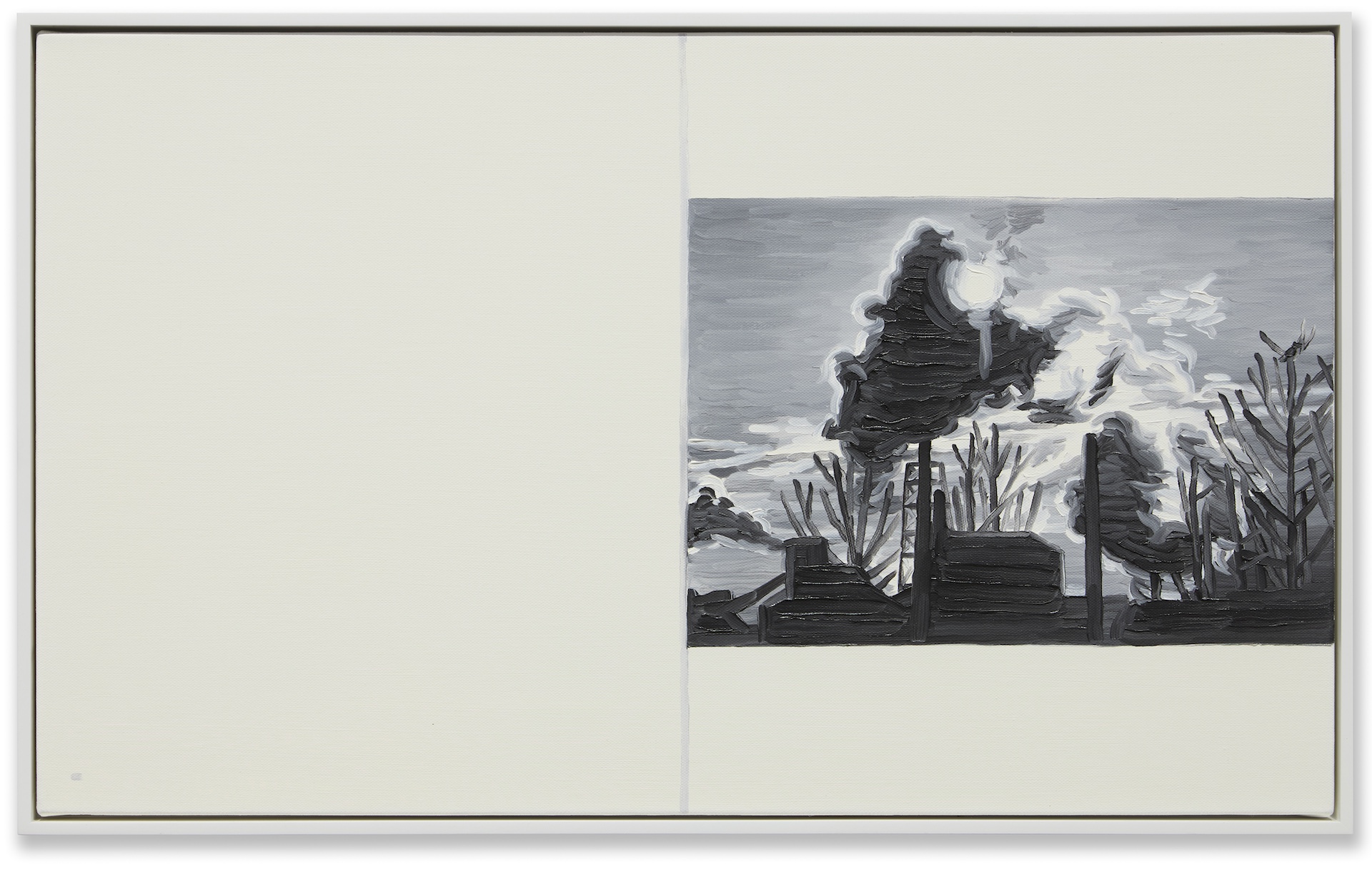 Cynthia Daignault, Bibliography (Masahisa Fukase), 2024. Oil on linen, 15 by 25 inches. Courtesy of Harper’s, New York.
Cynthia Daignault’s Bibliography (Masahisa Fukase), a modestly scaled oil on linen set in a white frame, is a puzzle that unfolds in stages. At first it reads as a white field with a small landscape set to the right. Then a thin gray line, easy to miss, comes into view just left of center. It evokes the seam of a book. The canvas becomes an open book: a blank left page, and on the right a landscape set within its own rectangle. The title points to Masahisa Fukase, one of Japan’s most highly regarded postwar photographers, best known for his book Ravens. The plate shows bare trees, dark architectural forms, and a sky of lit clouds. A white disc sits at the edge of a dark tree. In grayscale, the mind first reaches for the moon, but the glare and the bright clouds make it the sun. The handling recalls late Van Gogh, drained to the grays of black-and-white photography: thick horizontal strokes, glossy in the darks, with pale halos traced around each silhouette. The sun’s glare belongs to Burke, for whom a light too strong to look at overpowers the eye and becomes sublime. Here it arrives on a book page, where we can look at it without shielding our eyes.
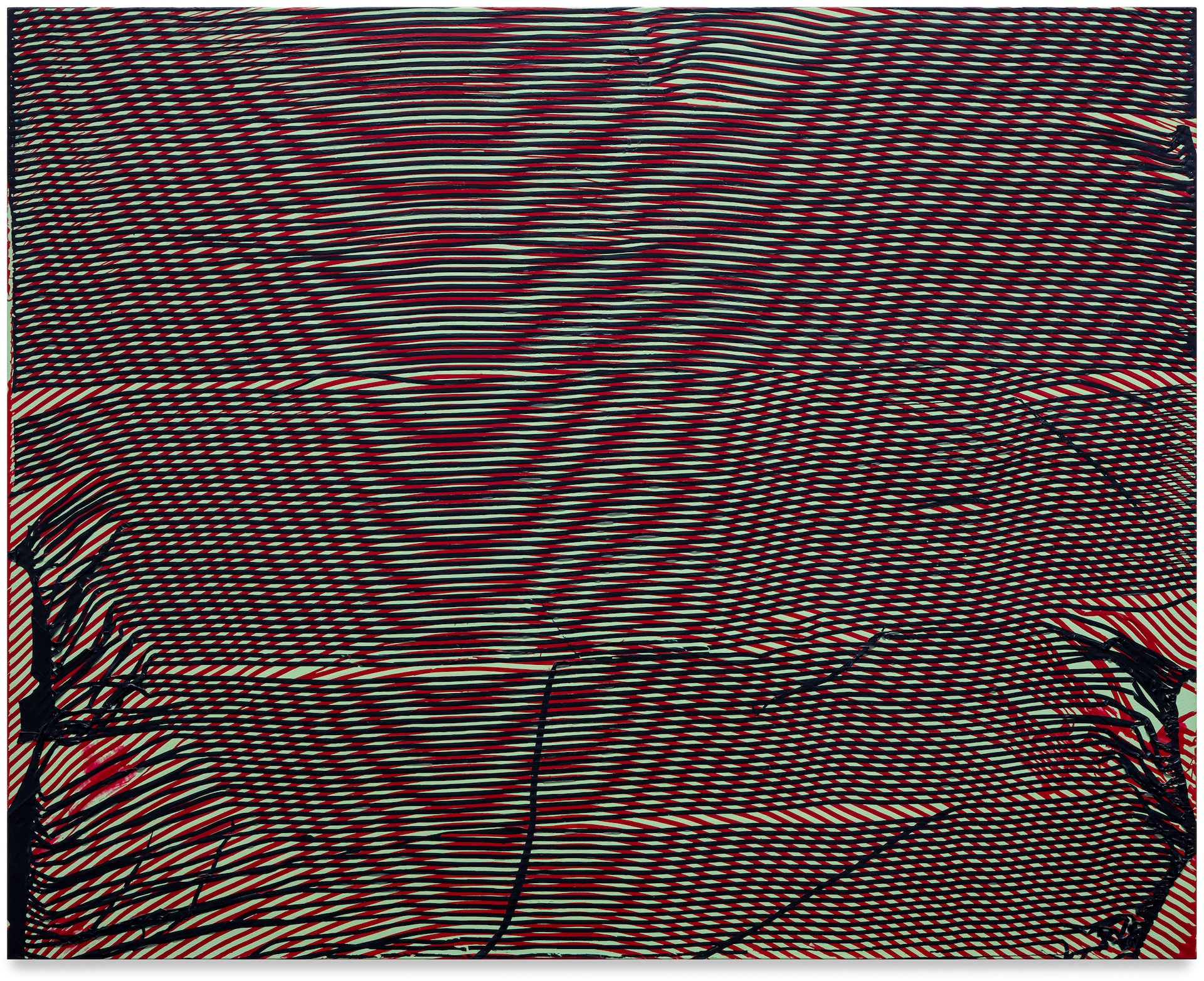 Fritz Chesnut, RGB Moiré 1, 2024. Acrylic on canvas, 48 by 60 inches. Courtesy of Harper’s, New York.
On the adjacent wall, Fritz Chesnut’s RGB Moiré 1 takes the red, green, and blue from which television screens build every image and mutes them into burgundy, pistachio, and dark navy. Here the moiré effect, that shimmer that appears when two fine patterns overlap, is a fluid waveform, not a uniform grid. Bridget Riley’s Movement in Squares (1961) makes a checkerboard drawn with Euclid’s ruler appear to curve inward toward a vertical line, though her intervals remain exact. Chesnut’s lines stretch and warp, and toward the margins they begin to tear, breaking out of their topology. The dark paint clumps, buckles, and drips, in a spill closer to Abstract Expressionism. Strands of color fray and come apart. In Chesnut’s painting, the linear insists on turning painterly at the edges sooner or later. Extended beyond the frame, the Cartesian plane gives up its stability to the eye; its lines pulse and drift as the body moves before it.
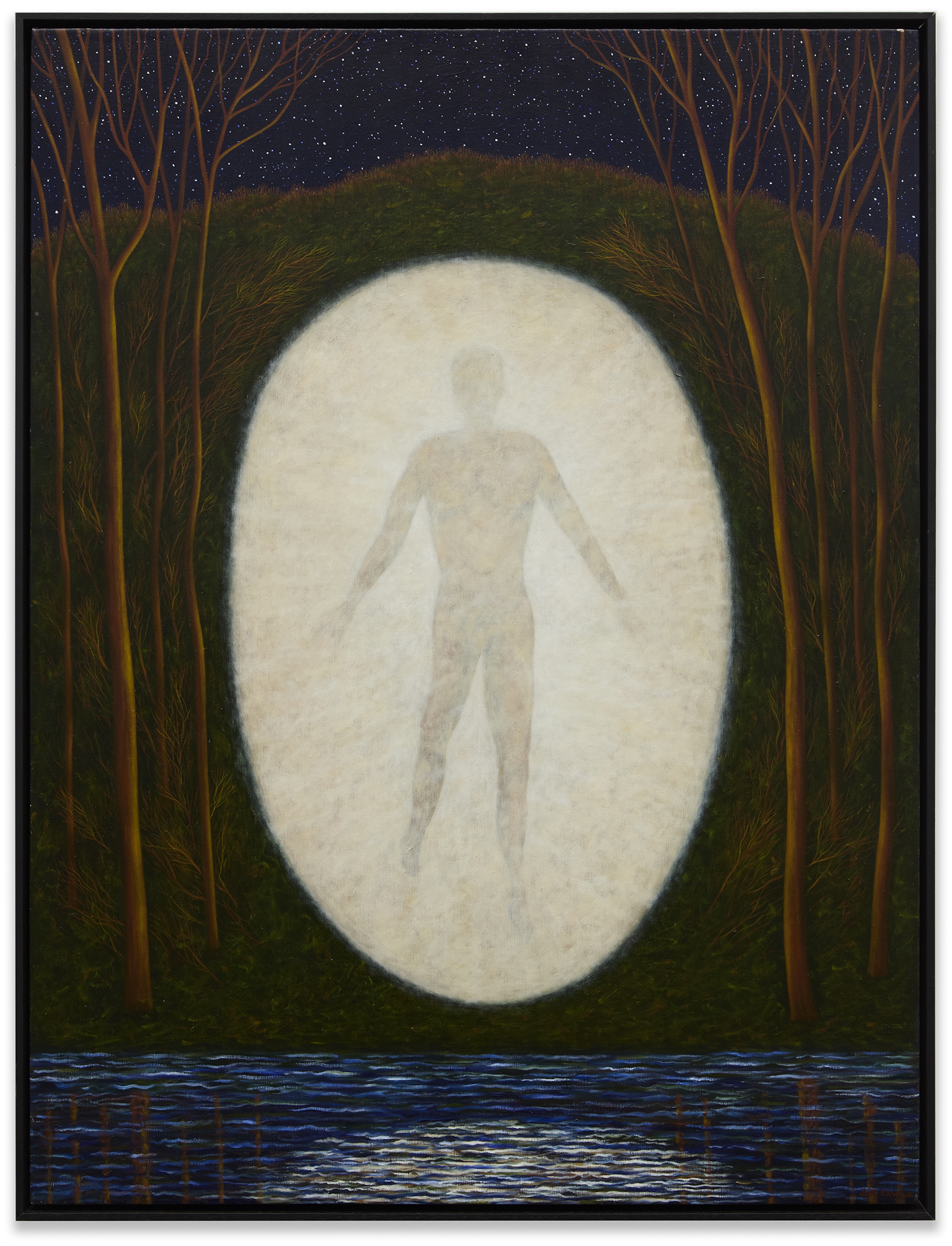
Scott Kahn, Reflecting in the Wilderness, 2004. Oil on linen, 40 by 30 inches. Courtesy of Harper’s, New York.
Scott Kahn’s Reflecting in the Wilderness is a night scene built with patient symmetry: tall, bare trees on either side, a dark green mountain rising behind, a starry sky above, and a band of rippling water below. At its center, a pale ellipse of light holds the faint silhouette of a standing nude figure, suspended as if in a container. Every star, branch, and blade of grass is set down with the same unhurried care. The painting belongs to a lineage that runs from Henri Rousseau’s naive visions to the Transcendental Painting Group in late-1930s New Mexico. The ellipse’s faint reflection in the water gives this impossible form a place in the landscape, between the earth below and the stars above. Kahn’s pensive tableau opens onto an oneiric territory where the body no longer stands above the landscape, as in Caspar David Friedrich's Wanderer above the Sea of Fog (c. 1818) at the Hamburger Kunsthalle, but hangs suspended within it. For Maurice Merleau-Ponty, the body is never merely a spectator of the visible world; it is a thing among things, caught in the fabric of that world.
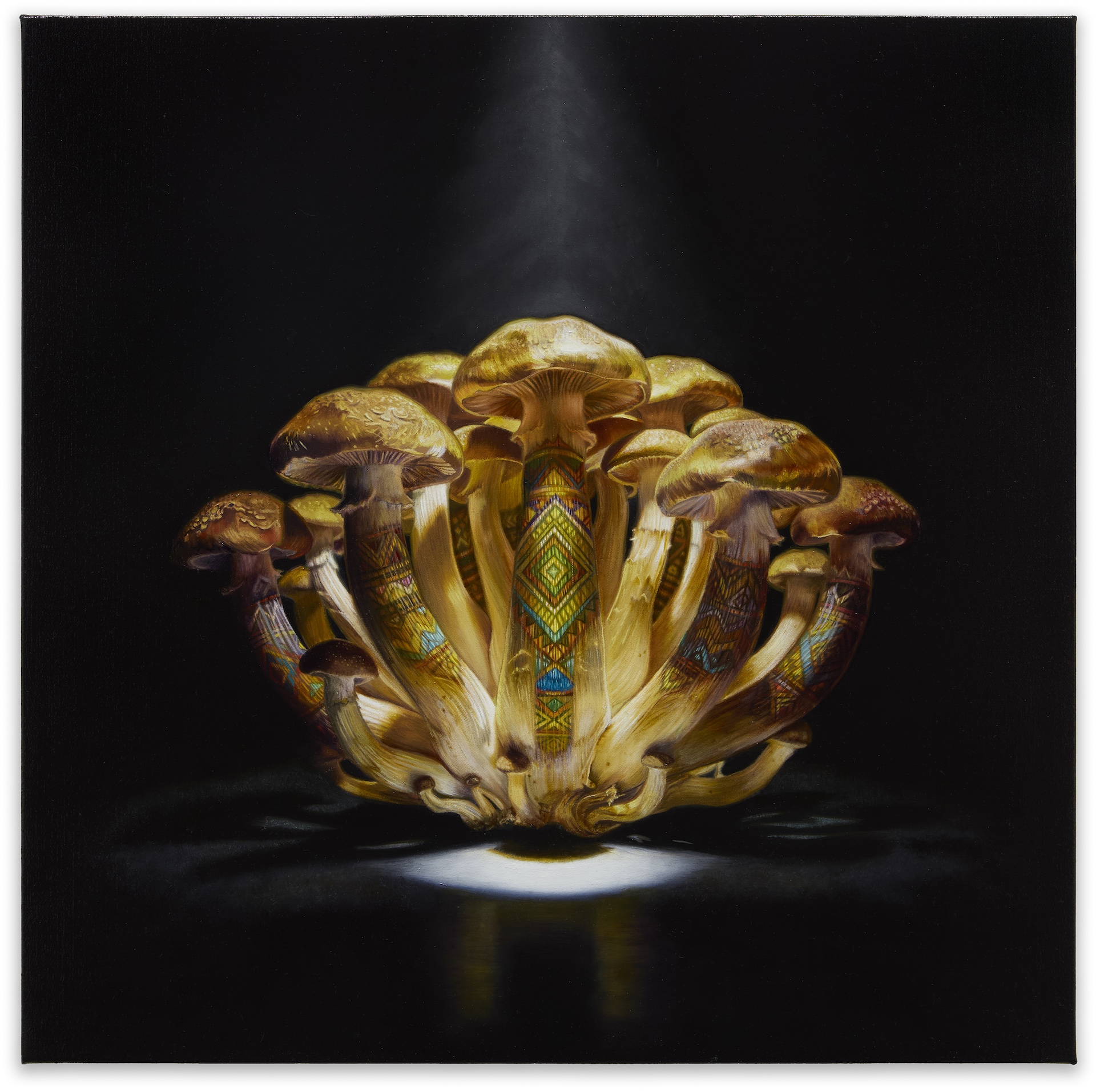 Noah Jordan, PSILOCYBIN, 2026. Oil on linen on cradled aluminum panel, 20 by 20 inches. Courtesy of Harper’s, New York.
Noah Jordan’s PSILOCYBIN sets a cluster of golden mushrooms under a single shaft of light, against black. Caps and stems are painted with near-photographic care, and several stems carry geometric patterns in green, yellow, and blue, like tattoos. Yet the pattern does not look applied. It seems to grow from the stems themselves. Kahn finds the light inside nature, whereas Jordan shines it from outside onto mushrooms inked like skin. Pattern and nature cannot be pulled apart. And the same holds across the show Dennis has assembled, from Chesnut’s geometry caught in self-doubt to the landscape on Daignault’s painted page.
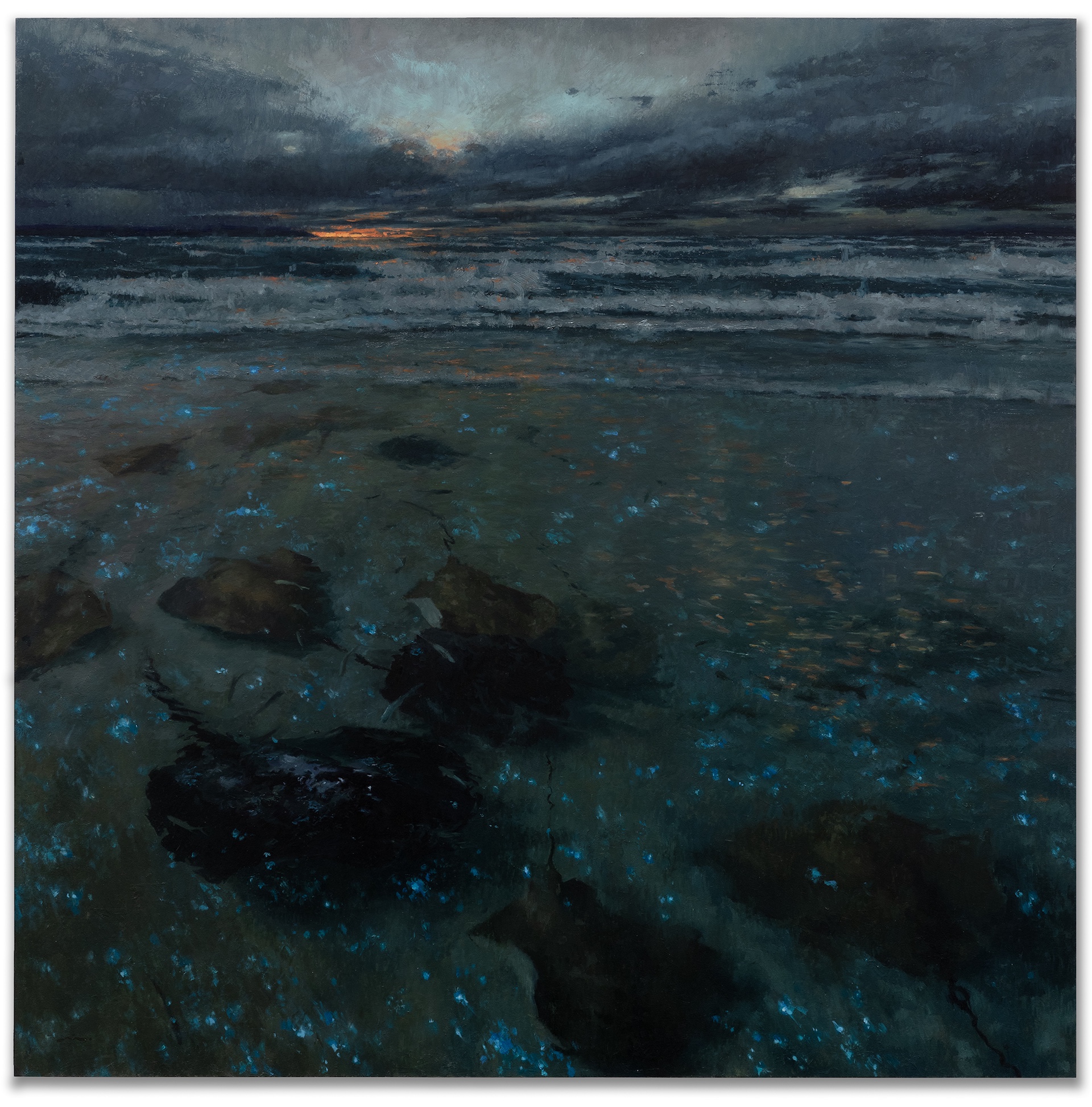 Mia Bergeron, Star Eaters, 2026. Oil on aluminum, 36 by 36 inches. Courtesy of Harper’s, New York.
For all its playful title, Mia Bergeron’s Star Eaters called to mind Whistler’s Nocturne: Blue and Gold—Southampton Water (1872) at the Art Institute of Chicago. Heavy blue-gray clouds hang over a thin seam of orange on the horizon, and gray surf breaks across the middle. Below it, shallow water lies clear over dark rocks, scattered with specks of glowing blue, like stars fallen into the sea. Where Whistler let the sea dissolve into haze, Bergeron keeps every rock and spark distinct. Her water is a form of transparency.
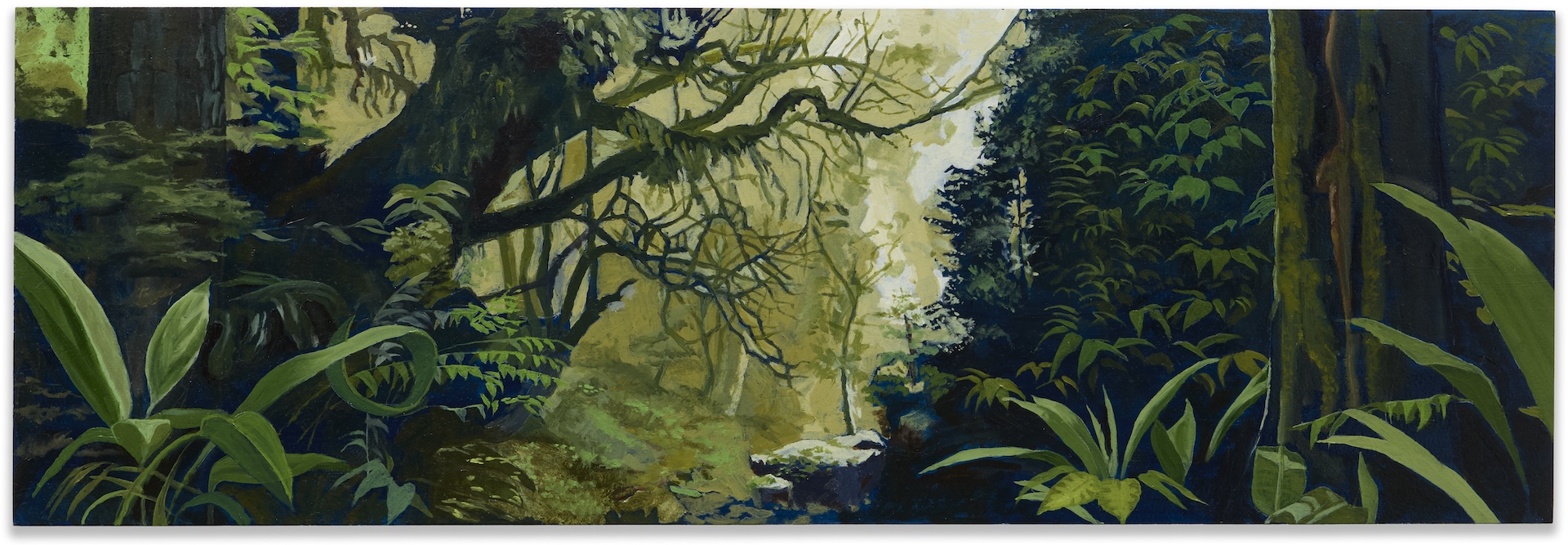
Steve Cope, Flock, 2026. Oil on panel, 10 by 30 inches. Courtesy of Harper’s, New York.
Steve Cope’s Flock is a small, long panel of forest interior. Dark navy shadows hold the edges, broad leaves rise on either side, and a mossy branch reaches in from the left. At the center, the forest opens into pale yellow-green light. Flock can be read as a revision of Courbet’s Le Ruisseau noir (1865) at the Musée d’Orsay: the ravine cropped into a frieze, the light let in. As in Charles Wheatstone’s stereoscope of 1838, Cope sets two near views at the edges, with depth opening between them. The leaves in front are crisp. In the distance, trees and undergrowth lose their lines and soften toward abstraction, as they do in nature. This defocusing corresponds to what happens to an eye fixed on the foreground foliage, a perceptual phenomenon Hermann von Helmholtz explained in what has become known as the theory of visual accommodation.
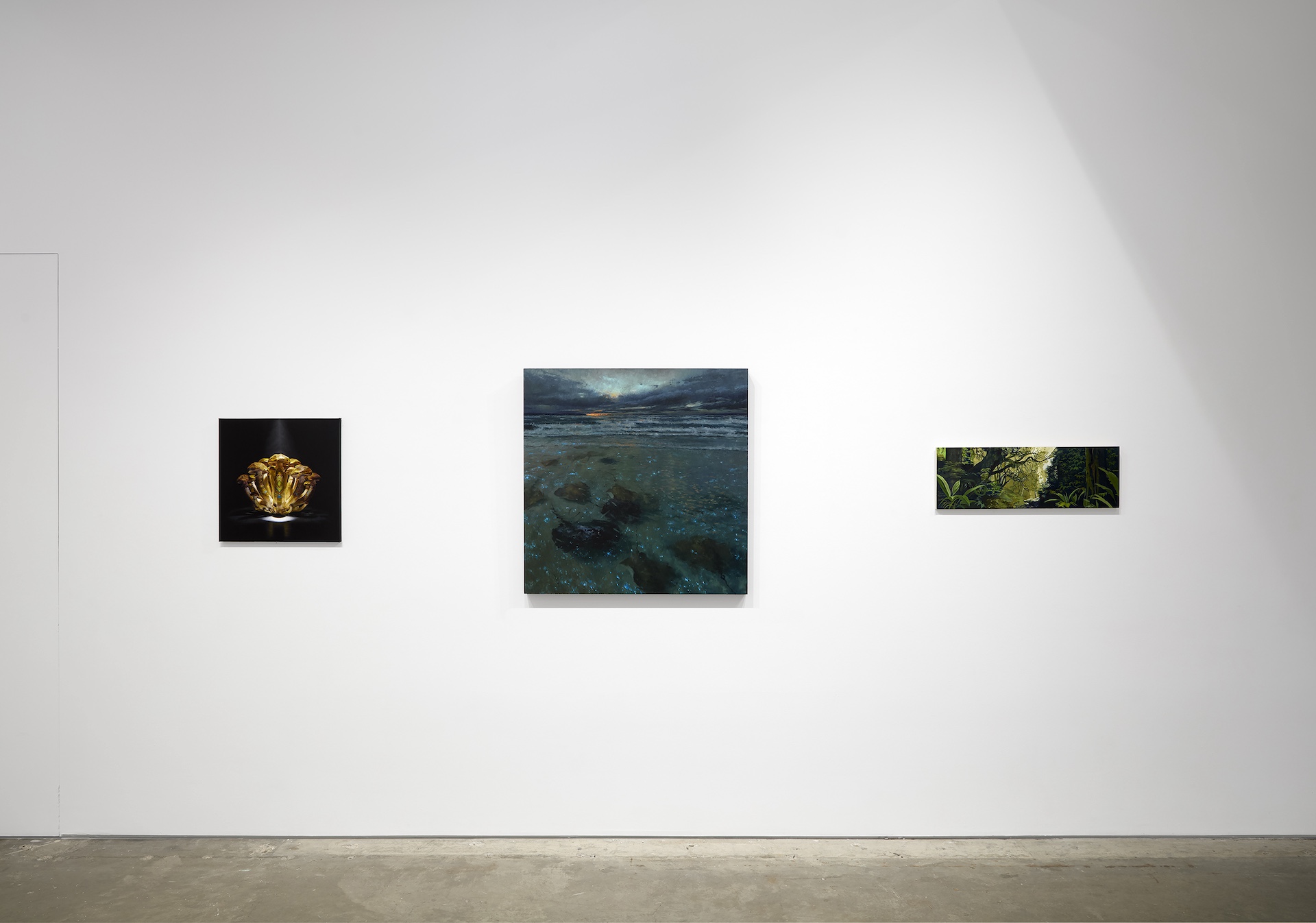
Installation view of Nature of Being at Harper’s Chelsea 534. Courtesy of Harper’s, New York.
Seen again from a distance, Melini’s Tree may register as nonrepresentational once more. The bark recedes, and a field of violet and black remains. Powers of Ten travels to the edge of the universe and into the nucleus of an atom, yet it begins with a man resting on a picnic blanket in Chicago, at the scale of a body. The works in Nature of Being make that journey within a single room. Each meets the eye before it meets the mind: a surface, a glare, a thread, a spark of light. Phenomenology calls this experience prereflective.
Harper’s Chelsea 534
Nature of Being
Curated by Marc Dennis
September 17–October 24, 2026

Raphy Sarkissian
Raphy Sarkissian received his masters in studio arts from New York University and is currently affiliated with the School of Visual Arts in New York. His recent writings on art include essays for exhibition catalogues, monographs and reviews. He has written on Rachel Lee Hovnanian, Anish Kapoor, KAWS, David Novros, Sean Scully, Liliane Tomasko, Dan Walsh and Jonas Wood. He can be reached through his website www.raphysarkissian.com.
view all articles from this author