Whitehot Magazine
October 2026
"The Best Art In The World"
"The Best Art In The World"
October 2026
Interview with Cheyenne Artist Luke Longfellow: The Politics of Materials, the Erotics of Craftsmanship
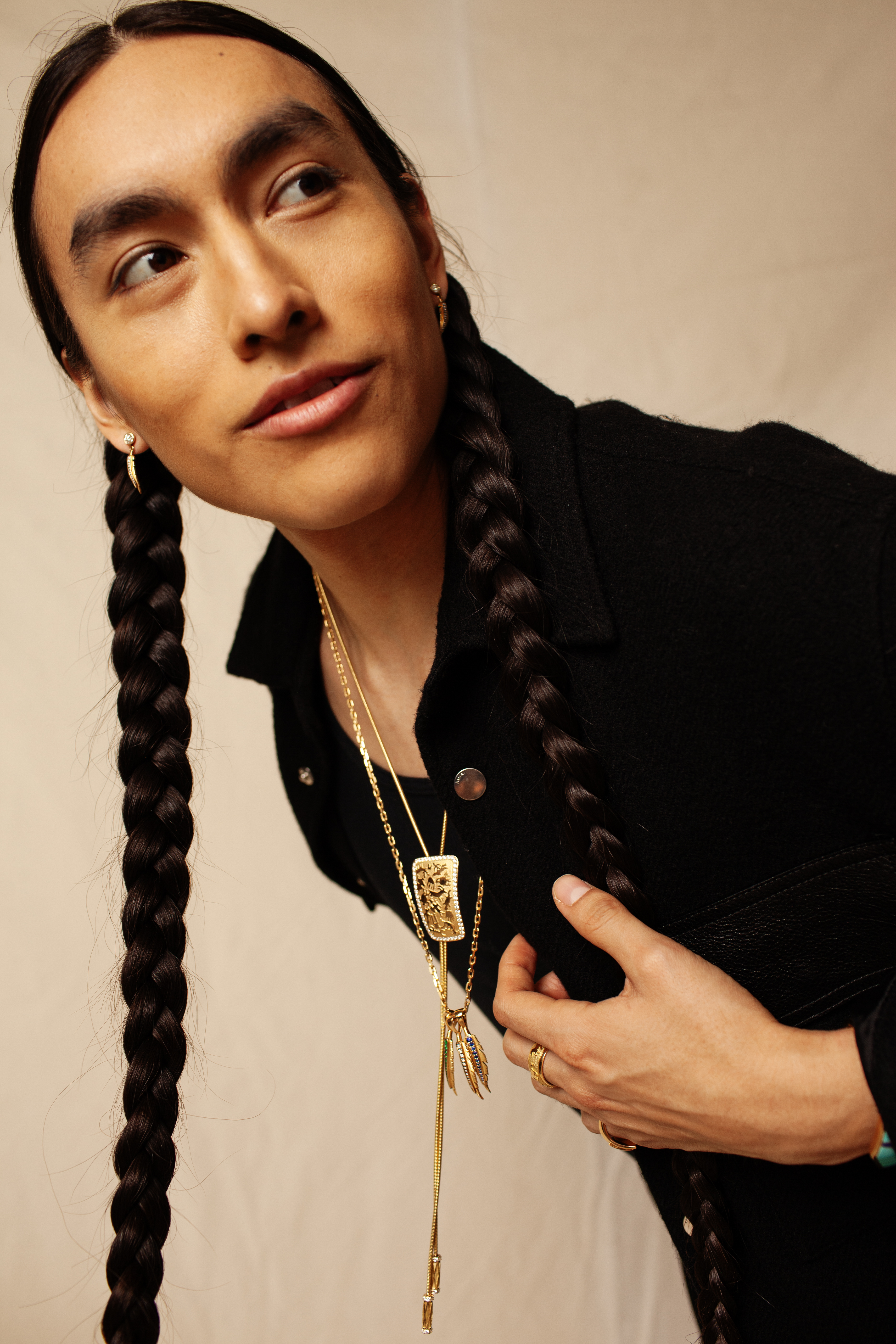 Jewelry by Luke Longfellow: Nighthorse.
By PETALA IRONCLOUD June 16, 2025
Gold: coveted, contested, and soaked in contradiction. It mesmerized conquistadors and catalyzed the theft of the Black Hills—homeland of the Oglala Lakota—as well as the Sierra Nevada and much of California. Today, it’s hoarded below Wall Street, propping up the U.S. dollar‘s illusion, and prized by doomers hedging apocalypse. Though central to Western jewelry, the xanthous metal was never historically used in Indigenous adornment north of Mexico. But queer Cheyenne jeweler Luke Longfellow is here to change that—tossing out settler aesthetics and mining a new, sovereign material legacy.
Luke Longfellow isn’t just reworking gold—he’s reworking what it means to create Native art in a contemporary, queer context. Raised in a Cheyenne family of artists, and trained in both metalsmithing and Indigenous epistemologies, Longfellow brings a material practice guided by lineage to each piece. His jewelry—often infused with irony, eroticism, and story —is as much about ancestral continuity as it is about disruption. By reclaiming gold, a metal once used to justify genocide, Longfellow makes adornment a political act: one that glitters with refusal.
In this interview we talk about the politics of materials, the erotics of craftsmanship, and what it means to imagine an Indigenized future—one link, clasp, and chain at a time.
 Jewelry by Luke Longfellow: Nighthorse.
PETALA IRONCLOUD: You’re relaunching your grandfather Ben Nighthorse Campbell’s legendary brand, Nighthorse. What does it mean to you personally and culturally to carry that torch forward?
It’s an incredibly meaningful time for me and my family. I wouldn’t call it a “relaunch”. It's more of a continuation, or evolution, of my grandfather’s legacy as an artist. We’re building on the foundation he created, and taking it into a new era with the same commitment to craft and storytelling. This has been my dream and my plan since I was a little boy.
My grandfather, Ben Nighthorse Campbell, is a true renaissance man. Born to a Portuguese immigrant mother and a Northern Cheyenne father, he spent much of his early childhood in an orphanage. From those beginnings, he went on to serve in the Air Force, become an Olympian, a U.S. Senator, and one of the first Native American jewelers to gain national recognition. But at the heart of it all was his art, a gift passed down from his father.
I started working with him in the studio when I was about six. Those early experiences shaped everything. Now, carrying Nighthorse forward is both a privilege and a responsibility. Personally, it means continuing a lineage I was raised in learning metalsmithing from him, working alongside my mom in our gallery. Culturally, it’s about honoring his legacy while expanding its language, creating space for Native identity that’s grounded in excellence and evolution not stereotype.
 Jewelry by Luke Longfellow: Nighthorse.
The original Nighthorse was rooted in silver, and your reinterpretation in gold feels both reverent and rebellious. What inspired that material shift, and what does gold symbolize for you in this context?
Actually, the original Nighthorse was also rooted in gold. My grandfather worked in 18k gold and was one of the first Native American artists to use it in a contemporary fine jewelry context. He was featured in Arizona Highways in the 1970s alongside other notable Native jewelers. His use of precious stones and high-karat gold was rare at the time and considered groundbreaking within Native arts.
Our choice to work exclusively in gold today is a continuation of that vision. It is not a departure from tradition but an evolution of it. While silver was foundational to his work, gold allows me to explore a different expression of luxury and meaning.
Native art has always belonged in the realm of fine art. Gold challenges the narrow ways it has been viewed and valued. To me, gold represents sovereignty, permanence, and quiet strength. It carries weight. It holds reverence. And it allows the work to speak in a new, powerful way.
Your debut campaign is deeply intimate, even radical. How did your collaboration with Phillip Bread shape the visual and emotional language of the project?
From the start of building the new Nighthorse collection, I knew I wanted Phillip Bread to be involved. He has a unique presence that embodies the spirit of the work. He is a joy to collaborate with and presents the jewelry at the level it deserves. As a fellow Indigenous artist, Phillip understood the emotional and cultural layers I wanted to express. Together, we shaped a visual language that feels both ceremonial and modern. The result is a campaign that reflects not only the pieces, but the deeper terrain we’re navigating. It is a love letter and a quiet form of resistance.
 Jewelry by Luke Longfellow: Nighthorse.
You’ve described the work as favoring “softness, sovereignty, and erotic quietude.” Can you elaborate on how those ideas informed the design and storytelling process?
“Softness” speaks to the curves, the textures, the sensuality of the forms. “Sovereignty” is the throughline it’s about self-determination, about reclaiming how Native bodies and stories are seen. And “erotic quietude” is the atmosphere I wanted: not performative or loud, but intimate, charged, and sovereign. The storytelling followed that mood with less spectacle, more invocation.
What were you hoping to challenge or dismantle in terms of how Native and queer identities are typically portrayed in fashion and media?
I wanted to dismantle the idea that we have to overexplain ourselves, or fit into narrow tropes. Native and queer people are often flattened, made hyper-visible in cliché, or erased entirely. I wanted to offer a different gaze: one rooted in self-possession, in quiet luxury, in complexity. Beauty on our terms. I wasn’t interested in assimilation, I was interested in expansion.
You treat adornment not just as fashion, but as ritual and resistance. How do you see your pieces functioning in the lives of those who wear them
Jewelry is deeply personal. It lives on your body and moves with you. I see Nighthorse pieces as talismans. They carry intention and energy, but also act as a kind of armor. I want people to feel strong, seen, and a little more themselves when they wear them. These aren’t just accessories, they’re statements of identity and presence.
Your jewelry feels sculptural, almost like small monuments. What artists, cultural practices, or ancestral influences shape your aesthetic?
Definitely my grandfather, his sense of form, reverence for symbolism, and fearless use of scale shaped my foundation. But my influences span both sides of my identity. On one hand, I’m deeply inspired by Indigenous material culture, beadwork, quillwork, textiles and artists like Fritz Scholder, Kevin Red Star, and Jesse Monongya, who each challenged expectations in their own ways. On the other, I look to Western masters like David Webb, JAR, and Hemmerle designers who understand how jewelry can be both maximal and refined.
There’s always a fusion happening in my work: a push and pull between history and the present, heritage and innovation, restraint and boldness. My grandfather is Northern Cheyenne, my grandmother was Swedish and I carry both. My aesthetic lives in that tension: rooted in story, but always evolving.
As a queer Indigenous designer, how do you navigate, or resist, the pressures of mainstream fashion while honoring your roots?
I try not to contort myself to fit into spaces that weren’t made for me. Instead, I focus on building a world that feels authentic, visually, materially, emotionally. That means being in dialogue with my lineage, not just aesthetically but ethically. It also means carving out room for softness, for ambiguity, for pleasure. My roots aren’t something I reference, they're something I live in.
How has your own identity shaped your relationship with ornamentation, embodiment, and storytelling through design?
Adornment has always been a way to assert presence, to communicate beyond language. I’m drawn to the way jewelry touches the body, how it can become an extension of identity, memory, and desire. Storytelling, for me, isn’t linear, it's layered, symbolic, textured. Design lets me braid all those threads together into something tactile and lasting.
What’s next for Nighthorse under your direction? Do you envision expanding beyond jewelry or collaborating across disciplines?
Absolutely. I see Nighthorse as a platform, not just a brand. Jewelry is the heart of it, but I’m deeply interested in expanding into objects, maybe even scent. I’d love to collaborate across disciplines with writers, visual artists. The spirit of Nighthorse has always been expansive. We’re just getting started. WM

Petala Ironcloud
Petala Ironcloud is a Lakota/Dakota art critic based in NYC whose writing on Indigenous aesthetics and contemporary art has appeared in The New York Times, T Magazine, Art in America, The Observer, Hyperallergic, and Flash Art. They sat on the boards of the American Indian Cultural Center of San Francisco and Natives in Tech.
view all articles from this author