Whitehot Magazine
October 2026
"The Best Art In The World"
"The Best Art In The World"
October 2026
En Plein Air: Two at PPOW
MIKE MAIZELS October 20th, 2026
On view now at PPOW are a pair of elegant exhibitions that appear far apart but that nevertheless hang together with an unexpected symmetry. At 392 Broadway, the gallery presents fluorochiaroscuro, a successful, focused exhibition of the painter Michael Wilkinson’s precisionist flower still lifes. The works are evocative and clean, rendering a feeling of easy breath. He leaves large portions of the linen backdrop conspicuously present, making them appear almost as skillful sketches rather than finished works. The light intensifies with fluorescent pigment against taupe, amplifying the sensation of suspension. The comparison is nonobvious, but the effect is akin to the work of Morris Louis, whom my thesis advisor credited with bravura handling of blank canvas sufficient to place him in the canon of Very Good Painters. It’s not easy painting empty space after all, less with radiant flower groupings hovering in suspension.
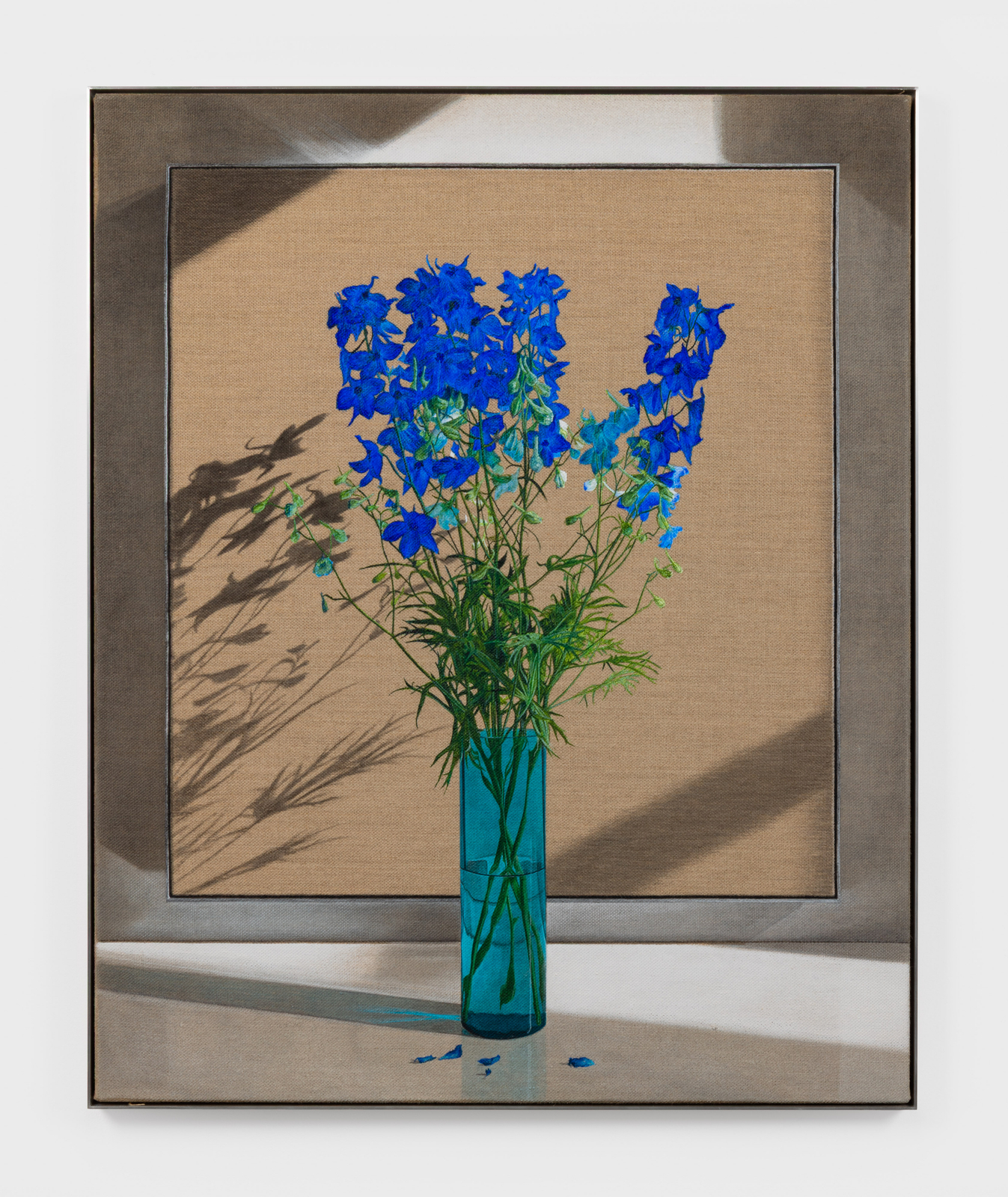 Michael Wilkinson, Delphinium ii (2026)
Next door at 390 Broadway viewers are primed to encounter a very different floating world. While Wilkinson’s flowers form intimate studies of time and perception, Hew Locke’s The Wanderers presents a body of exuberant assemblages that soar through themes of empire, migration, and memory. The exhibition covers a broad array of drawings and sculptural objects, but the visual anchor (a bad pun?) is the artist’s flock, or perhaps armada, of small boats sailing through the gallery air. The maritime vessels stretch from Spanish galleons to modern tankers, with more modest fishing craft interspersed amidst the ships of empire.
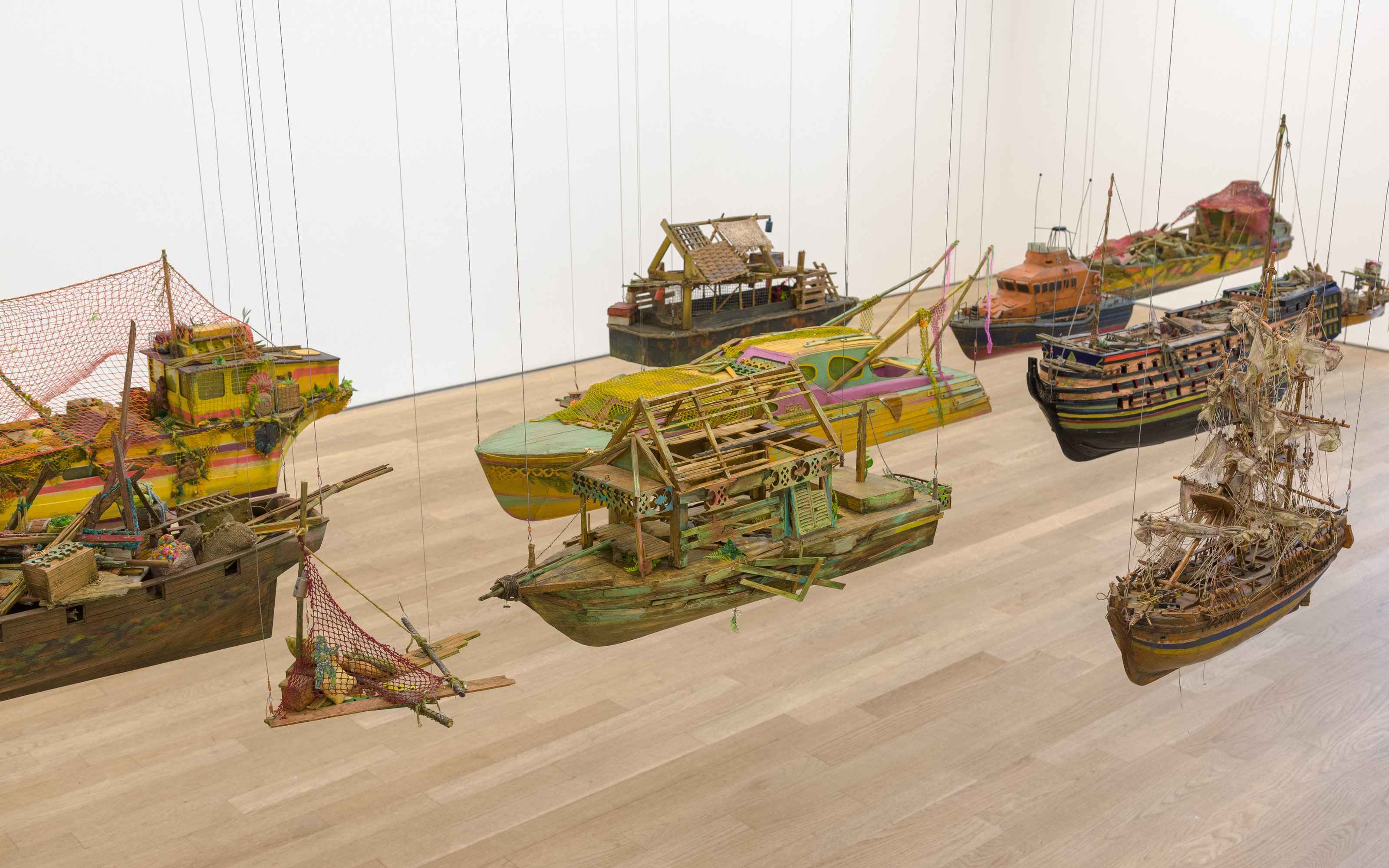 Hew Locke, installation view of The Wanderers (2026)
The forms feel floral and handmade, adorned with medals, shells, beads, flags, and other tokens of both affection and exchange. Beautifully crafted yet evidently delicate, they recall a child's paper boats set loose on a river. At the same time, they draw upon the tradition of devotional model ships once suspended in churches and cathedrals as offerings for safe passage at sea. Locke's vessels hover somewhere between toy, reliquary, and historical document, inviting viewers to contemplate the tangled currents of commerce, migration, conquest, and memory that have shaped the modern world.
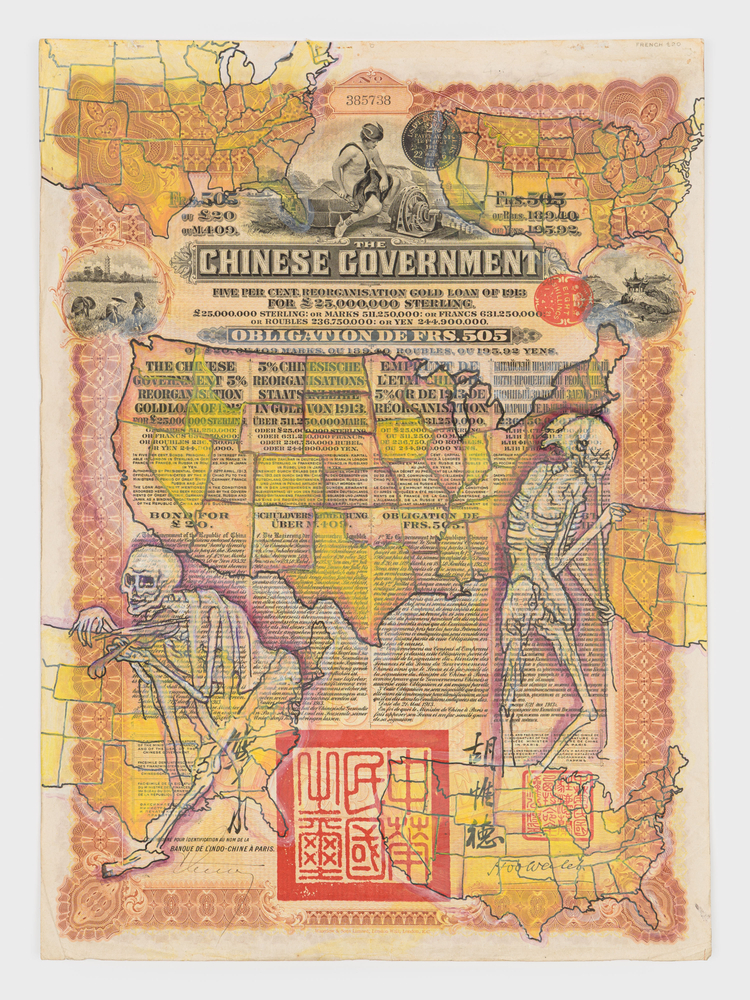 Hew Locke, Chinese Government Reorganization Gold Loan (2026)
Some of the most intriguing works in the exhibition are Locke's reappropriated share certificates: the kinds of financial instruments that might well have traveled aboard the full-sized counterparts to these miniature vessels. Fractional ownership powered the exploration and exploitation of the globe under sail no less than the compass or the cannon. Here Locke transforms historic securities into haunted documents, overwriting the language of finance with figures of skeleton crews still at work beneath the machinery of empire. Particularly striking are certificates connected to late Qing-era borrowing from Western banking syndicates, instruments that once converted geopolitical ambition into tradable paper claims. The specifics are historically fascinating, but Locke seems less interested in settling accounts than in exposing the ghosts that linger within them. Looking around the gallery, one begins to sense that the ships and the shares are engaged in the same project. One represents the movement of people, goods, and power; the other represents the abstractions that made such movement possible. Together they trace the material and financial infrastructures of empire.
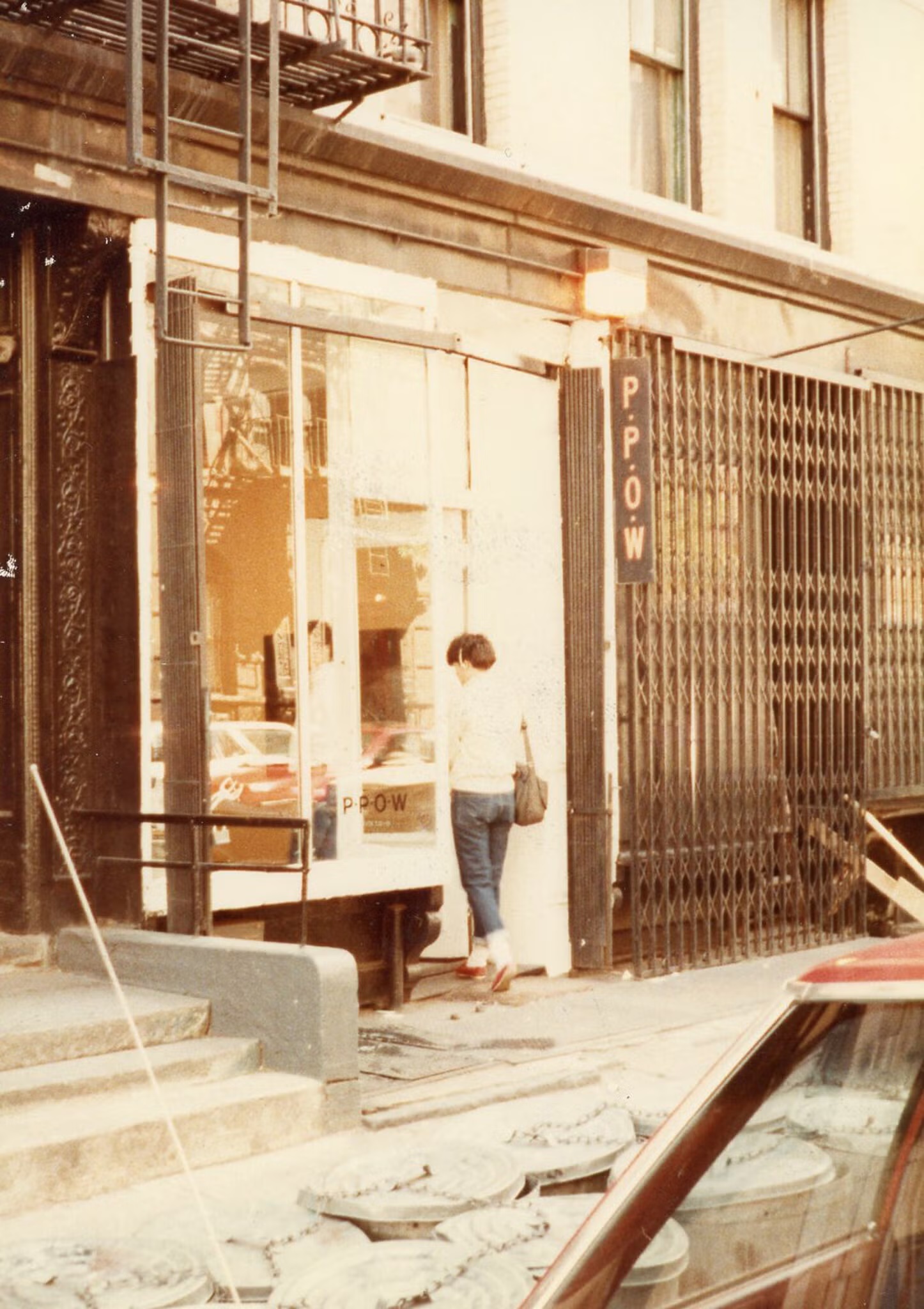 PPOW Gallery exterior at 10th street location (1985)
Overall, these exhibitions mark a notable stylistic departure for PPOW's longstanding East Village program. Founded amid the energy of the 1980s downtown scene and formerly associated with artists emerging from graffiti, street art, and related countercultural traditions, the gallery has increasingly broadened both its historical and geographic horizons. Wilkinson and Locke could hardly appear more different. One offers quiet paintings whose drama lies in the disciplined handling of light and emptiness; the other presents exuberant sculptural accumulations dense with historical reference. Yet both exhibitions share a fascination with what objects carry beyond themselves, whether perception, memory, history, or the lingering traces of human experience. There is something pleasantly surprising about encountering these shows under the PPOW banner. The irreverent spirit that once animated artists such as Rammellzee and Martin Wong remains, but it has matured into a program capable of engaging equally with formal restraint and global history. The result is a pairing that feels both unexpected and entirely convincing.
Both shows are on view through October 24.

Mike Maizels
Michael Maizels, PhD is an historian and theorist whose work brings the visual arts into productive collision with a broad range of disciplinary histories and potential futures. He is the author of four books, the most recent of which analyzes the history of postwar American art through the lens of business model evolution. He has also published widely on topics ranging from musicology and tax law to the philosophy of mathematics.
view all articles from this author