Whitehot Magazine
October 2026
"The Best Art In The World"
"The Best Art In The World"
October 2026
Andy Warhol, The Beauty and Horror of New Technologies - “Exploding Plastic Inevitable” and the Modern Sublime
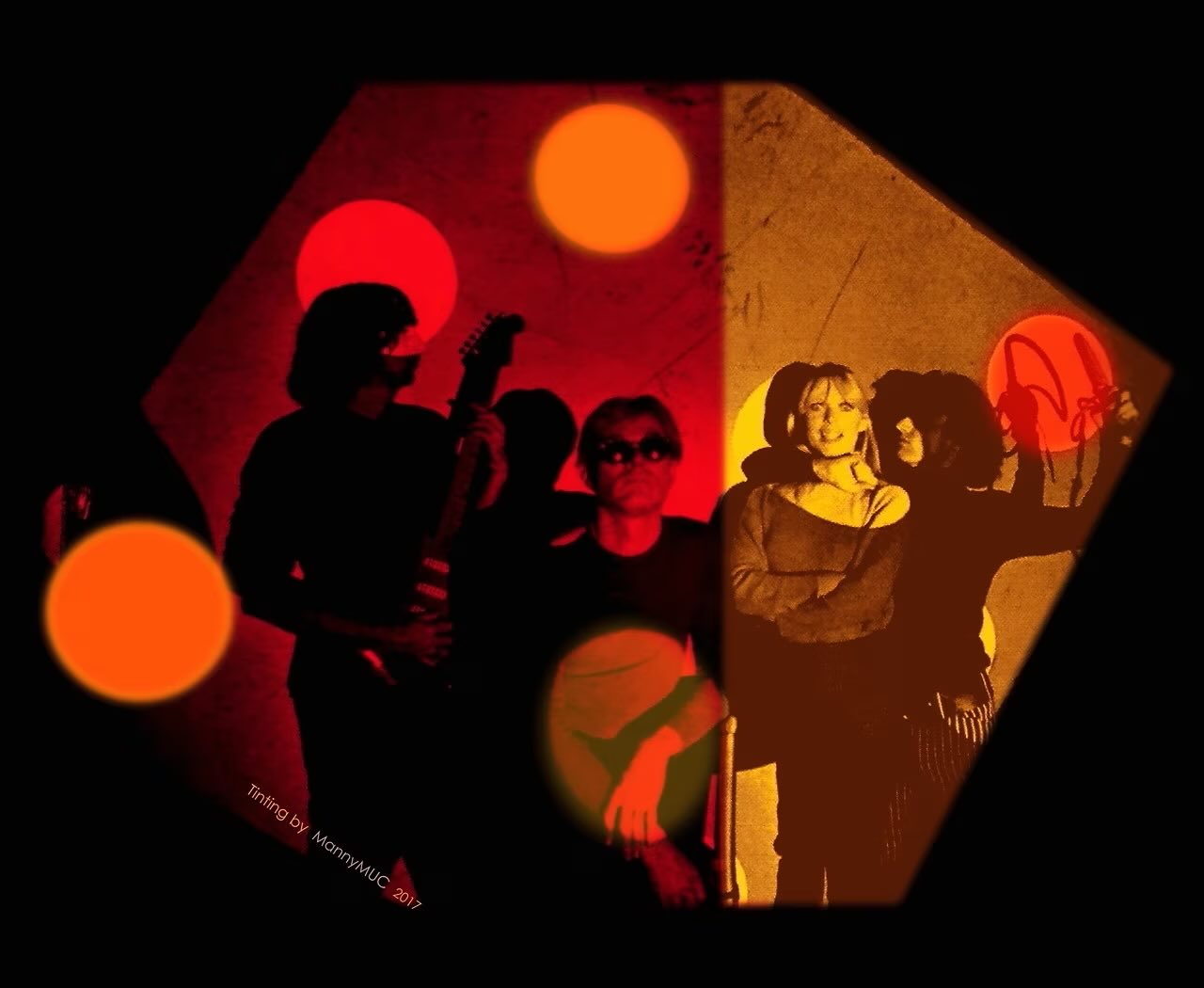 Andy Warhol’s Exploding Plastic Inevitable (EPI) (various locations) 1966-1967
By MELANIE DESLIENS January 15th, 2026
In 1948, artist Barnett Newman wrote “The Sublime is Now,” reflecting on the rise of Abstract Expressionism and its break with traditional Western artistic canons. The “sublime” (an eighteenth-century term describing an intense experience in which beauty and horror coexist) was no longer confined to landscape painting or religious imagery. It had become a condition of modern life.
The sublime describes what happens when human perception is pushed to its limits. Faced with excess (of scale, speed, intensity, or power) the senses struggle to keep up. Disorientation, fear, and fascination coexist. Yet this experience does not necessarily end in collapse. It raises a deeper question: when perception falters, what remains of human awareness?
Andy Warhol’s 1966 multimedia performance Exploding Plastic Inevitable (EPI) can be understood through this lens. The event immersed its audience in a dense environment of sound, light, film, and bodily movement. The Velvet Underground & Nico performed live, while Warhol’s films were projected onto performers and walls. Strobe lights, psychedelic images, aggressive choreography, and overwhelming volume created a sensory field in which orientation was constantly lost and regained. Pleasure and violence, joy and terror, unfolded simultaneously.
Warhol, often criticized for embracing the symbols of mass consumption, instead pushed them to their extremes. Through repetition, scale, and technological saturation, he exposed the psychological effects of a society increasingly shaped by machines, media, and acceleration. Exploding Plastic Inevitable was not simply a spectacle; it was an experiment on perception itself, one that tested how much the human body and mind could absorb.
Today, the rapid rise of artificial intelligence confronts us with a similar experience. AI arrives as an overwhelming force: opaque, fast-moving, and difficult to grasp, provoking both excitement and anxiety. Like the immersive technologies of Warhol’s time, it destabilizes familiar categories of authorship, creativity, and agency. We oscillate between fascination and fear, promise and threat.
By placing Exploding Plastic Inevitable alongside our current encounter with AI, one may wonder if Warhol’s work anticipated a condition that has now become widespread. When technology floods perception and disrupts established forms of meaning, the question is no longer whether humans are overwhelmed (we clearly are) but whether such moments of saturation lead to annihilation, or whether they force a rethinking of what it means to be human.
Warhol’s immersive events may have drawn inspiration from the British “Independent Group,” whose members were behind the landmark 1956 This Is Tomorrow exhibition at London’s Whitechapel Art Gallery. That exhibition effectively ignited British Pop Art and introduced a radically cross-disciplinary approach, collapsing boundaries between art, architecture, design, and popular culture.
The group questioned the link between humans and technologies and emerged as critics of the Institute of Contemporary Arts (ICA) of London, stating that it wasn’t taking the impact of mass media seriously enough. Just like the Abstract Expressionists before them, they challenged the limits on art imposed by the Renaissance and stated that the “rejection of mass-produced art was not (as critics think) a defense of culture, but an attack on it.” With “The Independent Group”, a new vocabulary emerged around new technologies which promised wonders but conveyed at the same time horror with the devastating recent use of the atomic bomb on Hiroshima. Nuclear power like Artificial Intelligence today was the assurance of a better future with the introduction of new household inventions, new information and communication technologies such as the TV, and the production of expendable products.
Andy Warhol and others started questioning human identity in this new context. They revealed the tension between joy and horror, explored assimilating technology, or how the machine could assimilate humans, becoming the mother of humanity. The fear of machines was documented in various art forms from sci-fi magazines to movies, to music and visual arts. Warhol also questioned if commercial art impacted society more than fine art by portraying systems of mass production and integrating the codes of the consumption culture and capitalism and pushing them to their paroxysm.
In 1966, the EPI gave birth to a 13-minute film by Ronald Nameth https://www.youtube.com/watch?v=7A7wA3zbSZ0. Its intensity was meant to convey to the viewer what attending the live performance must have felt like. The film begins with black and white images of a dark room, where powerful, blinding light projectors are directed straight at the viewer, as if struck by a camera’s flash or a beam of light. It then transitions to black and white movies projected onto the walls of the room. The viewer can barely identify anything else but objects with a source of light. The music or sounds are muted at first but quickly become louder, more rhythmic, and haunting. Gradually the viewer can finally identify some of the figures, they seem to be naked and choking each other in some sado-masochistic act. One character has his hands tight behind his back, and another is strangling him from behind. The images then show a young, seated man in a white t-shirt (young artist Gerard Malanga), who seems to have lost consciousness, with another man in a suit pulling his hair above him. He seems disoriented, completely lost, maybe drugged, and violently treated by the darker figure pulling his hair.
Nameth then introduces color to the movie as “The Velvet Underground” starts singing slowly. The viewer can see Malanga leisurely dancing on stage with another female dancer, both laughing. This time, in slow motion, Malanga holds a whip and hits alternatively the woman or a tambourine in rhythm. The scene is highly sexualized and evocative of intercourse. The colors become more red and highly saturated, and the light flashes repeatedly, leading the viewer into confusion and to question multiple realities. Indeed, it becomes challenging to discern whether one is looking at a person, their shadow, or the film of that person; wondering whether the light is added during editing or whether they are seeing actual stroboscopic light from the event.
The boundaries between multiple realities become porous and could be reminiscent of Plato’s “Allegory of the Cave.” In the allegory, a group of people, born and raised in a cave, are permanently chained inside facing a blank wall. The only things they can see from their point of view are shadows of silhouettes projected on that wall. Since they have never seen anything else they take these illusions as being the reality not knowing that they are shadows of humans passing through in front of a fire. This allegory is powerful has it shows how humans can be manipulated in taking an illusion for the truth. The EPI film also manipulates the viewer’s perception through its use of technology. It is violent and destructive, causing the viewer to lose a sense of the kind of reality they are confronted with.
As the music transitions to the song “Heroin,” new dancers are introduced, and images accelerate in color this time. Malanga joyfully starts to dance, performing very specific square movements with his hands that resemble a mechanical or computer code. The singer echoes the viewer’s disorientation by repeating the lyrics “And I guess that I just don’t know.”
As the music accelerates, Malanga’s individual experience progressively melds into a collective one, with flashes of light or stroboscopic effects revealing the presence of a crowd saturated in blue and red colors. The music derails, and suddenly, black, white, and color sequences are superimposed or overlap with fast images sequences and heavy electric guitar. The filmmaker employs a multitude of editing and movie effects to intentionally confuse the viewer. The film and the high-pitched guitar accelerate so rapidly that only forms and light are now perceptible. Suddenly, Malanga reappears in black and white amid the craze, overwhelmed with pain and exhaustion. At this point, the viewer’s senses are so overloaded with images and sound that it feels like being a punching bag or riding on a train at full speed, with no respite until all the instruments in the soundtrack seem to derail. Each instrument takes on a life of its own, reaching its climax, ultimately ending in a pitch so high it hurts the ear. What Nameth stages through film editing and strobe violence (too much information arriving too quickly) resembles the cognitive pressure we now experience daily in algorithmic feeds and AI-generated language.
It’s at this moment that the camera finally focuses back on Malanga’s face. Suddenly, he appears to leave the collective trance, regaining consciousness and pausing for a moment to take a final breath.
 Ronald Nameth, Andy Warhol, Exploding Plastic Inevitable, 13mn film, 1966
The film offers a sublime experience for the viewer, in a Burkean sense, encompassing both horror and beauty simultaneously. Nameth’s work also resonates with the ideas of French philosopher Jean Louis Schefer, who argued that “art history and its human representation are now an accelerated movie.”
The film triggers a strong push-and-pull sensation within the viewer, likely similar to what the audience experienced during the live performance. The music by The Velvet Underground includes some of their most emblematic songs, characterized by their beauty and mesmerizing qualities until they reach their paroxysm. The choice of songs is also intriguing; “Heroin” aligns with the sublime, providing great ecstasy to its user but harboring a perilous end. The song “And I just don’t know” takes on added meaning when considered in relation to Plato’s Cave After the abundance of the consumption society, the end of our world might be self-destructive; the audience is therefore invited to surrender and be part of the artwork, losing oneself in the immersive experience. It’s like watching an experiment on humans in Schefer’s accelerated way. The individuals are all colliding in the film, melting into each other in a collective manner until the end, where only one individual emerges.
The EPI made excellent use of technologies available at the time. Warhol wholeheartedly embraced and was fascinated by technology, utilizing it to produce his own art through silk- screen printing and film cameras for creating movies and photographs. But he also had a more philosophical approach to it, even famously declaring in 1963, “I want to be a machine.” By using constant repetition throughout his career, he embodied the repetitive work of machines, reminiscent of assembly lines in the Ford Factory, for example. However, unlike plants that produce endlessly perfect identical products, Warhol made the system derail. Indeed, his repetitions were not perfect; he made sure that mistakes were visible. As writer Herve Vanel stated, “He was interested in what interested no one, with a certain taste for small imperfections and signs of wear that repelled connoisseurs.”
The repetition technique is interesting; it triggers saturation to the point of numbness. For instance, the media coverage of 9/11 showcased the endless repeated loop of film on television of the towers’ collapse. Mass media tends to numb the audience’s reaction to tragic events.
Warhol’s 102 canvas piece titled “Shadows” is a good example of how the artist used repetition and scale to build an immersive environment. The museum of Modern Art of Paris showcased the piece in 2015 over 130 meters in length, each canvas hanged edge to edge with no frame, forcing the visitor to move and “investigate” the “abstract” piece as only an unidentified shadow was featured on each canvas. Each canvas featuring a unique color against a black flat background.
Another example is Warhol’s 1965 painting “Atomic Bomb: Red Explosion” which is peculiar as it is the only work that he did not repeat in a series; it is unique. On the canvas, the iconic image of the atomic bomb cloud is repeated fifty times in red and black. The first image in the top left corner is clear, with the dark silhouette of the cloud emerging against the red background of the sky. As Warhol repeated the image, he used the same silk screen without washing it to create a narrative sequence. As a result, the ink started to clog the screen, so the image gets darker. As the viewer’s eye follows the images, their quality gets poorer, and the red is taken over by black, so the cloud is no longer visible, disappearing and leaving darkness as if Warhol anticipated technology’s dangerous potential.
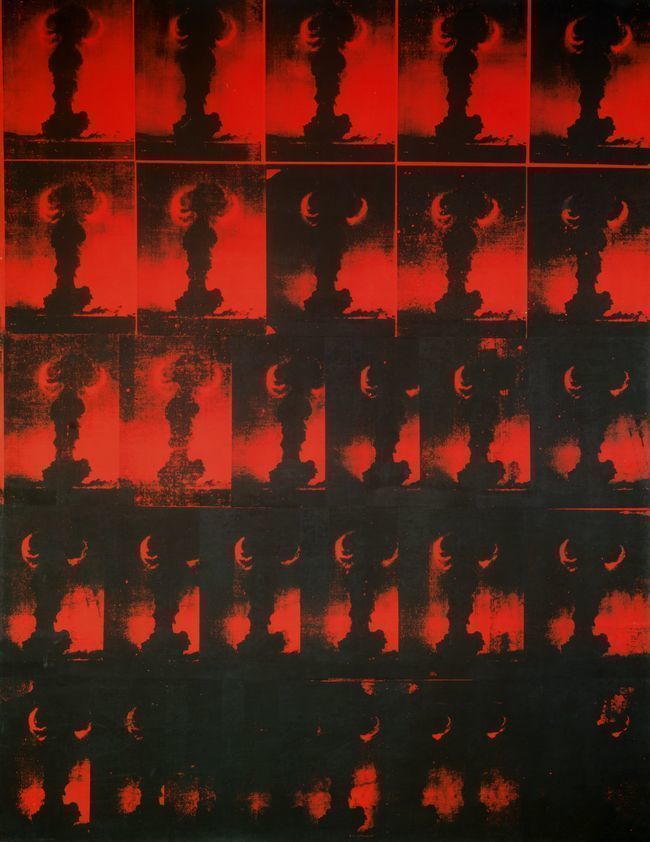 Andy Warhol, Atomic Bomb: Red Explosion, 1965, Saatchi Collection, London
Furthermore, as Warhol questioned in the EPI, with the emergence of AI, one might wonder which reality they are living in. The veracity of images is called into question, with “fake news” presenting a true danger to democracy. With cell phones and social media, addicted users flicker through images, becoming numb and assimilated by their screens, unable to react. There is intense pleasure in watching screens and horror at the same time. Mass media creates a kind of collective anesthesia, rendering humans unable to process or react, leading to a point of saturation, as depicted in the EPI; saturation of sound and visuals, colors, and light effects.
Seen through the lens of Edmund Burke, EPI can seem to end in annihilation: the subject overwhelmed by sensory excess, agency swallowed by fear. But this reading assumes that saturation equals defeat. A shift toward Immanuel Kant opens a different possibility. For Kant, the sublime emerges not when the senses are satisfied, but when they fail. The imagination collapses under too much intensity, too much scale, too much information and, yet the mind does not disappear. Thought persists beyond perception.
Malanga’s experience in EPI follows this pattern. His movement between terror and joy is not contradictory, but structural. The fear signals the limits of the body and the senses; the exhilaration follows the realization that something in the human subject remains intact even when those limits are reached. What looks like annihilation at the sensory level becomes, instead, a moment of heightened awareness. The experience does not resolve into comfort or control, but into a strange clarity: the recognition that one can still think, even when one can no longer fully see or grasp.
This framework resonates strongly with contemporary encounters with artificial intelligence. AI often arrives as an overwhelming force — too fast, too vast, too opaque — producing anxiety about displacement and loss. But as Graham Burnett has recently suggested in his New Yorker article, AI may also serve as a mirror rather than a replacement. By confronting us with systems that exceed our habitual ways of perceiving and understanding, it forces us to reconsider what is distinctly human: judgment, interpretation, ethical responsibility, imagination.
Like EPI, AI first destabilizes. It floods perception and unsettles established categories. Yet through that destabilization, it may also return us to ourselves in new ways — not by restoring an old idea of human mastery, but by sharpening our awareness of what cannot be automated. In Kantian terms, the promise lies not in escaping excess, but in discovering that even when perception falters, consciousness endures. The human subject is not erased by saturation; it is compelled to rethink itself.
Bibliography
Journal Articles
D. Graham Burnett. “Will the Humanities Survive Artificial Intelligence?”, The New Yorker, April 26, 2025
Bloom Paul. “How Moral Can A.I. Really Be?” The New Yorker, November 29, 2023
Deleuze Gilles. “Postscript on the Societies of Control.” October, Vol. 59, 1992
Harari Yuval Noah. “Yuval Noah Harari argues that AI has hacked the operating system of
human civilization.” The Economist, Apr 28th 2023
Kaprow Allan. “Notes on the creation of a Total Art.“ 1958
Kaprow Allan. “Essays on the blurring of art and life.“ 1958, p9
Newman Barnett. “The Sublime is Now.”1948. Reprint in Barnett Newman: Selected Writings
and Interviews, University of California Press, 1992.
Witt Stephen. “How Jensen Huang’s Nvidia Is Powering the A.I. Revolution.” The New Yorker, November 27, 2023
Books
Schefer Jean Louis. Figures Peintes, Essais sur la Peinture (P.O.L, editeur 1998) p 388
Vanel Herve. Mauvais Genre. Warhol Unlimited exhibition catalogue, Musée d’Art Moderne de Paris, 2016

Melanie Desliens Flint
Melanie Desliens is a founding member of Villa Albertine San Francisco. She also previously held the position of President at the French-American Cultural Society (FACS) foundation. She holds Master's degrees in Marketing from both French and American universities and previously served in a key role, responsible for strategic partnerships at Ubisoft in the US, a leading global video game publisher. In 2021, Melanie was honored with the "Chevalier de l'Ordre des Arts et des Lettres" medal by the French government.
view all articles from this author