Whitehot Magazine
May 2026
"The Best Art In The World"
"The Best Art In The World"
May 2026
The Flamboyance and Pizzazz of Miami Art Week 2025
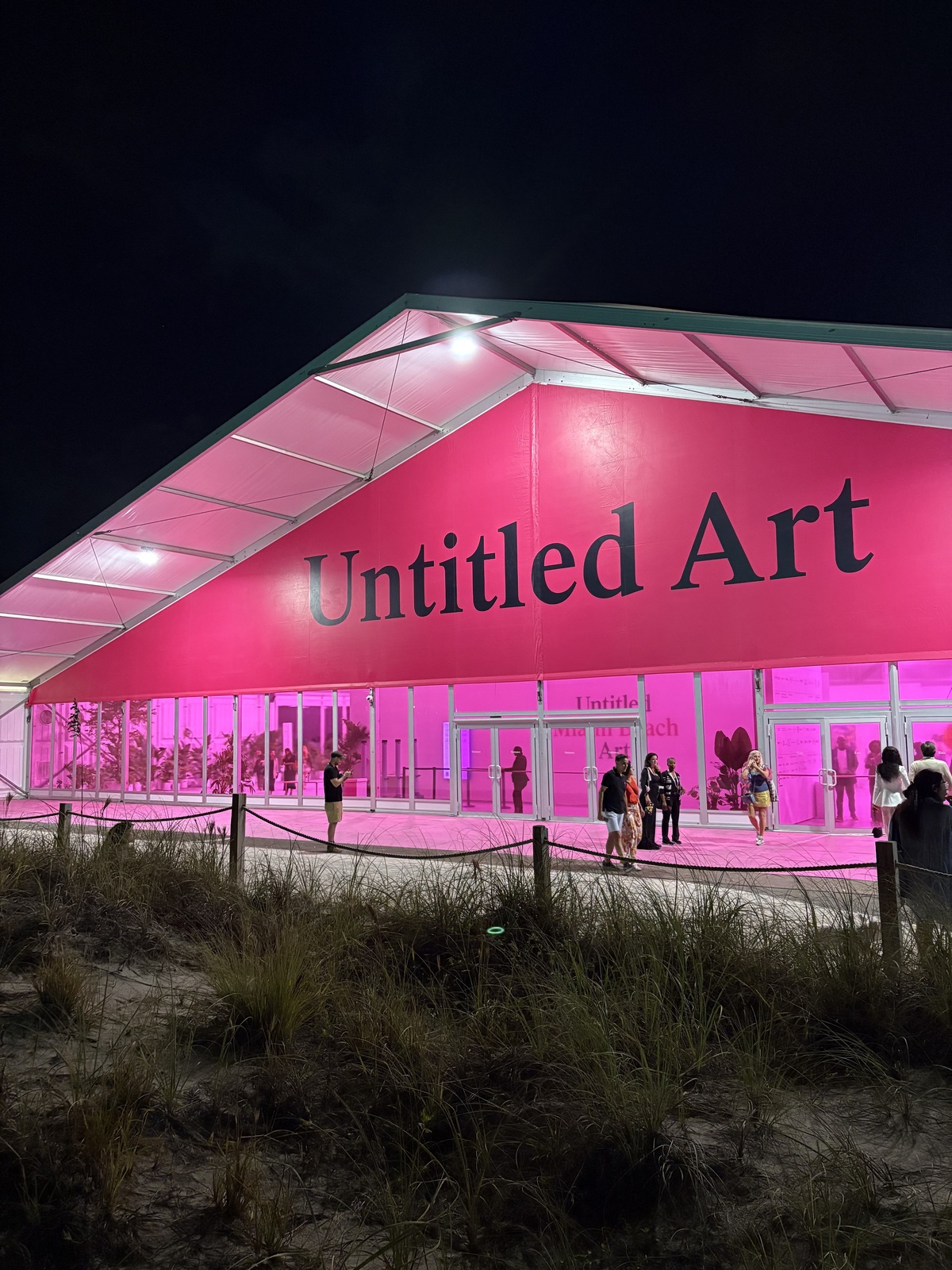 Exterior of Untitled Art Fair, South Beach, Miami, December 2025.
By LIAM OTERO December 15, 2025
Miami Art Week is one of the biggest urban art events in the United States, which makes it all the more incumbent for art lovers of all stripes to descend upon this tropical city. The seismic scale of Miami Art Week is pretty commensurate with the city’s urban sprawl. With this marking my first time there, I saw quite an exceptional range of artists & artworks - most of which being the out-of-towner galleries and booths that caught my attention.
Though there was much to take in, I must confess that the enormity of Miami Art Week’s programming across a not-so-easy-to-traverse cityscape in tandem with extremely humid weather and scattered traffic jams limited the extent of what I had hoped to check out. I had to skip fairs like NADA (New Art Dealers Alliance) on account of it being on the other side of the causeway with most of the action taking place in South Beach. Every so often, I would suddenly hear or discover an announcement about another fair or event occurring such as The Open Invitational Fair for Artists with Disabilities and Feria Clandestina.
 Miami Art Week logo. Image from CultureOwl.
My one critique about Miami Art Week is simply that the overlapped scheduling of reams of art fairs, public art programs, and exhibition openings across one of the largest cities in the country was too much spread too thinly, with the real brunt of it not so much affecting someone like me, but for the artists and galleries (both local and non-local) as this type of highly publicized event is an opportunity for one to gain exposure and sell work. The problem here comes down to competing programs at the mercy of time and geographic distance.
Frustrating as it may be to come away from a hectic fair weekend and to recall all the things one was unable to see and experience, I can still say that I was able to enjoy a solid chunk of Miami Art Week from the 5 fairs I attended: Art Basel Miami, Untitled, U-Haul Art Fair, SCOPE Art Show, and Satellite Art Show.
Similar to my reviews of the New York art fairs in September, I will provide a fair-by-fair breakdown of my highlights.
Art Basel Miami
Art Basel Miami, as one would expect, was a total riot. No matter where you turned, the best of the best artists of Modern & Contemporary Art History had their place. If it’s someone who has been the subject of countless monographs, biographies, essays, and what have you, then you were likely to find them here, to name a few: Jean-Michel Basquiat (Van de Weghe Gallery, New York); H.R. Giger (Nanzuka, Tokyo); Peter Halley (Mitterrand, Paris); Romare Bearden (Michael Rosenfeld Gallery, New York); Lisa Yuskavage (David Zwirner, New York), et al.
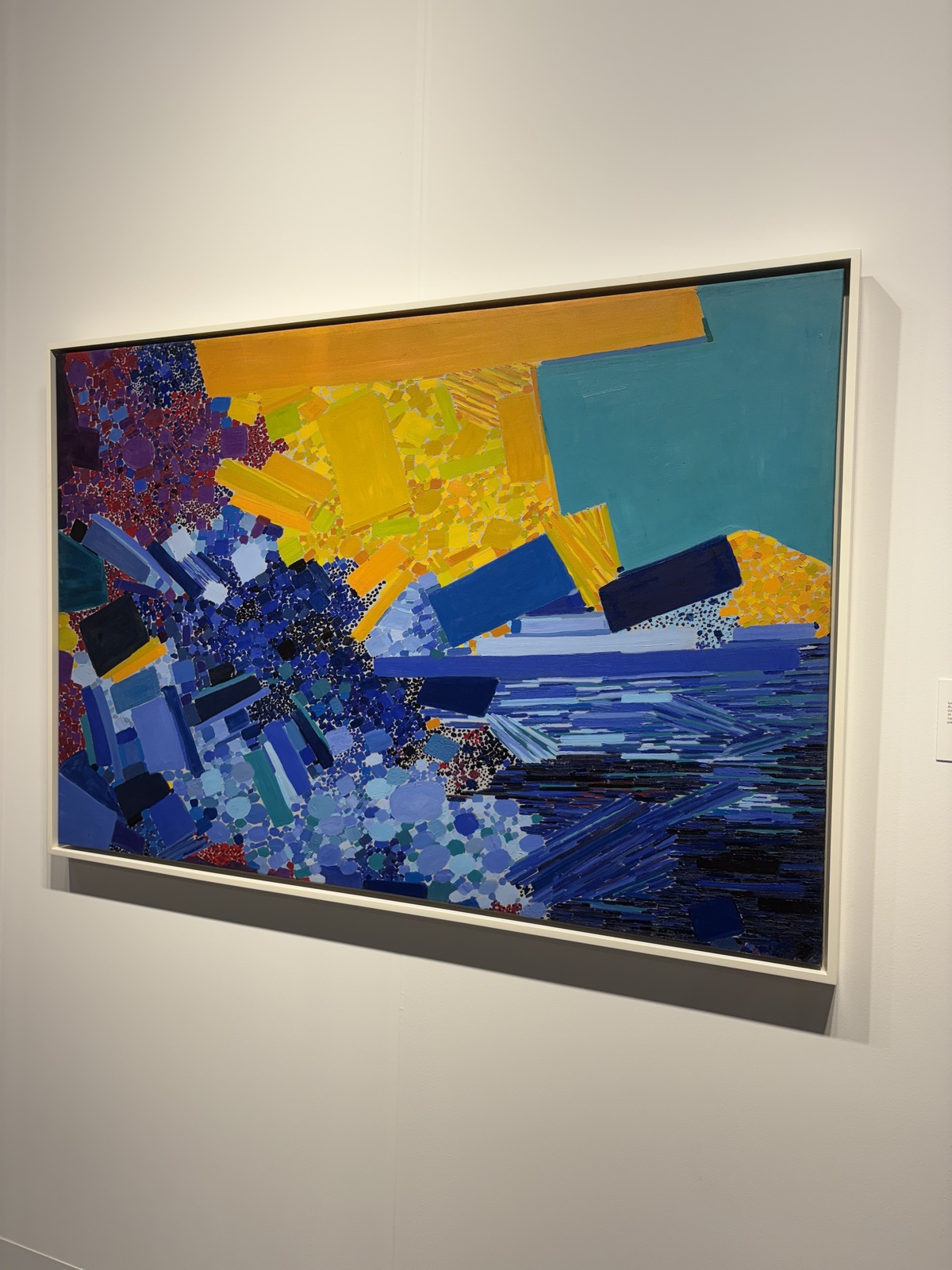 Lynne Drexler (American, 1928 - 1999), Blue Bay, 1968, oil on canvas. 39 1/2 x 59 inches / 100.3 x 149.9 centimeters. Image from Berry Campbell Gallery's booth.
But what I really want to talk about here are a few standout things beyond this summation of the famed who’s who of Basel: the underrecognized voices of the 20th Century; today’s major artists who are finally gaining traction; and the surprisingly strong presence of photography.
Berry Campbell Gallery (New York, New York) was a total winner in showcasing works by underrecognized names of 20th Century art, particularly among women, which is embodied in the curatorial philosophies of its founders Christine Berry and Martha Campbell. Lynne Drexler’s epic compositions of chromatically choreographed circles, squares, and rectangles that naturally give off a musicality to them would blow Kandinsky’s much earlier abstract paintings out of the water. Conversely, Bernice Bing and Ethel Schwabacher each zoomed out with their focus on much bigger expanses of shapes and more limited colors to pack one hell of a perceptual punch to the canvas.
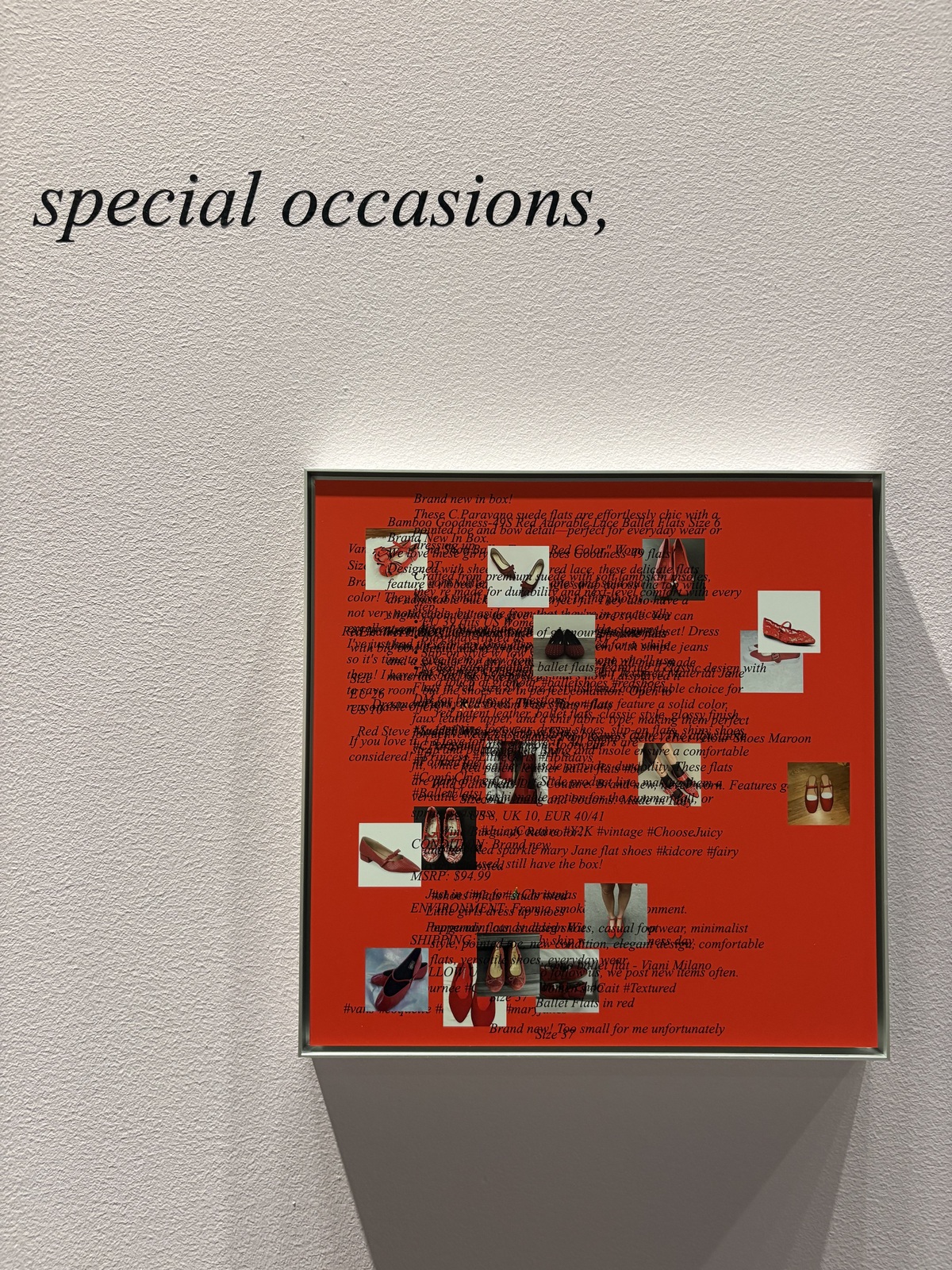 Installation view of Maya Mann's installation at Art Basel Miami.
I spent very little time with the Beeple display, partly because my Instagram feed was blown up with photos and reels of his creepy human-animal mechanistic hybrids (Mark Zuckerberg, ah!!!) and the throngs of people who hovered over the cordoned off space. But right near here, I discovered several booths solely devoted to younger artists who are leaving their mark in Contemporary art, with special attention to those bridging art and technology.
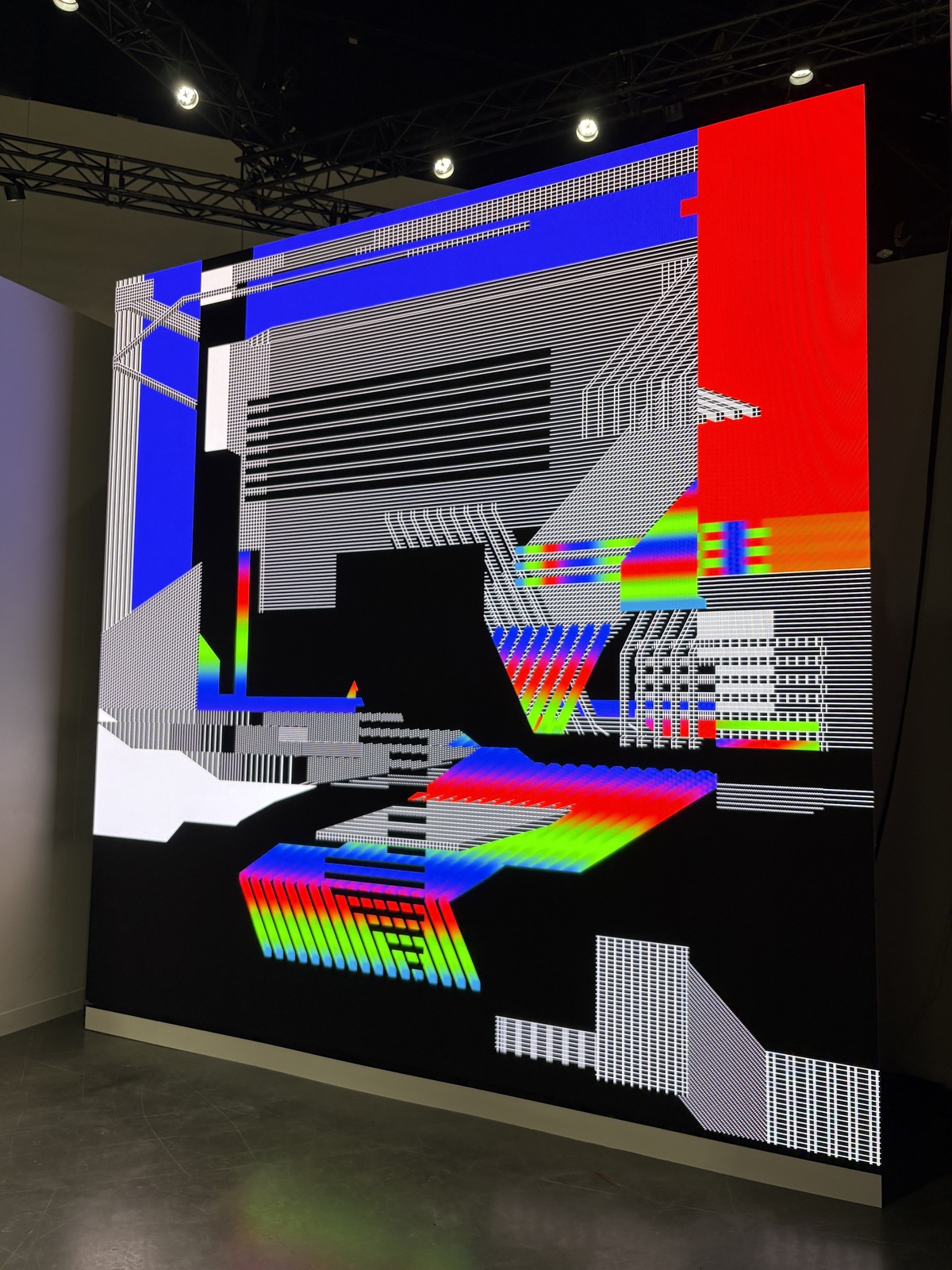 Kim Asendorf, Raster und Spektrum, 2025, real-time animation, WEBGl2 / JavaScript, no external dependencies. Presented with support from AbsenLive, Brompton Technology, Fuse Technical Group, and Superlumenary.
Maya Man’s technological collages speak to those of us who find ourselves chronically attached to our phones, for a series of screens featured a cadmium red background in which images of red women’s footwear appear in conjunction with all sorts of hashtags and descriptive text (#kidcore, #fairy, Viani Milano, etc.). Kim Asendorf’s generative screen display of boxy criss-crosses, gridded zones, and digital software palettes in waves extending from indigo to light green dance across the screen and transform in real-time. This animation was programmed through WebGL2 / JavaScript with no external dependencies involved, thus enabling a chance-based creation of a digital artwork akin to Harold Cohen’s painting machines from the 1990s, but with even more of a blurred boundary as to where authorship extends.
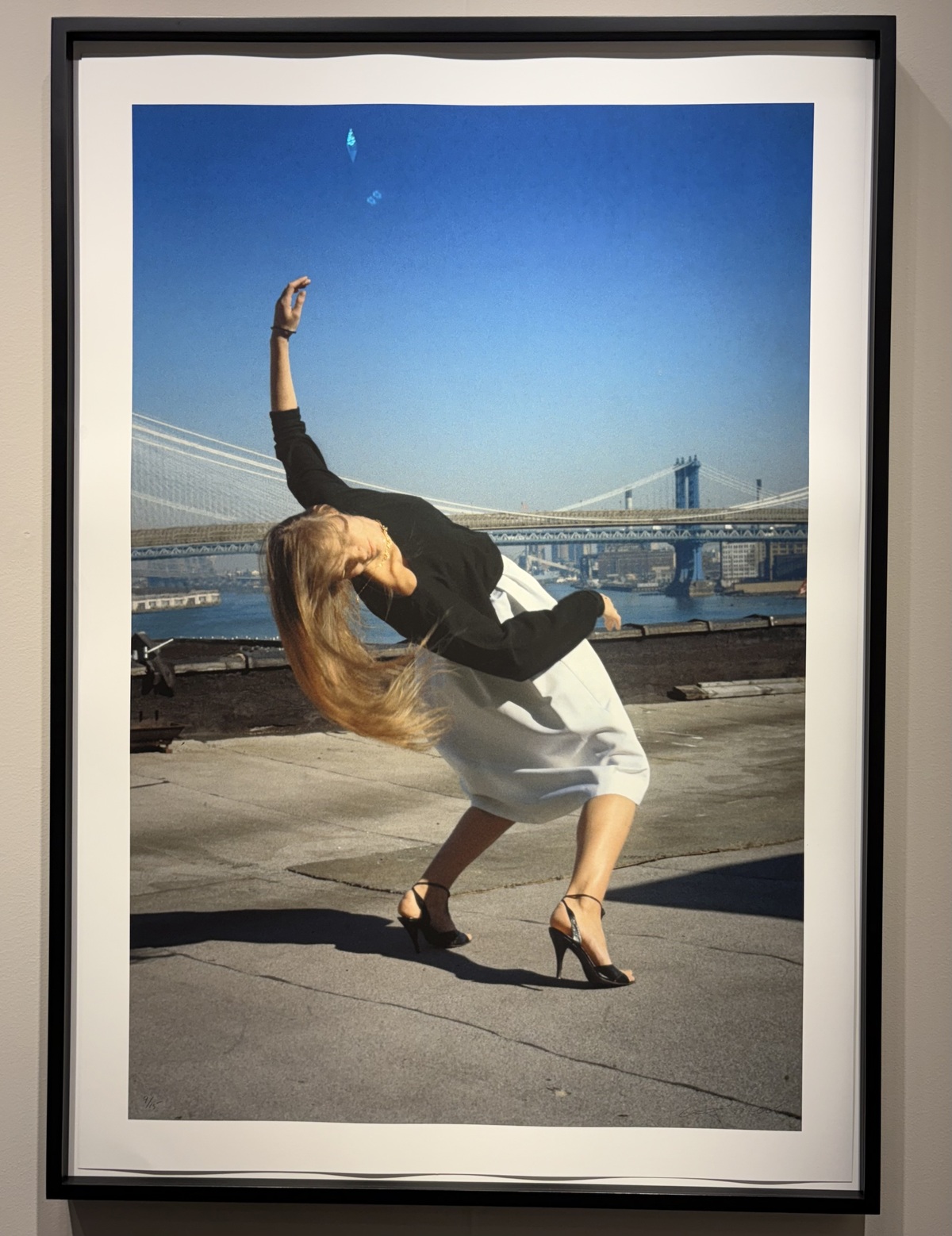 Robert Longo (American, b. 1953), Untitled (Men in the Cities #14), From Men in the Cities, 1977 - 1983, pigmnet print on Crane Portfolio Rag Paper. 39 3/4 x 26 1/4 inches / 101 x 66.7 centimeters. Image from Edwynn Houk Gallery's booth.
Fine arts photography occupied much more visibility than I was expecting given the primacy frequently placed on mediums like painting and sculpture. As an artist photographer and historian of photography, this made for a delightful experience which was reinforced by an impressive selection of artists and images that were well-curated.
Edwynn Houk Gallery (New York, New York) presented a series of heavy-hitter images by some of the greatest photographers of the 20th & 21st Centuries: Man Ray’s self-named rayographs from the 1920s; Robert Longo’s dramatic rooftop choreographed figure studies for his famed Men in the Cities series (1977 - 1983); Laurie Simmons’s playful Wedding Cake photo (1989); a self-portrait of Andy Warhol, etc. Gregory Crewdson’s massively scaled Untitled [Worthington Street] (2006), which captures a couple in an old, beat-up car along a suburban street under an early-evening sky, was perpetually surrounded by crowds likely because of the hyper-crisp details of the print.
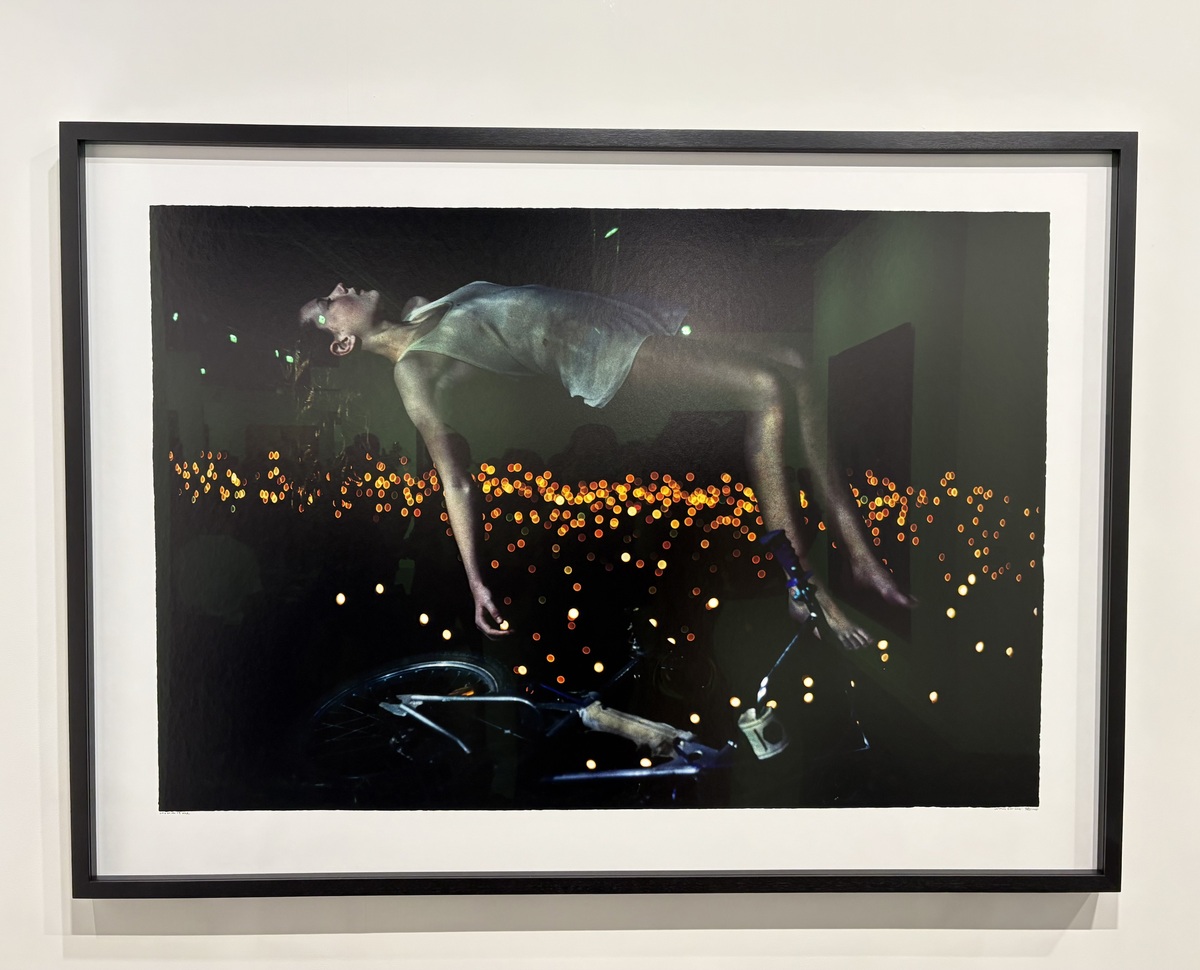 Bill Henson (Australian, b. 1955), Untitled, 2000 - 2001, archival inkjet pigment print. 127 x 180 centimers. Edition of 5 + 2 AP. Image from Rosalyn Oxley 9 Gallery's booth.
For global photographic recognition, Rosalyn Oxley 9 Gallery (Sydney, Australia) exhibited two heroically sized photographs by the Australian artist Bill Henson, one dreamy image of a young woman who appears to levitate over a fallen bicycle under a moonlit sky and the other being a sublime cloudscape; much ooh-ing and ahh-ing on my part as Henson is one of my favorite photographers (look up his Paris Opera series from the early-1990s) and this was my first time seeing his work in situ.
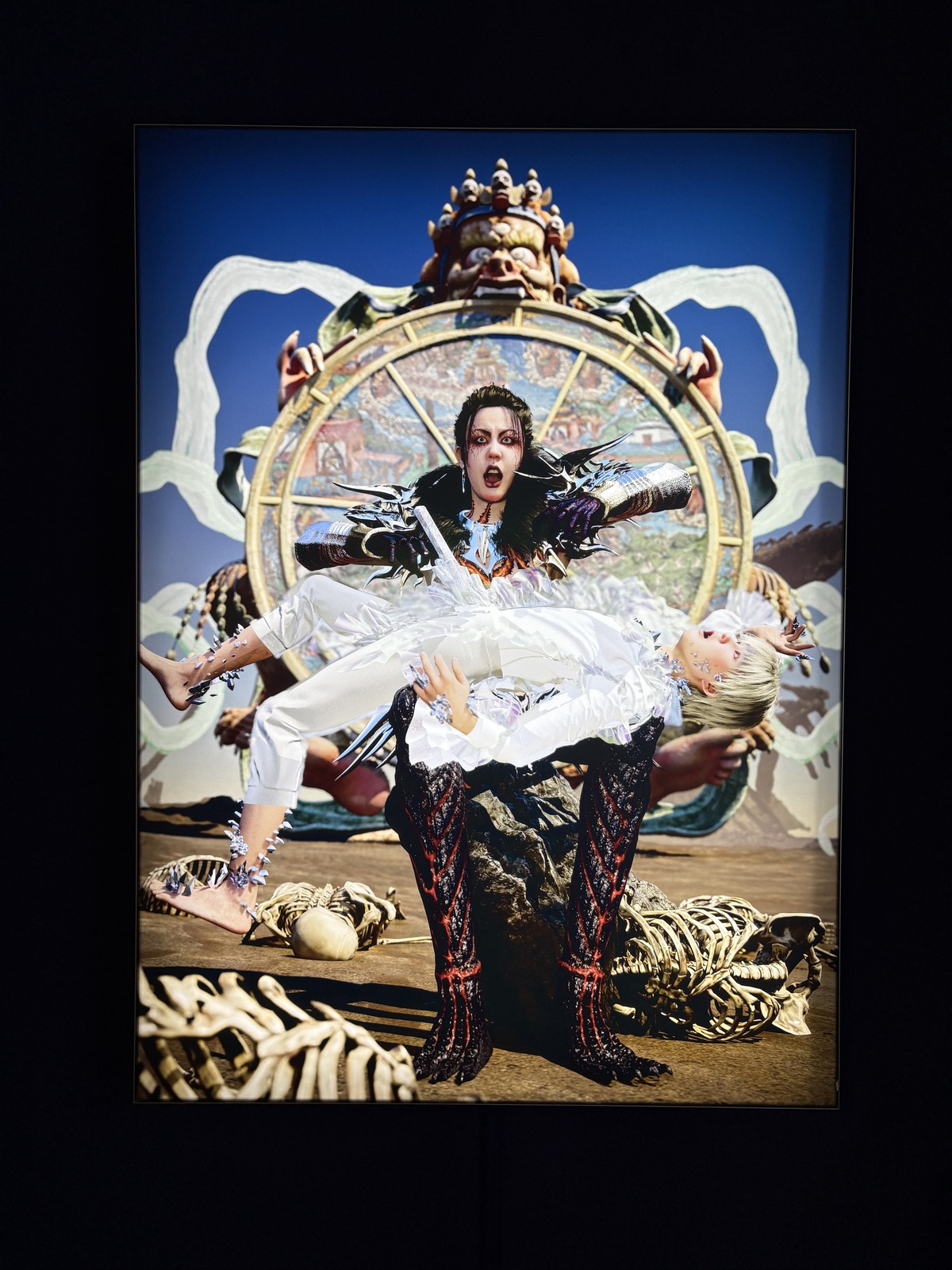 LuYang (Chinese, b. 1984, born in Shanghai, China), Image from their DOKU series.
Chinese photographer LuYang melded photography with new and emerging technological practices to probe questions of identity, the self, and popular culture. The three portrait photographs of their DOKU series was an awesome combination of Ancient Buddhist philosophy and East Asian futuristically anime-inflected personas evocative of a spectacular form of fashion photography.
Untitled Art Fair
Untitled was an extraordinary success best reflected in the not one, but three visits I took to this beachside tented fair. Where Art Basel tends to prioritize exhibiting mostly established art superstars, Untitled is more demonstrative of the future of Contemporary art as realized in younger and emerging artists working alongside galleries that foster these rising talents.
Since these fairs are microcosms of art ecosystems on the national and international stage, I paid close attention to not only booths, but particular cities that kept entering my purview. My top four cities in this regard were the following: London, United Kingdom; New York, New York; Detroit, Michigan; and Milan, Italy.
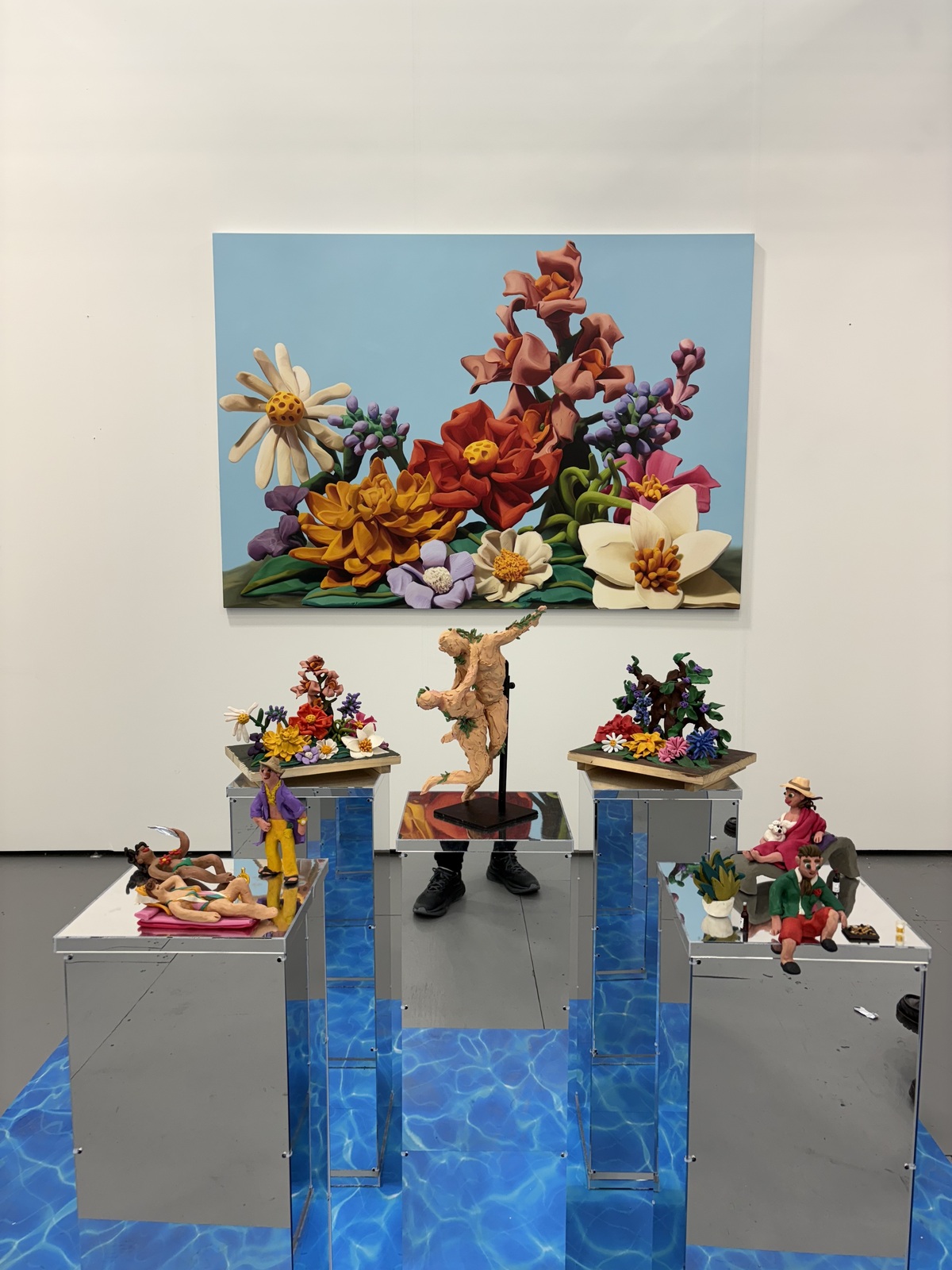 Installation view of Natalia Ocerin's Artist Spotlight in Gallery Rosenfeld's booth.
I lost track of how many London galleries swept me away. Gallery Rosenfeld had an artist spotlight on the London-based Spanish artist Natalia Ocerin who primarily works in hyperrealistic oil paintings and faux-naïf plasticine sculptures that belie social critiques of art market economics and gender politics, all of which done under the aegis of whimsical claymation aesthetics and dayglo coloration.
For Gillian Jason Gallery, the paintings of Georgia Dymock and Jenya Datsko each make manifest the interiority of women’s lives - the former in an elaborate menagerie of statuesque figures redolent of allegorical frieze sculptures, and the latter in examining female loneliness within cliquish social occasions.
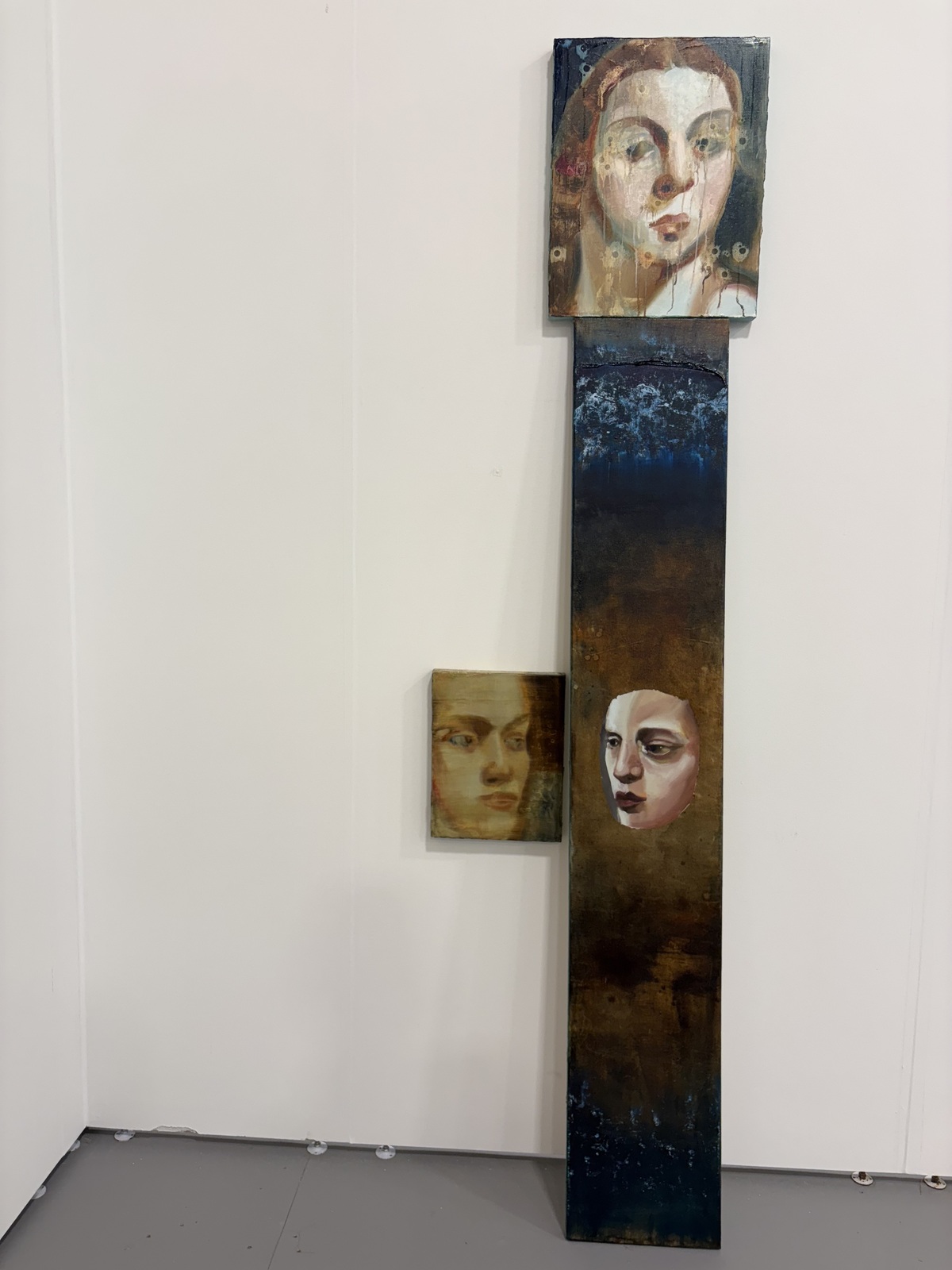 Anna Berghuis, Totem (Tall Child), oil on canvas. 92 x 23 inches. Image from Kravets Wehby Gallery's booth.
The New York galleries were a close second to the London galleries owing to their extensive presentations of a wide range of directions being taken in photography and painting: Giuseppe Lo Schiavo’s trompe l’oeil tondo window photographs that overlook the vastness of oceans (Danziger Gallery); Jessica Lichtenstein’s site-specific, wall-to-wall paintings of a fantasy world lush with blooming foliage (LatchKey Gallery); Anna Berghuis and Alison Blickle’s mystifying visualizations of the human figure as a lens for more-than-surface-level introspection (Kravets Wehby Gallery); Chellis Baird’s deconstruction of the painted canvas as sculptural framing interventions comprised of twisted, knotted, folded, and crossed-over links of fabric and wire with pockets of open space (Hollis Taggart Gallery).
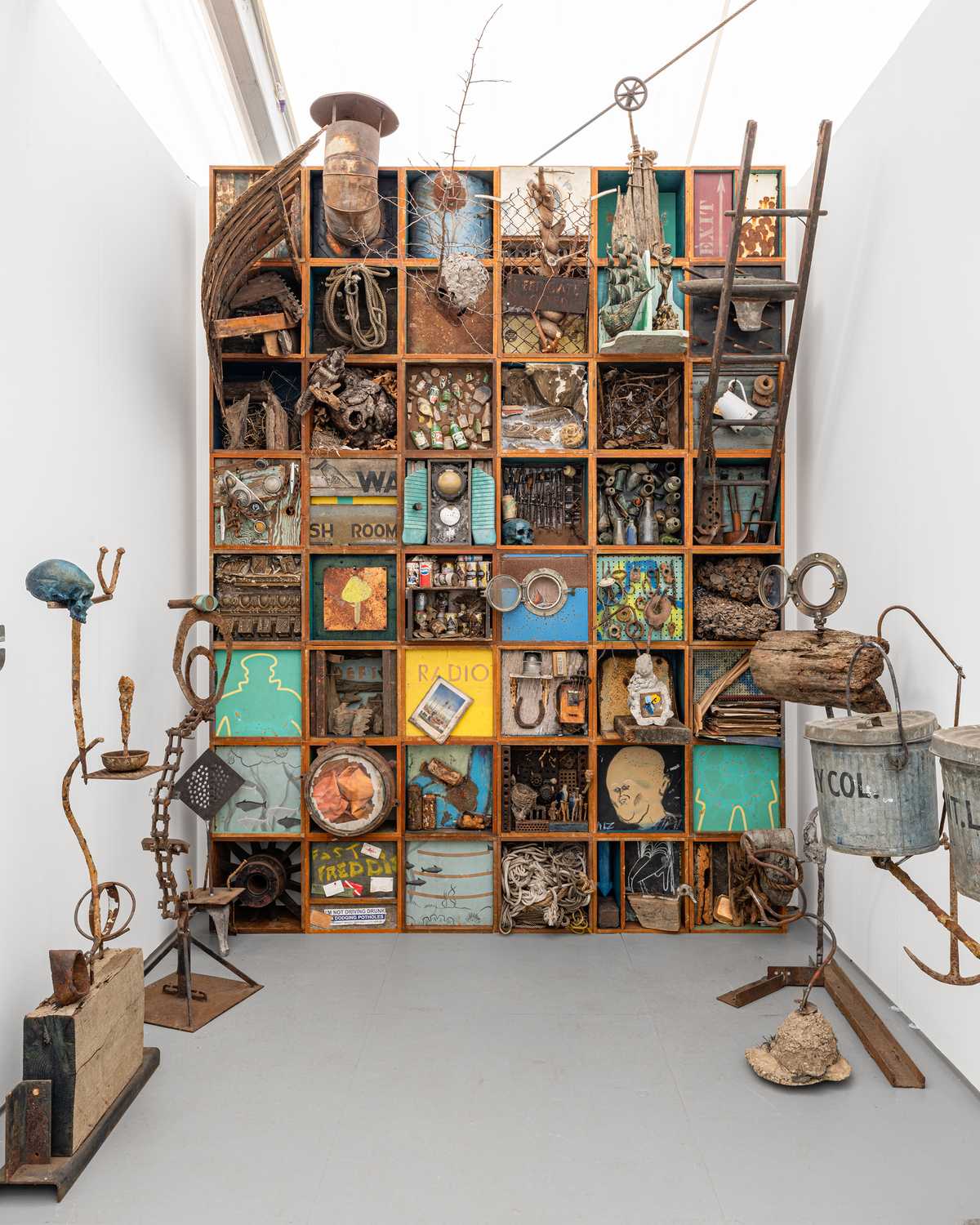 Scott Hocking (American, b. 1975), Water Works: RELICS, 2001 - 2025, 48 wooden boxes, Detroit found objects, salvaged materials from Stanton Yards and the Detroit River, mixed media. 144 x 108 x 12 inches / 365.8 x 274.3 x 30.5 centimers. Each box approx. 18 x 18 x 12 inches / 45.72 x 45.72 x 30.5 centimers. Image courtesy of Library Street Collective, Detroit, Michigan.
The Detroit galleries, many of which neighbored each other, were revelatory of the community-centric ethos which informs that city’s art scene. Scott Hocking (Library Street Collective) presented his extremely tall and super-detailed sculptural installation, Water Works: RELICS (2001 - 2025). This work is an assemblage of found objects and other mixed media elements derived from Stanton Yards and the Detroit River, with most of these being World War II-era ephemera from abandoned military barracks and warehouses. All of these objects were displayed in cubby hole boxes that felt like an enlarged version of a cabinet of curiosities with its menageries of rusted tools, weirdly graffitied illustrations, dusty yellowed papers, and heaps of stuck-together metallic remnants that had long been submerged underwater.
Louis Buhl & Co. showcased the works of several Detroit painters who each shared a commonality for summoning a certain ethereality to their compositions. Laura Berger’s translucent landscapes of flattened colors contain the ghostly figures of nude men and women who each convey a detached calm about them. Aaron Glasson’s more non-representational subjects are gelatinous glows of orbiting lights and rays that possibly dance over a sky that looks down upon a humble, depopulated rustic landscape.
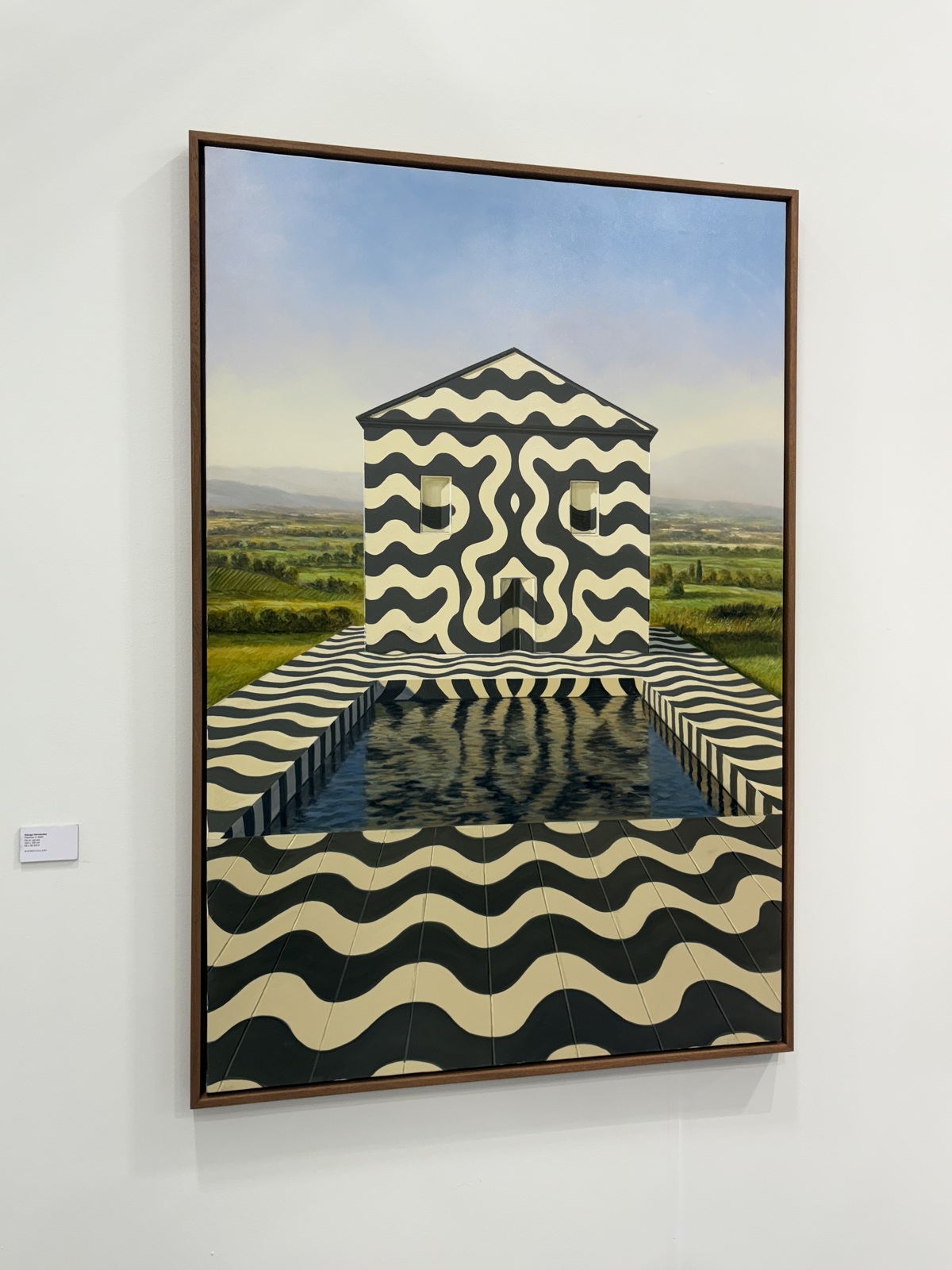 Diango Hernandez, Piscinas 3, 2025, oil on canvas. 150 x 100 centimers / 59 x 39 3/8 inches. Image from Wizard Gallery's booth.
Milan’s Wizard Gallery was a total showstopper with two architectural paintings by Cuban artist Dianjo Hernandez. Piscinas 2 and Piscinas 3 (both 2025) are marvelous experiments in pattern and perspective as each depicts a centrally positioned house whose facades are rendered in the most garish display of patterns imaginable that are replicated in the reflections of the pool in the middleground and again in the tiled walkways of the foreground; this intense play on repetition is miraculously evened out by the surrounding greenery of a lush Italianate landscape behind each house.
U-Haul Art Fair
U-Haul Art Fair was a surprise encounter as I stumbled across it after leaving Untitled on my first visit. Walking from the beach towards the flamboyantly illuminated Ocean Drive on a Friday evening, four U-Haul trucks were parked back-to-back along one of the most popular destinations in all of South Beach. Similar to my description of their inaugural fair in New York in September, the Miami edition felt like a hip beach party.
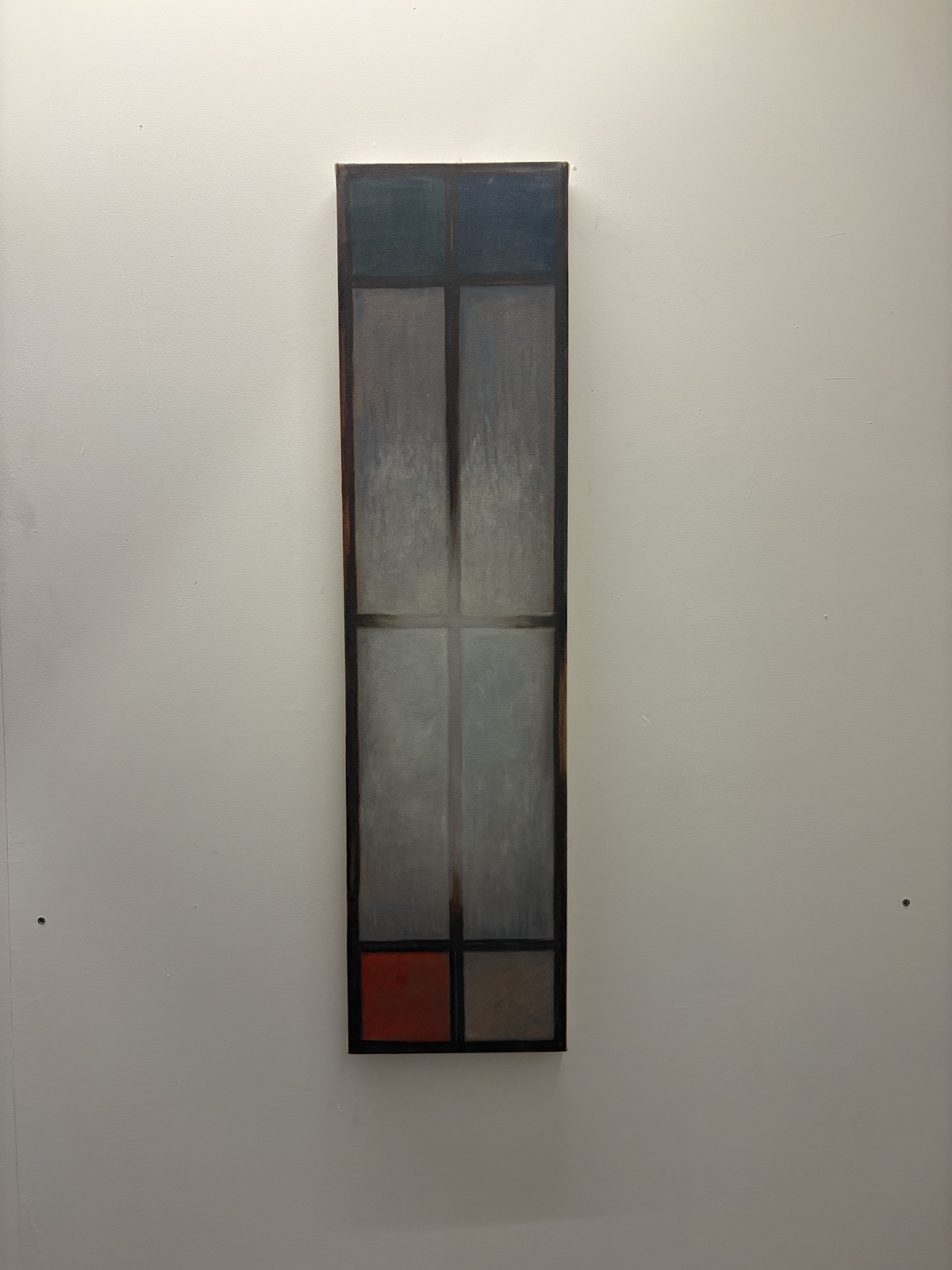 One of Niccolo Debole's paintings from the main U-Haul Gallery truck.
The first truck was the main U-Haul Gallery sans its signature globe logo (which was lost somewhere in New York’s Chinatown) and it contained a series of scattered paintings by Niccolo Debole that were giving some strong Postmodern vibes; a darkened vertical painting of a faux sullied grid in the style of a Mondrian was my favorite of these.
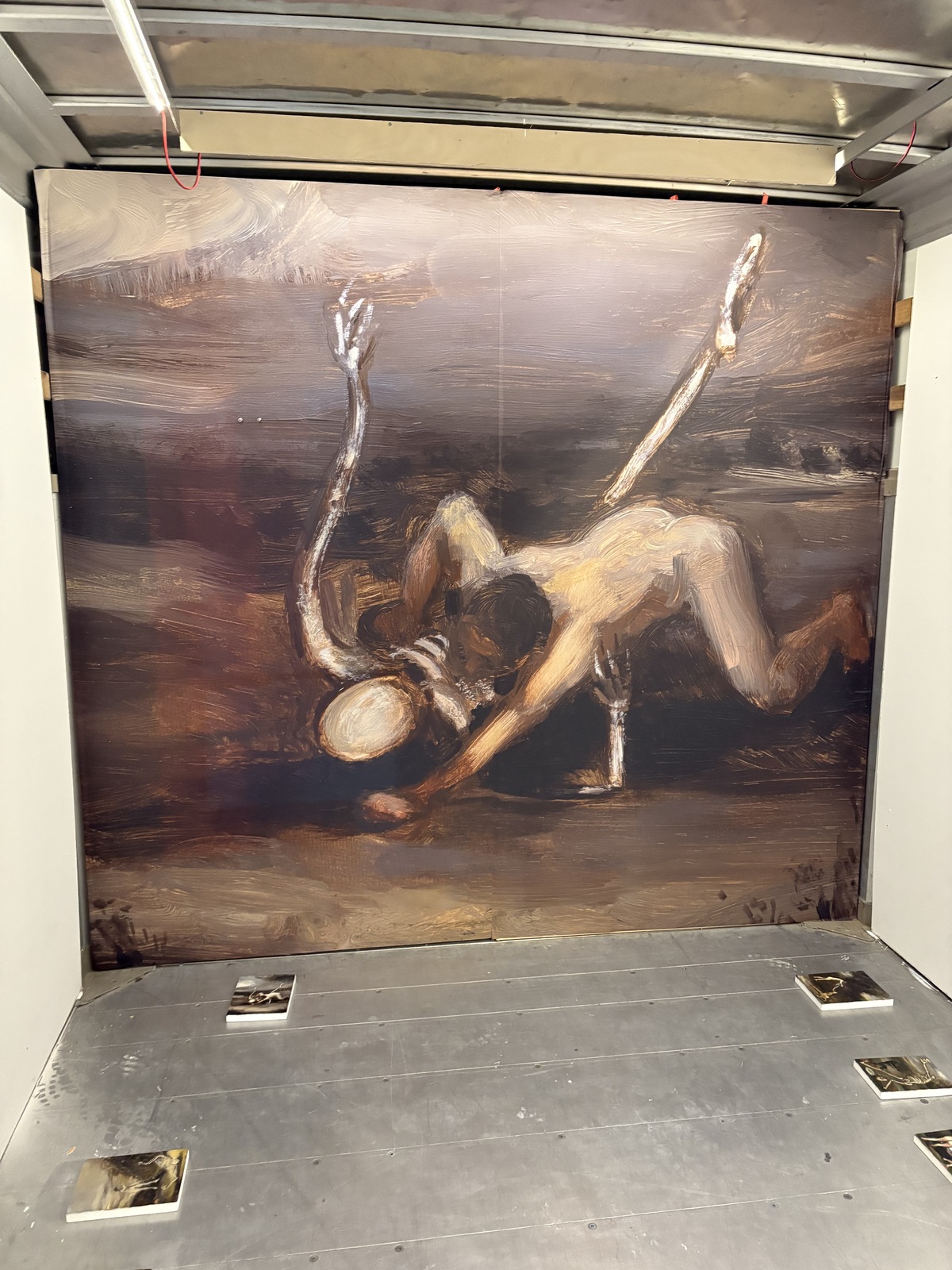 Installation view of Lisa Ivory's painting in Nino Mier's truck.
Next up, Nino Mier Gallery (New York, New York) had a truck whose centerpiece by Lisa Ivory was a harrowing earth-toned painting of a nude man pinning a skeleton (Death?) to the ground either in locked combat or in an act of devouring. Whatever the action may be, this was a stirring and violent scene that wielded an energy akin to one of Spain’s most legendary painters, Francisco de Goya.
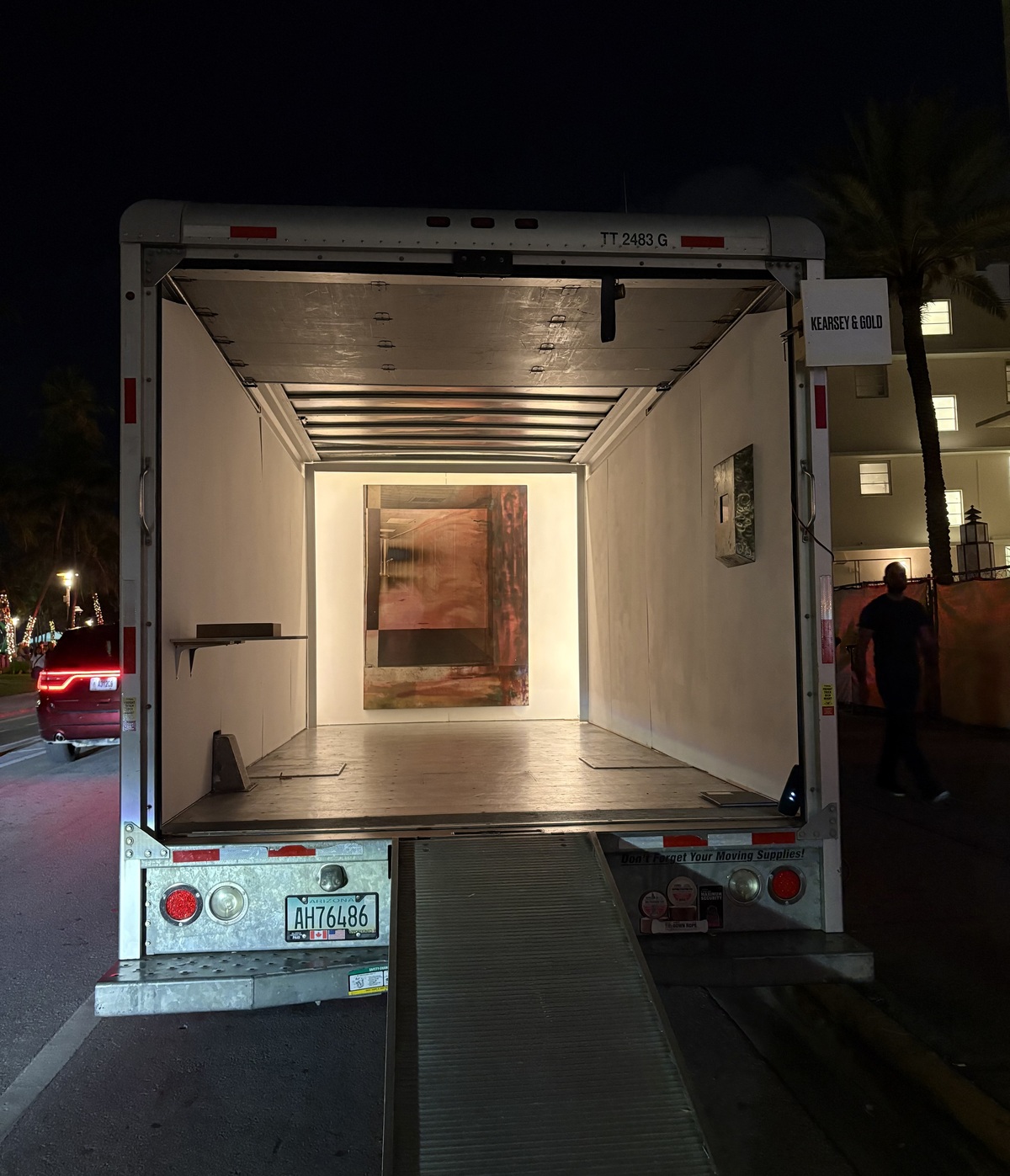 Installation view of Kearsey & Gold's truck with Filippo Antonello's paintings inside.
Kearsey & Gold’s (London, United Kingdom) truck served as an excellent curatorial foil to Nino Mier’s with the much tamer works of Swiss-Italian multidisciplinary artist Filippo Antonello. No harsh lighting was used in the back of this truck, for Antonello’s paintings are lush with a thick veneer of rust-colored shades that gradually reveal perspectival space leading to some place beyond.
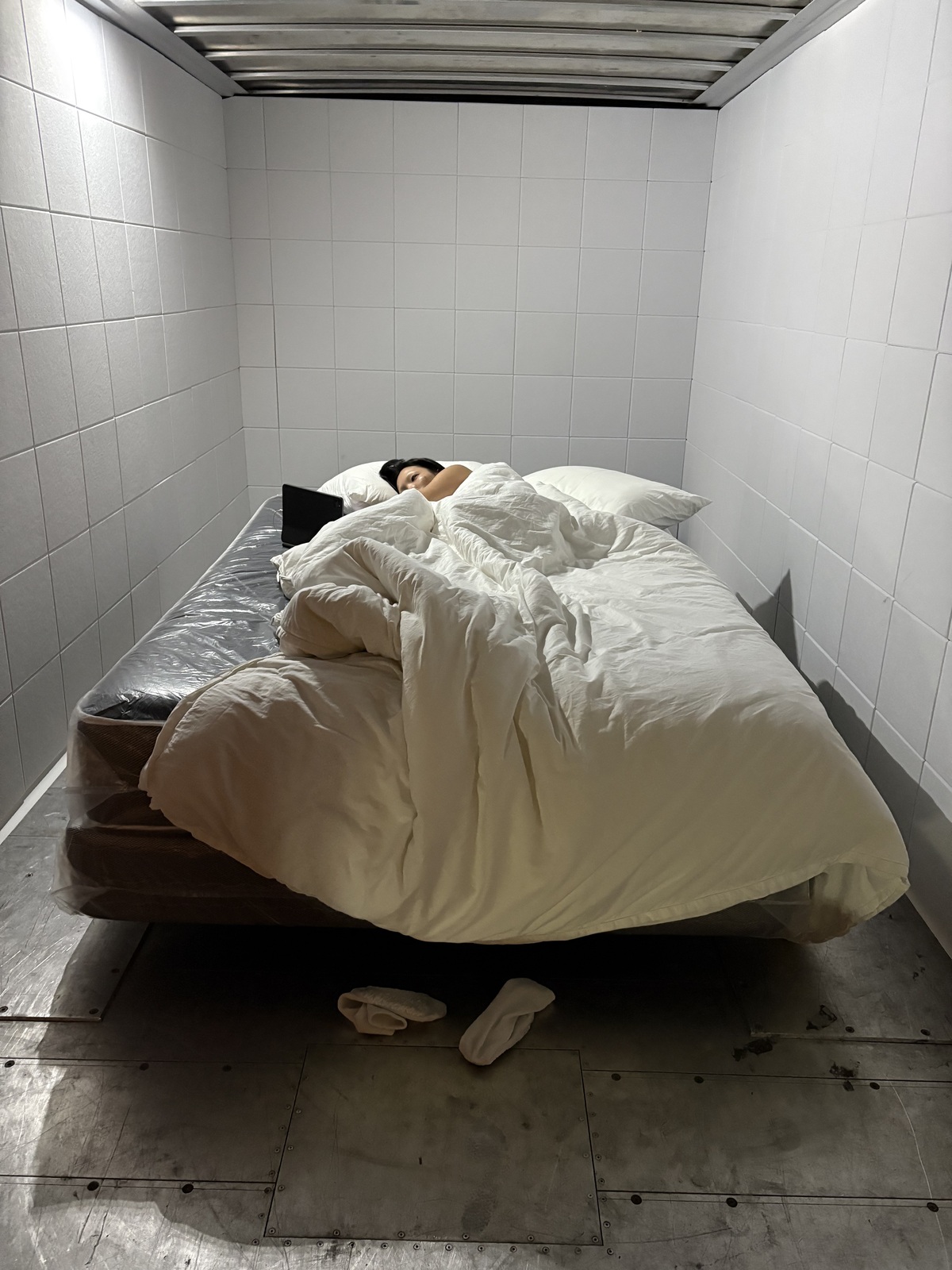 View of Princess Gollum's sleeping performance inside the Rusha & Co. truck.
The last truck by Rusha & Co. (Los Angeles, California) was an ongoing performance piece in which artist Princess Gollum slept on a bed to the full exposure of all who ascended the truck’s ramp. The gaze (particularly a gendered one depending on the viewer’s identity) and voyeurism were undoubtedly key themes that immediately came through in one of the most public parts of Miami.
With Miami being an epicenter of American car culture, it made sense that this was by no means the only spot in which U-Haul Art Fair had its presence, for the truck galleries migrated to other parts of the city to spread their visual wonders (certainly to great effect and social media publicity).
SCOPE Art Show
One could easily tackle Untitled and SCOPE on the same day as both fairs were directly next to each other on the beach. Just like Untitled, SCOPE was in a tented structure which provided viewers with a rather dramatic entrance. Victor “MARKA27” Quinonez, a Mexican-American artist who is currently artist-in-residence at MASS MoCA, exhibited his monumental sculpture Elevar La Cultura. Piles of golden storage containers were arranged into the shape of an imposing pyramid featuring shrines specific to different cultural backgrounds in homage to immigrant street laborers; this work was previously exhibited at The Shed in Hudson Yards for the recent Open Call: Portals exhibition.
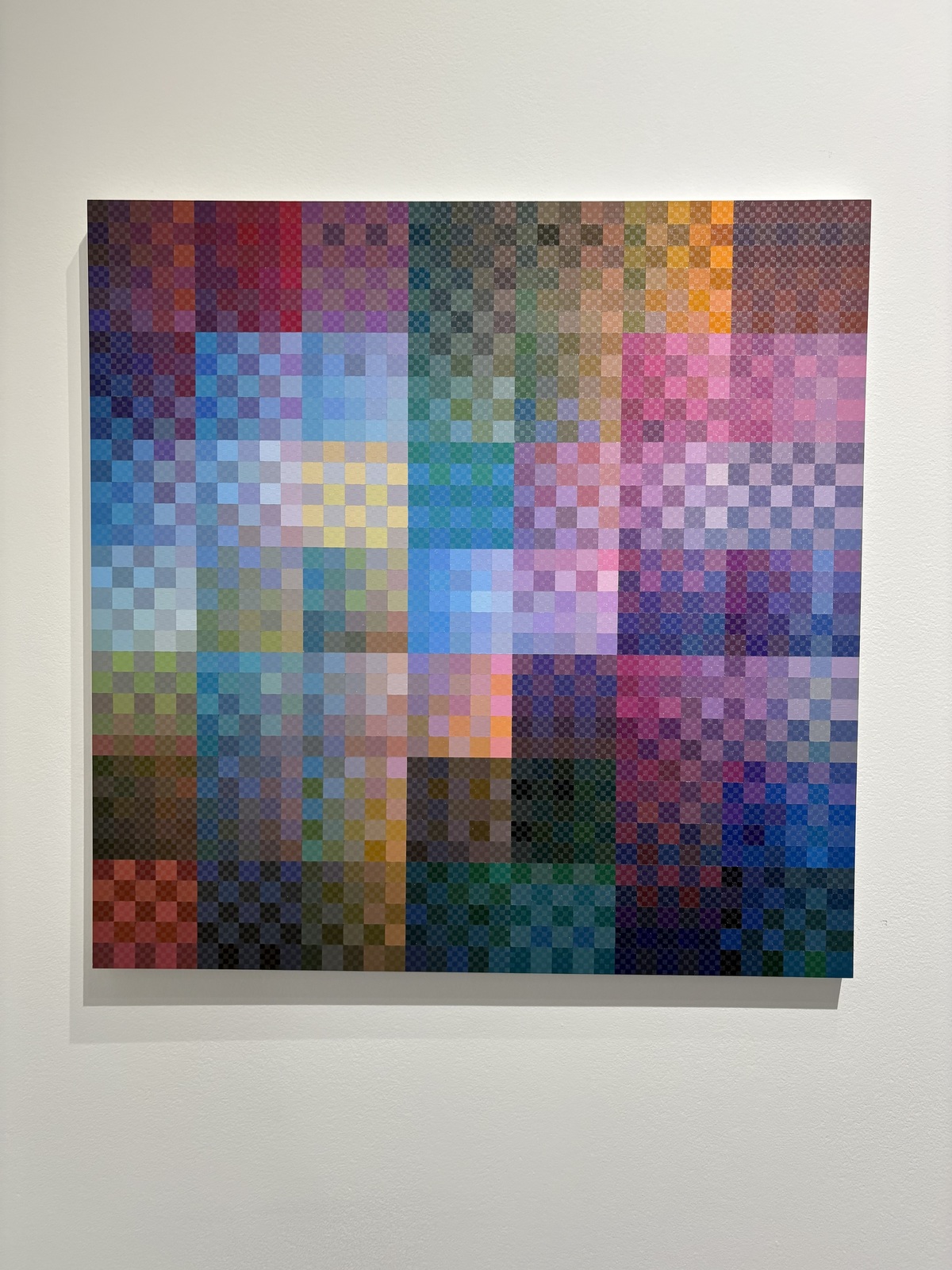 One of Aya Kawato's paintings from GoCA's booth.
GoCA (Gallery of Contemporary Art, New York) is a Japanese-owned art gallery that specializes in exhibiting works by Japanese & Japanese-American artists. Their sizable booth had the homey feel of the sort of gallery that you just need to keep revisiting (for me, an automatic given since I am a regular visitor at their space on W. 23rd & 10th Ave. in Chelsea). Aya Kawato’s meticulous paintings of gridded squares were attractively symphonic arrangements in color that were pleasingly contrasted with Ibuki Minami’s much looser and more thickly applied pigments over a systematized network of geometric forms.
Quite a few figurative painters offered an enchanting portal into fictive worlds seen through enlivened vignettes. In Mortal Machine Gallery’s booth (New Orleans, Louisiana), Pop Surrealist Mab Graves conceived a melancholic woodland scene in which the titular Lirien, a pink haired and cerise skin-toned woman or girl, weeps while she is comforted by pixies, fairies, hedgehogs, and other tiny creatures. Though we may not know the reason for Lirien’s grief, the sober lighting and distraught expressions of the characters is enough to evoke a similar reaction in us, the viewers.
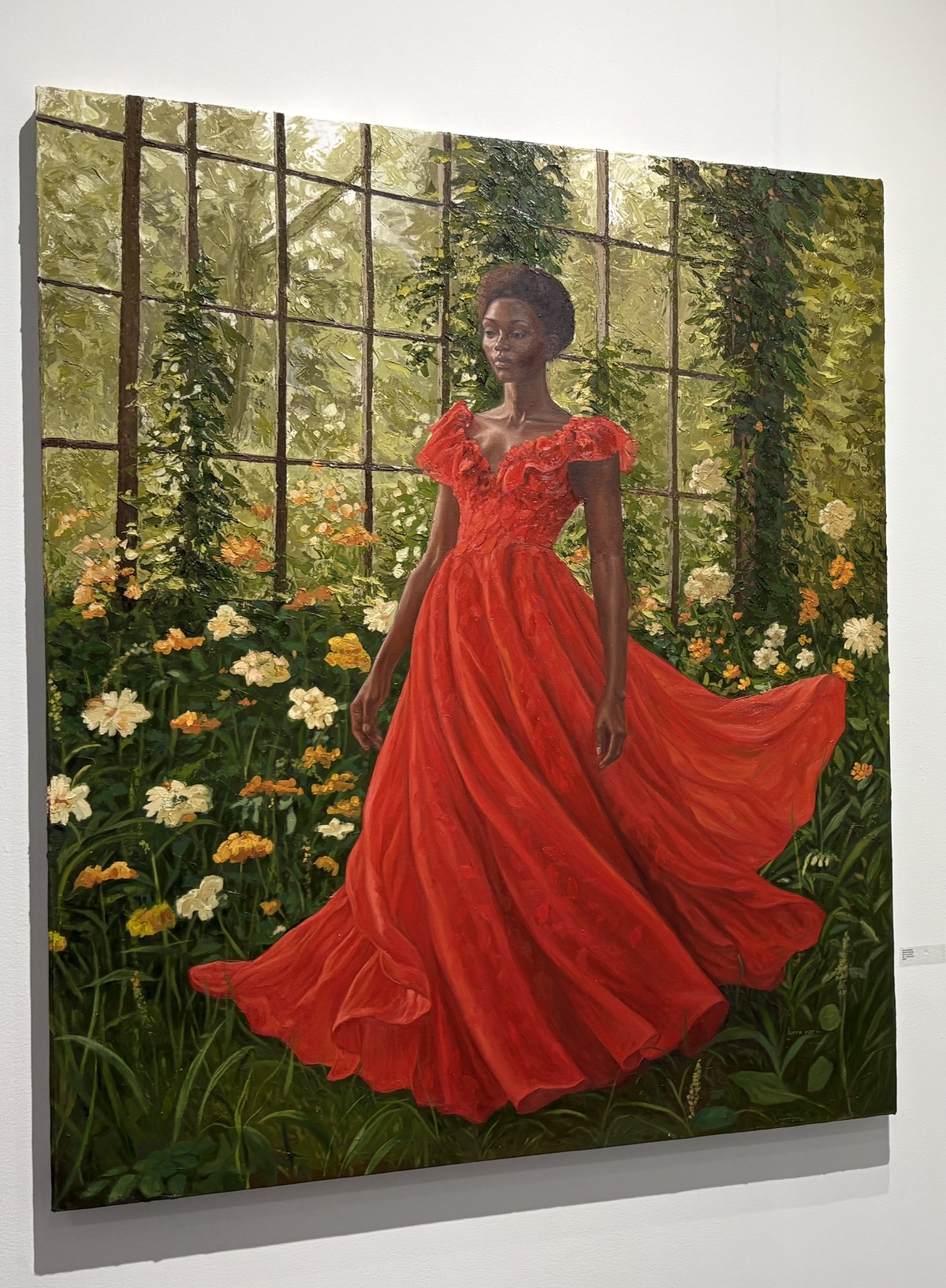 Izere Antoine, Velvet Evening, 2025, oil on canvas. 48 x 38 inches. Image from Mitochondria Gallery's booth.
Izere Antoine from Mitochondria Gallery (Houston, Texas) also worked with verdant subjects, but in a much more halcyon expression such as Velvet Evening’s baroque presentation of a young black woman in a flowing ruby red dress who stands before an overgrown flowerbed inside a building whose windows peer out into an even denser canopy of forested nature.
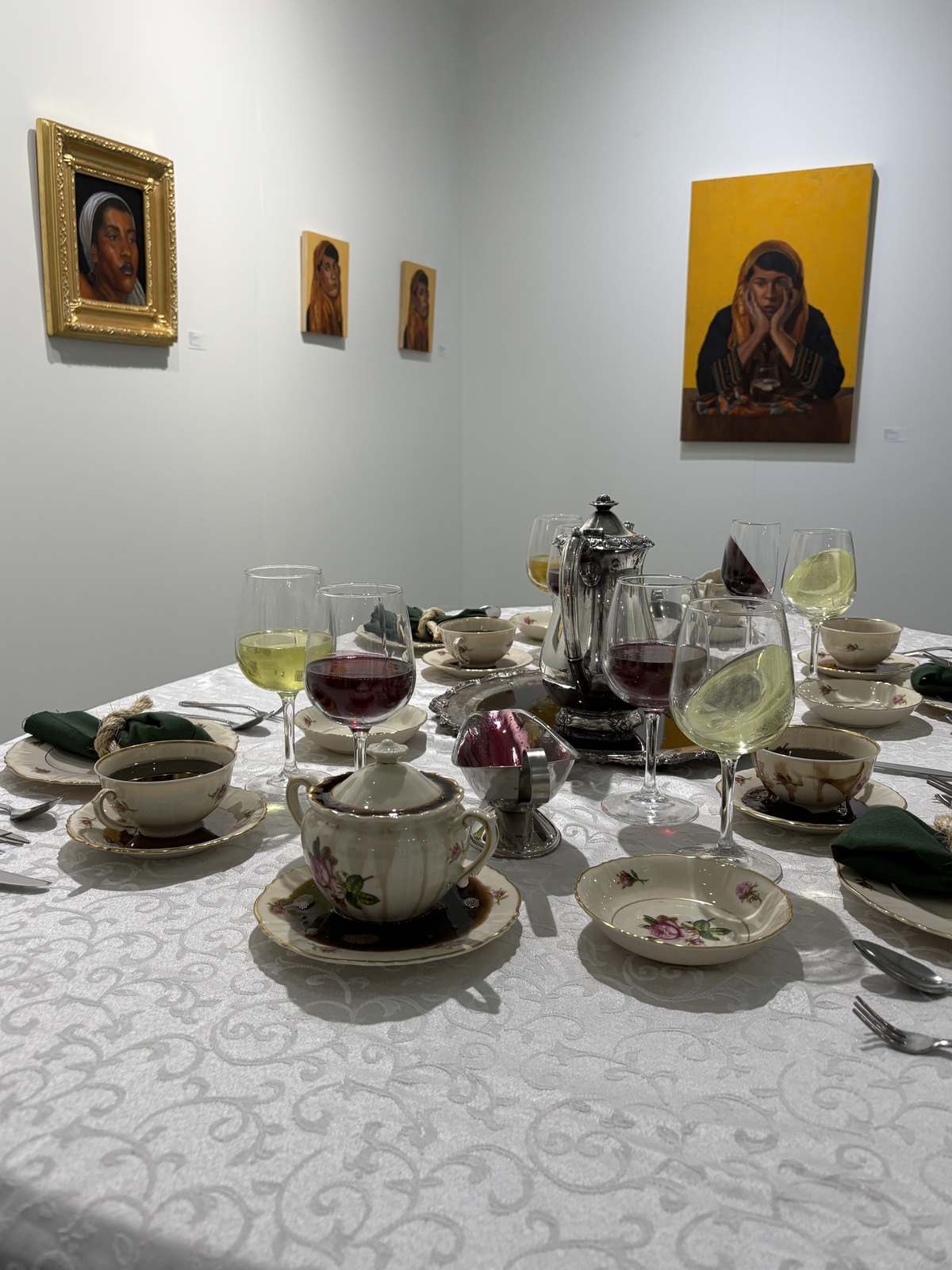 Installation view of Unique Fair's Consume U.S. in Devon Vander Voort's booth.
More politically engaged works had their time to shine at SCOPE. Also in Mortal Machine Gallery, Los Angeles-based painter Alex Schaefer exhibited a painting of an enormous firestorm that engulfs a Chase bank; Schaefer, whose works are quite literally inflammatory critiques of capitalism and wealth inequality, is known for his recurring depictions of banks on fire. Nearby, Rochester-based artist Unique Fair applied a more “the personal is political” approach by devising an imitation kitchen table replete with mock food, drinks, and silverware called Consume U.S. (Devon Vander Voort, New York) This installation was a conceptual remark on how this domestic feature can be interpreted as a platform through which a multiplicity of interactions occur: the comfort of family and community; roundtable discourse, debate, and conflict; sites of mourning and remembrance, etc.
Satellite Art Show
Satellite Art Show was an interesting venture in that this was an alternative art fair held in a kind of divey, rundown hotel (the sort that’s a cut above the status of a motel). The hotel rooms on the first and second floors were converted into temporary galleries and site-specific installations by younger artists and curators who, funny enough, largely hailed from New York.
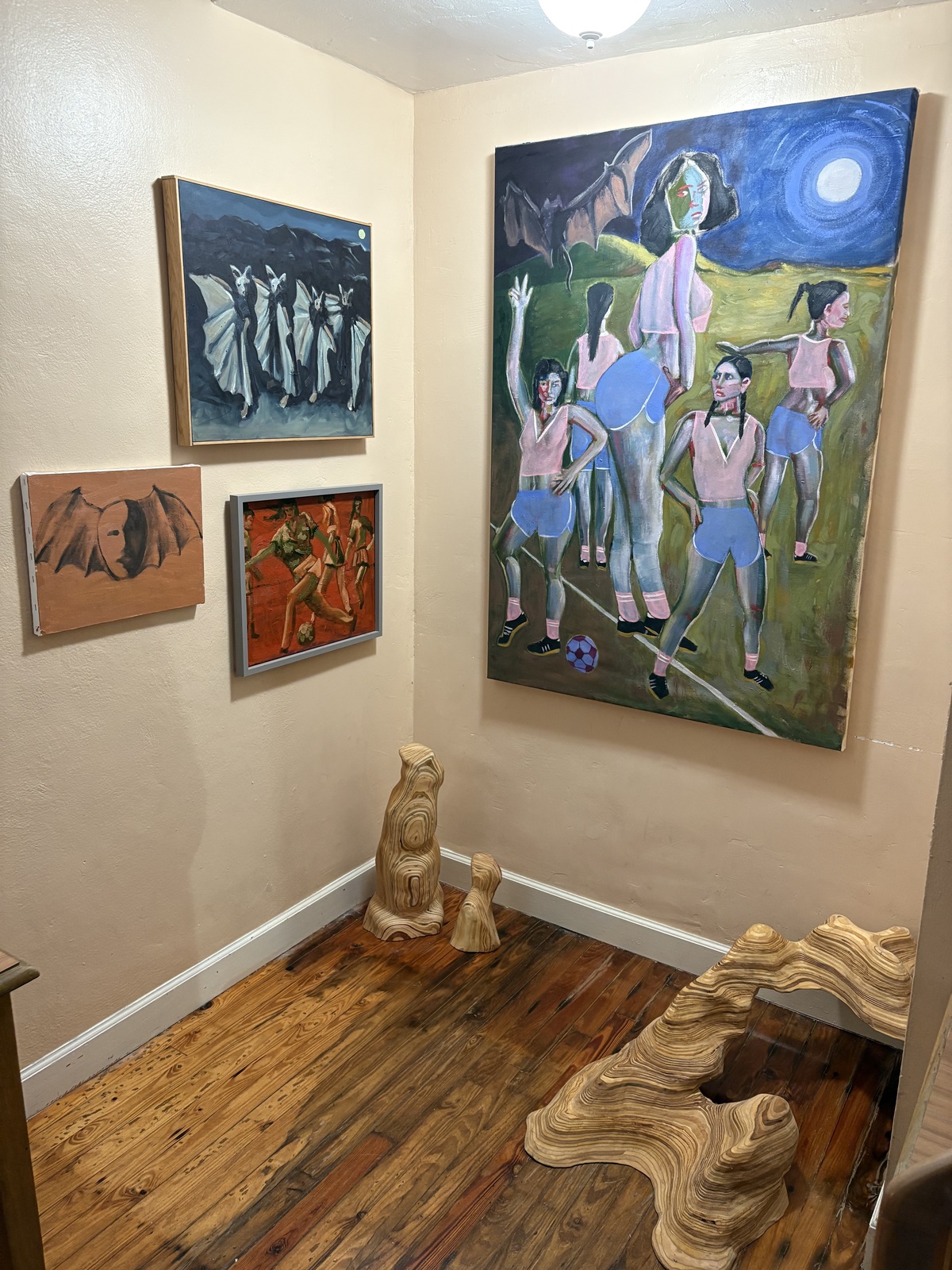 Installation view of Plum Gallery's display at the Satellite Art Show, with works by (from left to right): Nikki Shapiro and Alexander Zev.
I appreciate a raw edginess imbibed with a punk attitude as it draws out an authentically unabashed curatorial and artistic vision. Plum Gallery (New York, New York) occupied two rooms with a mixed batch of hip artists whose works seamlessly felt right at home. The curatorial brainchild behind this gallery, Mishka Gavora, gathered a fabulous group of artists and, as it turns out, some of whom I was already familiar with based on some brief encounters. Jackie Slanley’s outwardly extended plexiglass sculptures that recall the shapes of blooming plants or winged insects jumped out at me as I instantly recognized her sculptural style from the Bushwick Open Studios in September (we never spoke that time due to a busy flow of visitor traffic, but her work clearly remained firmly rooted in my subconscious months later). Alexander Zev’s reclaimed plywood sculptures managed to somehow exude a sense of weightiness and lightness at the same time, with perhaps the most fantastic example of this play with material contradictions coming in the form of a canyon-like mass situated on the floor in a corner niche.
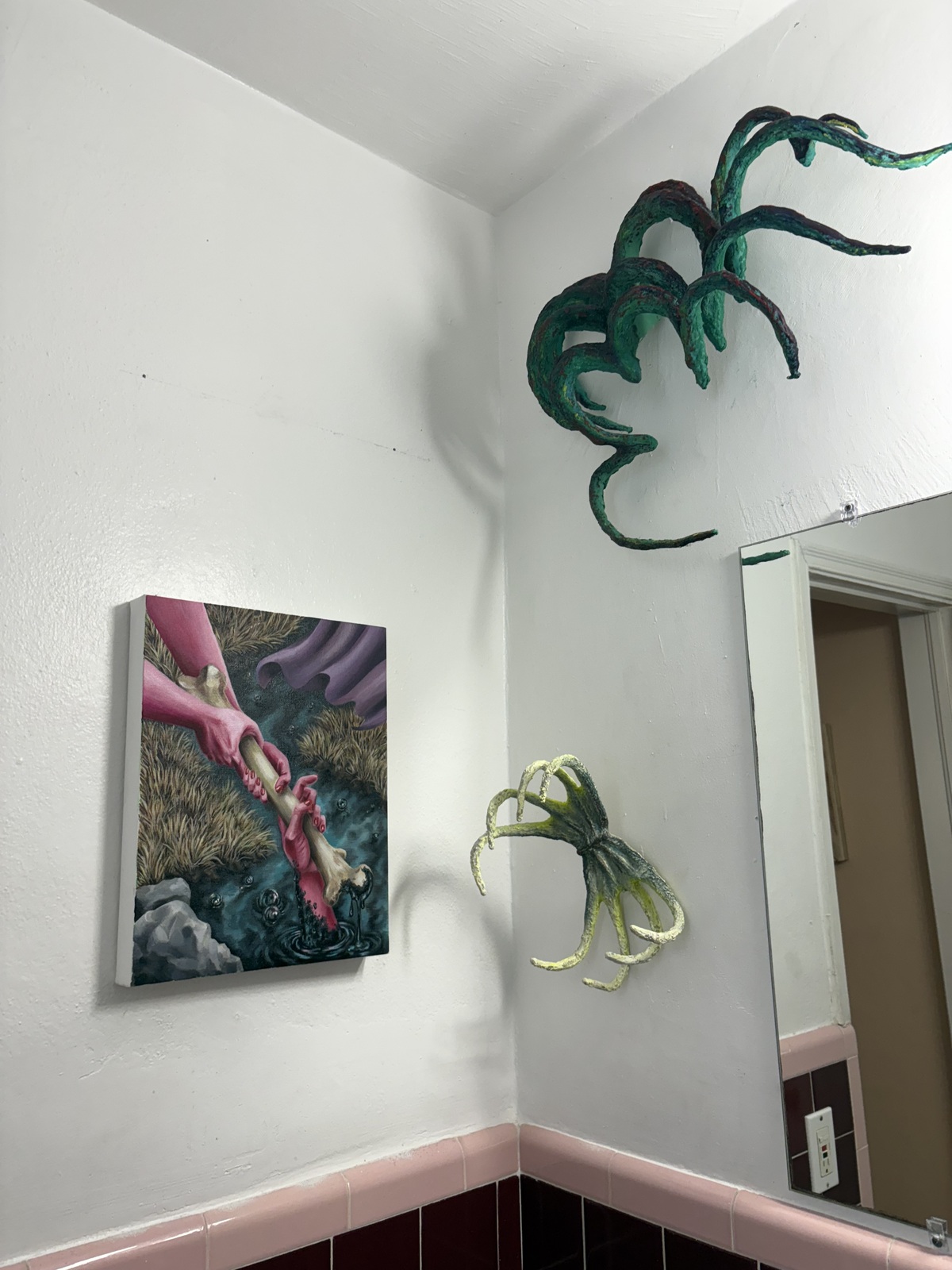 Installation view of Plum Gallery's bathroom displays, with works by (from left to right) Lauren Kolesinskas and Carrie R.
Some of the artists in this cohort had a lot of fun with the concept of zoomorphism. Joey Aji’s eco-resin LED lamps with their spindly bases resembled the slithering tentacles of a strange underseas creature while Carrie R.’s painted aqua-resin sculptures of crab-like insects that looked as though they were climbing the bathroom walls of one of the hotel rooms may as well have been an artist’s realization of one of my worst nightmares - entomophobia (fear of insects).
It also wasn’t until much later that I realized why I recognized Mishka Gavora: she was a recent interview subject on the popular social media series Subway Takes!
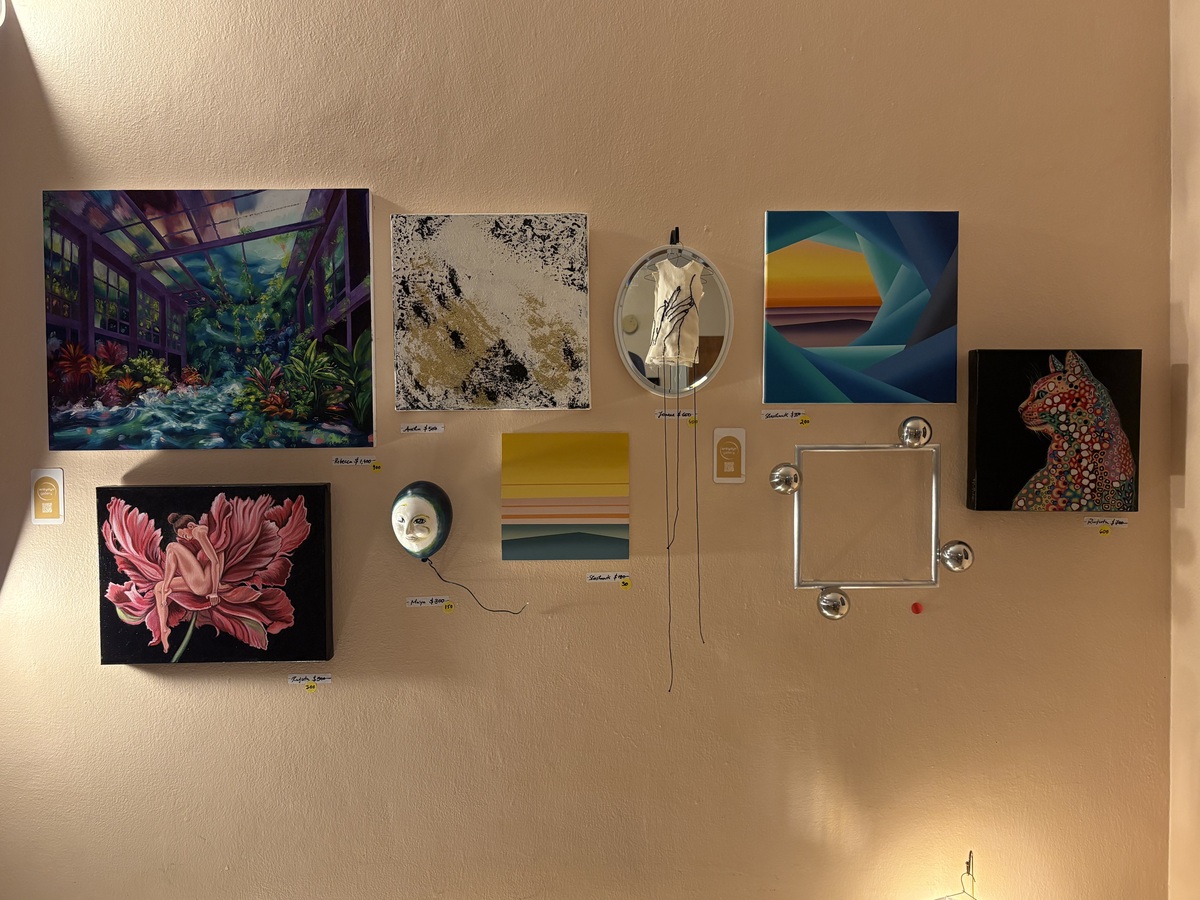 Installation view of Ankydyn Gallery's artworks display.
Ankydyn Gallery’s topsy-turvy hotel room makeover contained a whirlwind of artists ranging from mixed media abstract painters (Anshu Malhotra) and sardonic feminist agitprop (Joanne Steinhardt) to converted found object sculptural figurines (Mollie Serena) and luminescently glowing painterly vistas (Rebecca Sherman and Shushanik Karapetyan).
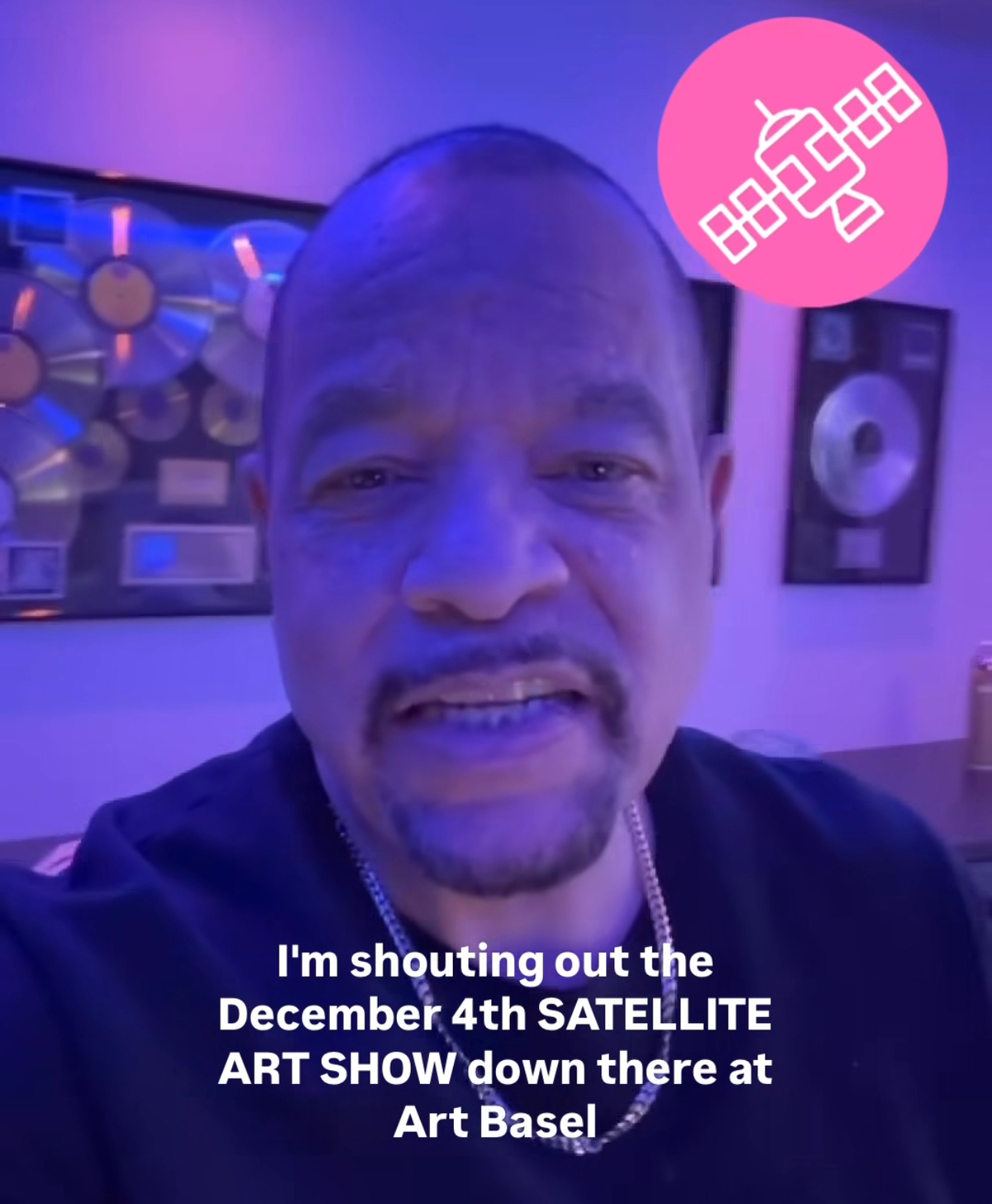 Screenshot of Ice-T's social media post in which he encourages his followers to visit the Satellite Art Show (posted on December 2, 2025).
But forget my own synopsis of Satellite Art Show for a moment, for the most significant endorsement by a notable figure for the importance and success of such an art fair came from none other than Ice-T, who later made a surprise appearance at the fair! WM

Liam Otero
Liam Otero is a freelance art writer in NYC. He was recently named New York Editor of Whitehot Magazine.
view all articles from this author