Whitehot Magazine
October 2026
"The Best Art In The World"
"The Best Art In The World"
October 2026
Marc Dennis: Petals and Mirrors Harper’s Gallery
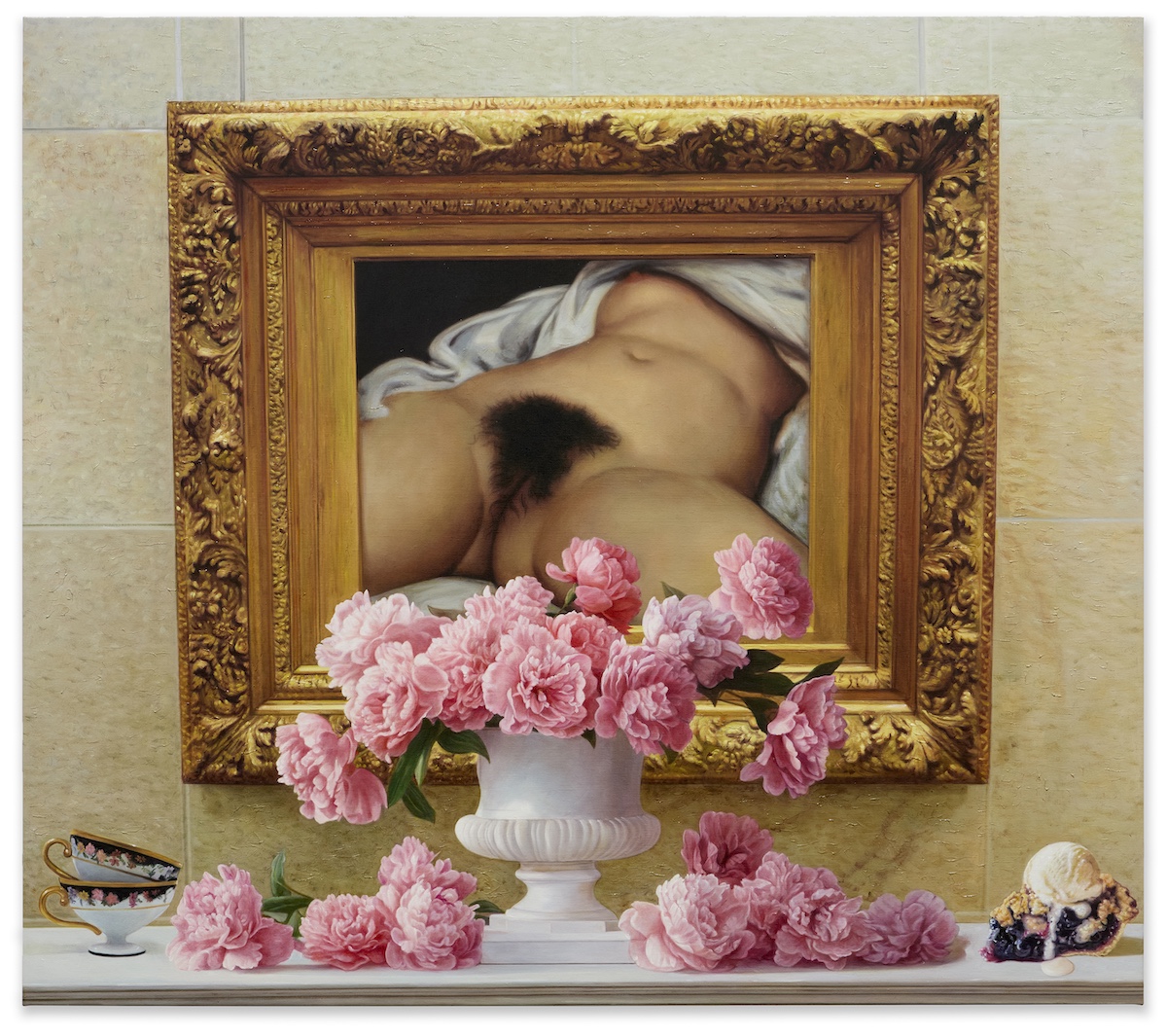 Marc Dennis, The Middle of the World, 2026. Oil on linen. 49 by 55 inches. © Marc Dennis. Photo: Daqi Fang. Courtesy of Harper’s, New York.
By RAPHY SARKISSIAN | October 18, 2026
In The Middle of the World, Marc Dennis paints Gustave Courbet’s L’Origine du monde, a picture with a long history of secrecy. When Jacques Lacan and Sylvia Bataille bought the Courbet in 1955, they hung it in Lacan’s study at La Prévôté, their country house west of Paris, where Lacan asked his brother-in-law, André Masson, to conceal it. Masson made a sliding wooden panel, drawn aside only for friends, and painted on it a Surrealist transposition of the image behind, taking Courbet’s title at its word: the reclining body becomes an almost abstract landscape. The painting remained in private hands until 1995, when it entered the Musée d’Orsay. Some seven decades after Masson’s panel, Dennis brings his version to Harper’s Chelsea, among bouquets, mirrored spheres, and repainted masterpieces, and sets flowers before it.
Where Masson covered the painting, Dennis’ pink peonies partly veil it. Georgia O’Keeffe spent half a century insisting that her flowers were only flowers; Dennis sets his before Courbet’s canvas, before the very anatomy critics kept finding in hers. The setting is domestic: the painting hangs in an ornate gilt frame on a wall of pale stone blocks, above a white mantel. Before it stands a white marble urn holding the flowers, some fully open, others still tight. The bouquet rises over the lower edge of the frame and across Courbet’s thighs, and stops just short of the center. More peonies lie cut on the mantel on either side. At the left, two porcelain teacups with gilt handles are stacked one on the other. At the right, a slice of blueberry pie carries a scoop of vanilla ice cream, which has begun to melt onto the white surface.
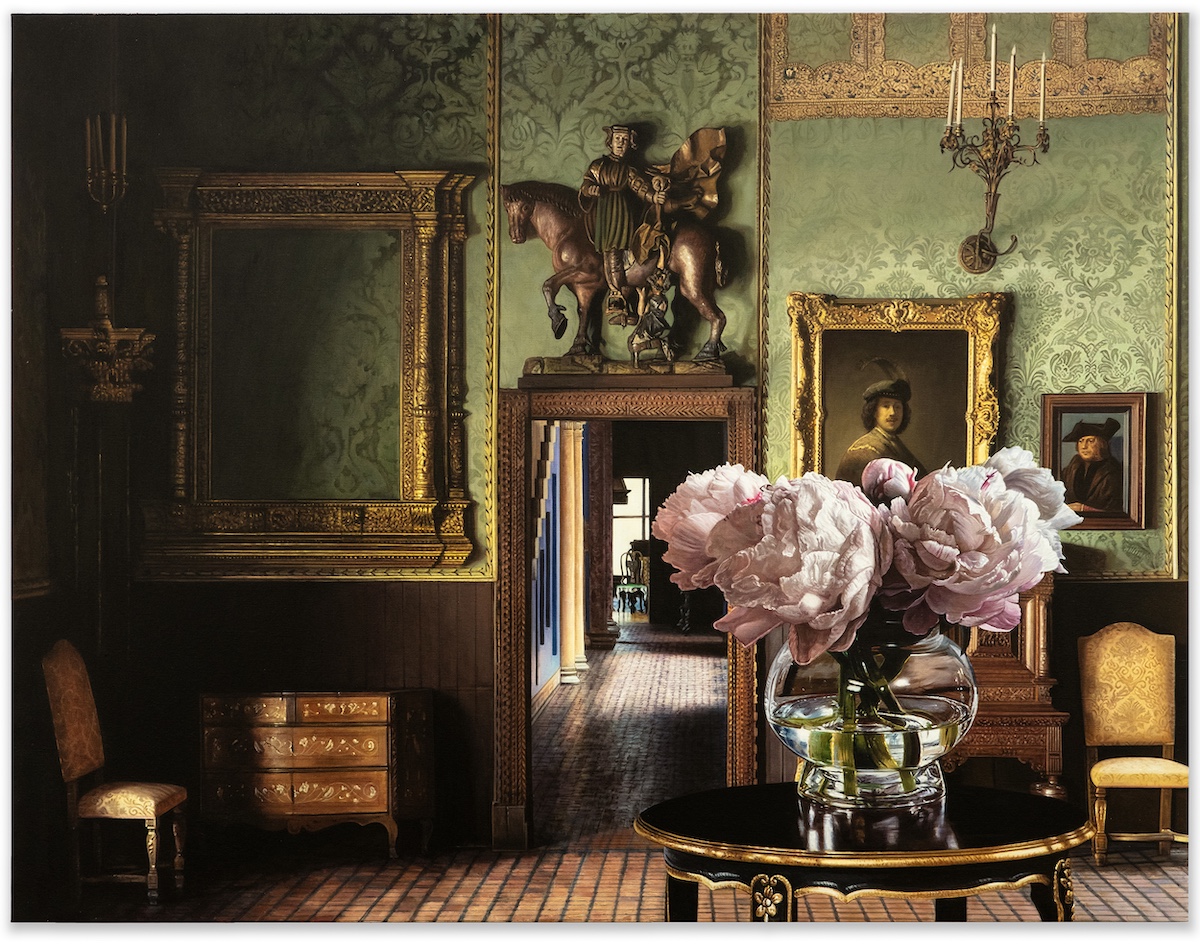 Marc Dennis, The Presence of Absence, 2026. Oil on linen. 54 1/2 by 71 inches. © Marc Dennis. Photo: Daqi Fang. Courtesy of Harper’s, New York.
The Presence of Absence moves from a private room to a museum. Dennis paints the Dutch Room of the Isabella Stewart Gardner Museum in Boston almost as it stands. Above the central doorway hangs a Bavarian relief of about 1520, Saint Martin and the Beggar, the saint cutting his cloak in two. Three frames hang along the wall. In the museum, the first and largest holds Frans Pourbus the Younger’s portrait of Isabella Clara Eugenia, Archduchess of Austria. Dennis paints the frame and leaves out the portrait. The room has known real absence: on the night of March 18, 1990, two thieves dressed as police officers took thirteen works from the museum, six of them from this room, and their empty frames still hang on the other walls. On the other side of the doorway hangs Rembrandt’s Self-Portrait, Age 23, which the thieves also tried to take and abandoned on the floor. Beside it, the smallest frame holds a portrait by Dürer. In the foreground, a glass bowl of pale peonies stands on a black and gilt table. Once again, the flowers partly veil a picture. They rise across the Rembrandt and leave the empty frame open.
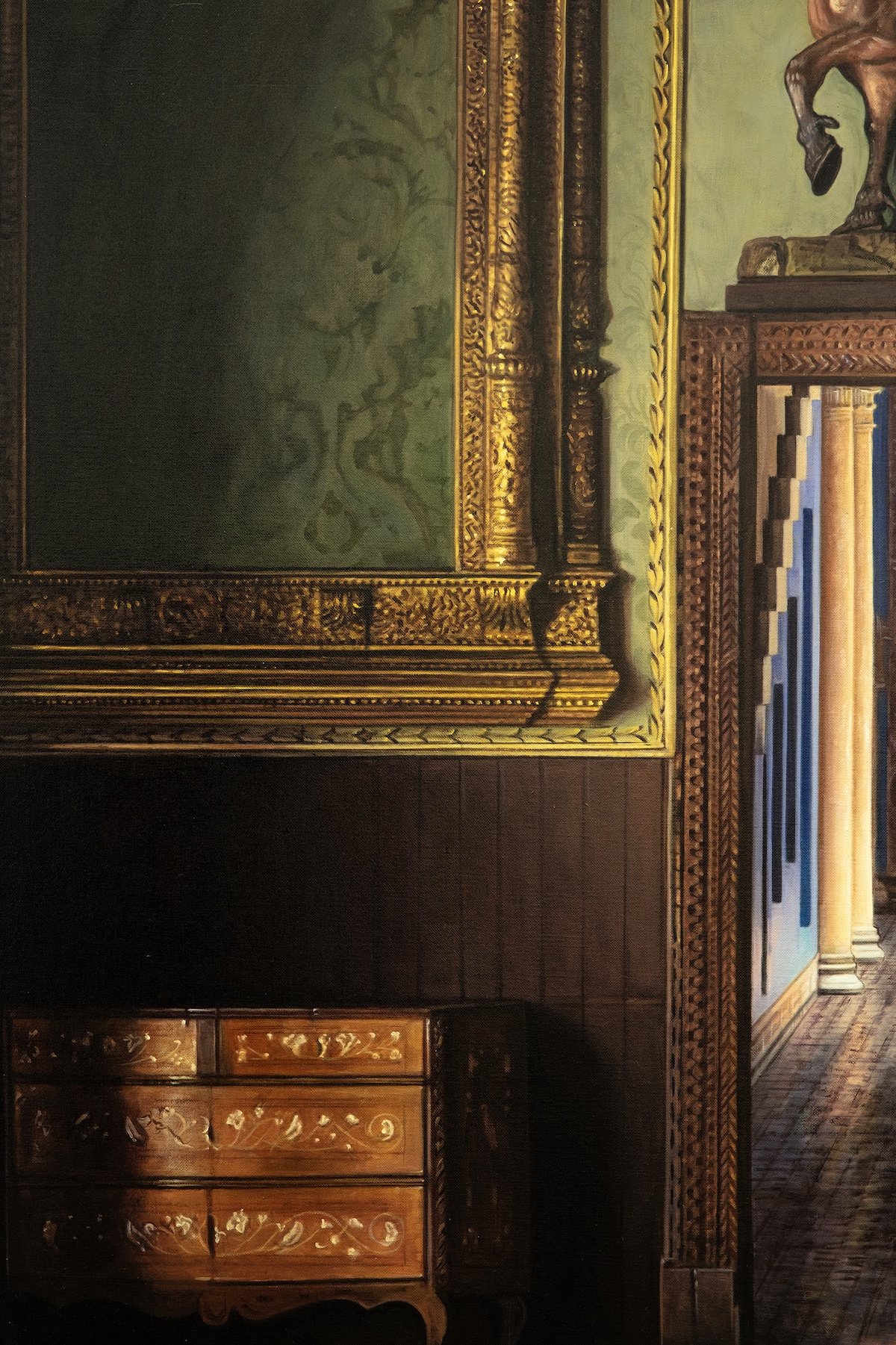 Marc Dennis, The Presence of Absence (detail), 2026. Oil on linen. 54 1/2 by 71 inches. © Marc Dennis. Photo: Daqi Fang. Courtesy of Harper’s, New York.
What remains is what Kant called a parergon, the frame that is supposed to stand outside the work. Derrida spent the better part of a long essay arguing that the frame never quite knows which side it’s on. Dennis makes the point with one canvas. The Archduchess has been dismissed; her frame keeps its post. Inside it, in the place of the ergon, the damask of the museum wall continues in shades of sage, and the frame confers on it the authority of a picture, as if by a Duchampian move. The means, however, are the least Duchampian imaginable. Duchamp turned against retinal painting, Rodchenko declared painting finished in 1921, and Mondrian carried it toward an abstraction that Pollock would complete. A century of obituaries later, Dennis paints every thread of the damask, as though the news never reached him.
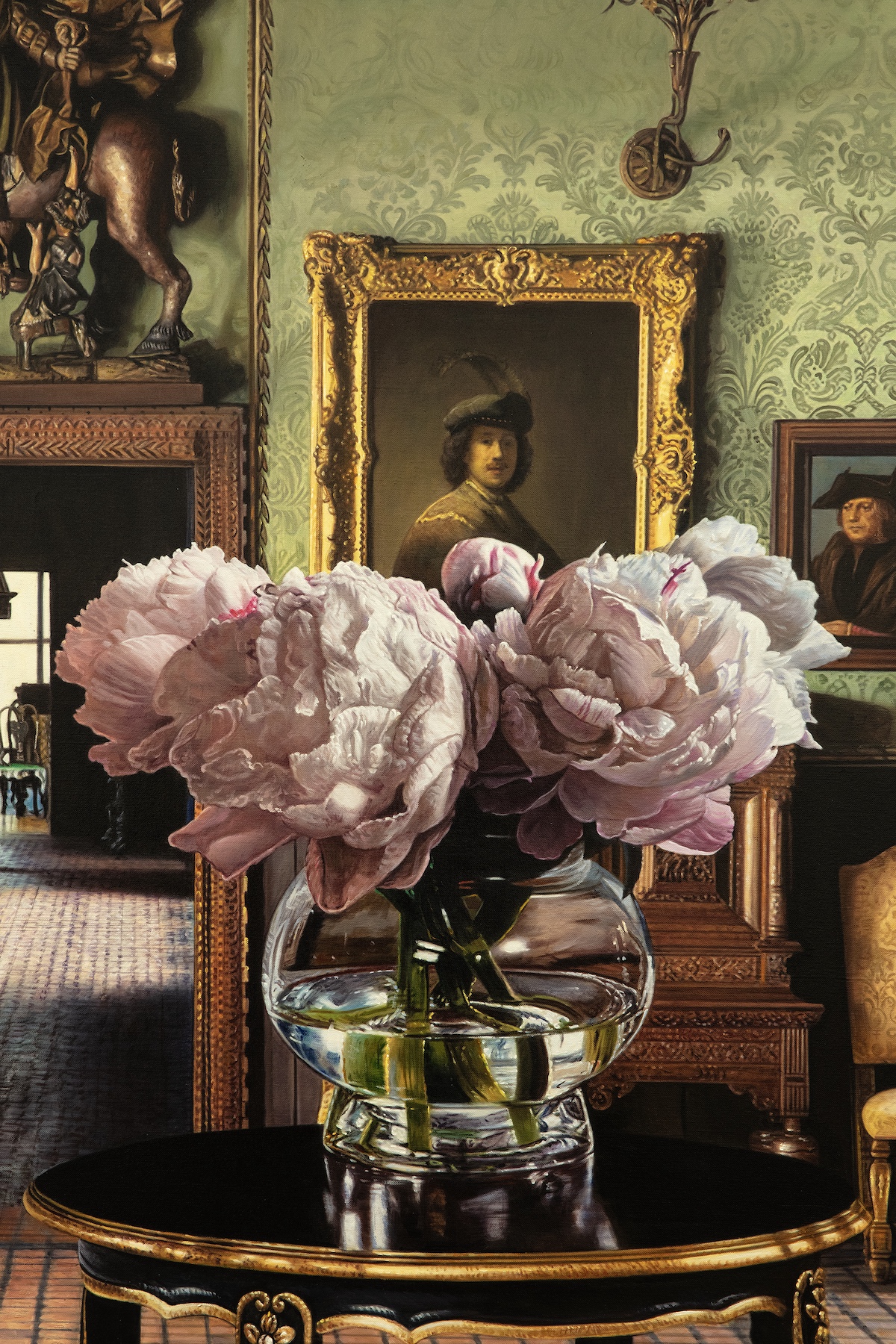 Marc Dennis, The Presence of Absence (detail), 2026. Oil on linen. 54 1/2 by 71 inches. © Marc Dennis. Photo: Daqi Fang. Courtesy of Harper’s, New York.
In the Gardner canvas, every petal has its own edge. The carved relief, the gilded frames, and the lacquered table each hold light differently. The focus never falls off. The peonies in front and the farthest room are equally sharp, which no lens would allow. Light enters from the right and leaves the left wall in shadow. It runs along the gilt moldings and catches the brass sconces, whose candles stand unlit. Beyond the doorway, a passage of columns leads to a window. Daylight runs back along the floor toward us, as through the open door of Pieter de Hooch’s A Woman with a Child in a Pantry. The bowl recalls the lit glass vessels of Jan Davidsz de Heem, where stems show through the water. De Heem sets his vases against darkness. Dennis sets his in the room’s own light. The water refracts the stems, bending them at the waterline.
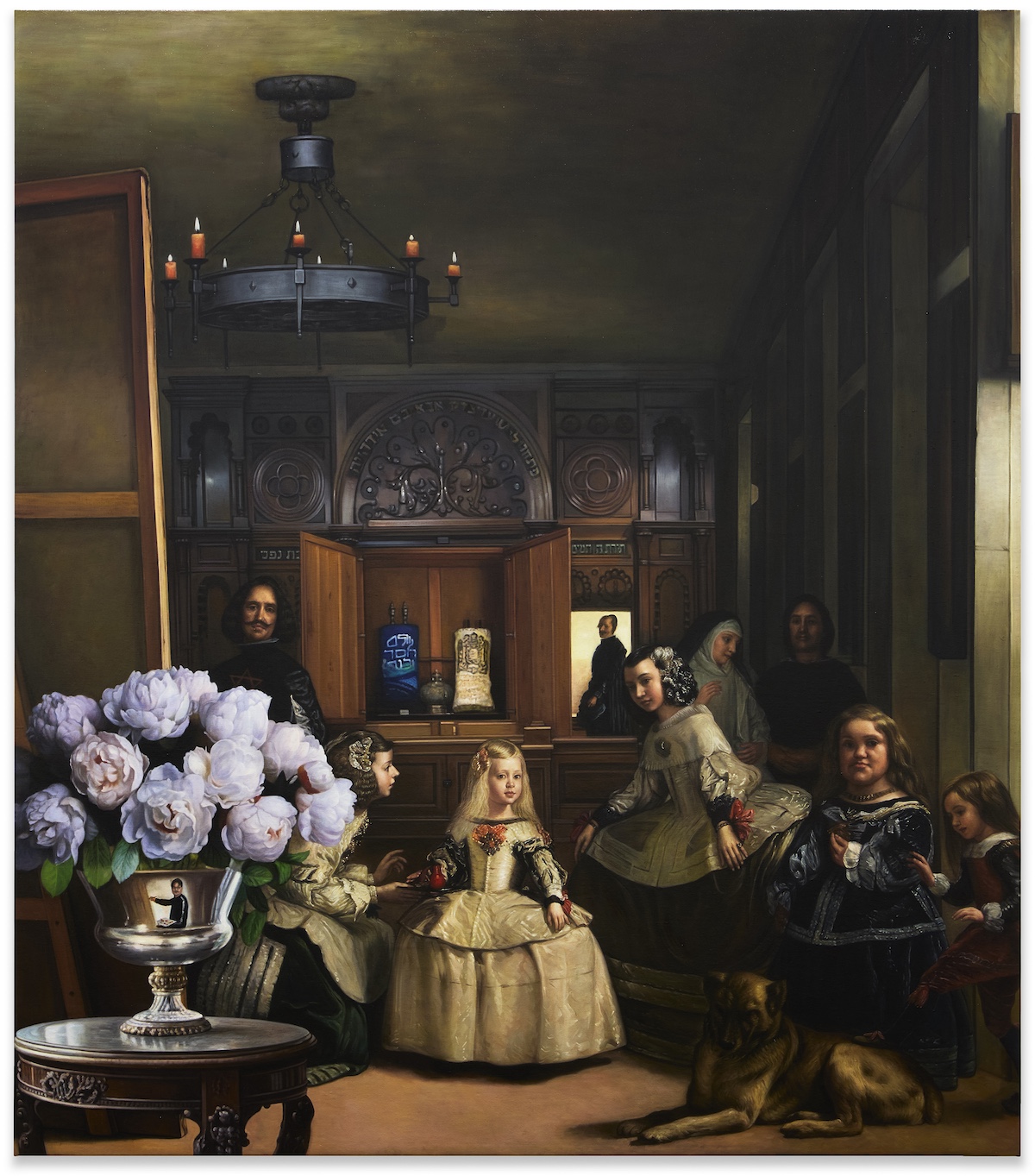 Marc Dennis, Las Bat Mitzvah, 2026. Oil on linen. 87 by 77 inches. © Marc Dennis. Photo: Daqi Fang. Courtesy of Harper’s, New York.
In Las Bat Mitzvah, Dennis repaints Las Meninas and changes its back wall. Where Velázquez hung the mirror that shows the king and queen, a carved Torah ark stands open, its scrolls in view. Spain had expelled its Jews in 1492. At the back, José Nieto, the queen’s chamberlain, still stands in the lit doorway. Dennis repeats that silhouette in the foreground. On a silver vase of peonies, he appears in the curved metal, this time as himself, at work, observing us.
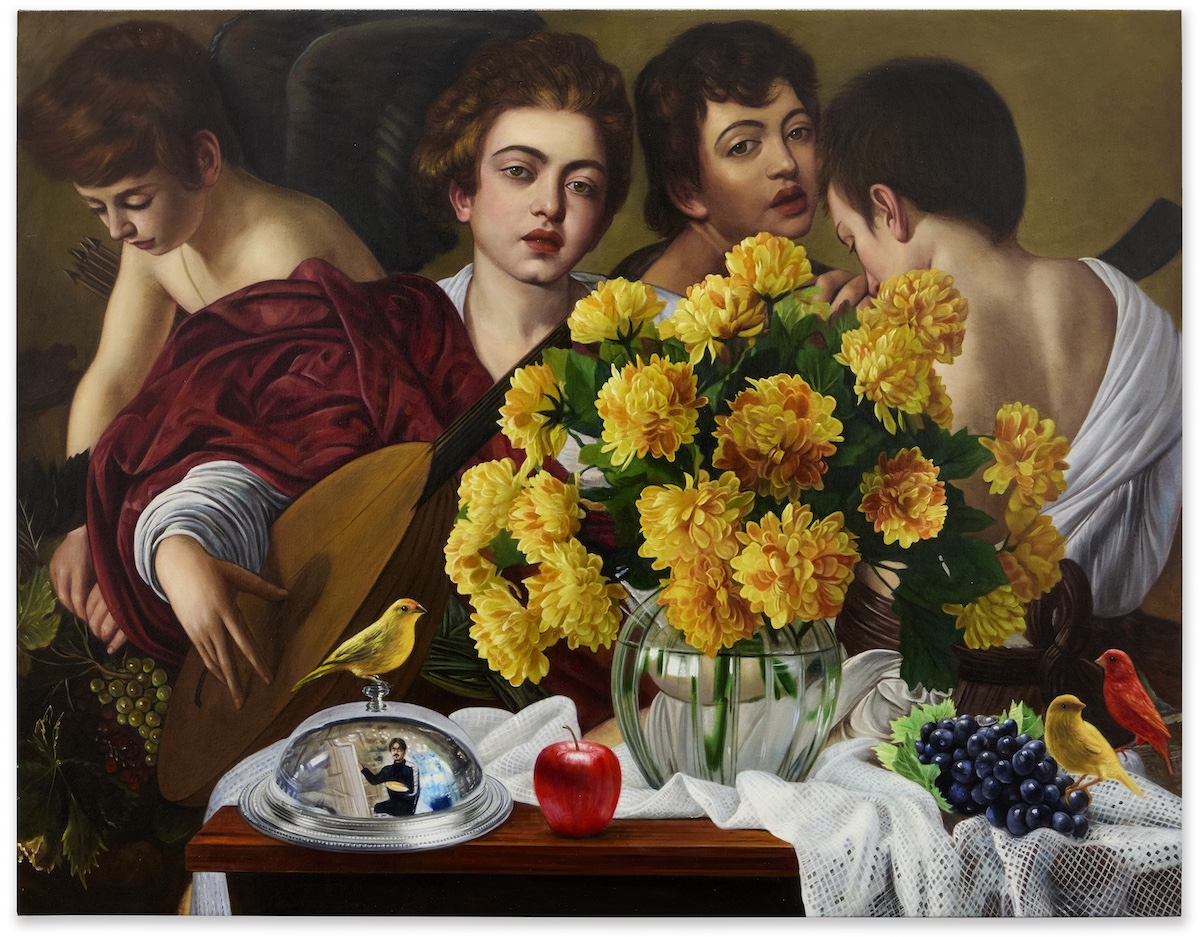 Marc Dennis, Caravaggio’s Canary, 2026. Oil on linen. 36 1/2 by 47 inches. © Marc Dennis. Photo: Daqi Fang. Courtesy of Harper’s, New York.
In Caravaggio’s Canary, Dennis repaints the Metropolitan Museum’s The Musicians (about 1595) with photographic fidelity, then changes its foreground. Caravaggio’s sheets of music give way to a still life that seems to have arrived from a mall: a red apple, a bunch of grapes, a glass vase of yellow flowers so pristine they look almost artificial, and a silver dome on a silver plate, polished to a pure mirror. In the dome’s curve, Dennis appears painting, palette in hand. His reflection echoes the figure second from the right, often identified as Caravaggio’s self-portrait. A yellow canary perches on the dome’s handle. Two more birds, one yellow and one red, listen from the lower right. The score has gone, yet the music has not.
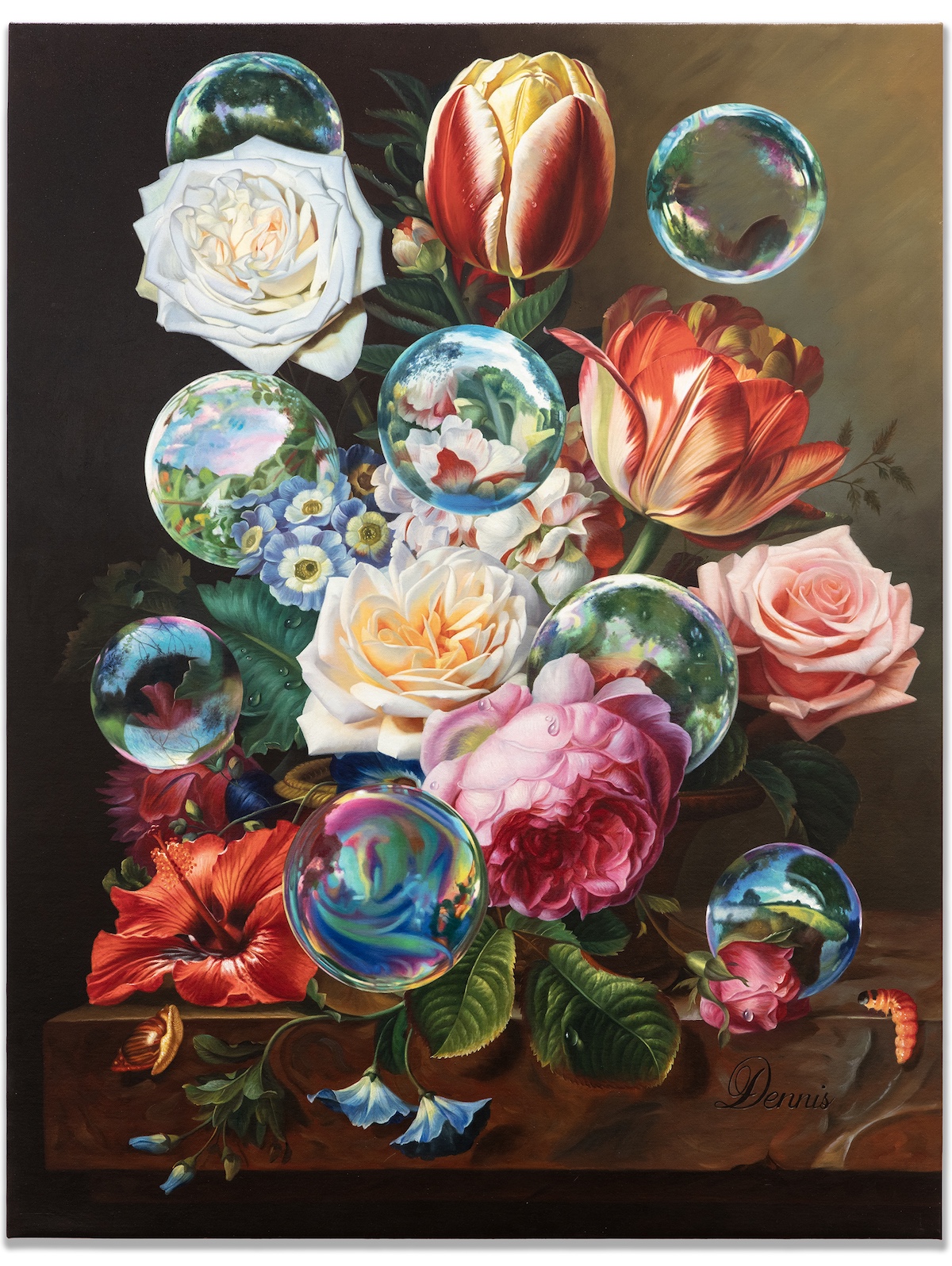 Marc Dennis, Where Love Goes, 2026. Oil on linen. 56 by 43 inches. © Marc Dennis. Photo: Daqi Fang. Courtesy of Harper’s, New York.
Flowers run through nearly every one of the fourteen works. Half a dozen are still lifes outright. Roses, some rare, are rendered with the exactness of the Gardner peonies. The color exceeds what a photograph can hold; not even a saturated Cibachrome is this bright. These flowers are fresher than flowers, as the Dutch masters’ were when they assembled blooms from different seasons into bouquets that never stood on any table. Among them Dennis sets reflective spheres. In Where Love Goes there are eight. They mirror what surrounds them, and some hold small, bent landscapes. The device recalls Caravaggio’s glass carafes, where a reflected window records the room in which the picture was made. Here the spheres multiply. One reflection is a witness; eight become a pattern. Unlike the silver vase and the silver dome, they bend the world and only rarely place anyone in it. They act as ornament and lens at once.
Two works bring in figures. In Jump, a blonde cheerleader leaps before a Dutch bouquet of peonies in a brass urn, her uniform lettered “ART,” her gold pompoms held out like two more blooms. On the ledge at the lower left, almost invisible at first, stands Dennis himself, no taller than a peony. In Celebration Day, a girl with very long hair stands with her back to us before a mountain of flowers and soap bubbles. Here the Dutch genre’s appetite meets American spectacle at its most mainstream. The pairing is coherent; the Dutch bouquet was the popular luxury of its day. Still, the figures break the quiet the other paintings hold.
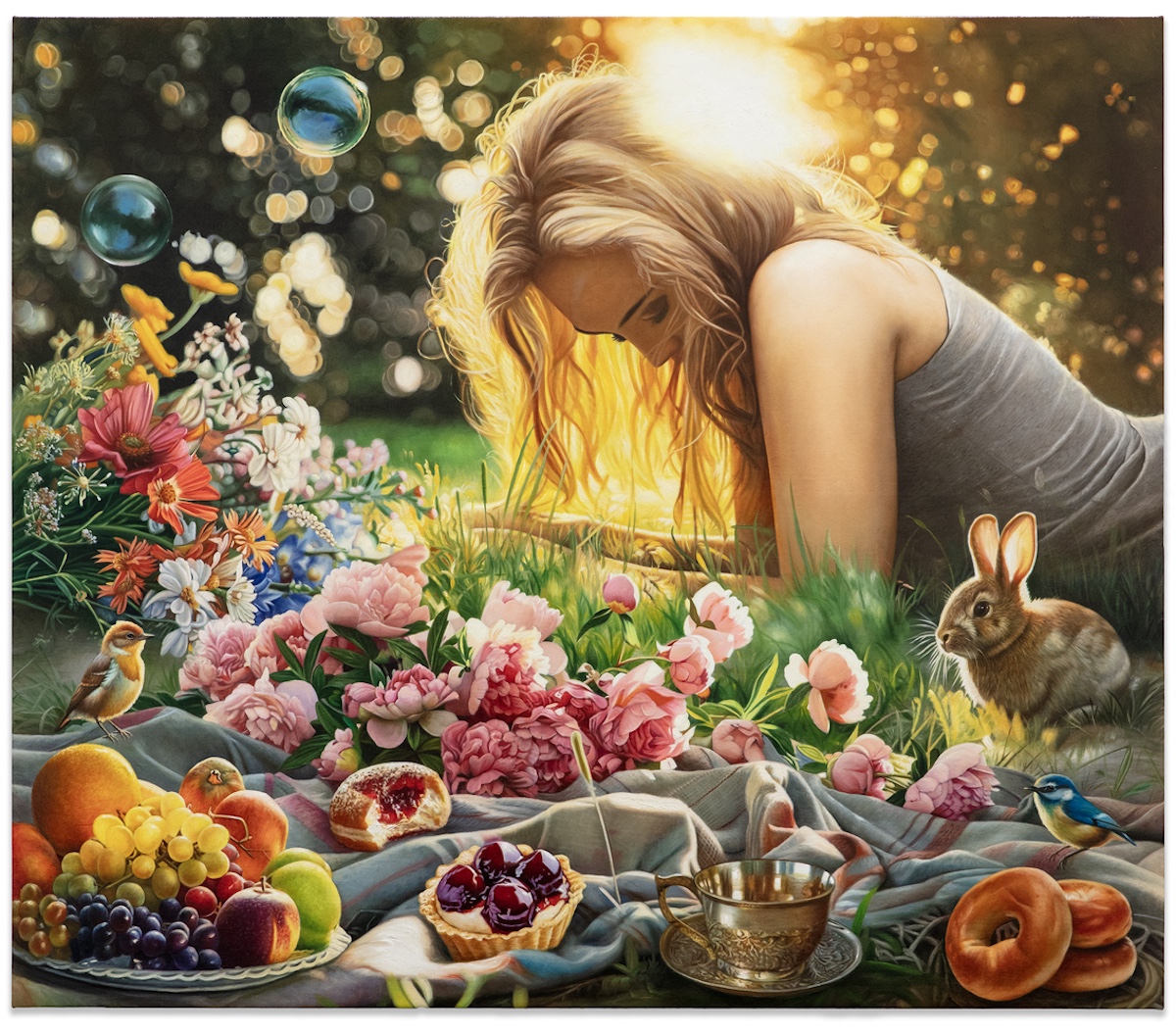 Marc Dennis, Luncheon on the Grass, 2026. Oil on linen. 52 by 60 inches. © Marc Dennis. Photo: Daqi Fang. Courtesy of Harper’s, New York.
Unlike the Velázquez and the Caravaggio, Luncheon on the Grass borrows Manet’s title, though not the painting itself. Manet painted a particular woman, Victorine Meurent, who looks straight at us. Dennis paints a type: a young woman lying on her front in the grass, eyes lowered, her hair lit gold by a low sun behind her. Manet’s spilled picnic returns as a full spread: grapes, a cherry tart, a bitten jelly doughnut, a silver cup, and a stack of bagels. A live rabbit sits at the right, and two small birds perch on the blanket. Two soap bubbles drift above the flowers, the Dutch emblem of a life that bursts. Behind her the light breaks into soft discs, the blur of an out-of-focus camera, imitated by hand. This is descriptive excess: even the blur is described. The picture’s surplus asks only to be aesthetically consumed, like sugar on the tongue.
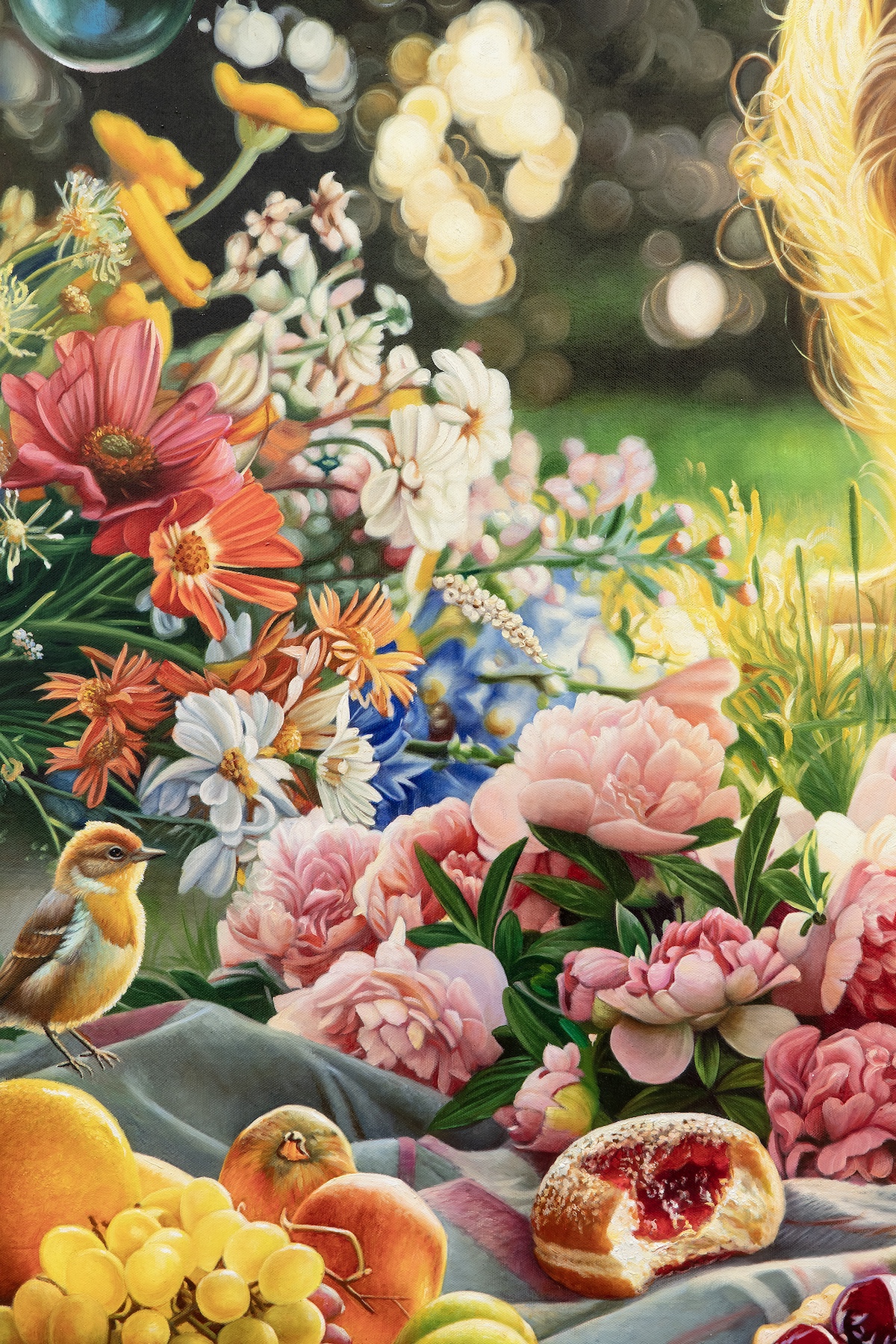
Marc Dennis, Luncheon on the Grass (detail), 2026. Oil on linen. 52 by 60 inches. © Marc Dennis. Photo: Daqi Fang. Courtesy of Harper’s, New York.
Much of this is tongue-in-cheek, as it is meant to be, and as Duchamp once made literal in his 1959 self-portrait With My Tongue in My Cheek, a pencil profile with a plaster cast of his own cheek. The painter turns up as Hitchcock turned up in his films, curved in silver or no taller than a peony on a ledge, while doughnuts are bitten, ice cream melts, birds hold their ground beside the bagels, and a title like Las Bat Mitzvah puns across languages and centuries. The humor extends to the show’s own setting: Dennis paints the world his paintings inhabit, its masterpieces and luxury goods, its openings and its buyers, and places himself and his public within it, a little absurd, a little vain, and entirely at home.
The painter among his public has its precedents. Velázquez painted himself at work among the court, and Courbet, in The Painter’s Studio, set the artist at the center of his world; photography carried the device forward in Cindy Sherman’s costumed Old Masters, Yasumasa Morimura’s Las Meninas, and Jeff Wall’s Picture for Women, where Wall stands reflected beside his camera in a mirror borrowed from Manet. Dennis returns it to oil on linen, where the camera’s effects must be made patiently, by hand.
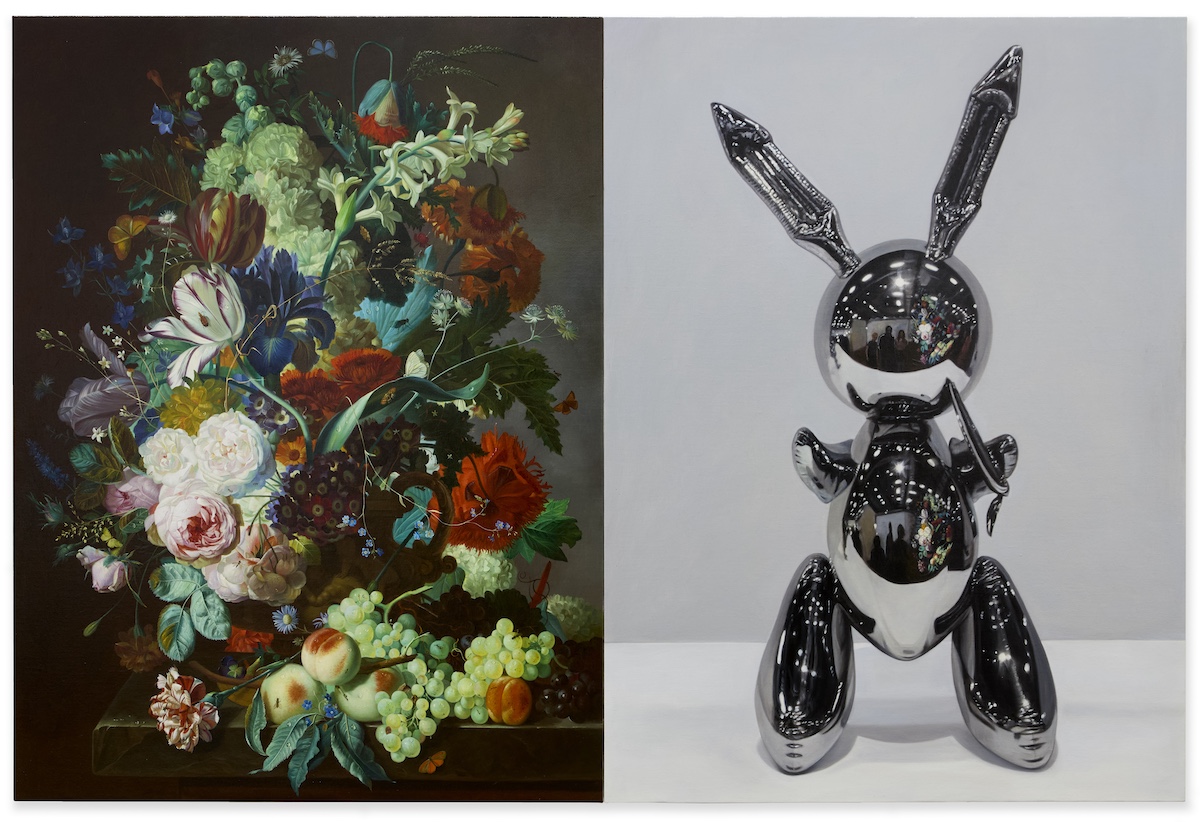 Marc Dennis, The Old Master and the Rabbit, 2026. Oil on linen, diptych. 49 by 73 inches overall. © Marc Dennis. Photo: Daqi Fang. Courtesy of Harper’s, New York.
Across the show, the reflections form a pictorial taxonomy: the spheres often return spaces, empty or inhabited, near and far, while the silver vase and the silver dome return the painter. Like Masson’s panel, the dome is a cover, a subterfuge that keeps whatever lies beneath it unseen. In The Old Master and the Rabbit, Dennis paints Jeff Koons’ stainless-steel Rabbit beside a Dutch flower still life. In the painter’s place, the rabbit’s steel returns an illusion of the gallery itself, its ceiling crowded with floodlights, the visitors reduced to dark silhouettes. Beside them, the still life from the facing panel is caught at least twice, warped by the rabbit’s pneumatic body, in full color. Velázquez gave the mirror at the back of Las Meninas to the king and queen, standing where the viewer stands, and painted them as a courtier would; Dennis gives it to the gallery, its visitors, and the proximate and distant histories of art, and paints them as a camera would, and as no camera could. WM
Marc Dennis: Sugar on My Tongue
Harper’s Chelsea 512
September 10–October 24, 2026

Raphy Sarkissian
Raphy Sarkissian received his masters in studio arts from New York University and is currently affiliated with the School of Visual Arts in New York. His recent writings on art include essays for exhibition catalogues, monographs and reviews. He has written on Rachel Lee Hovnanian, Anish Kapoor, KAWS, David Novros, Sean Scully, Liliane Tomasko, Dan Walsh and Jonas Wood. He can be reached through his website www.raphysarkissian.com.
view all articles from this author