Whitehot Magazine
October 2026
"The Best Art In The World"
"The Best Art In The World"
October 2026
Ian McMahon at Wolfhouse: A Persuasive Pairing of Objects and Space
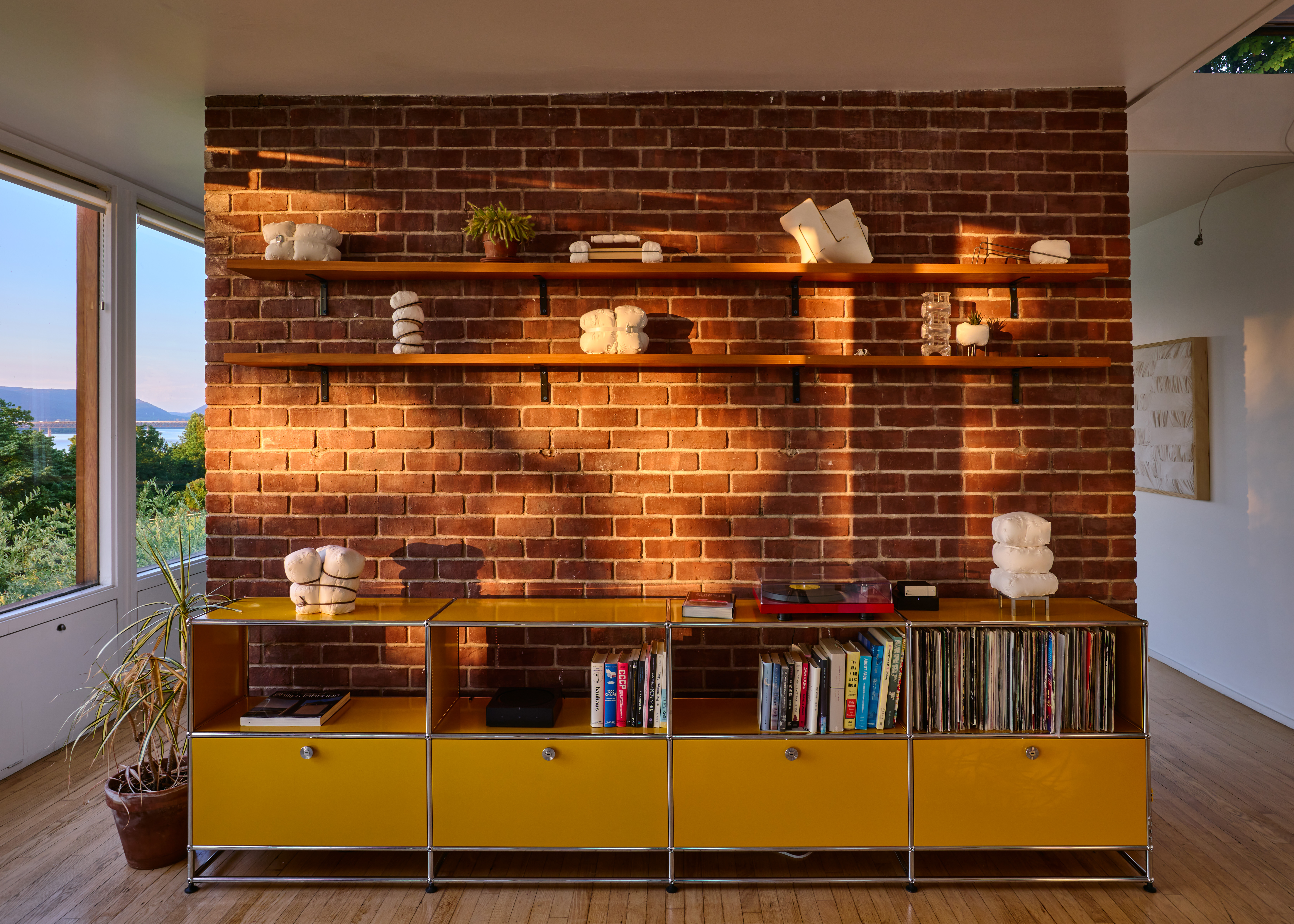
Installation view of IMA at Wolfhouse, 2026. Photo credit: Joshua Simpson
By KRISTINA ANDERSSON BICHER August 18, 2026
Innovation and novelty fuel the art world. And I’m all for thinking outside the cube: the museum in an elevator shaft or art sold out of a U-Haul. But sometimes, nothing satisfies like a coolly considered aesthetic synthesis: the right objects in the right space (to paraphrase Samuel Coleridge’s definition of poetry). Such is the pleasure of IMA at Wolfhouse, an exhibition of three dozen intriguing works by Newburgh-based sculptor Ian McMahon installed throughout a local Philip Johnson residence.
McMahon’s restricted palette of materials (mostly plaster, steel, and shrink wrap) and color (predominantly white, with black and brown accents) as well as his tightly associated family of forms result in a harmonious throughline. His works fit well in this minimally furnished home of white walls and abundant light, bisected by a single red brick wall. Such cohesion would have gratified Johnson, who prized unity within and without.
Sculpture and furniture by McMahon can be found everywhere in this low-slung, cedar-clad residence: hung on walls and over beds, on the floor and atop shelves. Commissioned by Benjamin Wolf, the house was built by Johnson in 1949, the same year he completed The Glass House. Wolfhouse boasts a span of some fifty feet of relatively uninterrupted plate glass facing the Hudson River. Since the 6 ½-foot-tall windows rise nearly to the roofline, the ceiling effectively disappears and visitors are immersed in trees, sky, rolling hills, and water.
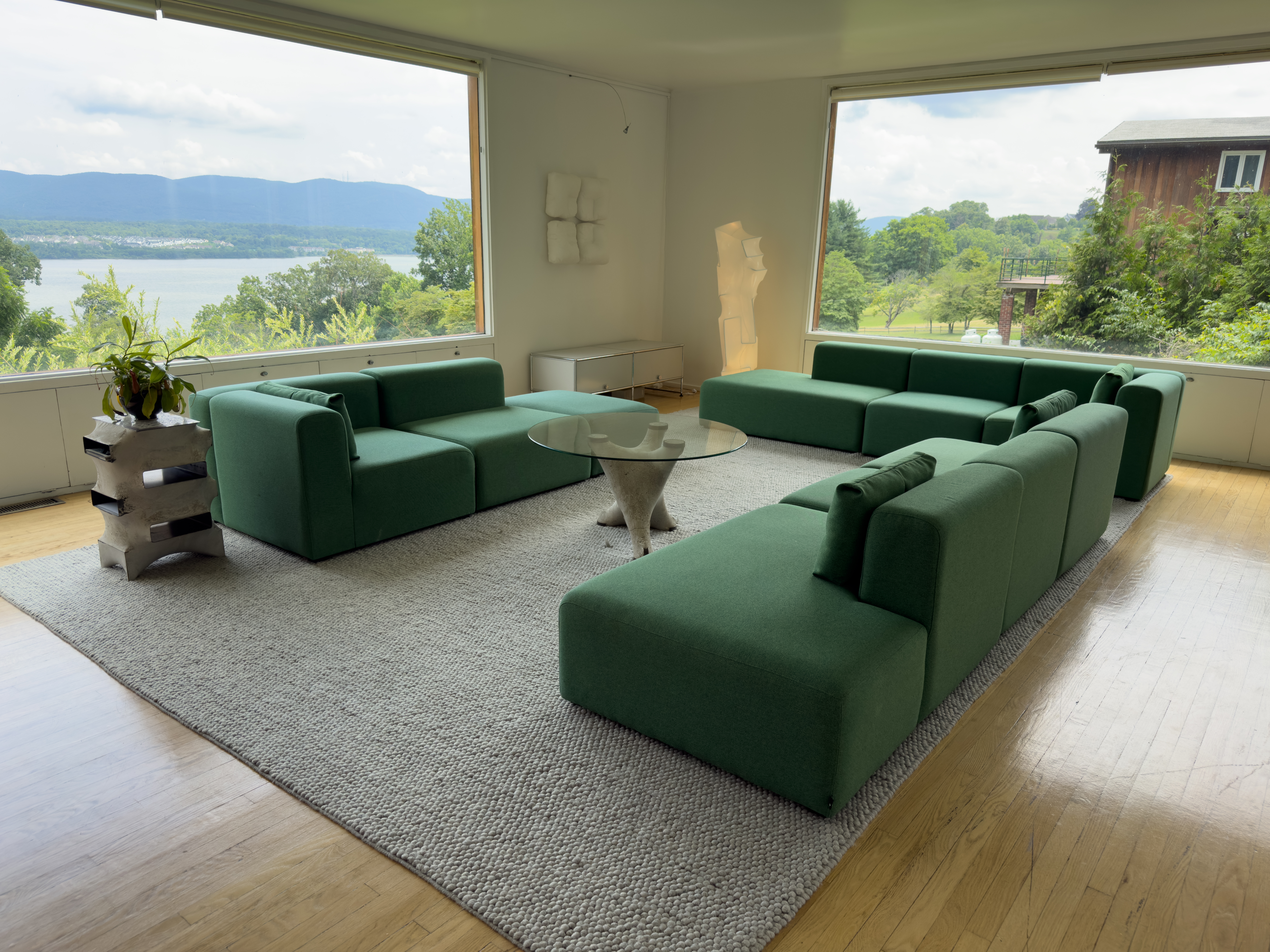 Installation view of IMA at Wolfhouse, 2026. Photo credit: Ian McMahon
Following an extensive renovation by previous owners from 2020 to 2023, Wolfhouse changed hands at the start of 2026 with a public-facing mission centered on a variety of activations. According to Creative Director Shawn Tang, “After seven decades of closed doors, we’re opening Wolfhouse to contemporary art and culture through dinners, exhibitions, film screenings, music sessions, and more. Most major mid-century homes in this country stay private, but we want this one enjoyed by everyone. We want to have the house build meaningful dialogue with the people who walk through it.”
Newburgh is well-located for visitors, smack amid a buzzy Hudson Valley art scene that’s witnessed a dramatic influx of artists, collectors, and admirers in the post-COVID era. To wit, the local Upstate Art Weekend (UAW) has mushroomed since its inception and this summer included some 160 participating organizations from barns and studios to established players like Olana and Magazzino. Wolfhouse’s inaugural installation (curated and produced by Zoë Burge Dayman and Lucy Dayman) was not affiliated with UAW but would have been an apt addition.
While the house provides the frame, the artwork brings the drama. The unexpected juxtaposition of form and material creates a little rush, that body-joy that sculpture can elicit. McMahon repeatedly gives rigid materials the language of softness: curves, folds, dimples, and twists. The works occupy a middle ground between geometric and organic forms. Plaster pieces read as puffy rectangles or squares, with puckered seams like a sack of flour or indentations like a mattress. Tabletop sculptures are composed of stacked forms, sometimes confined by metal bars or cinched with a band but always seeming squeezed, pushing against their boundaries. The shapes appear more familiar than they are and don’t conform to expected size or proportions. McMahon’s shrink wrap sculptures are more free-form; they feature concave curves that suggest some sort of implosion has drawn the material taut against the edges of the metal armature.
Across these works, something always seems to be pressing outward or pulling inward. That tension, that embodied gesture, results from processes developed over many years. McMahon spray-casts thinned industrial plaster on the inside of inflated molds; elsewhere, he covers bent metal elements with boat-grade shrink wrap and applies heat until the plastic contracts and the metal protrudes like bones beneath skin.
The finish of his plaster sculptures is especially pleasing. Fine grains of gypsum and silica create a smooth, uniform surface that plays happily with light, appearing chalky and raw in harsh light or glowing like marble in lower light conditions. Less refined in appearance, the shrink wrap still possesses an appealing translucence McMahon sometimes exploits by embedding light bulbs inside the works.
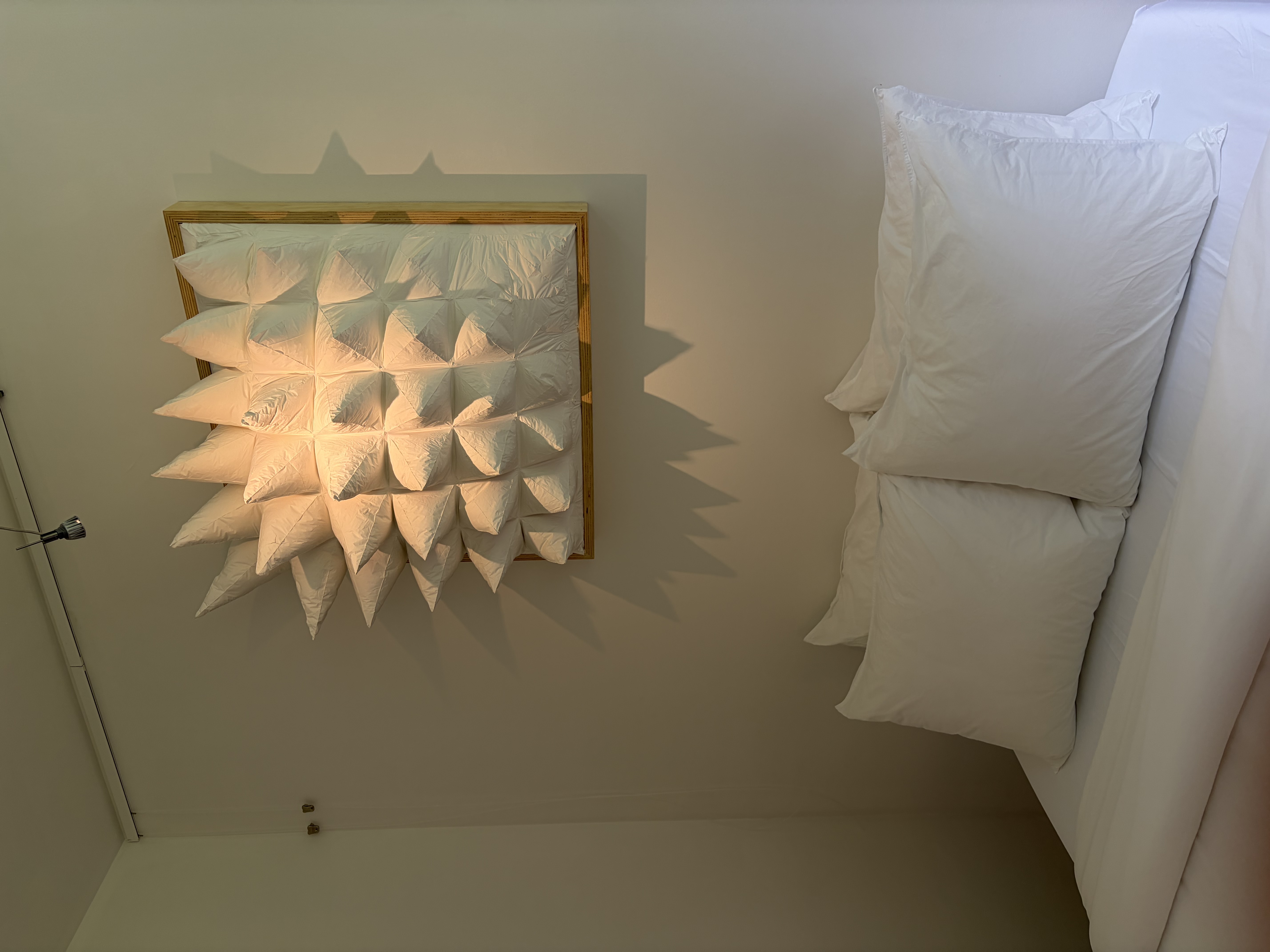
Installation view of IMA at Wolfhouse, 2026. Photo credit: Kristina Andersson Bicher
Pushing materials as far as they can go is what drives McMahon. As a ceramics major at Alfred University, he was initially obsessed with making large, unfired clay installations but came to feel that the kiln “stole the life from the clay.” He later turned to industrial plaster, fascinated by how it’s both rigid and malleable, how it hardens without heat. McMahon also became hooked on plaster’s combination of tensile strength (“even the thinnest veil can hold its weight”) and its “remarkable fidelity on the tiniest of scales. Every micro-indentation can be seen.”
Unlike the more common trajectory from small pieces to large, McMahon began on a monumental scale with works that incorporated existing architecture as an artistic element. Because of their massive size and built-in nature, these works could not be deinstalled; they had to be destroyed by hand, a process that further deepened McMahon’s understanding of his material’s properties.
One of McMahon’s large-scale experiments even pushed beyond what structural engineers thought possible. At a Seattle installation venue in 2014, McMahon fabricated two huge freestanding plaster curtains, each 19 feet tall and 50 feet wide. Just last year, he created Portico, a huge plaster bubble pushing out through the wooden porch of an empty 1830s Newburgh home, ballooning above and between the railing and balusters.
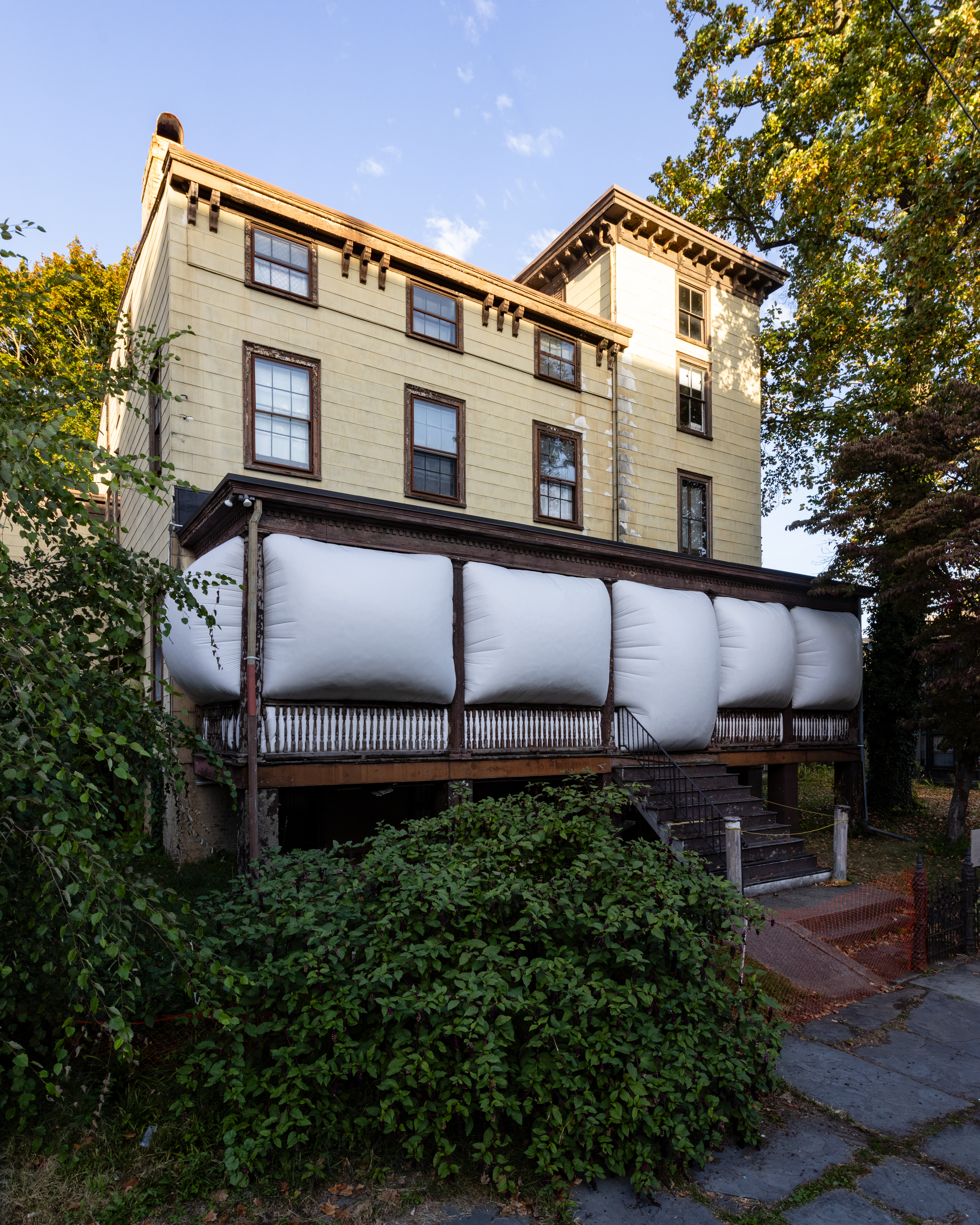
Installation view of Portico, 2026. Photo credit: Joshua Simpson
While his more monumental pieces (including his recent 2026 show at the Catskill Art Space) make scale and volume themselves part of the encounter, the smaller, more domestically sized sculptures on display at Wolfhouse create a sense of intimacy. As Tang puts it, “The work is in perfect harmony with the house: no disturbance, no grappling for attention, just coexistence.”
McMahon currently has more ideas (“so many, it’s untenable!”) than time. Says the artist, “I’m unabashedly excited.”
IMA at Wolfhouse is on view from July 9 until August 19, 2026.

Kristina Andersson Bicher
Kristina Andersson Bicher is the author of Heat, Sob, Lily (MadHat Press, 2025) and She-Giant in the Land of Here-We-Go-Again (MadHat Press, 2020), as well as translator of Swedish poet Marie Lundquist’s full-length collection I walk around gathering up my garden for the night (Bitter Oleander Press, 2020). Her poetry appears in such literary journals as AGNI, Ploughshares, Hayden’s Ferry, Plume, and Narrative. Her translations and nonfiction have appeared in The Atlantic, Brooklyn Rail, Harvard Review, Asymptote, and Writer’s Chronicle, among others. She holds an MFA from Sarah Lawrence College and an MA in Contemporary Art from Sotheby’s Institute of Art.
view all articles from this author