Whitehot Magazine
November 2026
"The Best Art In The World"
"The Best Art In The World"
November 2026
Cindy Craig and Leigh Salgado at Launch LA Gallery: Wickedly Funny Perspectives on Femininity and Female Stereotypes
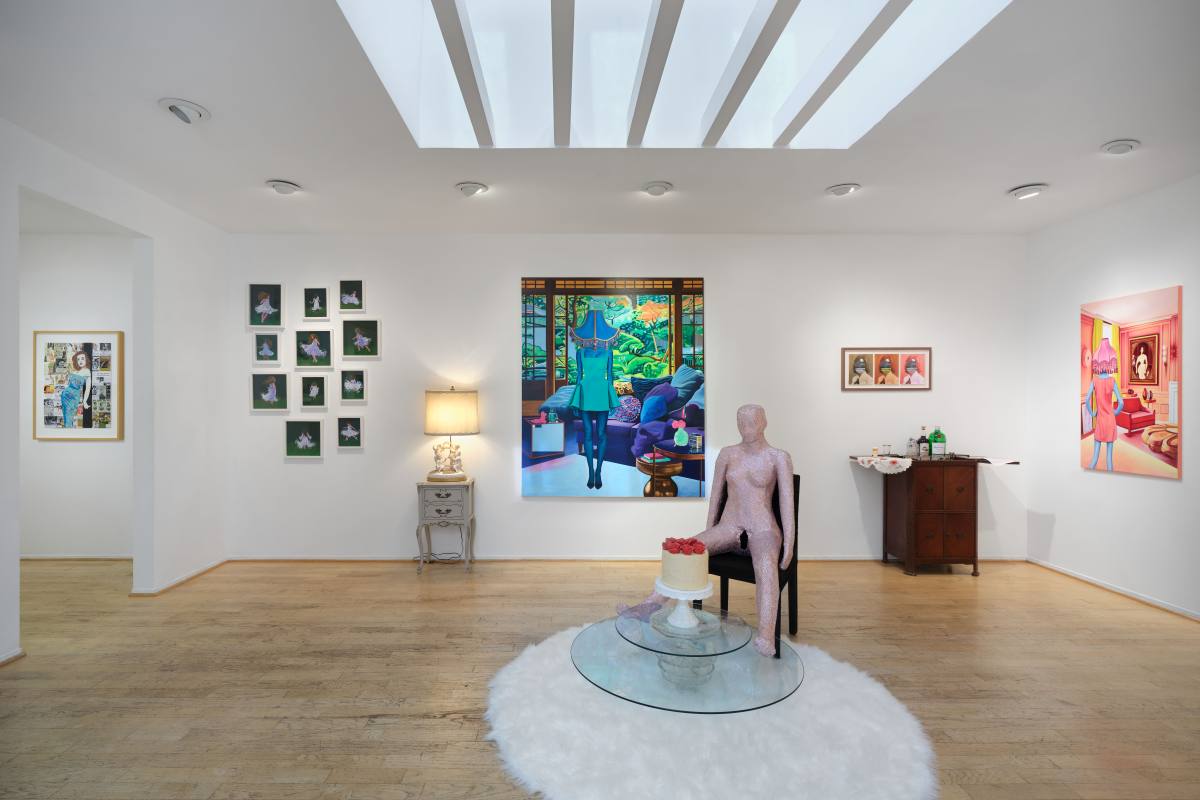 Cindy Craig 2026, Installation view, “Weeping Women” Photo credit Paul Sevlas,
courtesy of Launch LA
By Lita Barrie, Los Angeles, November 11, 2026
Two concurrent solo exhibitions by Cindy Craig and Leigh Salgado at Launch LA use irreverent humor as a tactical tool for feminist art, demonstrating that the subversive potential of women’s laughter is more effective than polemics. Craig explores the systemic absurdity of outdated gender roles and Salgado creates her own unique female language of girly lingerie to show that femininity is empowering. Paired together, these dual exhibitions are a new chapter in the conversation about feminist art—that is fun to behold and sparks immediate joy, rather than solemn contemplation.
Craig’s multimedia exhibition Weeping Women explores the frustration women feel beneath the feminine masquerade of conforming to the oppressive domestic roles of perfect 1950s housewives. Two large candy-colored acrylic paintings of women as standing lamps embody the psychological stress caused by the crazy-making contradiction between women’s desire to please men by being perfect, decorative and servile and the sorrow of feeling misunderstood. Craig shows the sharp contradiction between their external appearance and internal emotions—the seen and unseen—in this masquerade by turning them into hilarious furniture with lampshades covering their heads that obliterate their real identity.
In Women as Pink and Fuchsia Decor, a slender woman in a sexy mini sheath dress is viewed from behind with her arms placed assertively on her hips in exasperation as she looks at a large painting of a Victorian woman primly dressed in a corset posed in a luxurious living room. Is she wondering how far she has come? Or is she exasperated that she is still subjugated as a piece of furniture? In Woman as Green and Blue Decor, another woman posed as a standing lamp is viewed from the front with her arms stiffly by her side as though she is waiting for male approval to validate her existence. A large window view of natural trees behind her accentuates her dehumanization.
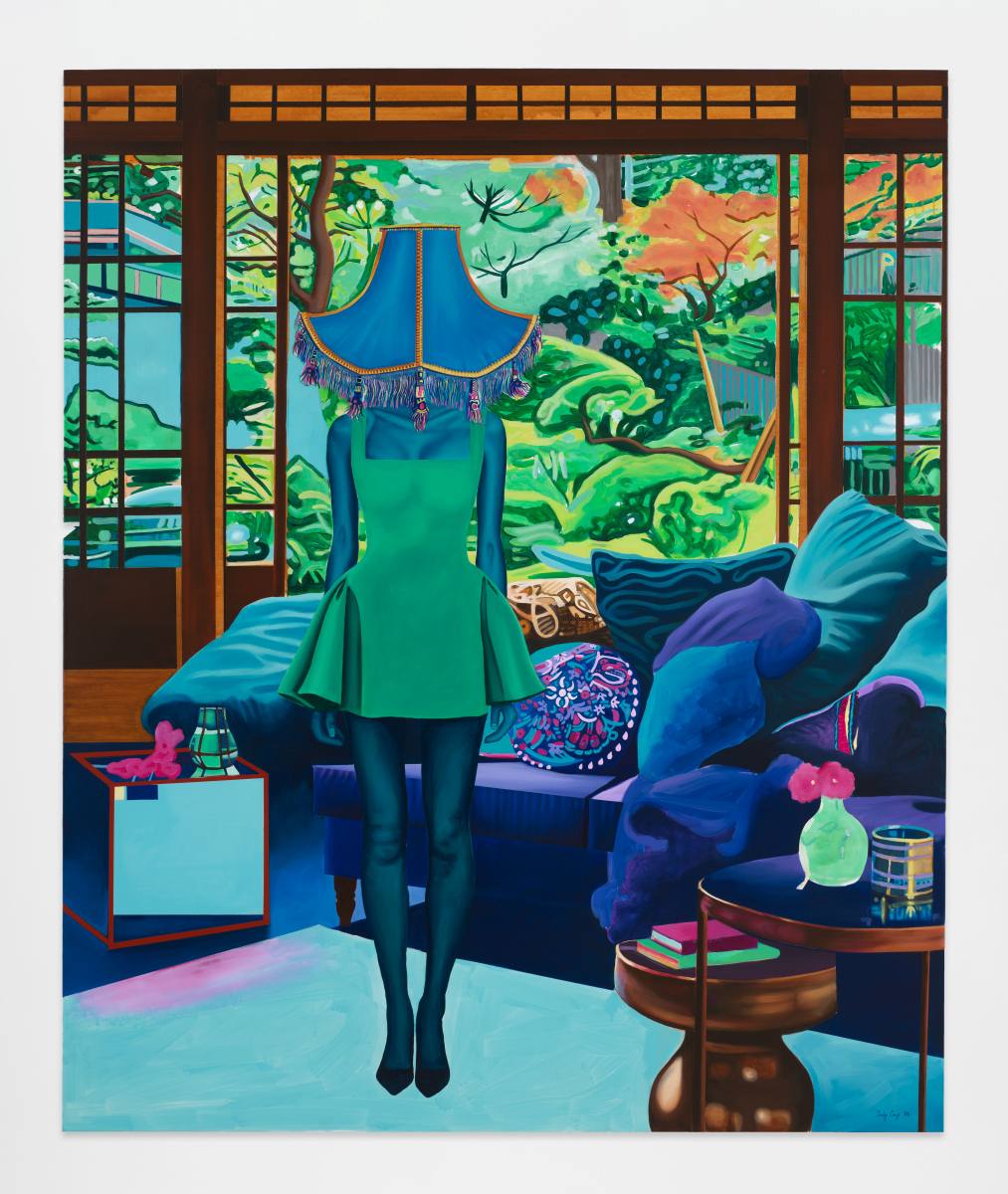 Cindy Craig 2026, Woman as Green and Blue Decor, Acrylic on canvas, 60” x 72”, Photo credit Paul Sevlas
She Baked a Cake is a life-size sculpture of a woman made from papier-mâché covered in thousands of rhinestones meticulously applied by hand with tweezers. The woman has a shockingly large gaping hole in her pelvic region and sits in a chair looking at a huge cake she has given birth to. The enlarged pelvic area is accentuated as a site of pleasure, pain and violation. The woman seems suffocated by the heavy jewels and her baldness is tied to vulnerability and mourning.
Behind this disturbing work, a series of small acrylics on paper feature a little girl running, jumping and dancing by herself for fun. The freedom of this frolicking little girl—which recalls Kim Dingle’s iconic bad girls Fatty and Fudge—is a statement about a time of innocence before the demands of the male-constructed vision of what women are supposed to be were imposed.
Craig told me that “art has been like a diary entry for me. Basically I’m a storyteller.” This exhibition unfolds like a tragic comedy about ludicrous chauvinistic demands and their heavy psychological toll on the female psyche. Nine collages show magazine clippings of brainwashing advertisements from the 1950s about getting a husband and the fear of losing him. Women are shown crouched on the floor serving their husbands below cringe-making slogans like “you won him now how are you going to keep him?”
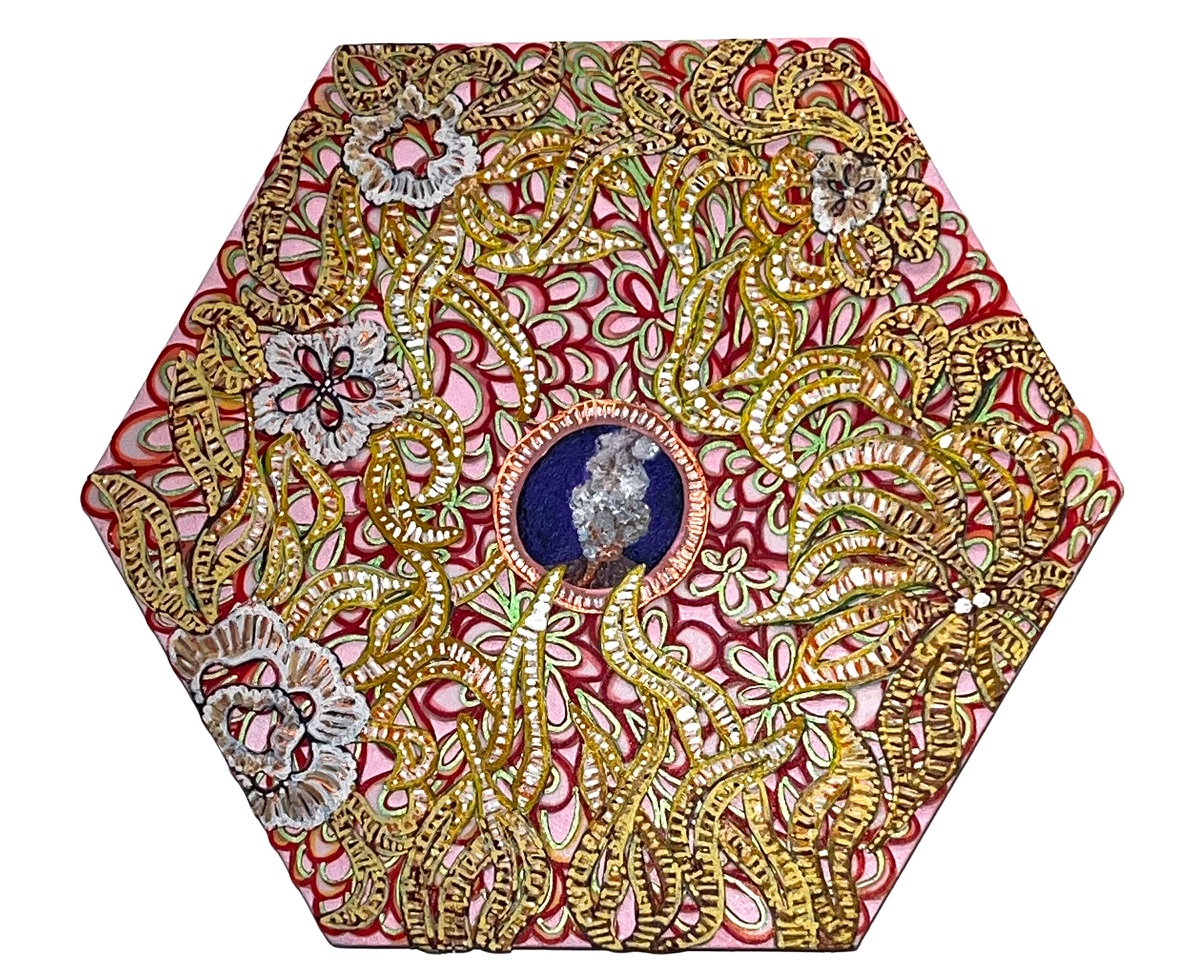 Leigh Salgado, Marguerite , 2026, Hand- cut paper with acrylic on wood, Hexagon, 6 x 6 7/8 inches
Salgado’s Small Eruptions celebrates girliness as self-expression, pleasure and female power. Over four decades she has unabashedly explored imagery of lingerie to reclaim lacy panties and bras as signifiers of the power of femininity which are also beautiful objects in themselves that cannot be trivialized as merely frivolous. Salgado addresses the voyeuristic pleasure men derive from lingerie and dismantles the power of the male gaze by shifting the perspective towards a woman’s unapologetic enjoyment of girly underwear. Salgado shows that female sexuality is empowerment rather than disempowerment by shifting the perspective from the male gaze to female tactile pleasure.
For Salgado, meaning resides in the making—in her choice of materials and methods.
Her labor-intensive artwork combines precision and obsession. Salgado’s innovative work process evolved naturally when she pulled out a huge piece of paper for doodling—just to free herself—and after she attacked it with a utility knife she felt an enormous emotional release. She says her work is “fueled by rage.” Salgado channels her rage in her laborious paper-cutting process by using a lethal utility knife—even though she has cut herself. Interestingly, she listens to baseball while she is working because she likes the aspect of not knowing where her actions might lead her. Salgado has created a unique signature style from intricate hand-cut paper, painted with paint markers and tiny brushes. She also draws on the Mexican papel picado and Chinese jianzi.
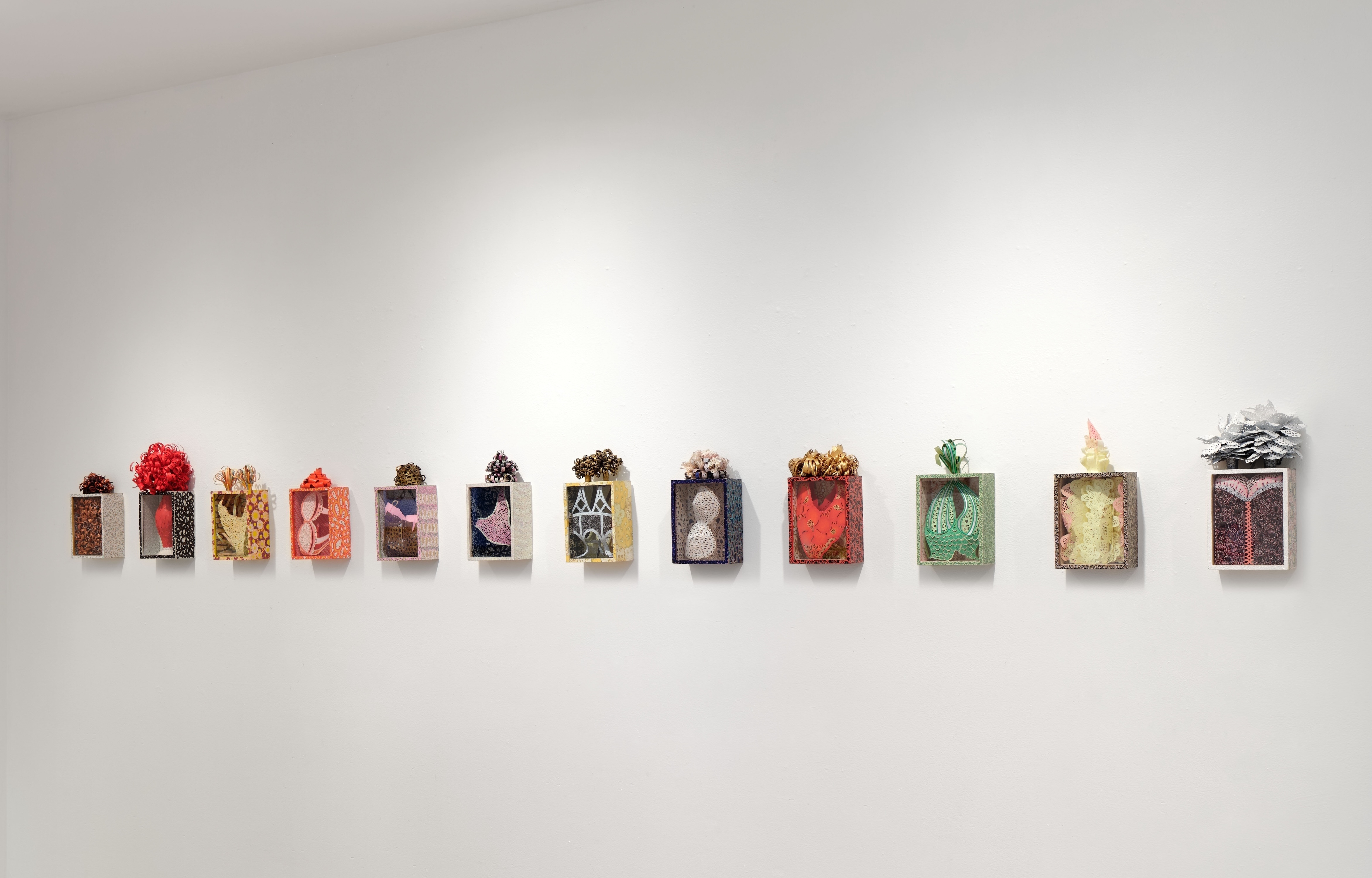 Leigh Salgado, Wall Boxes
In this exhibition Salgado uses small wall boxes fronted with acrylic which recall Joseph Cornell and Betye Saar’s glass-fronted shadow boxes. But instead of displaying mementos and found objects, Salgado uses meticulously painted wall boxes that encase lingerie imagery and lace-like patterns as a metaphor for psychological confinement and eruption. She attaches organic sculptural forms to the top of these ornate boxes that erupt like a Jack-in-the-box—as a witty sexual metaphor for feminine energy that cannot be contained. The small boxes are hung in a row which emphasizes the continuous juxtaposition of female fragility and dormant female power.
Salgado also explores small hexagonal shapes. Unlike the large shaped canvases that were the dominant form of abstract painting in the 1960s (used by Frank Stella, Ellsworth Kelly, Kenneth Noland and Jasper Johns) and grew out of the desire to move into real space, Salgado is interested in what she can do within the small scale with evocative fragile patterns and floral motifs—that allow viewers’ projections. This series of jewel-like canvases is also hung in a row for close viewing. The repetition creates a personal awareness of the artist’s hands—unlike the impersonal facade of monolithic male paintings.
Both Craig and Salgado make innovative art that has a radical authenticity because they have the courage to pursue what comes naturally to them.
Launch LA Gallery: Weeping Women / Small Eruptions
170 S. La Brea Ave, Ste. 202
Los Angeles, CA 90036
On View: October 17 – November 14, 2026

Lita Barrie
Lita Barrie is a freelance art critic based in Los Angeles. Her writing appears in Hyperallergic, Riot Material, Apricota Journal, Painter’s Table, ArtnowLA, HuffPost, Painter’s Table, Artweek.L.A, art ltd and Art Agenda. In the 90s Barrie wrote for Artspace, Art Issues, Artweek, Visions andVernacular. She was born in New Zealand where she wrote a weekly newspaper art column for the New Zealand National Business Review and contributed to The Listener, Art New Zealand, AGMANZ, ANTIC, Sites and Landfall. She also conducted live interviews with artists for Radio New Zealand’s Access Radio. Barrie has written numerous essays for art gallery and museum catalogs including: Barbara Kruger (National Art Gallery New Zealand) and Roland Reiss ( Cal State University Fullerton). Barrie taught aesthetic philosophy at Claremont Graduate University, Art Center and Otis School of Art and Design. In New Zealand, Barrie was awarded three Queen Elizabeth 11 Arts Council grants and a Harkness grant for art criticism. Her feminist interventions are discussed in The Encyclopaedia of New Zealand and an archive of her writing is held in The New Zealand National Library, Te Puna Matauranga Aotearoa.
view all articles from this author