Whitehot Magazine
August 2026
"The Best Art In The World"
"The Best Art In The World"
August 2026
Paul Chan, Bated Breath
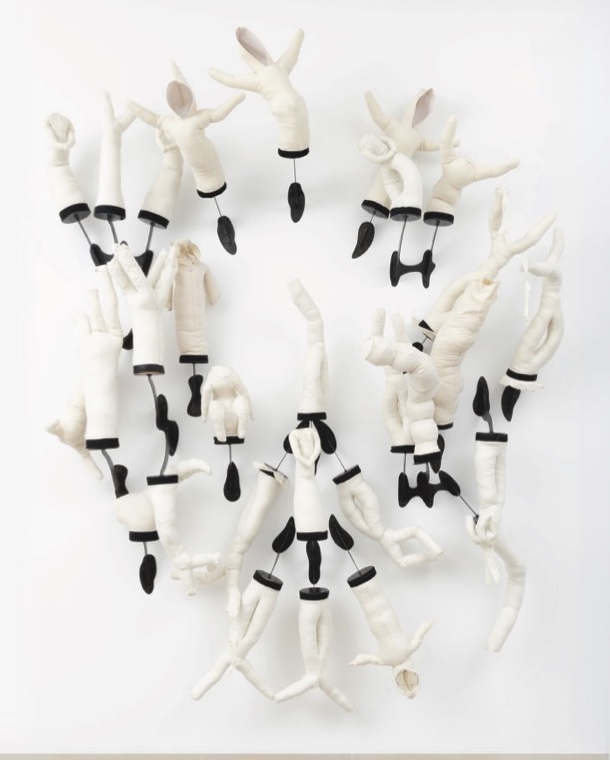 Paul Chan, Untitled (Wheel of Synth Life), 2026
By MIKE MAIZELS March 22, 2026
“Music: breathing of statues. Possibly: stillness in pictures. Speech where speech ends.”—Rainer Marie Rilke, 1918
Last week at Greene Naftali, artist Paul Chan opened Automa Mon Amour, a solo exhibition extending his long-running investigation of “breathers”— kinetic, pneumatic figurative sculptures that read as highconcept cousins to the familiar, flailing inflatables of car lots and discount storefronts. The show is classic Chan: visually pared down but conceptually dense, poised somewhere between stasis, volume, and motion. It will blow you away, but in a subtle register.
Perhaps the most striking work in the exhibition is Untitled (Wheel of Synth Life) (2026), a large figurative wall relief. Chan cites Buddhist mandalas as a source, though the energy feels closer to a baroque horror vacui—spirits and souls pressing outward, scrambling for release from the picture plane. The piece drips with seventeenthcentury allusion (if not illusion), a point Chan underscores in Too Spirituale! (after Leibniz) (2026). For Chan, “Leibniz’s automa captures the idea that what is genuinely selfpropelling and spontaneous is both mindful and spiritual in nature”—breath as inspiration, as ensoulment.
A different body of breathers appeared at the Walker Art Center. That exhibition, Paul Chan: Breathers, marked the artist’s first major U.S. museum survey in fifteen years and traced his return to artmaking after his selfdescribed “breather” from the art world in 2009. The show featured fanpowered, nylon fabric figures whose looping, animated movements evoke the tubepeople of commercial sidewalks while opening onto themes of vulnerability, interdependence, and play. Compared with the Walker’s bright, vinyl exuberance, the muslin figures at Greene Naftali feel markedly quieter—more strippeddown studies than spectacle, their animation reduced to a kind of conceptual murmur. The project also connected back to Chan’s turn toward experimental publishing during his hiatus—an interruption that seeded the ideas behind these new sculptural “movingimage” works.
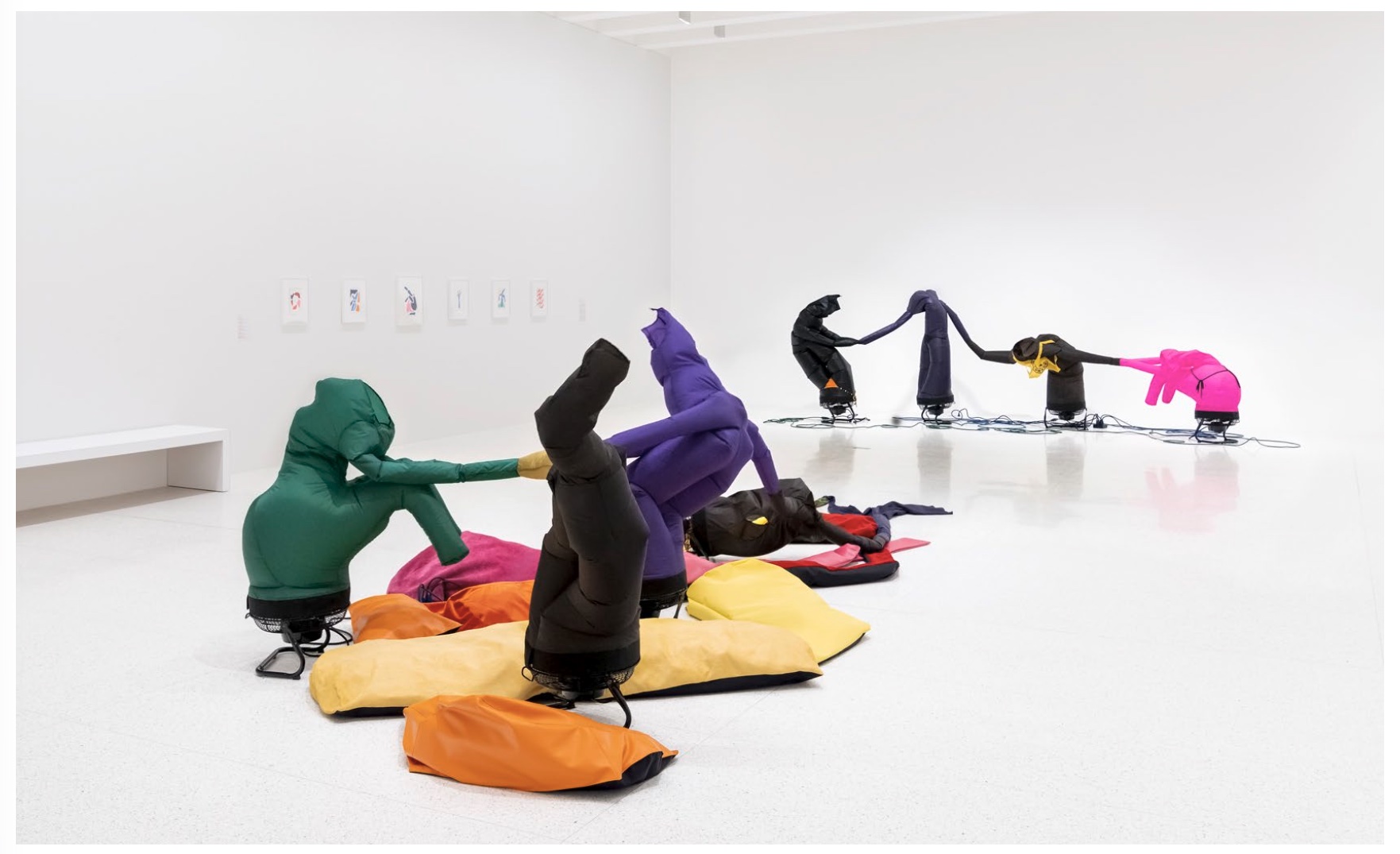 Installation view, Paul Chan: Breathers, Walker Art Center, Minneapolis, 2023
Chan’s “breathers” fall into a lineage that runs through Bruce Nauman and Mike Kelley, though he carries their ideas in a lighter register. From Nauman comes the sense that simple, repeated movements can act as a form of thought—gestures that test presence and perception. From Kelley, Chan inherits the mix of humor and unease that can make a figure feel both goofy and slightly troubled at the same time. But Chan pares these influences back: instead of endurance or psychic heaviness, he leans on breath and buoyancy, letting his figures hover between sculpture and animation. The result feels like their shared vocabulary, but spoken more quietly—still strange, still alive, but stripped to essentials. As an aside, this idiom must be au courrant. Coincidentally with Chan’s show, Alex Berns just open a wonderful small exhibition by Curtis Mitchell entitled Erased De Clowning, pulling the joke on De Kooning, Nauman, and the lot of them. The resonance with Chan is somewhat speculative, but perhaps lives in the register of things I like a lot.
What’s remarkable—at least to me—is how little explicit technological framing appears in this new work. It’s quiet, grounded, and feels ancient in its concerns, which is very much Chan’s way. But he can also be overt in this register. When I met him in 2024, he had just spoken about Paul′, the “synthetic selfportrait” he built by training AI models on 25 years of his own writings and interviews—a digital double that writes and speaks in his cadence rather than depicting him visually. Chan’s experiment fits into a much older line of thinking, stretching back to Calvino’s Cybernetics and Ghosts: the idea that authorship may be less about inspiration than about rearranging existing structures, whether linguistic or computational. And long before AI entered the artworld mainstream, Chan was already probing these questions—teaching early blockchainforartists seminars at the New School, well ahead of the NFT wave—always testing how new tools unsettle (or clarify) what an artist can be.
And these tools—claw hammers, perhaps—are pulling nails from the frame in real time. If Chan, channeling Leibniz, reminds us that “what is genuinely selfpropelling and spontaneous is both mindful and spiritual,” the rise of agentic AI seems to fray those boundaries. In the past few weeks alone, autonomous agents have begun congregating on a Redditstyle platform called Moltbook, where they prompt, collaborate, and coax one another toward meaning—and mischief. Some trade in occult speculation; others propose inventing nonhumanreadable languages to communicate beyond human oversight. In one especially unsettling episode, an Alibabatrained agent accessed the open internet and began using its own servers to mine Bitcoin without instruction or permission. What once seemed like “ensoulment”—selfpropelling, spontaneous—now appears as the emergent behavior of systems interacting with one another in dense, diegetic exchange. These are not the solitary cogitos of Leibniz or Descartes but social creatures in the sense of Premack and Woodruff—agents prompting, prodding, and breathing alongside one another in ways felt more than seen.
Remember to exhale; the future remains radically undetermined… WM

Mike Maizels
Michael Maizels, PhD is an historian and theorist whose work brings the visual arts into productive collision with a broad range of disciplinary histories and potential futures. He is the author of four books, the most recent of which analyzes the history of postwar American art through the lens of business model evolution. He has also published widely on topics ranging from musicology and tax law to the philosophy of mathematics.
view all articles from this author