Whitehot Magazine
October 2026
"The Best Art In The World"
"The Best Art In The World"
October 2026
Jiang Miao: A Path Carved Through Layers of Time
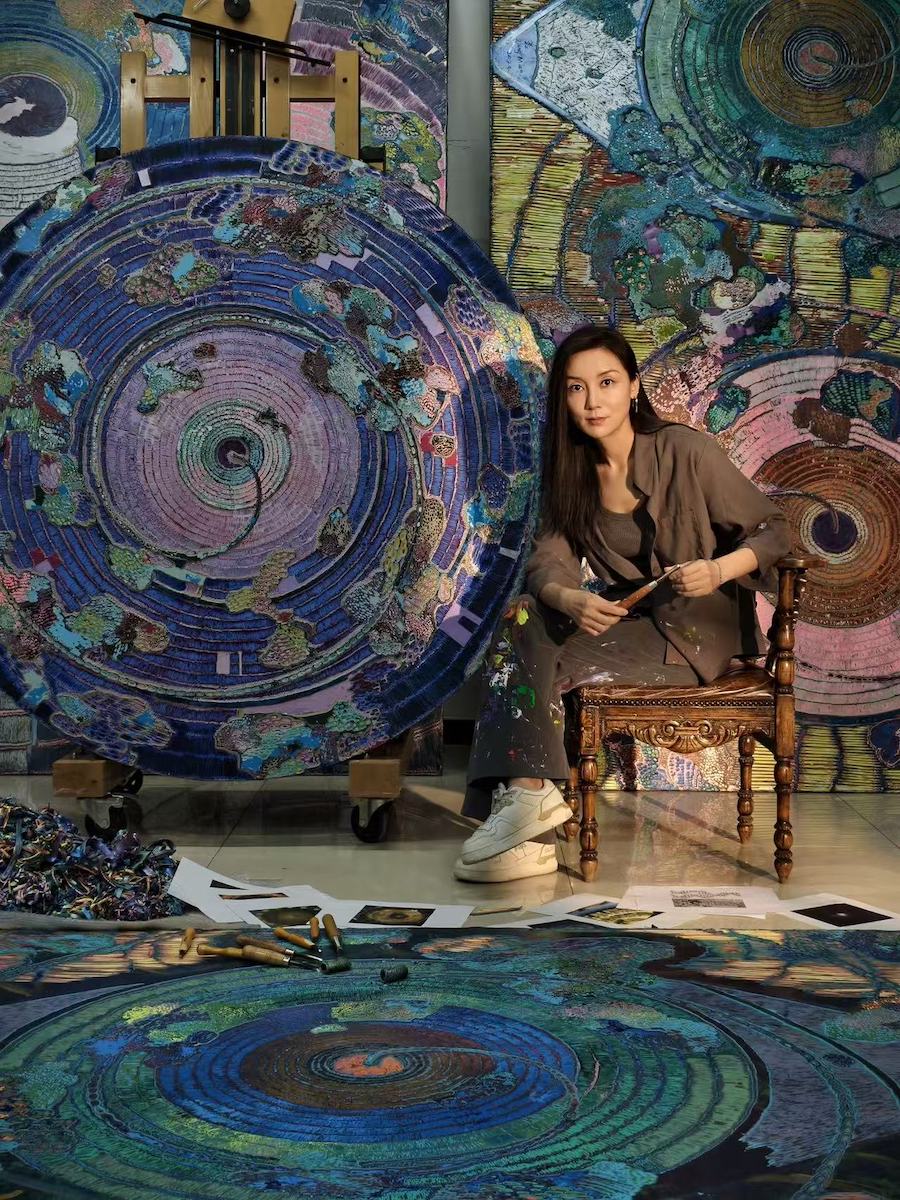 Jiang Miao Profile Photo. Courtesy of the artist.
By XUMENG ZHANG May 7th, 2026
In contemporary abstract art, symbols often appear in a detached form, gradually separating from the cultural and intellectual contexts to which they originally belonged. They remain as visual elements, but in the process, the structures that once supported their meaning begin to loosen or even disappear. As a result, these symbols no longer carry specific beliefs or narratives; instead, they function more as a visual language within the image, participating in the organization and generation of structure. Jiang Miao’s work exists within this shift. The ancient visual languages she employs, together with the structure of the spiral, do not remain as references to history, nor are they transformed into narrative imagery. Instead, they are reactivated in the present. Within her paintings, these elements gradually develop into an internal, almost psychological structure, allowing the work to unfold as a continuously flowing field of energy.
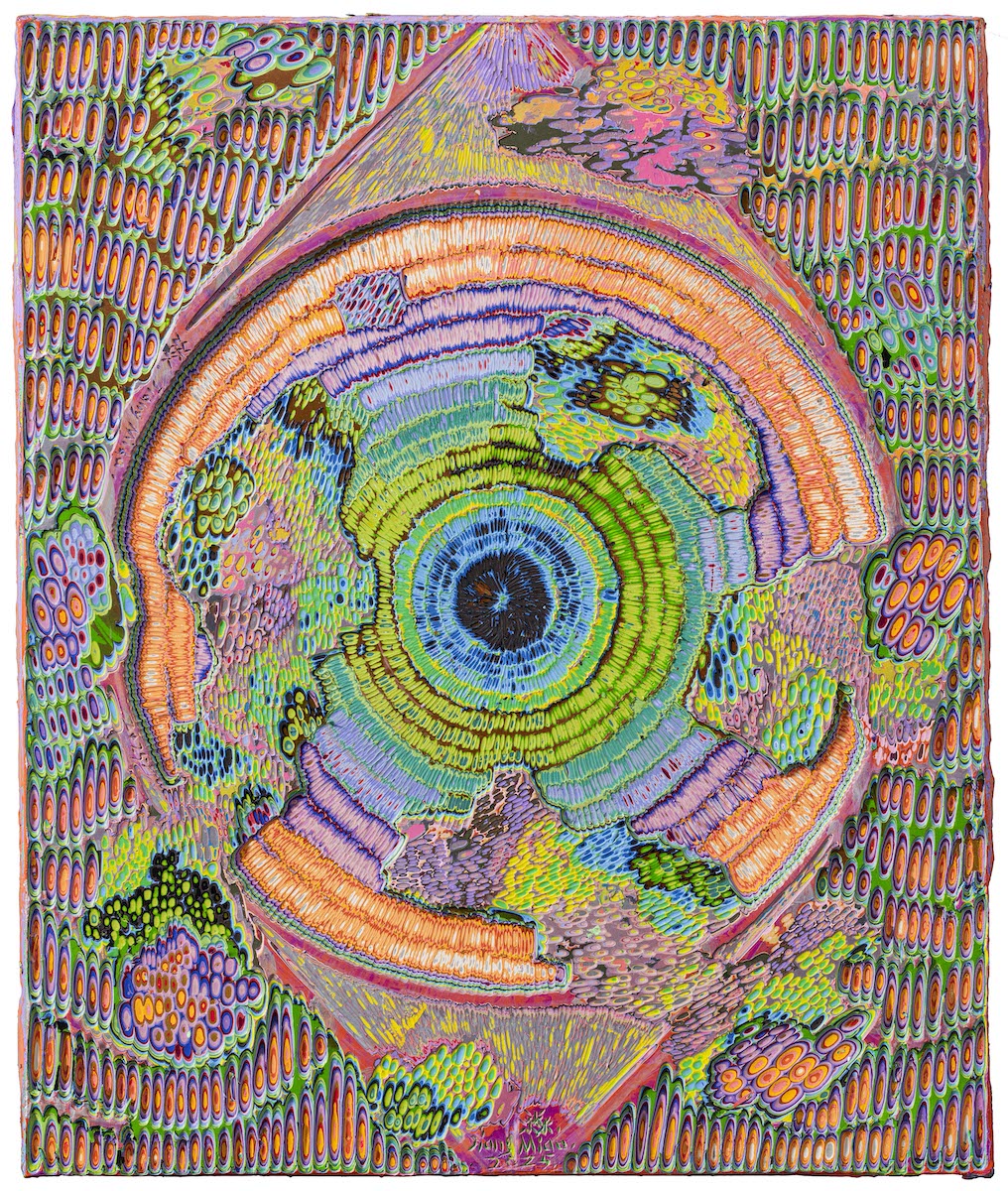
Heavenly Eyes 20250725, 2025. Courtesy of Jiang Miao.
“I think everything moves in a spiral,” she notes. “Life, time, the universe. It’s not a straight line. It always returns, but never to the same place.” For Jiang Miao, the understanding of life points toward a deeper question: how the individual situates itself within the structure of the cosmos and unfolds along an internal path. In her thinking, the spiral constitutes a fundamental form that traverses both life and the universe. It suggests not only a trajectory of becoming, but also a rhythm of perpetual return and expansion. The spiral therefore exceeds its role as a visual motif and becomes an organizing principle that extends into both the image and her personal philosophy. Points, lines, and planes are drawn into its orbit, generating a field of continuous movement in which the energy of light and color resonates.
This logic extends into her layered painting process. While the final image is certainly important, the act of making itself carries a quality akin to a sustained, disciplined practice. Seen from the side, the surface of her paintings appears rugged and dense, resembling the cross-section of Danxia landforms. Dozens of layers of pigment are repeatedly applied, quietly settling upon the canvas, each layer bearing the passage of time. Through processes of permeation and sedimentation, pigment transforms into color and accumulates continuously. This sustained accumulation reflects not only Jiang’s remarkable patience, but also a persistent and almost uncompromising commitment. It is as if time collapses as the hands of a clock are turned backward; pigment, too, is folded and compressed within the painting, becoming stratified traces that overlap and interweave across a single plane.“I keep adding layers,” Jiang explains. “Sometimes fifty, sometimes more. At a certain point, I no longer remember what was there in the beginning. But it doesn’t disappear. It stays in another way.”
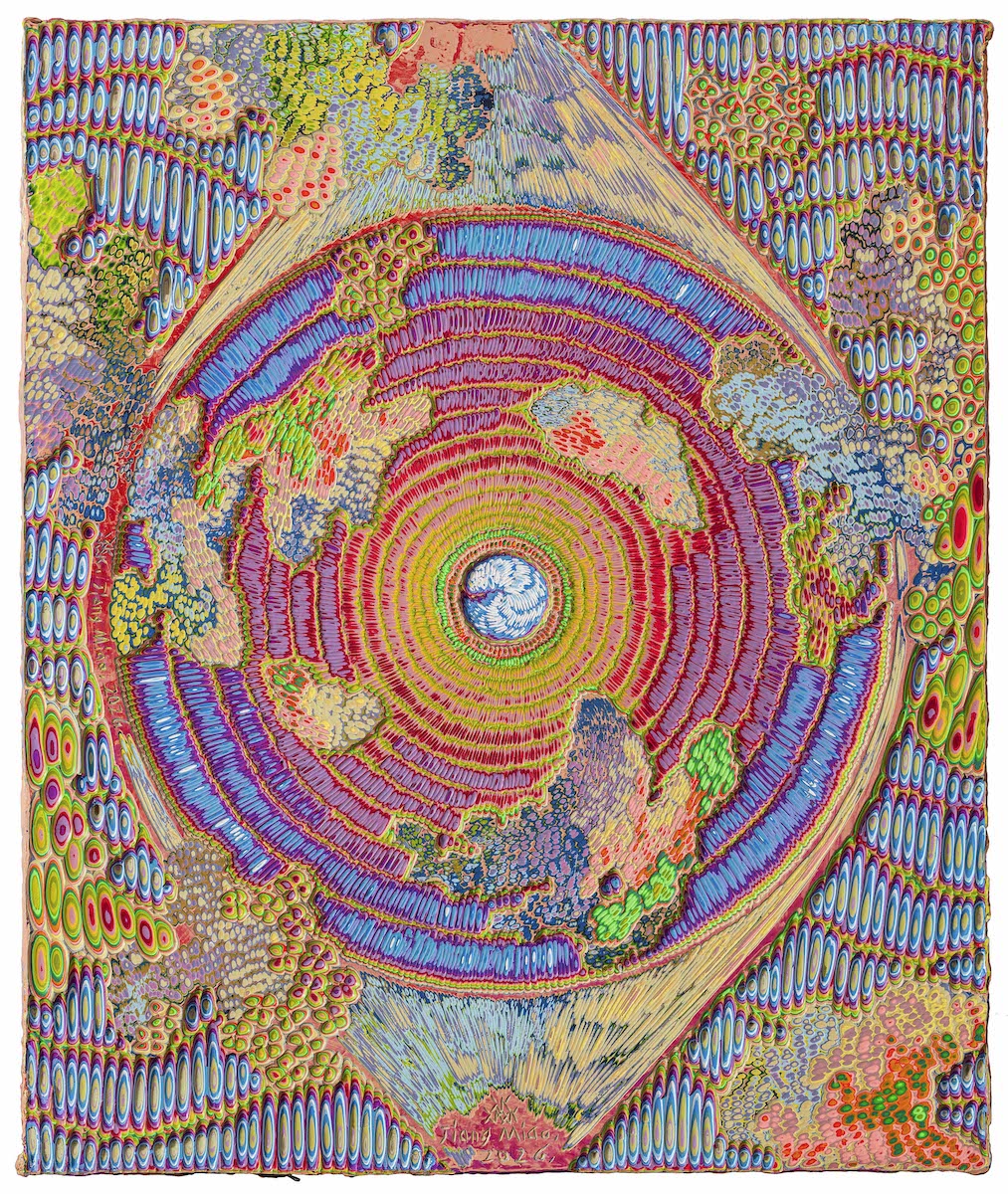
Heavenly Eyes 20251110, 2025. Courtesy of Jiang Miao.
The introduction of carving marks a decisive turning point in this process. With meticulous precision, Jiang repeatedly incises spindle-like units into the surface, allowing the buried layers beneath to gradually reemerge. This step requires immense confidence and resolve, as each incision is irreversible—unlike traditional oil paint, it cannot be covered or corrected. Every mark must therefore be made with exact control and careful calculation. This act of incision extends the logic of “cutting and revealing” rooted in her printmaking practice, while also echoing traditional Chinese craft techniques in which depth is achieved through repeated layering and polishing. Her paintings thus move beyond the mere accumulation of color and become structures composed of inscription, revelation, and sedimentation. The exposed layers vibrate and expand across the surface, forming ridges and ruptures, much like geological transformations unfolding over time. Pigments buried deep beneath the surface gradually recede into stillness. Within this process, time itself appears to be cut open and rearticulated, unfolding across the surface and giving rise to a dense tactility and profound depth.
In this mode of generation, the work no longer points toward a fixed moment, but instead resembles a tunnel extending inward through the image. Each layer of covering and each act of incision becomes a node within this structure, linking different temporal traces into a continuous field. What is concealed is not severed, but persists in deeper strata, maintaining continuity in unseen regions and allowing the entire work to function as an internally connected field. Viewing, therefore, is no longer confined to the surface; it is guided inward, along this spiraling path, into both the depth of the image and the interior space of the self. Within this process, memory, energy, and time are no longer separable, but move together along a shared, concealed trajectory, as if being reorganized and reawakened within the structure itself.
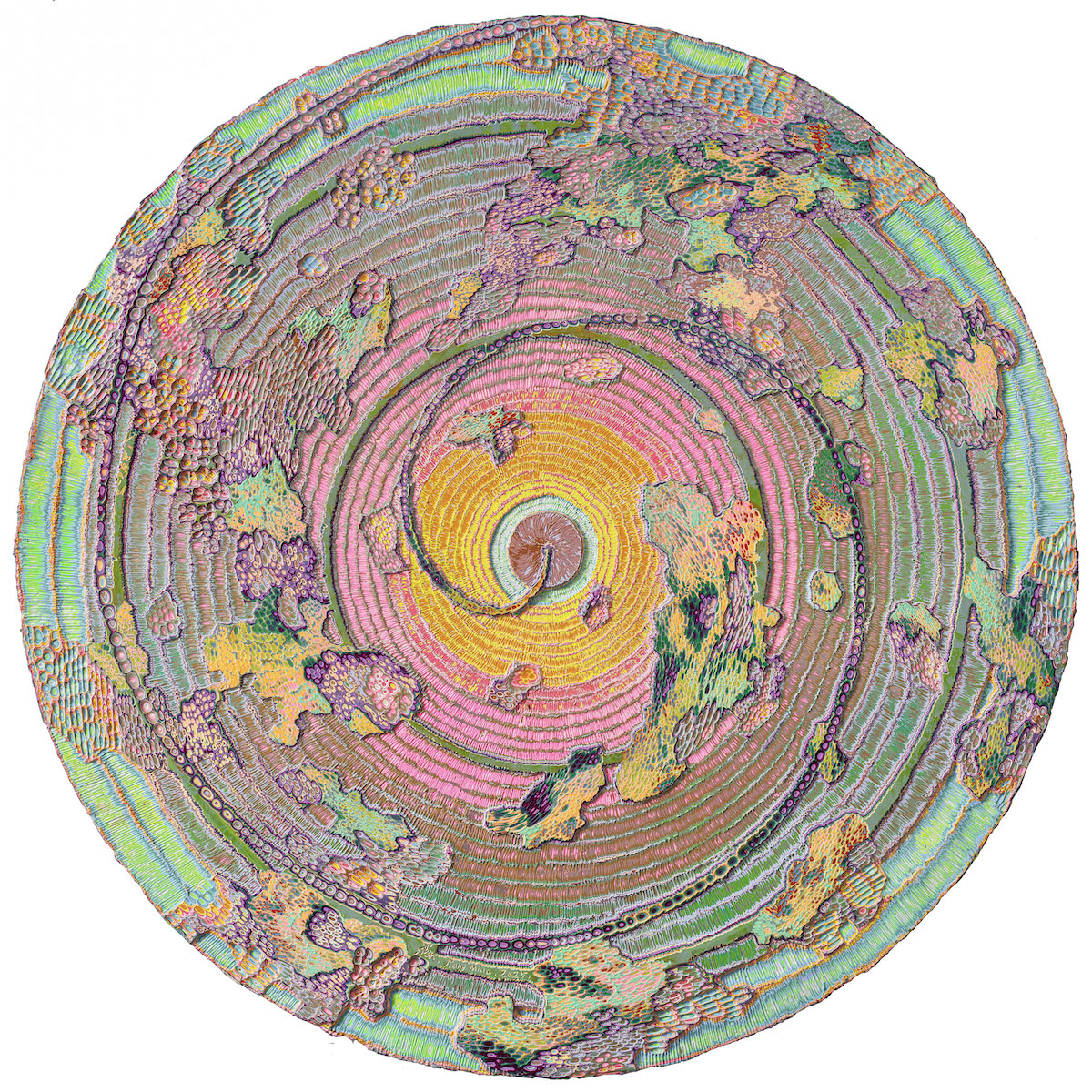
Taoist Trinity and the Self 20251203, 2025. Courtesy of Jiang Miao.
Xumeng Zhang
Xumeng Zhang (b. 2001) is a curator based in New York and Beijing. Her practice focuses on the intersection of contemporary art, mental health, and community-based collaboration.
view all articles from this author