Whitehot Magazine
October 2026
"The Best Art In The World"
"The Best Art In The World"
October 2026
Palomar (Part 1)
By ZIA PAO-ZIEGLER May 30, 2026
On its face Palomar (Part 1) is a show dedicated to celestial cycles, yet it cleverly avoids an over-rehearsed orbit by invigorating the gallery with diagonal freestanding walls, offset installations, works at the periphery of sight and hung high enough to lift your chin.
Four suns strike the cardinal directions overhead, cyanotypes by John Opera hung almost ten feet above the floor. Part of a larger series, Sun/Sky, these four works were newly produced with Opera’s cardboard photographic apparatus through the exposure of photosensitive linen to the sun. Amidst the indigo linen, the final product teasingly oscillates between pale moon and shining sun.
The four works from the Sun/Sky series effectively segment the show in tandem with the freestanding walls, so no remaining sightline extends from one side of the gallery to the other. Weaving around and in between the walls interrupts the circumambulatory course, enlivening the mystique of the show through concealment.
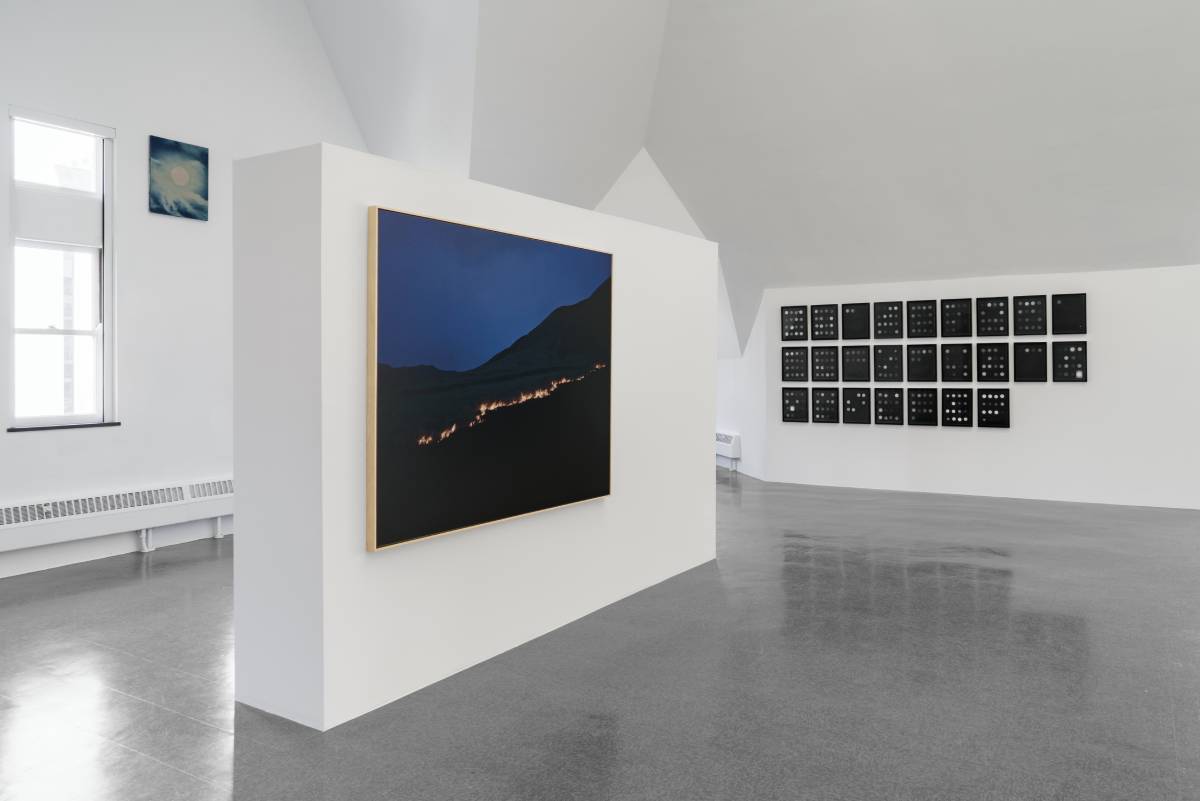
Palomar (Part 1), 2026, installation view, the Renaissance Society at the University of Chicago. Photo by Robert Chase Heishman for Bob.
Another series, Ametsuchi, by Rinko Kawauchi, traces the realignment of human cycles in tandem with elemental cycles. Cresting flames burnish the ridge of a hill, illuminating inky fields and a midnight blue sky. In this chromogenic print, Kawauchi captures the regenerative cycle of yakihata, a traditional practice of seasonal field burning.
Carrie Schneider’s Moon Drawing series captures the entirety of the twenty-eight-day lunar cycle on a single negative. Translucent spheres, crescents, and waning moons are scattered across three asymmetrically hung silver prints. The wonder of the final image is born from its dual nature as highly improvised and unpredictable, yet systematic in its execution.
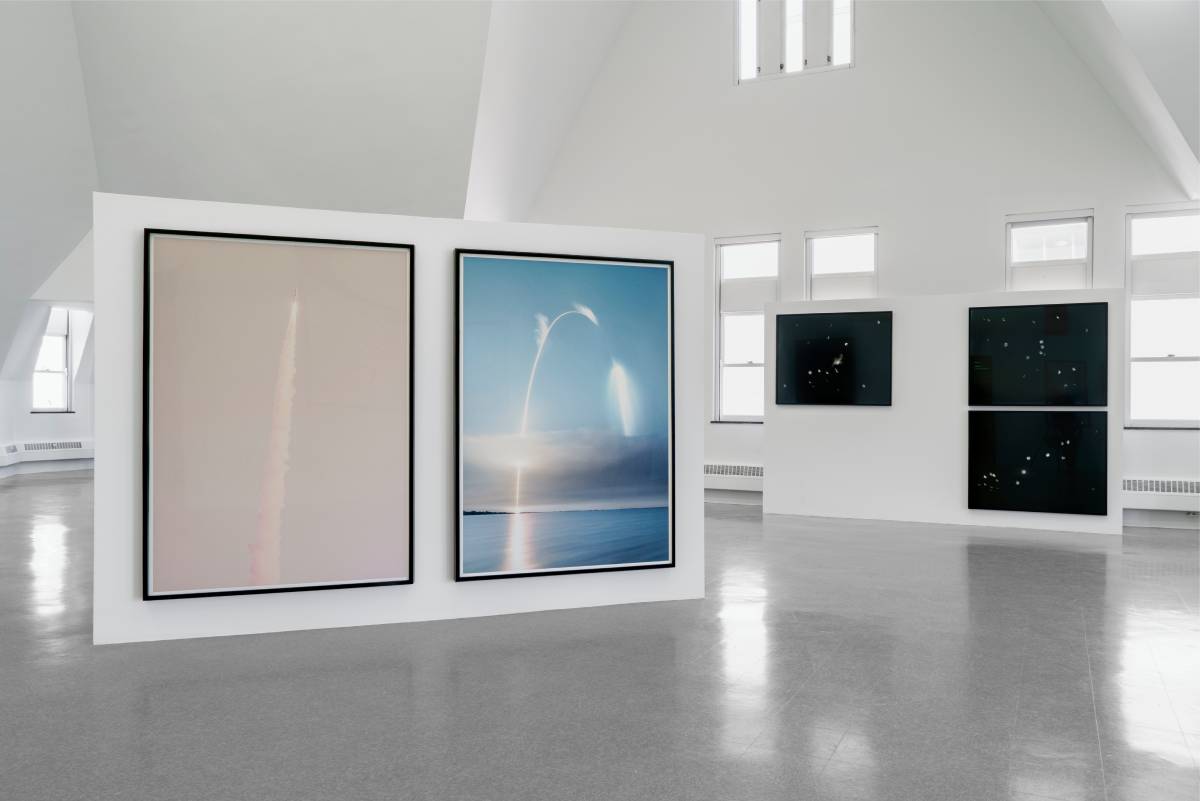 Palomar (Part 1), 2026, installation view, the Renaissance Society at the University of Chicago. Photo by Robert Chase Heishman for Bob.
Simultaneously, these capsules hold a grounded position within the same cycles they observe, attentive to the maneuvers of the individual. Tony Lewis channels vast abstractions of emotion through his soles into three frames of sparse grayscale improvisations. On rough-edged paper, the tread of Lewis's shoes through graphite and drags of rubber cement compress time into nonlinear “shorthand markings.” These traces might otherwise be read as illegible calligraphy, less concerned with celestial bodies than with the conceptual nature of moving through time. The show resists being dominated by celestial photography; Opera's cyanotypes and Lewis's graphite improvisations bring visual, not just interpretive, mystery.
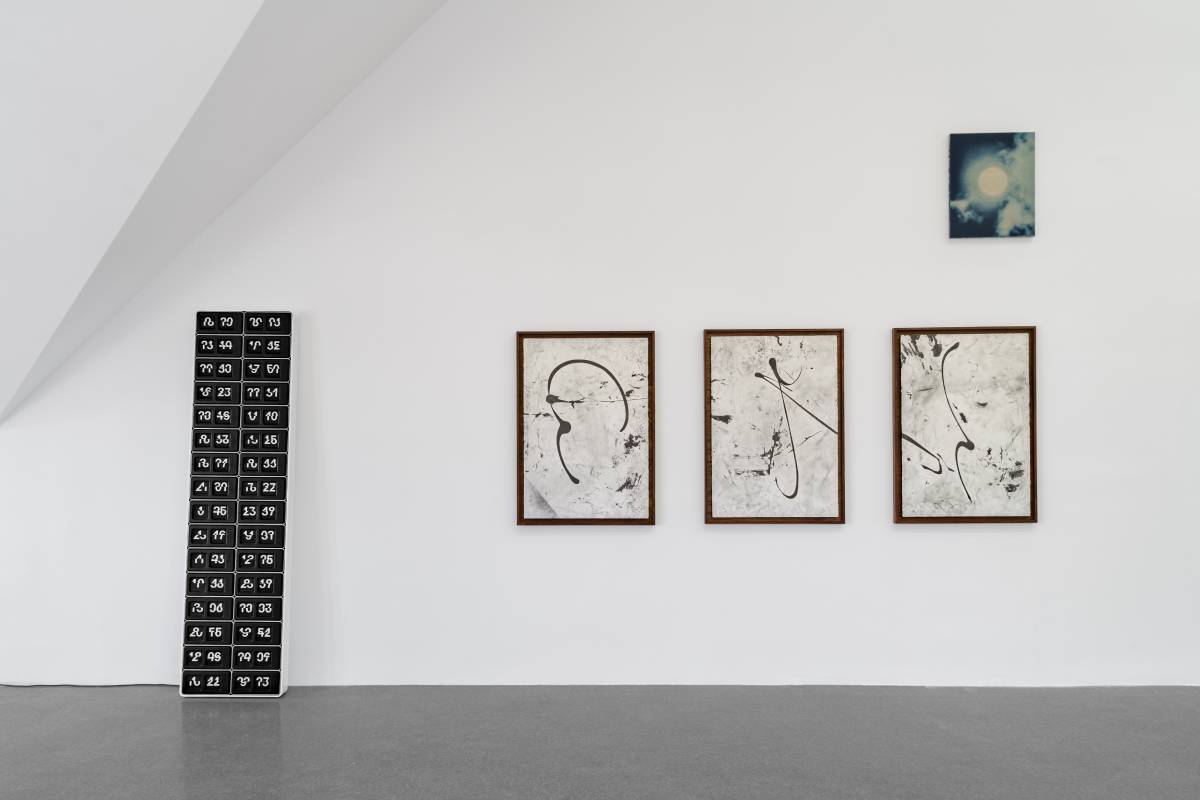 Palomar (Part 1), 2026, installation view, the Renaissance Society at the University of Chicago. Photo by Robert Chase Heishman for Bob.
Idyllic at first glance and increasingly unsettling as context expands, a diptych by Chantal Penalosa Fong looks to the same cluster of clouds from either side of the U.S./Mexico border. Wispy clouds coalesce into an opaque cluster in a picturesque sky; in the second frame, taken nine minutes later from Tecate, California, the same cluster holds while the right edge begins to gray and darken. This “performance action” reminds us that celestial access is resolutely political.
The solar prints, the lunar prints, the burning fields, the shoe-dragged paper: each captures a different compression of time, one phase drifting into the next. Palomar (Part 1) offers no fixed vantage point, only the next interval.
Palomar (Part 1)
The Renaissance Society
May 2 - June 7, 2026

Zia Pao-Ziegler
Zia Pao-Ziegler is a writer and researcher based between Chicago and New York. Her work focuses on modern and contemporary art. She will begin graduate study at the Institute of Fine Arts, New York University, this fall.
view all articles from this author