Whitehot Magazine
October 2026
"The Best Art In The World"
"The Best Art In The World"
October 2026
Marin Majić Paints a World Between Euphoria and Collapse
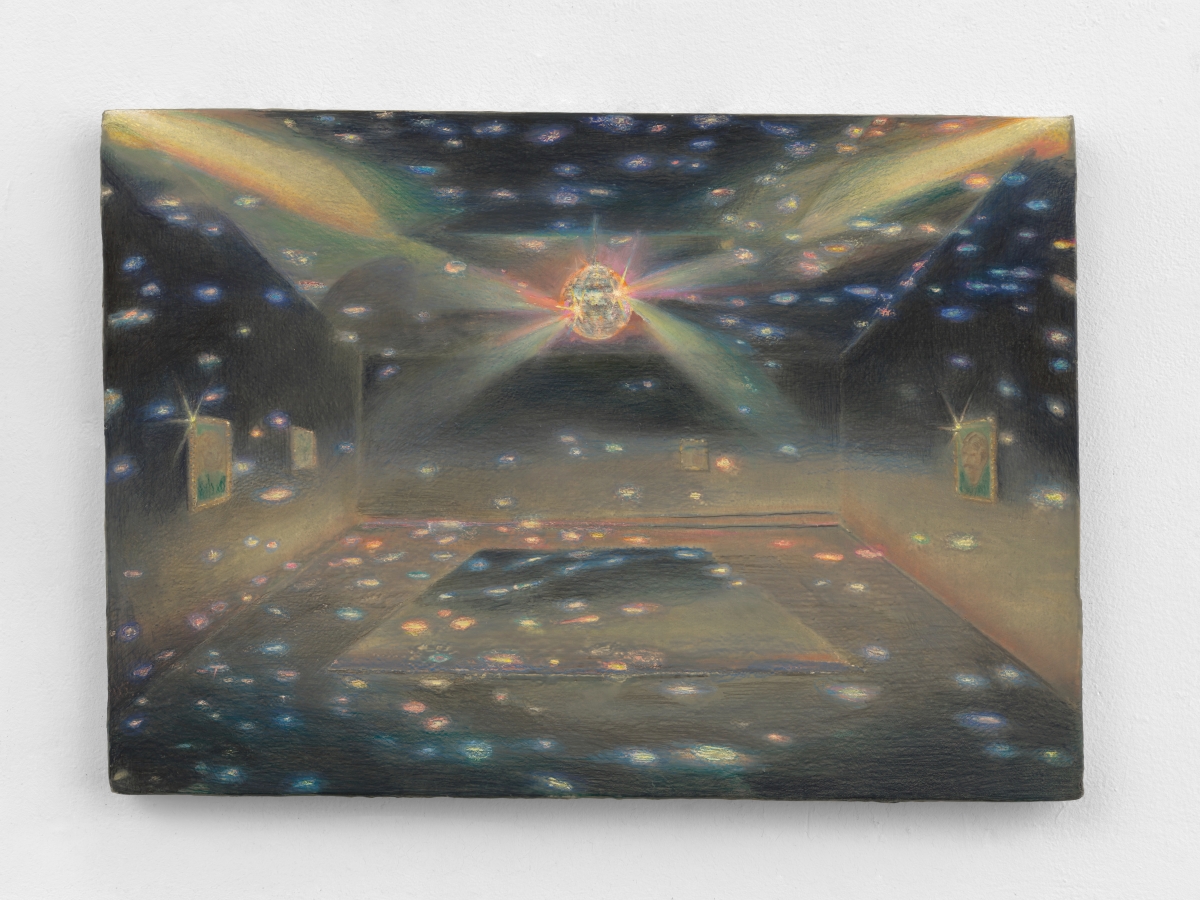 Marin Majić, Friend zone I (2026), colored pencil, oil color, and marble dust on linen, 15 x 20 inches (38.1 x 50.8 cm)
Image courtesy Nino Mier Gallery. Photo by Elisabeth Bernstein.
By MATTHEW MCPHILLIPS May 31st, 2026
I came back from Venice last week with the particular kind of exhaustion that only the Biennale produces, an amalgamation of sensory overload, invigoration, and fatigue. This year's edition, "In Minor Keys," conceived by Koyo Kouoh before her death and carried forward by her team, left me with less a set of images than a feeling: that contemporary art is processing a world we are trying to keep from coming apart at the seams. The most honest response is not only protest but beauty made under duress, euphoria held alongside dread. You don't have to go to Venice to find that sensibility right now. It's on view in Tribeca at Nino Mier Gallery.
Marin Majić's discodisco is an exhibition of intimately scaled paintings of discotheques, landscapes, and the charged middle ground between them. Expanding on the nocturnal vocabulary of his 2023 exhibition Nocturnes, where the show felt like wandering alone through a dreamscape, discodisco puts bodies in the room. Dancers, animals, and suited figures populate these canvases, all of them caught dancing, gazing, or suspended in stasis, gestures pointed away from what comes next. Their soft, scratchy, muted palette of greens, greys, and oranges oscillates with a surrealist sensibility while nodding toward the English Romanticists. The scale insists on intimacy in a moment of overwhelming spectacle.
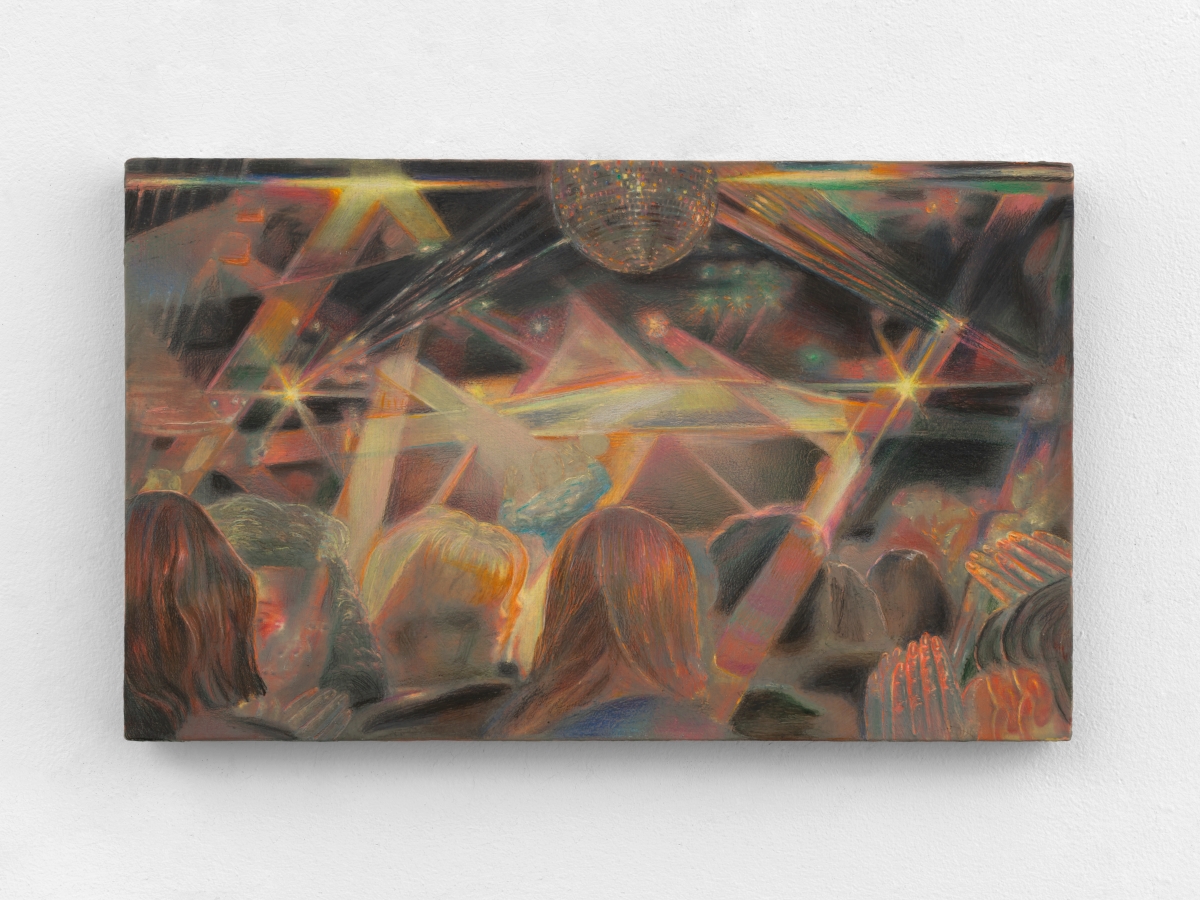 Marin Majić, Tree falling (2026), colored pencil, oil color, and marble dust on linen, 11 x 18 inches (27.9 x 45.7 cm)
Image courtesy Nino Mier Gallery. Photo by Elisabeth Bernstein.
The discotheque was never simply a place of pleasure. Born in Nazi-occupied France during WWII, discotheques became threshold spaces of protest, emerging in defiance of bans on live bands and jazz music. Literally a “record library,” they were ways to skirt the rules, eventually making their way to the US with the opening of Le Club in Manhattan. The closest modern evolution we may have today is raves. At a collateral exhibition of this year's Biennale, I stood in front of Dedicated to the Youth of the Whole World II and III (2019/2023) by Roman Khimei and Yarema Malashchuk — two videos filmed in 2019 and 2023 at raves in Ukraine. The footage is almost identical. The context transforms everything. In 2019, with the war's decreasing intensity, the rave seemed like a world of its own. By 2023, with full-scale war underway, the same dancing reads as an escape bookended by the potential danger of drone strikes. Majić’s dancefloors inhabit precisely that line between reality and escape, everyday life and dream. In Tree falling (2026), bodies pack closely together under the surrealist bouncing light cast from the club space. Lift off pushes the euphoria toward the sublime. Friend zone I and II (2026), the emptiness of the dark blue spaces suggesting a hybrid between club and gallery. These are not paintings about escapism, perhaps closer to representations of how we find our comfort, our safe spaces in this world.
And then there’s his disco balls. The first patent for what its inventor called a "myriad reflector" was filed in the United States in 1916 — a mirrored sphere designed to scatter a single light source into a thousand moving fragments. Majić's surfaces operate on the same principle as the disco balls he paints. He works in colored pencil, oil color, and marble dust on linen, mixed with wax and turpentine, then sculpting away at the surface to carve pockets of light directly into the paint layers rather than depicting light through illusionistic means. This places him alongside painters like Mary Corse, whose glass microspheres used originally in industrial street signs appear to radiate light from within, and Marial Capanna, whose worked surfaces with marble dust similarly shimmer amidst their muted palette. For all three, material is epistemology. The paint doesn’t deliver meaning so much as generate it through the encounter between surface and viewer. In Gravity (2026), the exhibition's central disco ball is rendered in obsessive cloisonné-like detail, light seeming to emanate from within rather than reflect from its environment. It is the myriad reflector as painting: conceptually scattering your own light back at you.
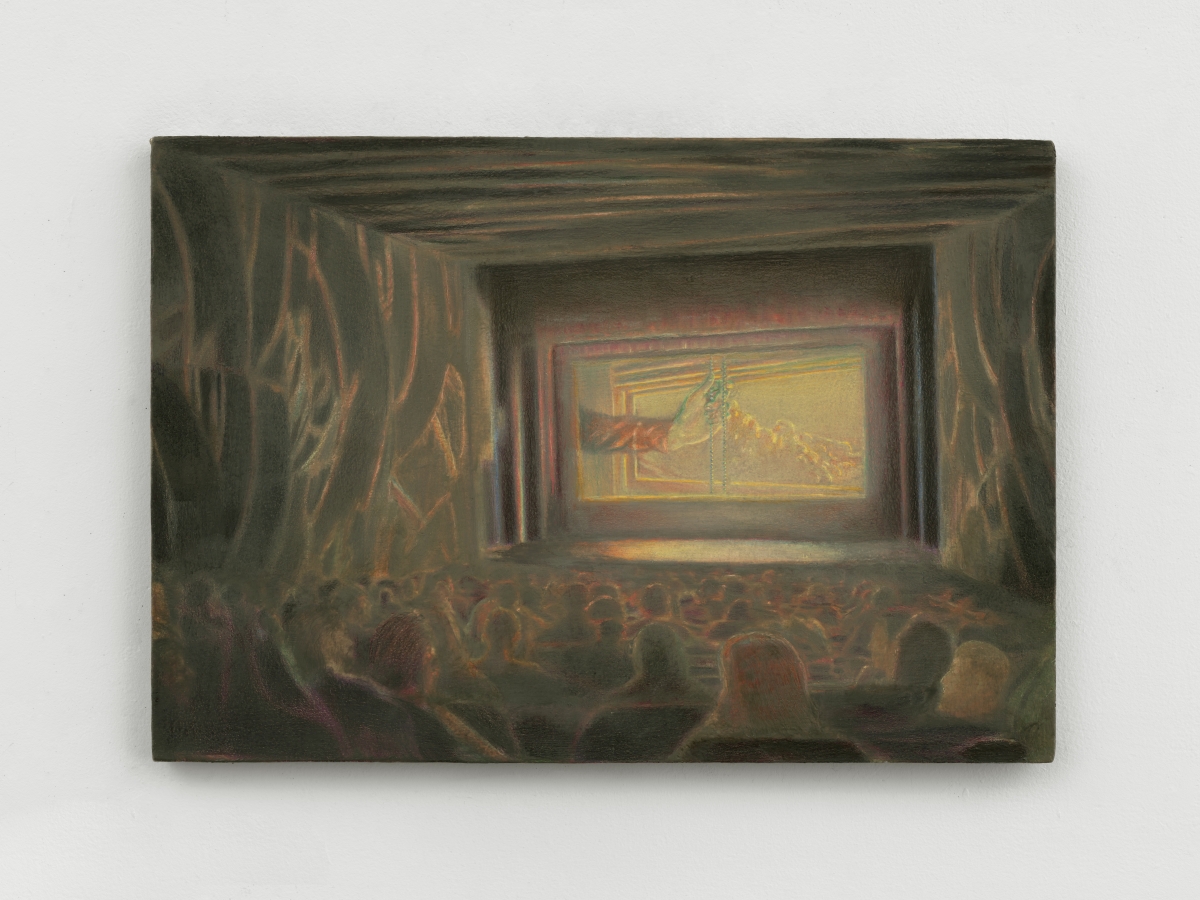 Marin Majić, Watching the sun set on you (2026), colored pencil, oil color, and marble dust on linen, 12 x 22 inches (38.1 x 55.9 cm)
Image courtesy Nino Mier Gallery. Photo by Elisabeth Bernstein.
There is a painting that stops you longer than any other. Watching the sun set on you (2026) shows an audience in a movie theater directed at a figure holding open window blinds to reveal a surrealist cloudscape beyond — something between a sunset and an explosion. It is quietly ominous and structurally revelatory: the movie screen replaced by a window, the window opened onto something beautiful and threatening in equal measure. This portal logic runs through the entire show. The spiral staircase of Purgatory (2026) ascends toward a glowing void that could be heaven or annihilation. When the exhibition finally opens onto the landscape itself, the relief is short-lived. Loop (2026) and Take only what you need (2026) show figures lying still in the grass. But this is not the garden of Eden, these are figures lounging in a garden of anxiety, resting in a world that has already changed irrevocably around them.
It is here that Majić's debt to Turner and John Martin becomes most legible, a Romantic tradition of small figures before vast, indifferent forces, not diminished by the landscape but clarified by it. Into this he introduces the dreamlike overlay of Feverish (2026) and Fading (2026), where figures dissolve into their surroundings in a manner recalling Francis Picabia's Transparency paintings. In Majić they feel like consciousness under pressure, the way the present becomes permeable when the future is uncertain. And yet Moving me moving you (2026) and Hiding not running (2026) counter this dissolution with collective euphoria, the body insisting on existing loudly while it still can.
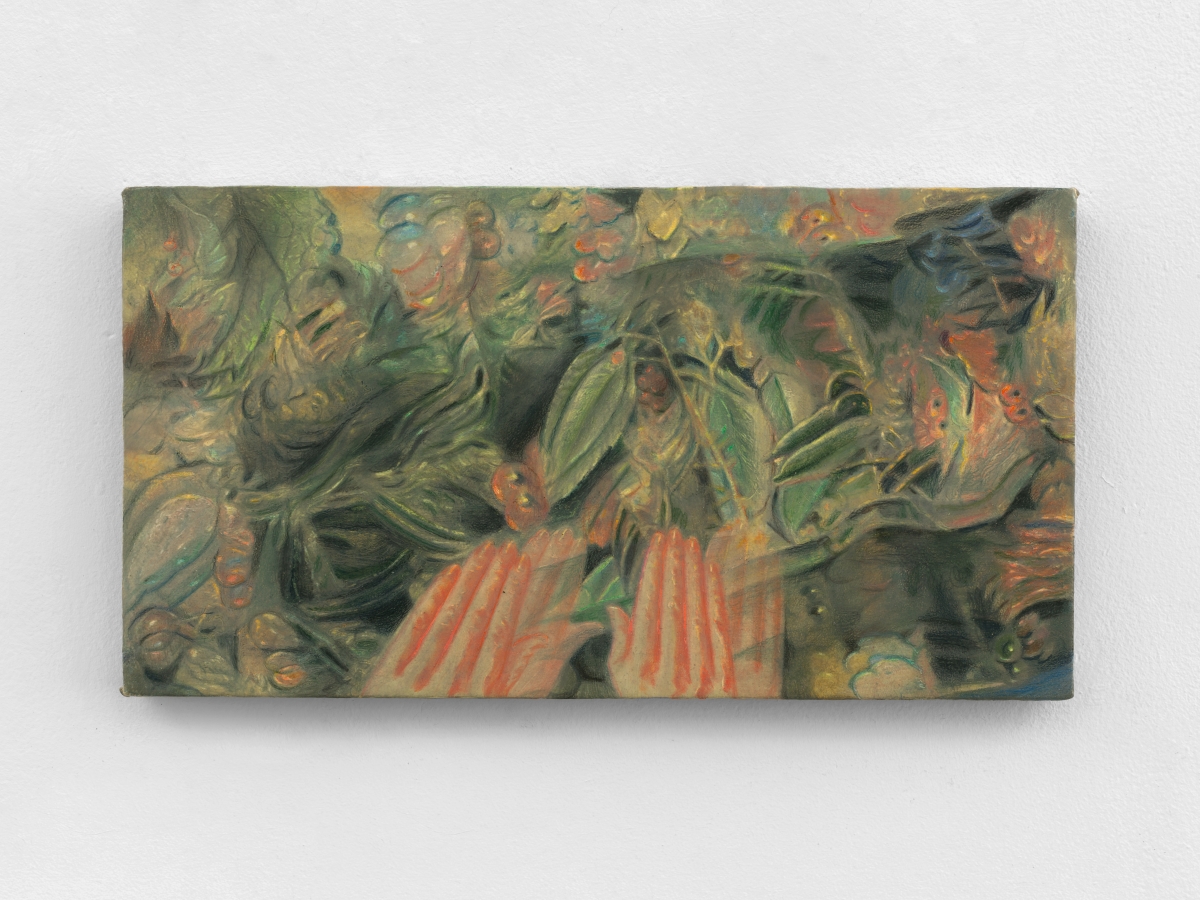 Marin Majić, Feverish (2026), colored pencil, oil color, and marble dust on linen, 8 x 15 inches (20.3 x 38.1 cm)
Image courtesy Nino Mier Gallery. Photo by Elisabeth Bernstein.
Surrealism was born from the same catastrophe as the disco ball — the conviction that liberation existed in spaces where logic loosened its grip. Majić is working in a different catastrophe but the same territory. His discotheques and landscapes feel exiled from a digital world that delivers horror in real time, framed and scrollable. These paintings offer the opposite, surfaces that require your physical presence, existing only in the encounter. Whether you step into his discotheques or landscapes or not, Majić’s paintings, like his disco balls, continue scattering light.
Marin Majić: discodisco is on view at Nino Mier Gallery in Tribeca through June 13, 2026.
Matthew McPhillips
Matthew McPhillips is a New York City-based curator and writer. He previously held positions at Westwood Gallery NYC, most recently as Associate Director, where he worked for nine years on over fifty exhibitions with historic New York based artists and estates.
view all articles from this author