Whitehot Magazine
October 2026
"The Best Art In The World"
"The Best Art In The World"
October 2026
An Earlier Future: Joseph Raffael's White Ground Paintings at Nancy Hoffman Gallery
By RIAD MIAH June 28th, 2026
I walked into Nancy Hoffman Gallery in Chelsea, anticipating Joseph Raffael’s work as I had long understood it: large-scale watercolors whose optical lushness and chromatic density hinge on sustained engagement with perception, surface, and duration. Instead, what I found was disorienting. The paintings on view bore little resemblance to the work that secured Raffael’s reputation. Their material, scale, and pictorial logic felt so distinct that I initially questioned whether I had misunderstood the exhibition’s date.
The surprise deepened upon learning that these works, currently exhibited under the title White Ground Paintings—date not from a late period, as their experimental character might suggest, but from the latter half of the 1960s. This temporal dislocation is crucial. Rather than signaling a departure, these paintings reveal an earlier moment of inquiry that complicates a linear understanding of Raffael’s development. What emerges is a body of work that feels both historically grounded and strikingly prescient.
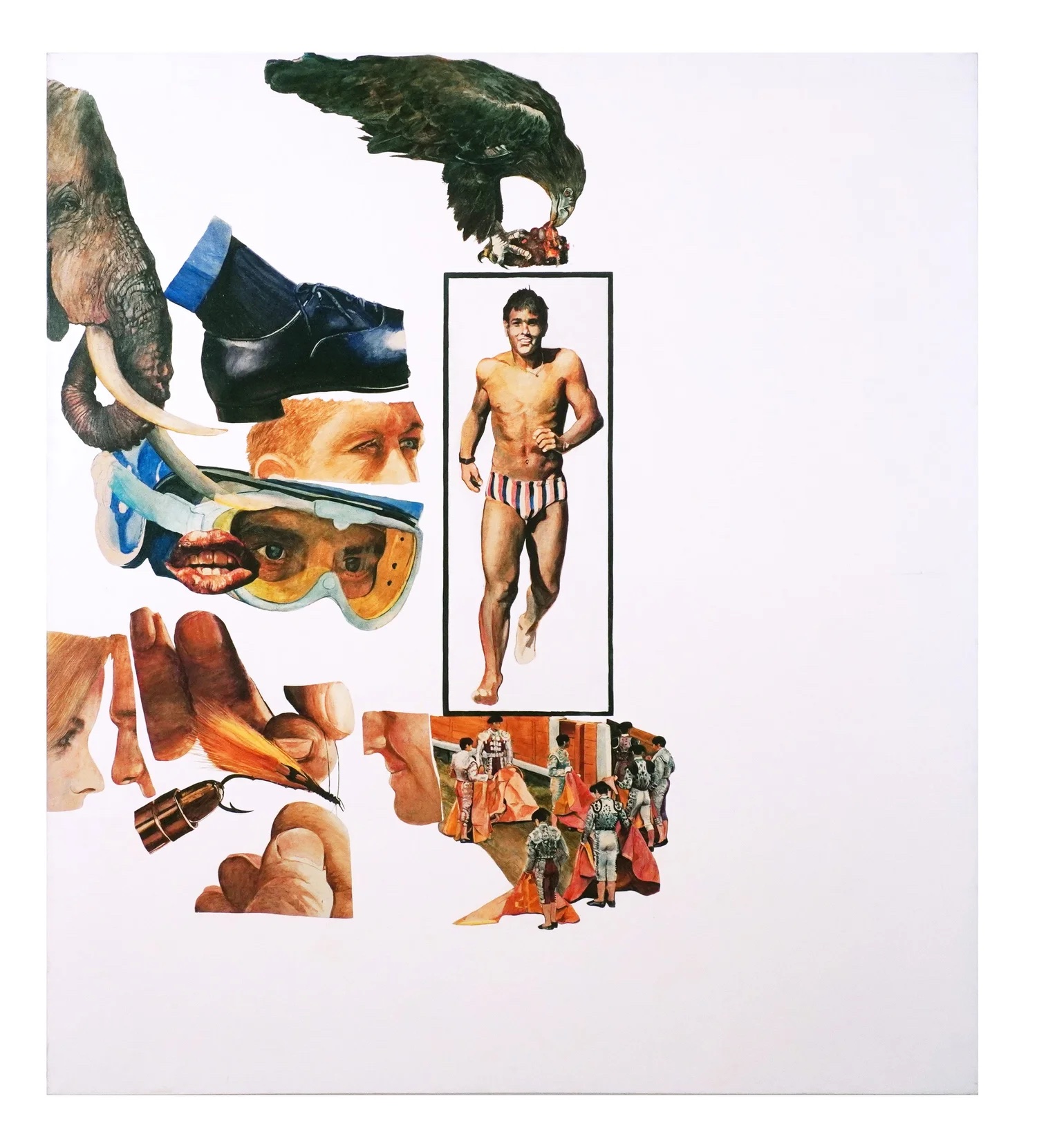 Sonny (4 of 4), circa 1967, oil on canvas, 50” x 45”
The exhibition features medium- to large-scale oil paintings whose fragmentary imagery and open, discontinuous fields challenge conventional distinctions between abstraction and representation. The title is matter-of-fact yet precise: expanses of white primed canvas dominate the compositions, functioning less as a passive background than as an active structuring force. These areas of white serve as visual silences—intervals that interrupt and recalibrate the viewer’s engagement with the image. The ground is not something to be covered over but something to be preserved and negotiated. This use of the white ground situates Raffael within a broader art-historical lineage, recalling the flatness articulated by Clement Greenberg. Yet whereas Greenberg sought to stabilize painting through medium specificity, Raffael’s white ground resists closure. It oscillates between void and field, absence and presence.
Against these expanses, fragments of imagery appear—cropped, isolated, and disjunctive. A hand, a portion of a face, an object glimpsed without context: these elements hover within the pictorial field rather than fully inhabit it. The result is neither fully abstract nor conventionally representational, but rather suspended between the two. The viewer is drawn into an act of reconstruction, attempting to piece together a coherent image or narrative that continually eludes completion. Throughout the exhibition, this logic holds. Figures are truncated, objects isolated, and images juxtaposed without hierarchy. Motifs appear as if excerpted from disparate visual worlds—advertising, art history, personal memory—yet are held in suspension by the expansiveness of the white ground. The result is not literal collage but a pictorial field that behaves like one: discontinuous, associative, and resistant to closure.
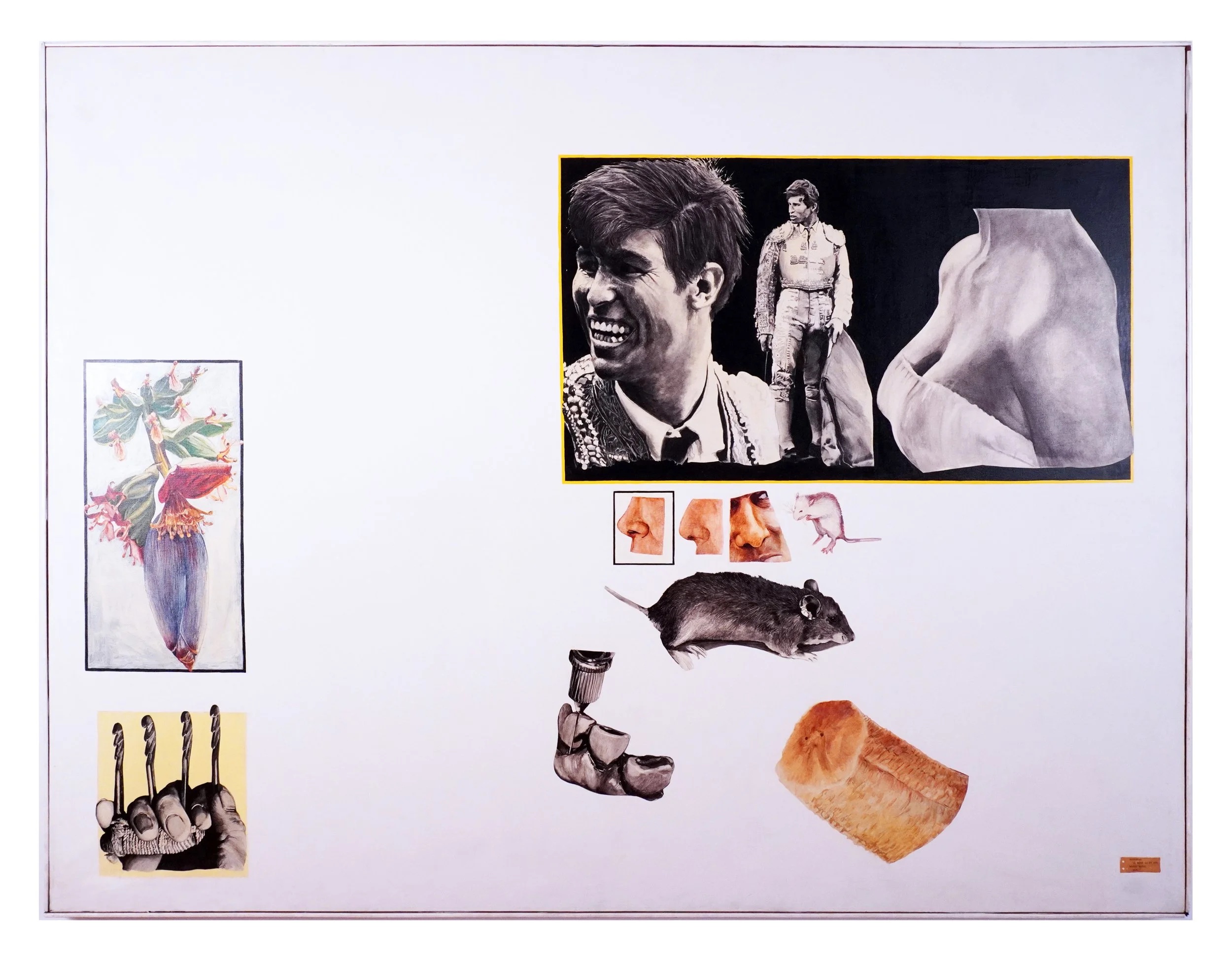 Morto Padre, circa 1967, oil on canvas, 60.75” x 80.75”
Morto Padre (circa 1967) is a particularly lucid example of this strategy, though it is by no means unique. Here, a constellation of images—a bullfighter in close-up and full figure, a classical torso, a rodent, fragments of a banana, a sequence of noses, a hand gripping drill bits—is rendered with meticulous naturalism yet refuses to cohere into a single narrative. They float within the white field, some faintly bordered, others left exposed, as if drawn from different registers of seeing. The painting sharpens what is at stake across the broader body of work: the tension between recognition and disjunction. The white ground in these works is not emptiness but a structuring force, a stage where fragments appear and recede. It is a painted silence that emphasizes each image's autonomy while compelling the viewer to seek relations among them. The paintings insist on our desire for narrative—only to frustrate it. In this refusal, Raffael anticipates a defining strategy of postmodern painting: meaning produced through juxtaposition and gap rather than hierarchy or sequence.
Historically, these works emerge at a moment of transition. By the mid-1960s, Abstract Expressionism was waning, giving way to Pop and Minimalism. Raffael’s paintings register this shift yet resist alignment with any single movement. The use of fragmentation and cinematic cropping recalls James Rosenquist, while the focus on everyday images echoes Claes Oldenburg and Jim Dine. Yet Raffael avoids Pop’s graphic immediacy; his surfaces remain painterly and psychologically charged. Recurring motifs—bodily fragments, animals, tools, organic matter—introduce a muted symbolic register throughout the exhibition. These elements suggest a dispersed meditation on mortality and materiality, recalling vanitas traditions without overt allegory. Meaning flickers rather than settling.
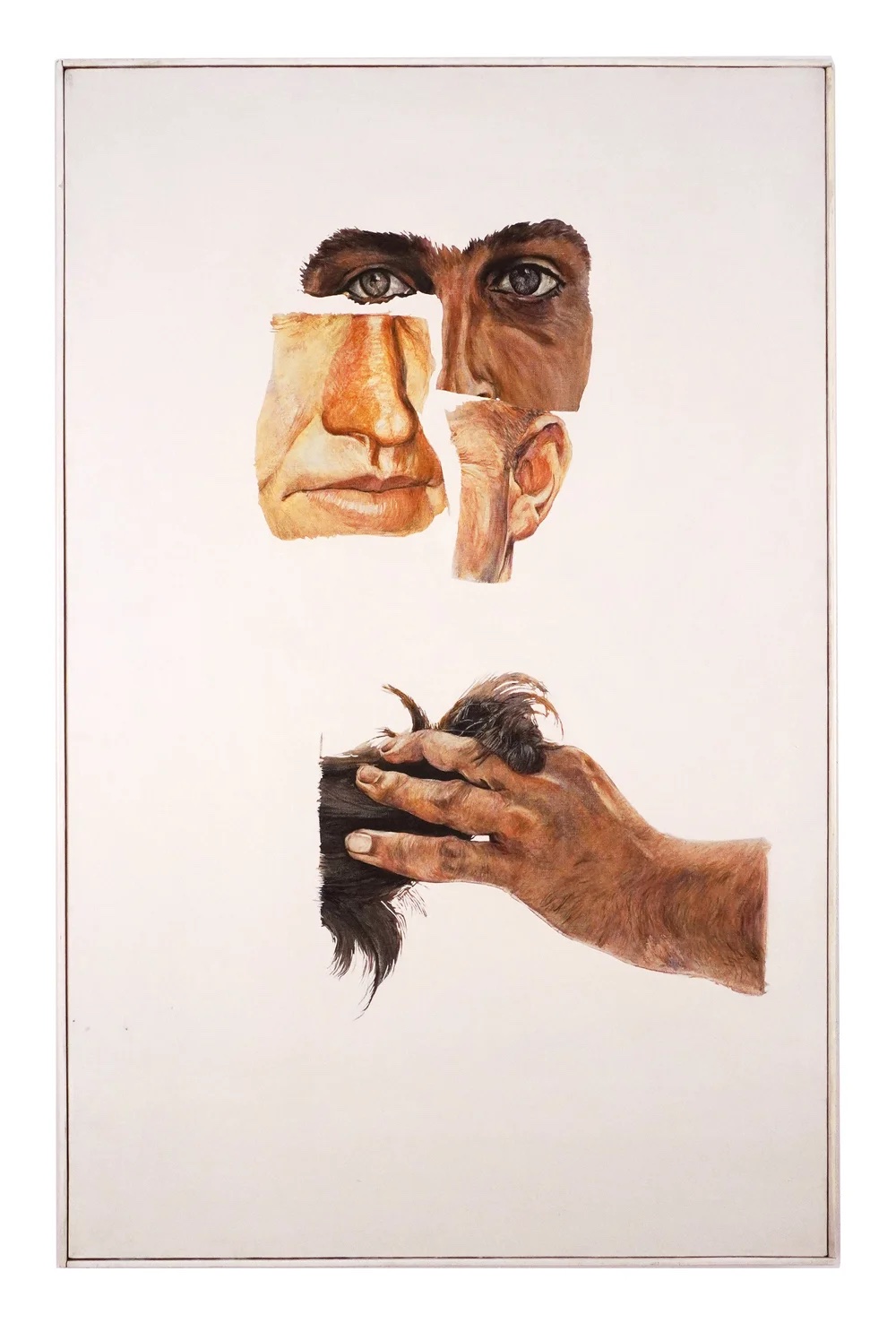
Faces, Hair, Hand, 1965, oil on canvas, 50” x 32”
The White Ground Paintings also anticipate Photorealism, not through mimicry but through their engagement with the mediated image. Cropped fragments read as if extracted from photography or cinema, yet they resist mechanical reproduction. Raffael occupies a space adjacent to, yet distinct from, the photorealist project. More striking still is how these works prefigure the discontinuous logic of postmodern figuration. The juxtaposition of images anticipates strategies later seen in the work of David Salle, Eric Fischl, and Francesco Clemente. In Raffael’s case, however, these juxtapositions feel exploratory rather than ironic, testing how images can coexist within a single pictorial field.
What ultimately distinguishes these paintings is their resistance to temporal fixity. Despite their historical specificity, they feel contemporary. The fragmentation of the pictorial field and the tension between image and ground resonate with today’s visual culture, shaped by screens and discontinuous flows of information. The viewer searches for narrative, yet the paintings refuse to stabilize meaning. At the same time, Raffael’s surfaces carry a palpable slowness—a deliberateness that counters the speed of contemporary image consumption. The viewer is invited to linger, attend to subtle shifts between ground and figure, and sit with ambiguity. This tension between immediacy and duration gives the work its urgency.
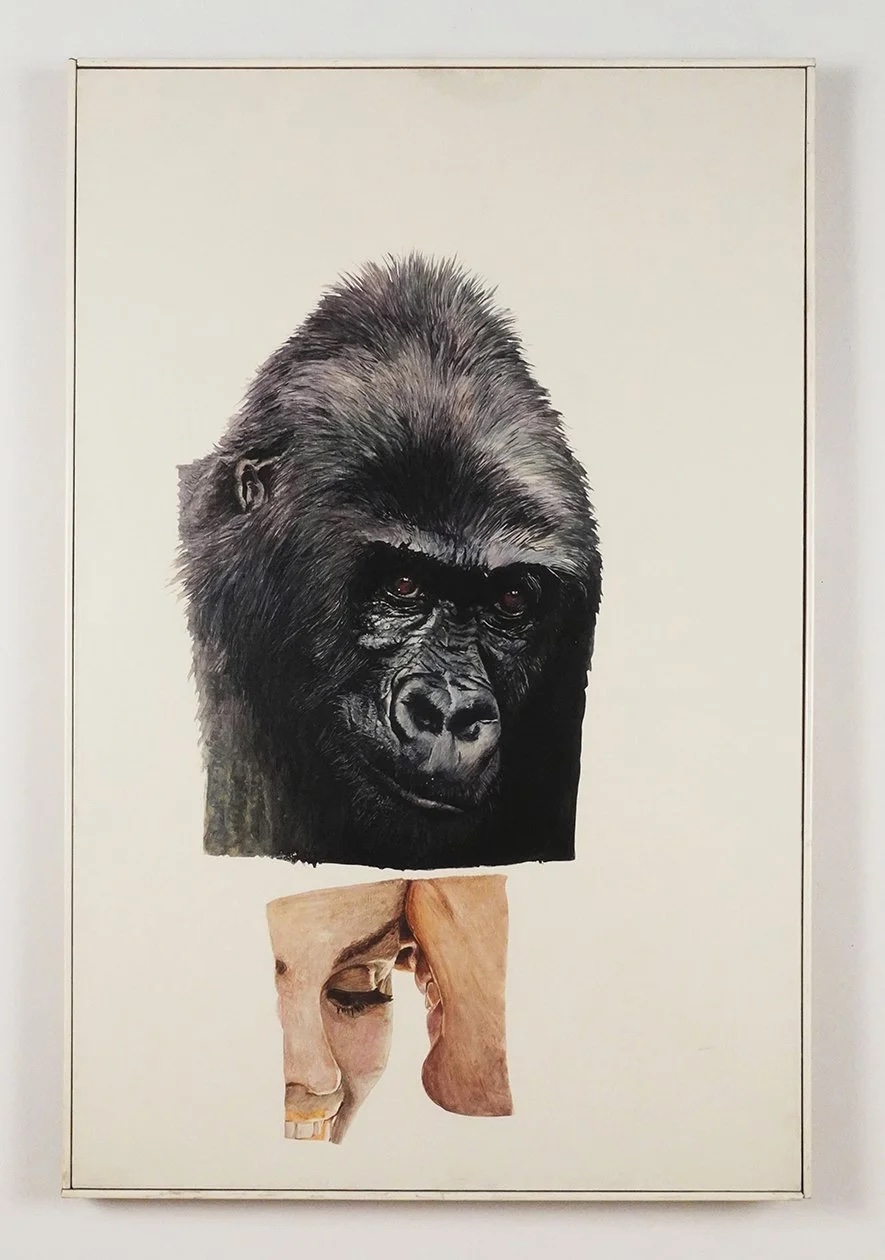
Gorilla with Faces, circa 1967, oil on canvas, 40.75” x 26.75”
The White Ground Paintings thus occupy a liminal position within Raffael’s oeuvre and within postwar American painting. The paintings are part of a broader field of inquiry. Taken together, these works articulate a sustained investigation of fragmentation, perception, and the instability of images—one that not only reflects its moment but also anticipates the fractured visual logic of decades to come.

Riad Miah
Riad Miah was born in Trinidad and lives and works in New York City. His work has been exhibited at the Baltimore Museum of Contemporary Art, Sperone Westwater, White Box Gallery, Deluxe Projects, Rooster Contemporary Art, Simon Gallery, and Lesley Heller Workshop. He has received fellowships nationally and internationally. His works are included in private, university, and corporate collections. He contributes to Two Coats of Paint, the Brooklyn Rail, and Art Savvvy.
view all articles from this author