Whitehot Magazine
September 2026
"The Best Art In The World"
"The Best Art In The World"
September 2026
Paul Tzanetopoulos: The Unspoken Influence Over Los Angeles’ Art Scene
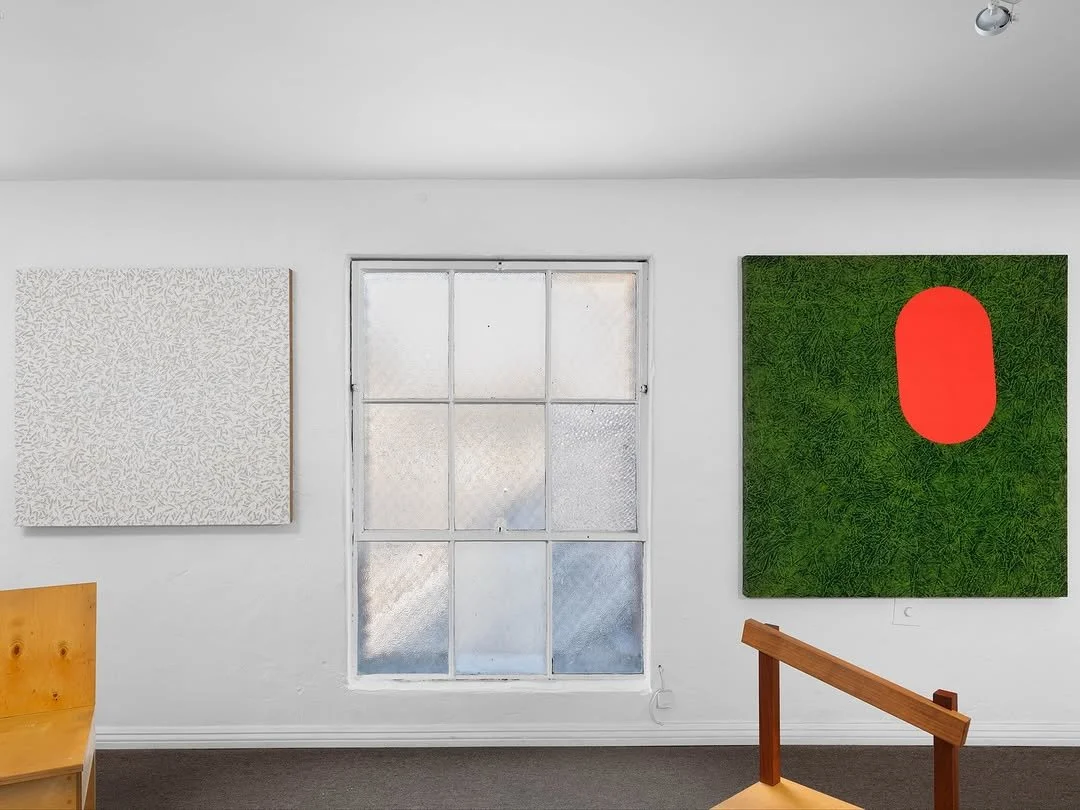
Paul Tzanetopoulos: New Work, as-is gallery (Nov 1, 2025 – Dec 13, 2025), (left) Fortunes, 2025, Collage on paper, 36”x36”; Collage on Paper (right) Now More Bran (FashionNation Series), 1988, Acrylic on denim, 39”x42”, courtesy as-is gallery
By Carlota Gamboa, May 19, 2026
For Paul Tzanetopoulos, the act of making has never been a matter of discipline so much as one of natural compulsion. “If I wasn’t an artist,” he says jokingly, “I’m not sure what I would be.” Though presented with levity, there is also a matter-of-factness about such a statement and how that’s truly been the case for Tzanetopoulos. His life has been a result of the condition of his work, and it can be seen in the subjects and mediums in which they manifest. Introduced by his mother as an artist from the age of eight, and exhibiting drawings publicly by fourteen at the Kennedy Center, Tzanetopoulos’ trajectory did not unfold through decision but through impulse. “I’ve been making art since I can remember,” he recalls. “It almost wasn’t a choice.”
Describing himself as a conceptually-based artist, Tzanetopoulos does what he can to move away from traditional labels and how they can obfuscate people’s ability to engage with the work. He reflects on how his early drawings, often highly detailed and technically precise, would draw attention for their realism rather than their intention: “I would do an anti-war piece, and it would be this elaborate drawing, and all I would hear is, ‘Oh, it looks like a photograph,’ and it would make me crazy!”
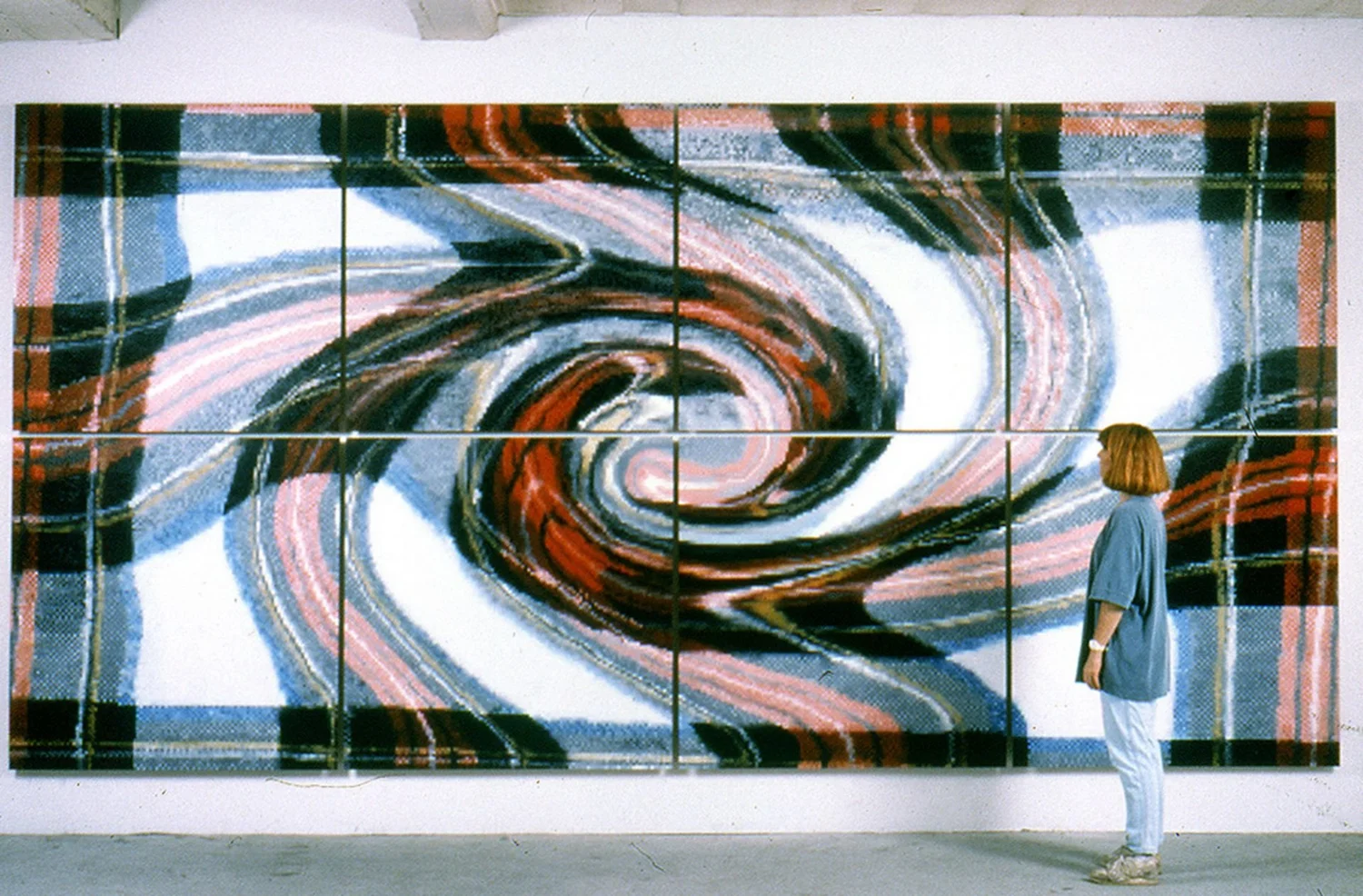
Paul Tzanetopoulos, Rotoplaid, 1993, Oil on panel, 10' x 20' x 4"
After such a personal and thorough career in meaning-making, it makes sense that Tzanetopoulos prefers to move away from labels or lineages or strict straightforward representations of reality which might confine interpretation. “I’m a conceptual artist that draws and paints,” he says. “The concept always comes first, the medium second, and then scale and everything else follows.” This methodology has produced a body of work that is formally expansive—spanning painting, drawing, film, video, projection, sound, installation, and interactive systems—yet philosophically consistent.
Embedded within Tzanetopoulos’ practice is the infrastructure of Los Angeles itself. Over the course of more than three decades, he has contributed to upwards of thirty public art commissions, many of which operate at a scale or level of integration that resists immediate authorship. Rather than presenting as discrete objects, these works often function as responsive and environmental systems, contingent on the movement of people through space. This approach reflects his continued interest in what might be described as “geosocial” phenomena: the convergence of physical landscape, civic design and collective perception. In this sense, his work is less about producing singular images and more about shaping conditions, moments in which the public, knowingly or not, participates in the realization of the piece. It also complicates traditional ideas of visibility and recognition. While certain projects have become synonymous with the visual identity of Los Angeles, they are rarely experienced as authored artworks in the conventional sense. Instead, they exist as part of the city’s visual language, absorbed into its rhythms, its transit systems, its thresholds.
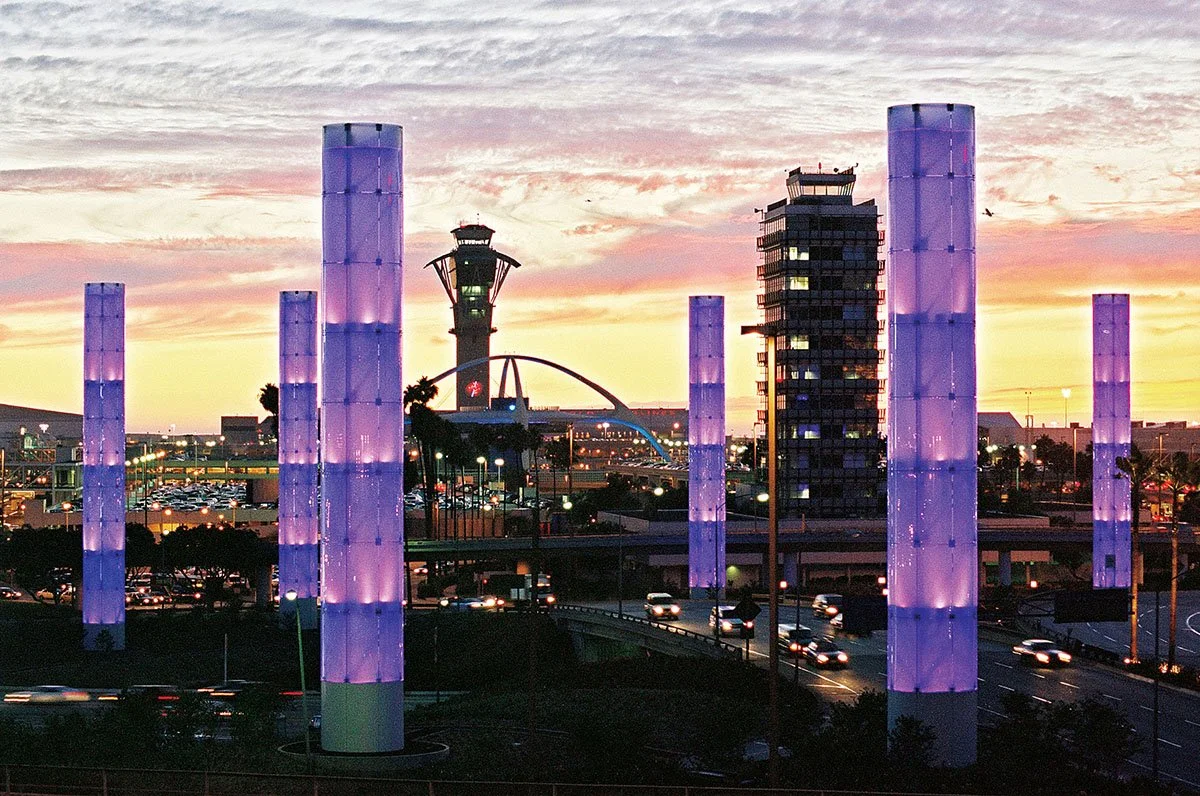
Paul Tzanetopoulos, LAX Gateway Pylon Project, 2000, Los Angeles International Airport, 11 pylons, 6’ diameter, ranging from 25’ to 60’ on Century Blvd. and 15 pylons, 12’ diameter, 100’ high at the intersection of Century Boulevard & Sepulveda Boulevard (Photo: unknown)
This same sensitivity to time, accumulation and perception extends into his current studio work, particularly in his ongoing effort to restore and recontextualize a vast archive of photographic, film, and video material. Spanning several decades, the archive contains not only finished works, but processes, interventions and ephemeral actions that would otherwise remain inaccessible. In revisiting this material, Tzanetopoulos is not simply preserving a record of past activity, but reconsidering how these works might function in the present. The photographic output, in particular, occupies a unique position within his practice. While continuous throughout his career, it has often remained secondary to his larger installations and public-facing projects—less visible, but no less conceptually rigorous.“I never got that work out so much,” he notes. “So I’m working on getting a photo show together.”
The process of organizing and restoring this body of work becomes, in itself, an extension of his conceptual framework: an engagement with time and the shifting contexts through which his art is manifested and presented. As images are revisited, reprinted, and potentially exhibited for the first time, they prompt new readings, not only of the works themselves, but of the conditions under which they were originally made.
The inclination toward site-specific and large-scale work, evolving into what he describes as “guerrilla environmental work”— projections onto mountains, buildings, and billboards, as well as temporary interventions in open landscapes—is what initially positioned the environment not as a backdrop but as an active participant.
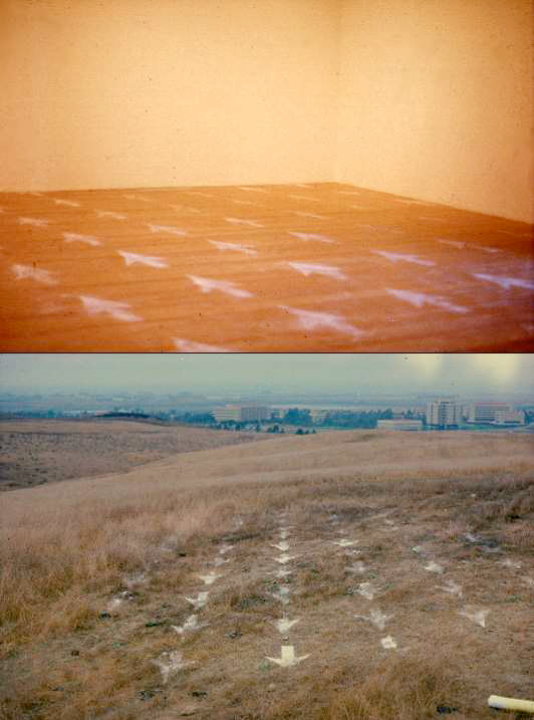
Paul Tzanetopoulos, As A Direction, 1975, Installation, mixed media
When asked how these impulses to work with his surroundings began, Tzanetopoulos used a story from his MFA days as an example. “How do we make decisions? How do I decide what to do? What color to make something? How do I decide these things? I thought, well, it’s entirely possible that artists are actually following something unseen. Not an unseen hand, but some path that exists that an artist taps into and needs to interact or work with. During my MFA, I thought, I’m going to reserve a space in the gallery on campus, and I’m going to do a show, pick a date, and I’m going to figure it out. When I got to the gallery, I had this really strong feeling that there was something going on in the room, a kind of energy, and I decided to believe that there was something in the space moving a certain way. And that’s where the title came from: As a Direction.”
Tzanetopoulos stenciled out arrows, gathered dust from his environment and plaster from the art lab, and created a field of arrows on the ground in the direction he felt existed there and documented the experience. However, that was just the beginning of his discovery. Outside the gallery, a mile in the direction he felt so pulled to document on the ground, Tzanetopoulos would end up finding a square of mowed grass in a field, the exact size and shape of the gallery.
Tzanetopoulos’ projects don’t begin with material but with a question that persists until it demands articulation. “I don’t do anything until it bugs me,” he explains. “Until I can’t not do something about it.” That innate impulse has carried on since then, finding expression in everything ranging from forging postal stamps to see if the letter could circulate the postage system (a kind of private, mini-performance act) to a large-scale painting using analog computer output that was acquired by the Los Angeles County Museum of Art in 1990.
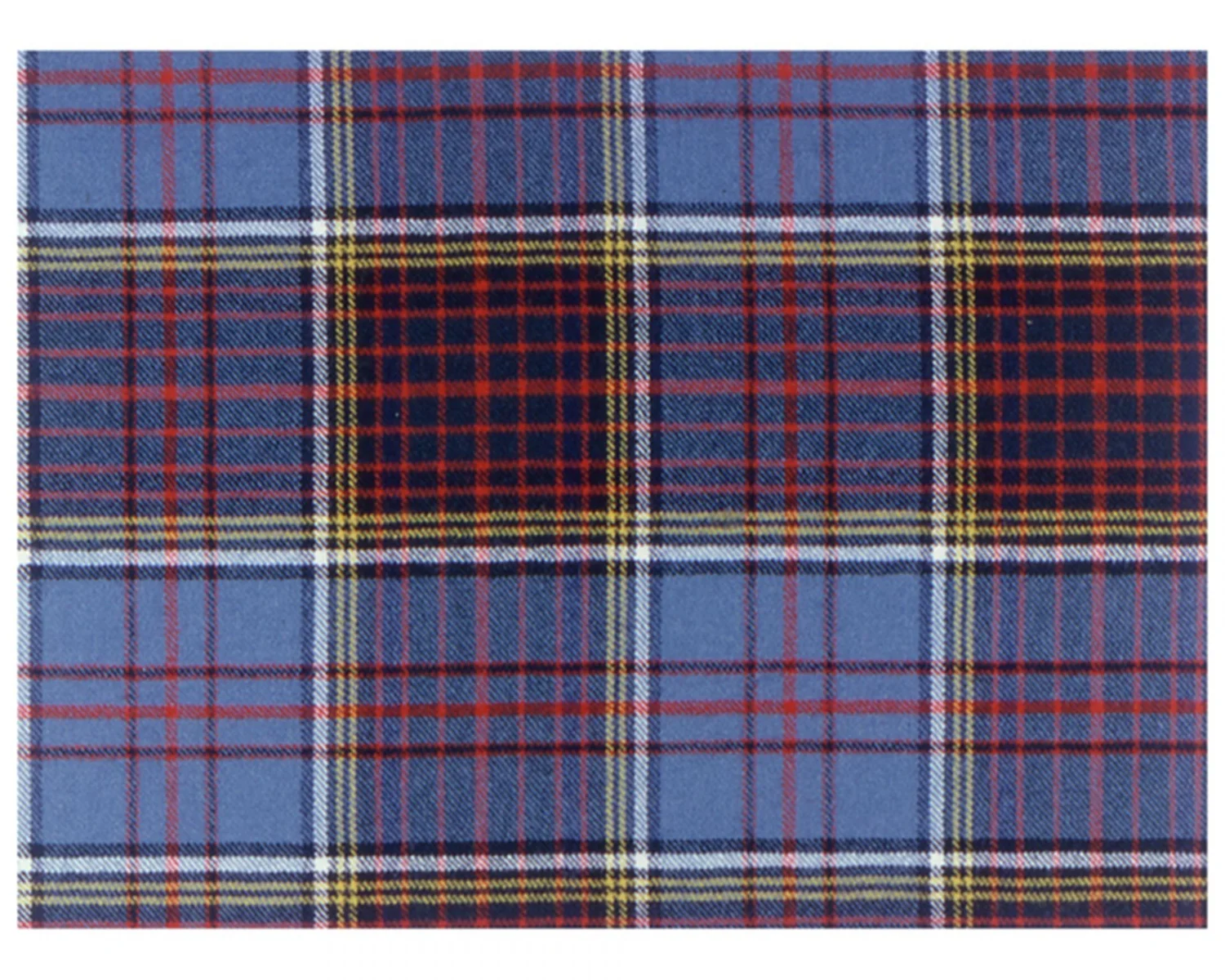
Paul Tzanetopoulos, Anderson (Plaid Series), 1989, Acrylic ink on raw canvas, 7’ x 9’, LACMA permanent collection
Now based in Silver Lake, where he maintains multiple studios, Tzanetopoulos continues to sustain a practice defined by multiplicity, “I always have at least two or three projects going at one time,” he says. He’s also working on the restoration of the well-recognized (and beloved by us LA natives) multi-color pylons which adorn the LAX entrance. Although it is bittersweet to bid farewell to the original structures which were first installed in 2000, his reimagining of the public artworks is on the horizon.
Since their installation in 2000, the vibrant odes to Los Angeles’ diversity and our planet will be reimagined and reinstalled with the intent to be visible for the 2028 Los Angeles Olympics. In addition, Paul Tzanetopoulos’ contributions have since been recognized through inclusion in major collections, including the Los Angeles County Museum of Art and the United States Consulate General in Ho Chi Minh City, as well as through more than thirty public art commissions since 1992.
To learn more about Paul Tzanetopoulos and his work, please visit his website and follow him on Instagram @paultz_studio

Carlota Gamboa
Carlota Gamboa is an art writer and poet from Los Angeles. You can find some of her writing in Art & Object, Clot Magazine, Salt Hill Journal, Bodega Magazine, Oversound and Overstandard.
view all articles from this author