Whitehot Magazine
October 2026
"The Best Art In The World"
"The Best Art In The World"
October 2026
The Origins and Communities of The CAMP Gallery
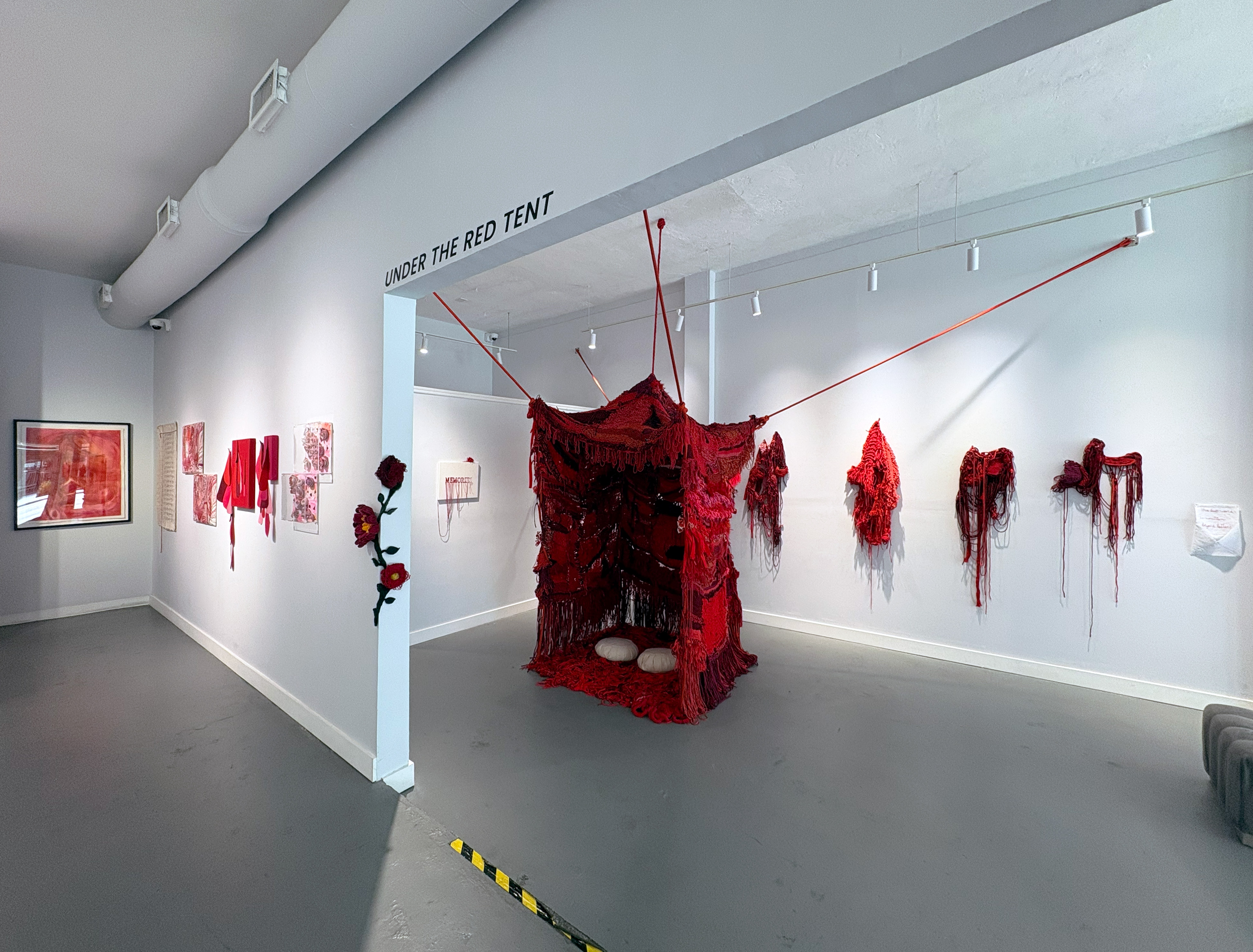 Under The Red Tent, courtesy The CAMP Gallery
By CARLOTA GAMBOA March 25, 2026
For The CAMP Gallery, the practice of gallery keeping is not only an aesthetic or commercial project, but a collective one. Built out of a refusal of isolation, and a belief that access is not a secondary concern but the condition under which art can actually function, founder Melanie Prapopoulos makes it her mission to bring intertextual work and performance into an inclusive space.
The gallery formed out of the organic collaboration between Prapopoulos and other artists for whom she organized site-specific pop-up shows, creating its foundation during Covid. Refusing to let the pandemic decimate the relationships between artists and their audiences, Prapopoulos’s impulse was to digitize existing slotted exhibitions, moving them into the only viable landscape of the time.
“There were so many artists who had their exhibitions canceled, and I didn't want them to be left miserable in the middle of their creativity,” Prapopoulos explains. “I had a gallery space in Miami, but because of the lockdown nobody was going. We still held a couple of exhibitions in that space just so the artists could still have their exhibitions going, but we hosted a lot of artists online. It's only grown from there. Now that we have physical space, we do exhibitions, we do art fairs, we do online exhibitions.”
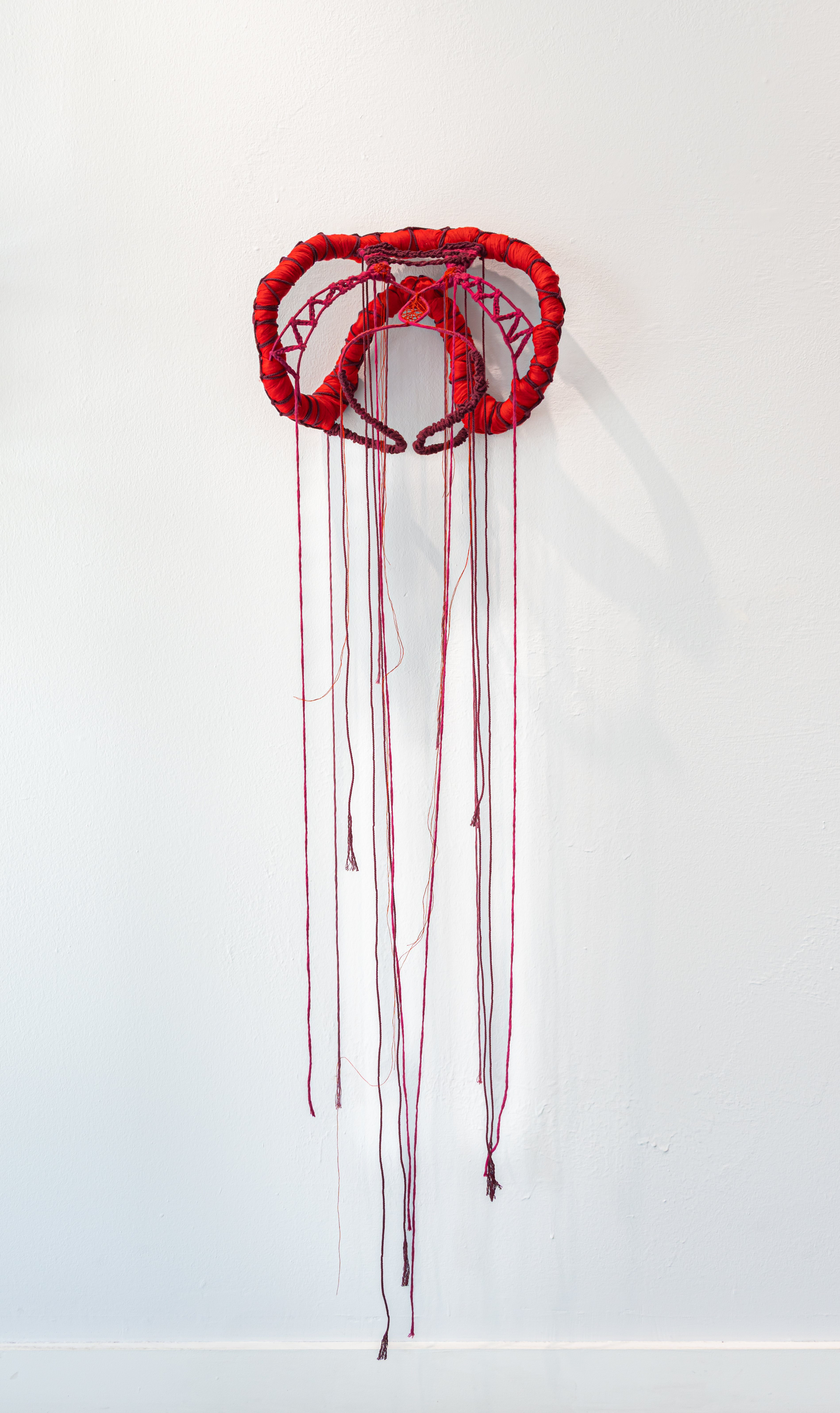
Under The Red Tent, Commonality, Aida Tejada, courtesy Polmo Studio
Prapopoulos’s working life began in the garment district in New York in the early 1980s, gaining business experience and connections. By 2000, she continued to find obvious holes in the gallery system. “I came across so many different vanity galleries and scams,” she says. “Artists I knew told me stories about how they never got their artwork back and other horrible experiences. I thought I would like to do something better, to help out artists and surround myself in art.”
Her approach has been interdisciplinary from the start, often focusing on the hybridization of arts with other mediums in order to expand a viewer’s potential interests.
“My studies at NYU and my master's at the University of Indianapolis were both in literature with a minor in art history,” she says. “My undergraduate thesis was on Gabriel García Márquez in relation to different Latin American artists and how one could understand them as individual arts or in tandem. When I did my master's, it focused on the Harlem Renaissance, taking poetry, and painting and connecting the two. One of the things that became so apparent during my studies is that everything is so interconnected. When you look at, let's say, literary modernism, you find the same elements happening in the physical arts, in the plastic arts and the performing arts. You find it in philosophy, sociology, psychology, they're all interconnected. Why do we have to keep dividing these lines? I think one of the problems in the art world is it's still very often an exclusive club where not everybody understands what's going on. I think bringing in the other disciplines helps people gain access to the work.”
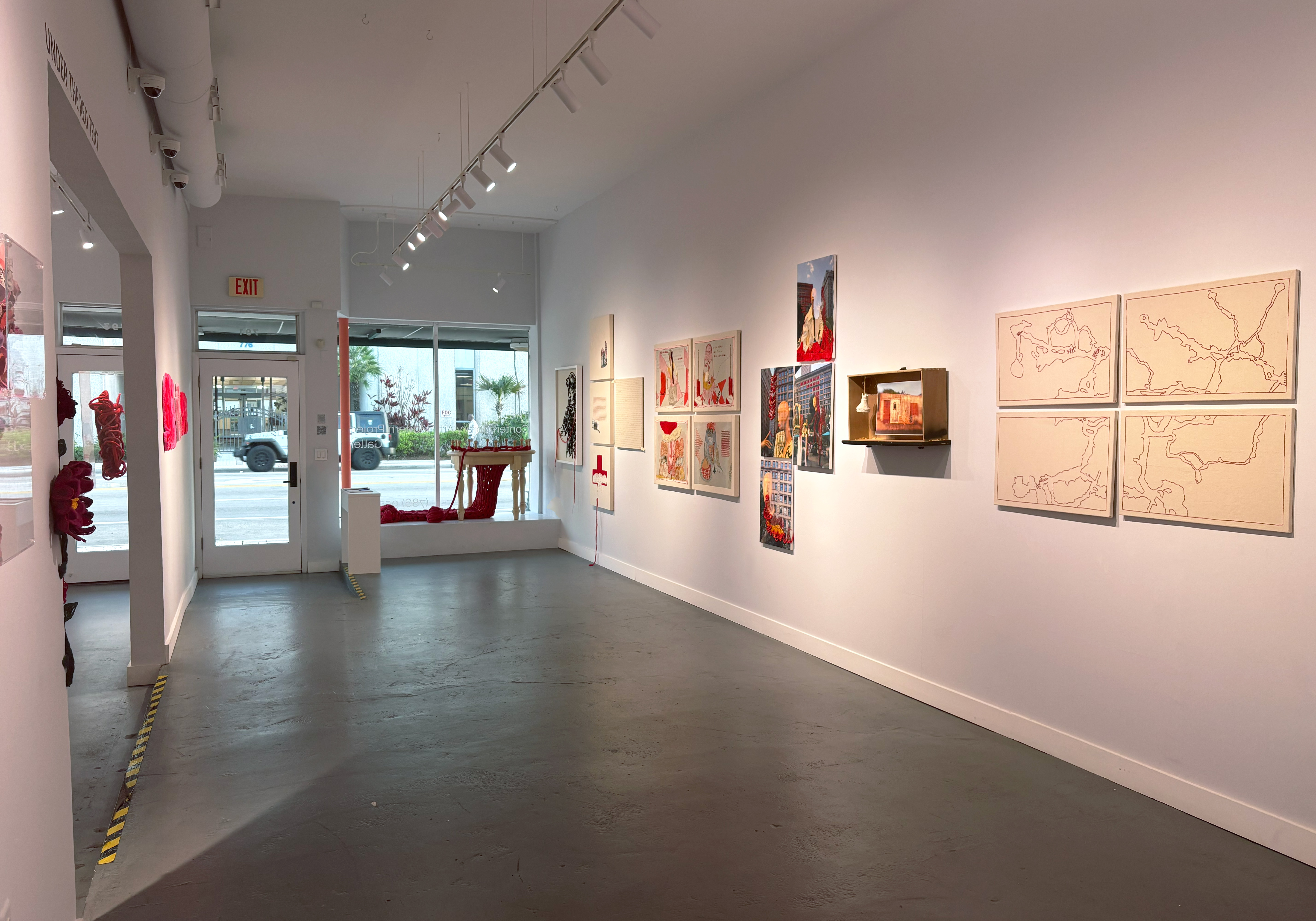 Under The Red Tent, courtesy The CAMP Gallery
This natural gravitation toward inclusion and interdisciplinary practice can also be seen in the through-line of the artists she champions. CAMP’s mission is primarily geared toward the fiber arts, an often overlooked and unappreciated practice (at least for the last few centuries, though that’s now changing). Prapopoulos’s focus not only comes from the reality that many of those who work with textiles are women, or indigenous communities, but also the very practical reality that fiber works are more sustainable and less expensive to produce than an oil painting for example.
“I was drawn to fiber even as a young child,” says Prapopoulos. “I really began to be interested in textile artists when a friend showed me some of her textile sculptures, and I felt they were so interesting. It made me think about all the quilts that have been made in the United States and the often hidden subversive messages in those quilts. I started to become really intrigued with indigenous traditions and their textiles. On the surface the textiles looked so beautiful, but there's so much woven into them with intense meaning and message that it's not necessarily apparent to the naked eye. If you look at a quilt or a textile, you don't necessarily know what it's talking about unless you take the time. Fiber sometimes makes you work for it in a way that painting doesn't.”
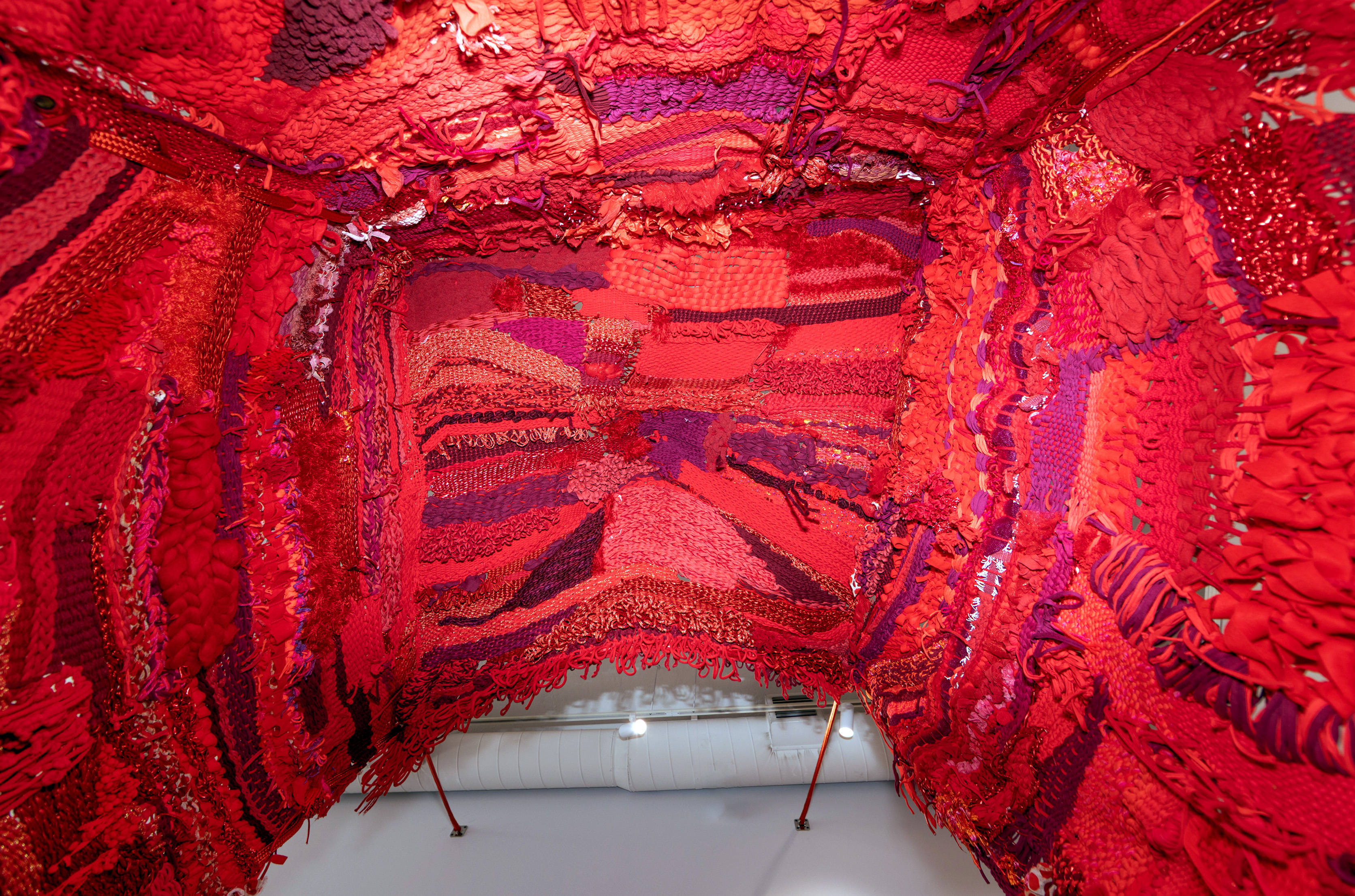 Under The Red Tent, photo: Marine Fonteyne, courtesy The CAMP Gallery
CAMP’s dedication to alternative space has only snowballed with the support of intentional community building. Their ongoing exhibition Under the Red Tent (March 8 - April 26, 2026) extends this model into physical form. Presented by Red Thread Art Studio Miami at The CAMP Gallery, the immersive fiber installation opened on International Women’s Day. Organized around a collective of more than twenty women artists—including Aida Tejada, Angela Bolaños, Anna Biondo, Aurora Molina, Bella Cardim, Cynthia Passavanti, Debora Rosental, Eva Llarena, Fernanda Froes, Flavia Fortuna, Flor Godward, Juliana Torres, Katia Bandeira de Mello, Marine Fonteyne, Mila Hajjar, Mirele Volkart, Paola Mondolfi, Robertha Blatt, Sarah Laing, and Susanne Schirato—the exhibition reimagines the gallery as a shared sanctuary built from thread, conversation, and lived experience.
Throughout the run of the show, performances, workshops, and gatherings activate a living oral history archive in which visitors are invited to contribute personal narratives that gradually become part of an evolving audio environment within the installation itself. The title draws from the novel The Red Tent by Anita Diamant, where the red tent functions as a place of communal retreat and generational storytelling. Here, that symbolic space becomes material: a woven, cocoon-like environment unified by the color red, the thread of life, labor, danger, protection, and continuity, where textile becomes both medium and message, and where the act of gathering is itself the artwork.
Beyond this, there are workshops, performances, and conversations held in tandem with the exhibition, creating a multitude of opportunities for those in Miami to participate. Though it’s not officially part of the gallery’s annual show called Women Pulling at the Threads of Social Discourse, which first began in 2019, it certainly adds to the conversation.
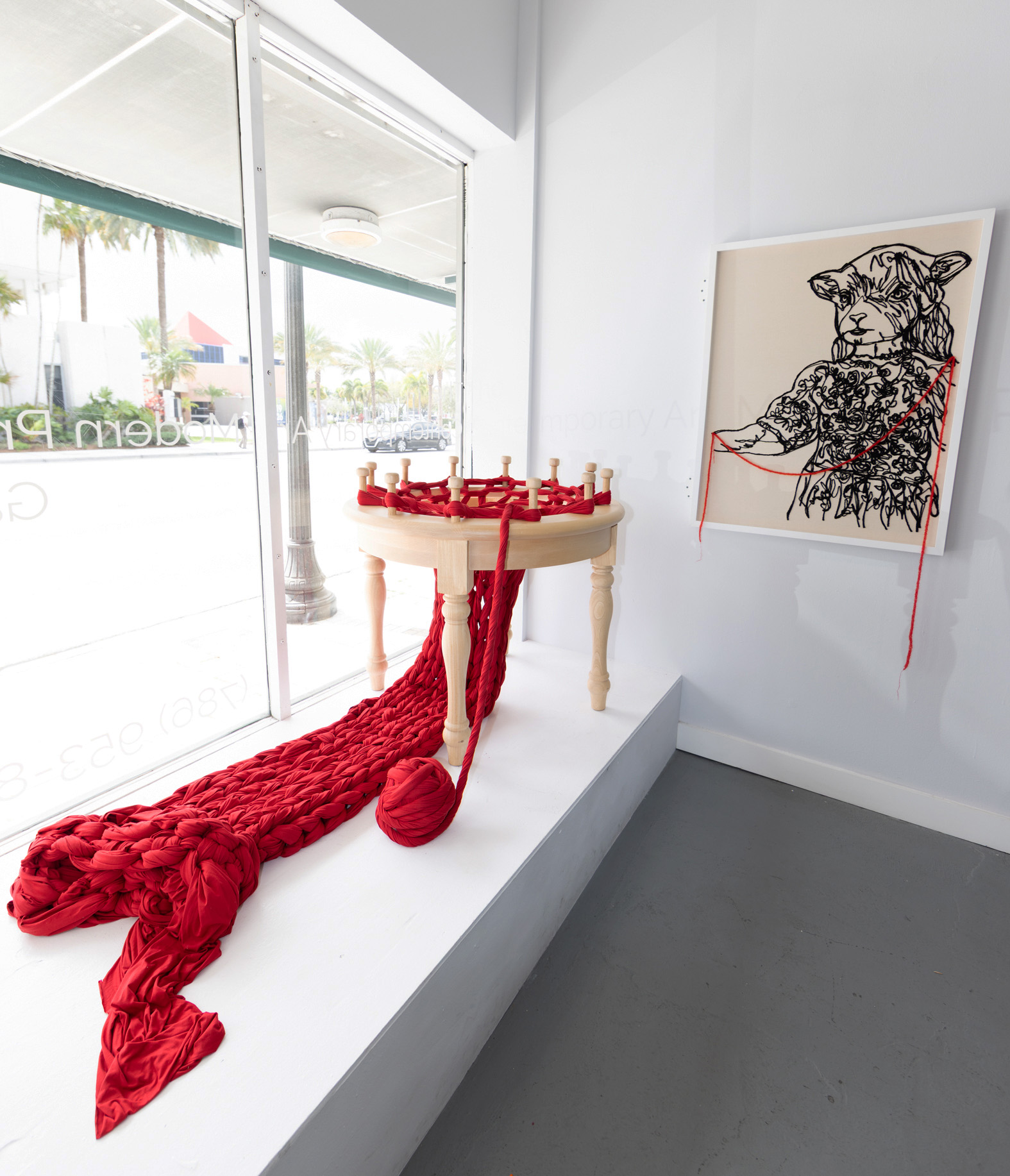 Under The Red Tent, photo: Marine Fonteyne, courtesy The CAMP Gallery
In a similar fashion, the yearly group show provides a prompt for artists to respond to, opening avenues for wide interpretation and diversity. “The Women Pulling show began with Aurora Molina and I in 2019,” says Prapopoulos. “The first one we ever did was with only eight artists. We explored fiber artwork from a Marxist perspective. And then in 2020, the year that marked the centennial of the ratification of a woman’s right to vote, we did it with 40 artists creating flags. They did not necessarily have to be the American flag. The only constraint was size and shape. It was a beautiful, beautiful exhibition, which then traveled to the MOCA in Connecticut. They saw it online and they asked us to bring it up. When we brought it up though we added local artists to the conversation because I wanted to see where this as a social project could add to the exhibition. I wanted to see the differences in the voices of the artists. After that, the exhibition traveled to the Jewish Museum of Milwaukee to bring the show there, and again we added new artists to the exhibition. It was really fascinating to see, given one particular prompt, how artists react when added to the rolling conversation. Ever since then we’ve done an exhibition every year.”
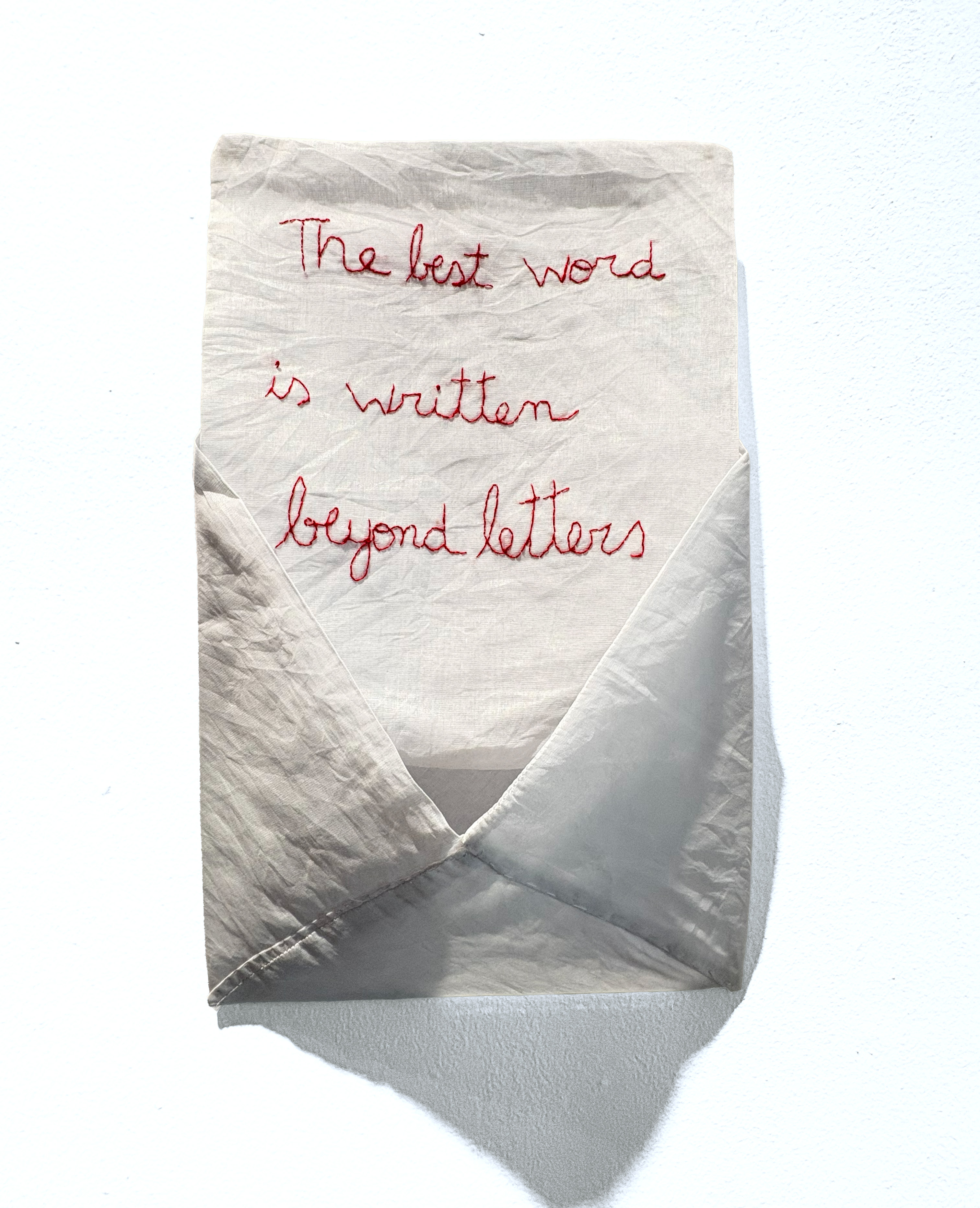 Under The Red Tent, Love Letter, Marine Fonteyne, courtesy The CAMP Gallery
In May, CAMP will be going to the Future Fair in New York (booth U4), and then VOLTA Art Fair (booth C14) during Art Basel. The prompt for this year’s Women Pulling at the Threads of Social Discourse: The Epistle (opening in October) will be an epistolary one. The selected works will be small portraits signed in fiber and handwritten letters to other artists, hoping to keep it very personal. “They are the eyes and the soul of a community,” says Prapopoulos about creatives. “It is their purpose to remind us of our humanity, and our sense of being.”
To learn more about CAMP’s program, please visit their website here and follow on Instagram @thecampgallery

Carlota Gamboa
Carlota Gamboa is an art writer and poet from Los Angeles. You can find some of her writing in Art & Object, Clot Magazine, Salt Hill Journal, Bodega Magazine, Oversound and Overstandard.
view all articles from this author