Whitehot Magazine
October 2026
"The Best Art In The World"
"The Best Art In The World"
October 2026
Robert Obier on Temporal Ambiguity in Sculpture
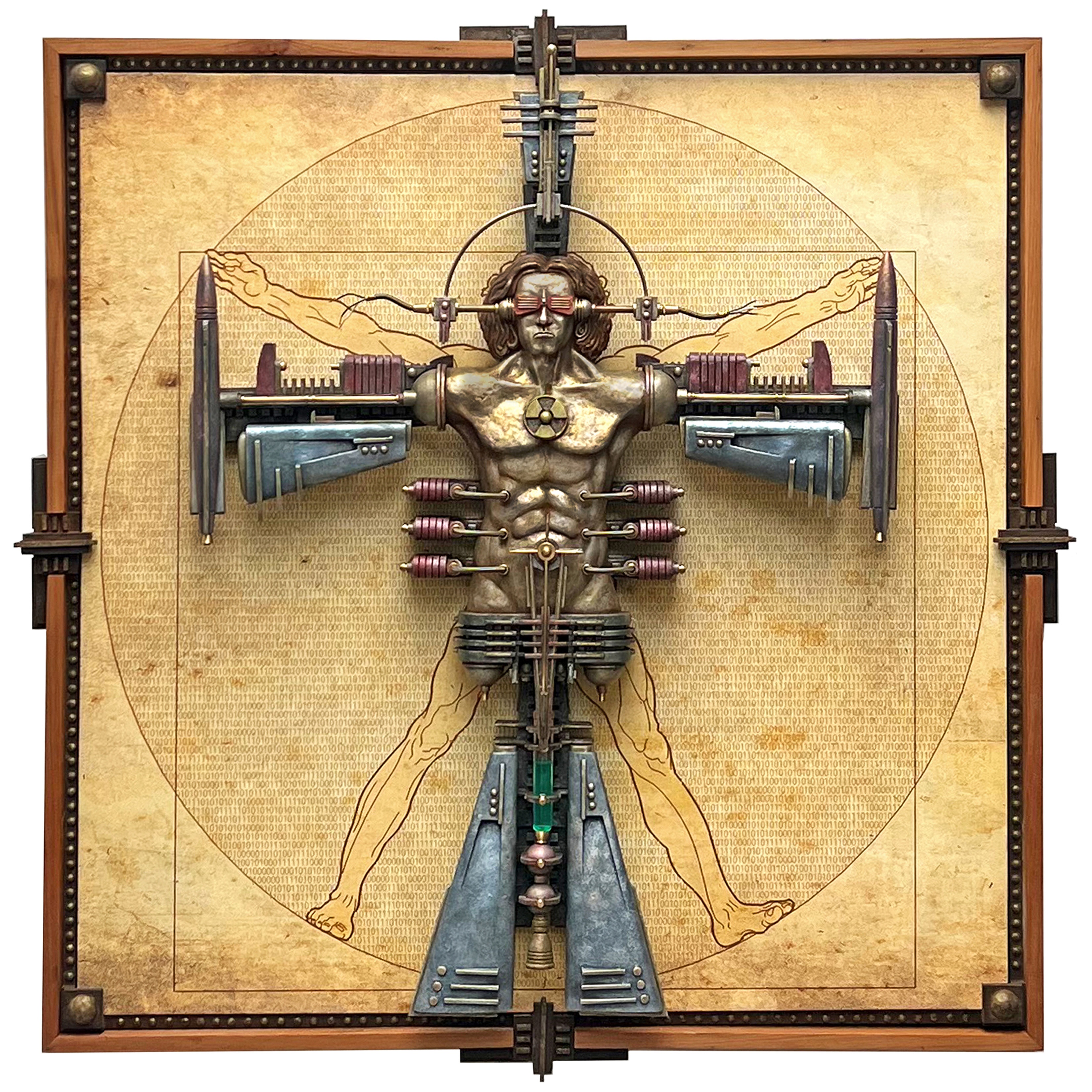 Robert Obier, Renaissance Man 2.0 (Science), 2023, Mixed Media, 54 x 54 x 8 in
BY Victor Sledge April 30th, 2026
Robert Obier is an architect and artist whose sculptural work suggests that human perception of the past, the present and the future occurs simultaneously. “We view the world through an ageless lens,” he says. “This perception is both a temporal ambiguity and an opportunity to imagine other possibilities represented by these works."
We all have knowledge of the past while living in the present and dreaming constantly of the future. Obier’s work visualizes this experience, giving it physical contours that place us in a liminal place in and out of time.
Obier’s sculptural work can sometimes look like an ancient artifact. Other times, it can look like a prototype of work from the future. Perhaps a reference to retrofuturism aesthetics, he creates these works by combining woodworking, metalworking and digital processes to create a balanced resolution of traditional craftsmanship and innovative technological technique.
“The ultimate goal is unity, and the ultimate achievement with the development of a piece is complete resolution,” he explains. As an architect and industrial designer, Obier spent years exploring this concept of construction and problem solving.
He says, “One of the fundamental aspects I have worked on throughout my entire career is this understanding of an organizational discipline – the idea that there is a unifying methodology by which shapes are assembled and integrated to create form.”
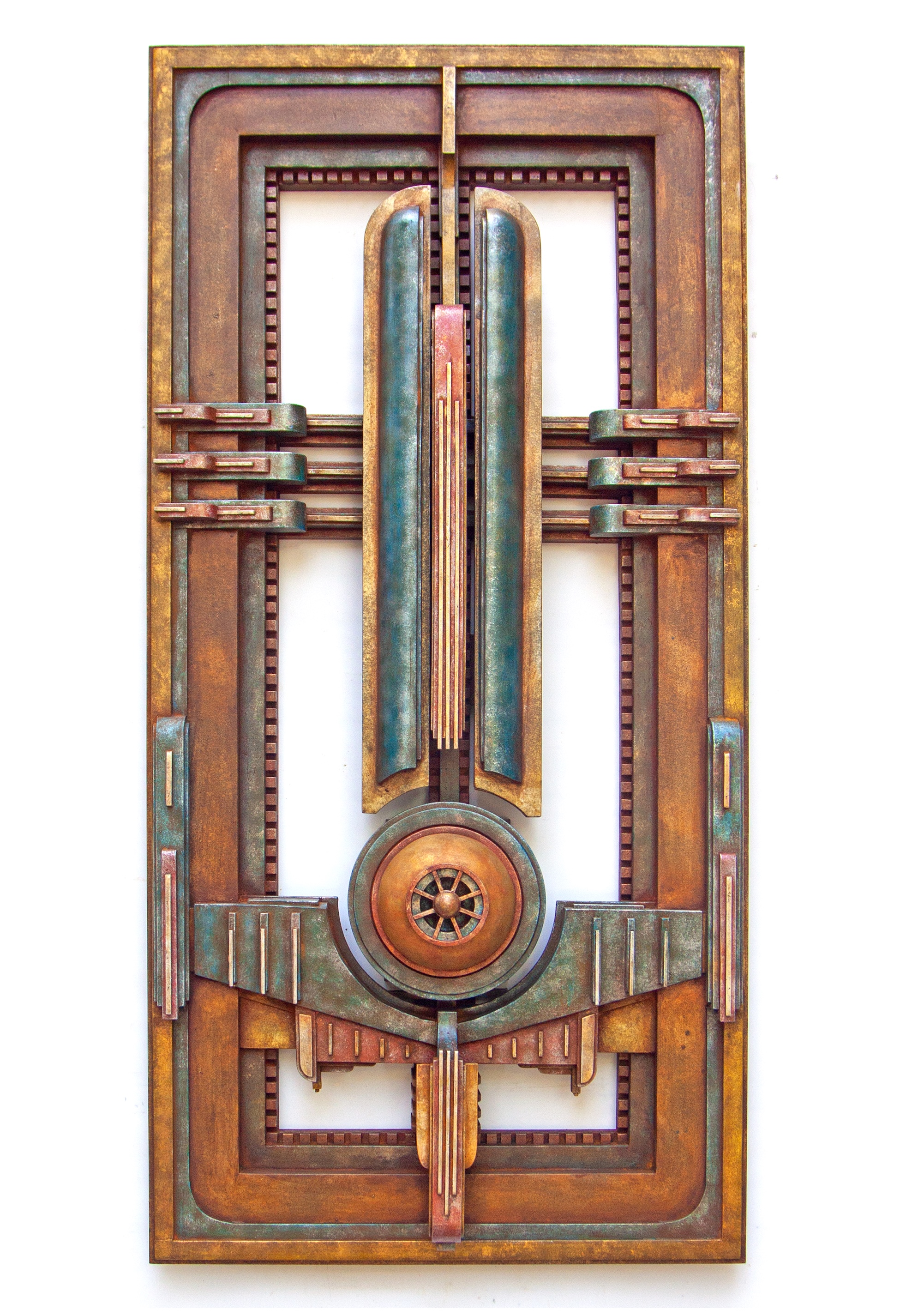 Robert Obier, Diesel Deco - Iteration #1, 2024, Mixed Media on Wood, 47.5 x 23 x 7.5 in
“The artistic process is one of continual decision-making and evolution,” he says. “Precisely how our vision, as an artist, gives shape to this process and informs our creative impulse has been a source of wonder my entire life.”
This sense of wonder is central to both retrofuturism and futurism, albeit in different directions: the former looking at how the future was imagined in past eras, the latter looking towards the future given technology’s current advancements. In either case, the Obier’s approach is to reach a final harmony and balance. “For the civilizations that came before us, the ultimate goal when creating architecture or objects was to achieve this balance, harmony and unity in the final form,” he says. “To properly be aligned with creation and to achieve deeper meaning from the observable world.”
He likens the process to a musical composition. “We all recognize the sound and structure of melody. Yet we can immediately distinguish random sounds as noise. As an architect and artist, it is this quality of composition and melody that I continually strive to achieve.”
This may be why in his sculptural work there is often a symmetrical pattern. One side of a piece always feels in connection with its opposite. No element of any sculpture feels random or abstract. Every detail of Obier’s work has its place, fit into a careful composition, whether that composition feels mechanical or organic.
Obier views his career as an artist as a natural extension of his work as an architect and industrial designer. In his sculptural work, you can clearly see those influences, offering an insight into Obier’s evolution as an artist. He says, “The ‘storytelling’ aspect that I endeavor to achieve in design is an essential element in my work as an artist.
It could be the story stemming from something he learned about transportation design in school years ago, or it could be the fantasy that comes with one of his more futuristic pieces. When you look at his work, you’re always experiencing more than what meets the eye, a narrative tied to shape and form rather than language to communicate truths about our connection with time and civilization.
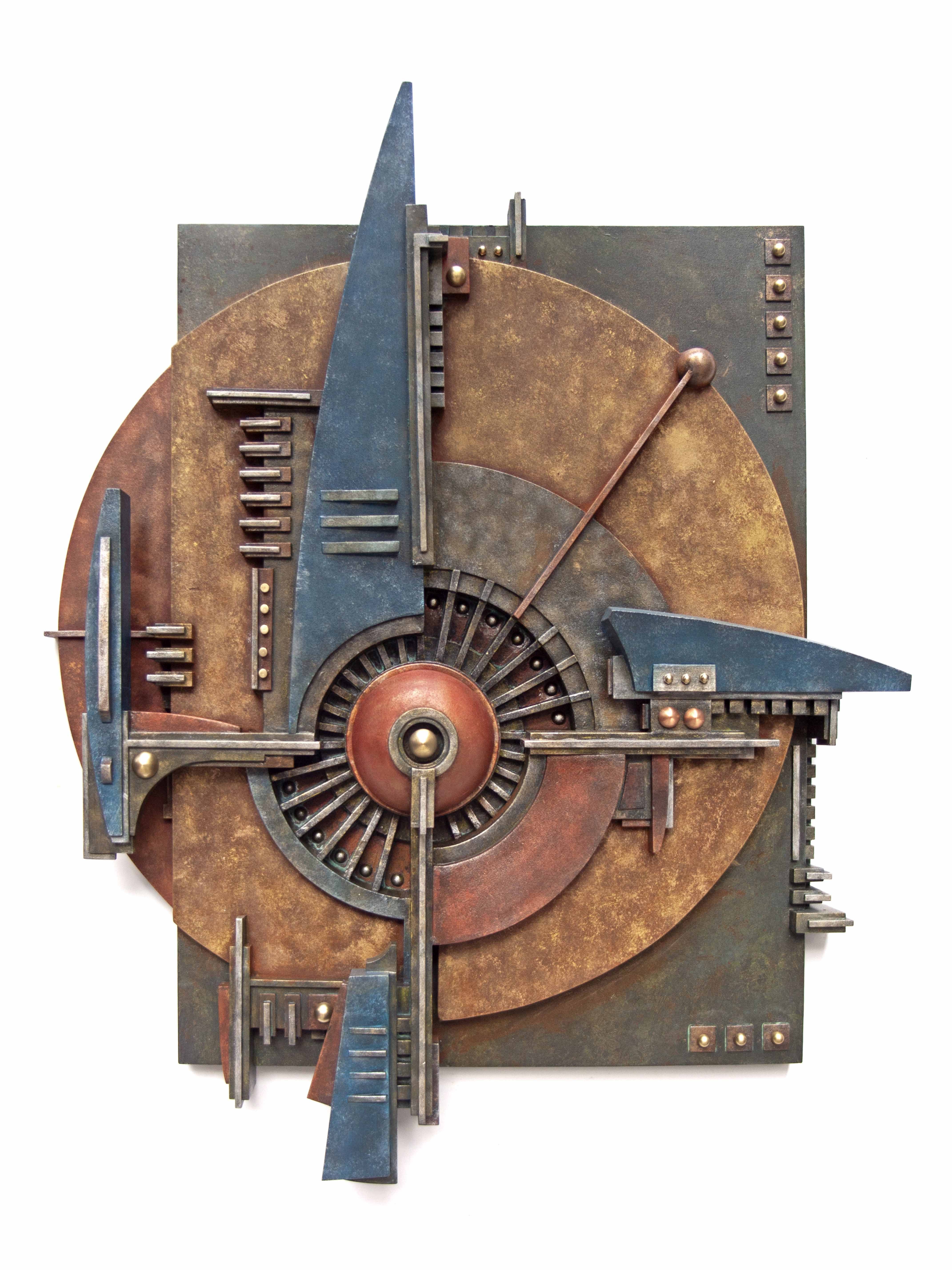
Robert Obier, Solar Wind, 2025, Mixed Media on Wood, 40 x 32.5 x 7 in
On the surface, his Renaissance Man series seems to tell a story of his fascination with the drawings and creations of Leonardo Da Vinci. On a deeper level, he’s speaking to this moment we live in between humanity and technology that he refers to as Renaissance 2.0.
The Renaissance was the beginning of our modern era of science, technology and art. “I believe we are at the beginning of a new such era as a result of artificial intelligence,” he explains. “Therefore, I am exploring the great opportunities and incredible dangers we face contending with this game changing technology and the complexities of the modern world.”
Maybe it’s because when Obier started his journey as an architect, computers weren’t a major factor in his world or in the world of an artist. But years later, computers have become a more consistent part of his artistic process. Now, even though it’s not a direct part of his artistic efforts, artificial intelligence can perform so much of an artist’s work with the simple press of a button.
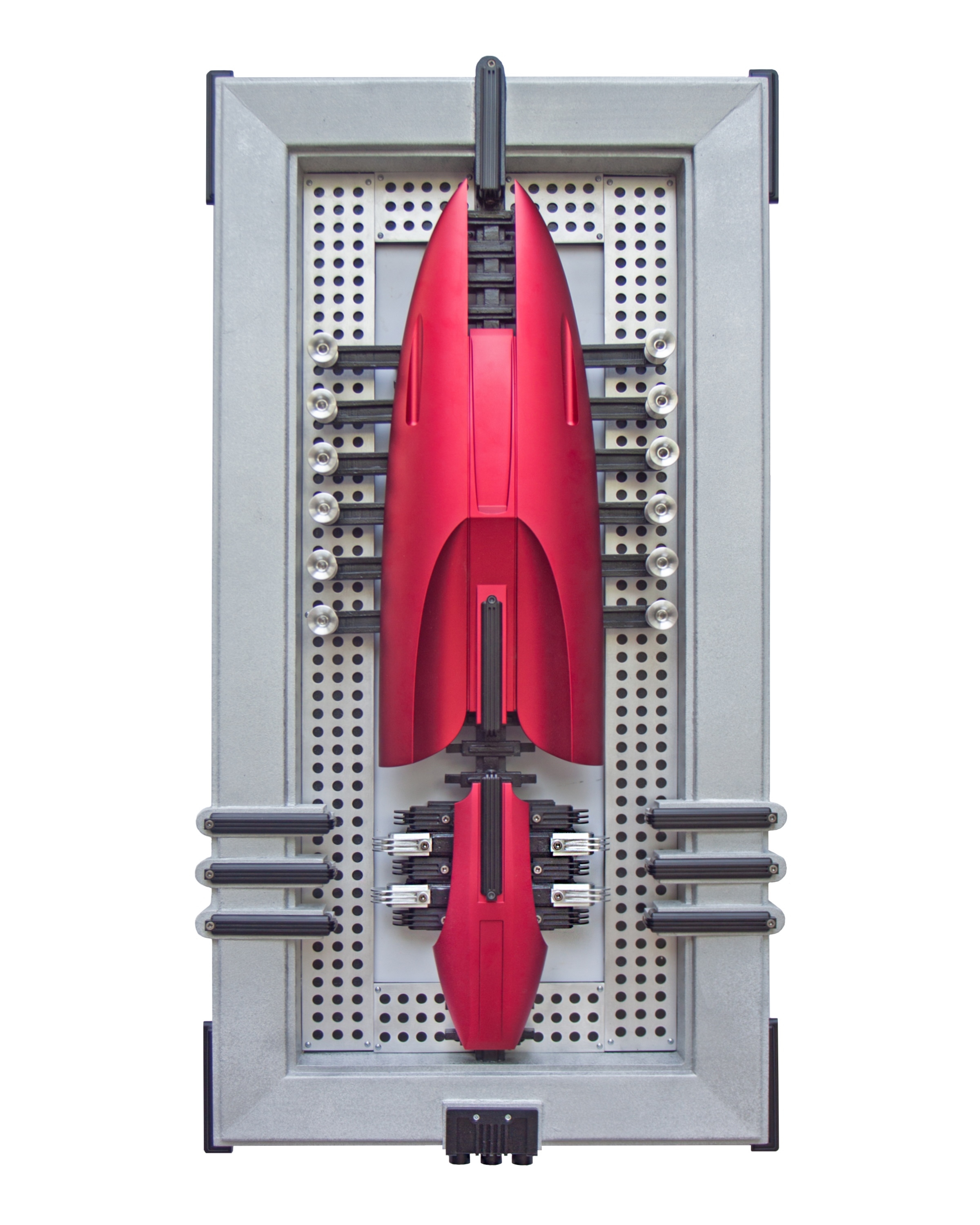 Robert Obier, Formula 1x - Sylvia 2/12, 2025, Mixed Media - Anodized Aluminum - Wood, 37 x 18 x 5 in
When asked about how artists can tap into practices of the past to help inform what art can be in the future as tech continues to advance, he says, “I don’t know that there’s ever been a time in history where it’s been so difficult to answer a question like that because of AI.”
And yet, he has work like the Renaissance Man 2.0 series that places a human at the center of it all. It seems to mirror the artist’s experience in this time, surrounded by technology and a host of tools to automate one’s craft, while people like Obier are still employing traditional craftsmanship to tell stories about our shared humanity and imaginative futures.
The origin of each piece, Obier says, is a simple and very quick hand sketch. “For me, this is where the magic happens. The hand and the mind work together to capture that fleeting spark of creativity. After that point, everything else is execution.”
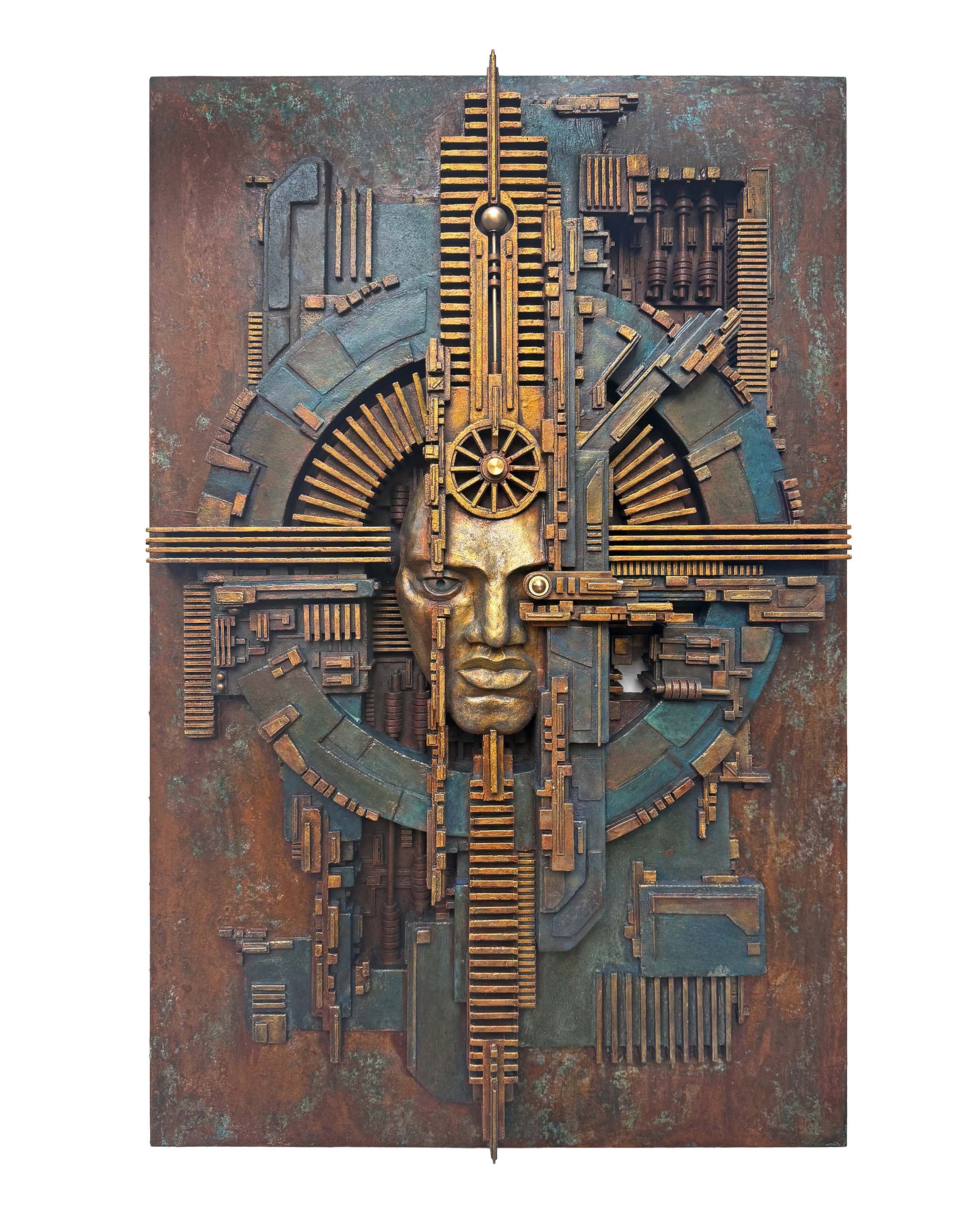 Robert Obier, Atlantis 2.0 - Ghost of the Singularity from the Digital Deep, 2025, Mixed Media, 44 x 28 x 6.5 in
Now that he’s at a place in his career where he’s joined the manual craft of his work with the digital enhancements (and concerns) of technology, there’s almost a full circle moment where he’s learned how to level the two and use technology on his own terms.
And that’s the sort of response his work inspires. Technology and craft are not diometrically opposed. In fact, when put together in Obier’s work, they become quasi-monuments that look beyond both toward humanity’s most elemental truths about harmony, unity and the coming together of sometimes radically different forms and moments in time.
“That’s what these pieces are meant to embody – different ways of understanding our humanity and where we as a people have been and are going,” he says.
If you want to learn more about Obier’s work, you can visit his website and follow him on Instagram @obierstudios

Carlota Gamboa
Carlota Gamboa is an art writer and poet from Los Angeles. You can find some of her writing in Art & Object, Clot Magazine, Salt Hill Journal, Bodega Magazine, Oversound and Overstandard.
view all articles from this author