Whitehot Magazine
October 2026
"The Best Art In The World"
"The Best Art In The World"
October 2026
On the Photography of Colin Snapp
 National Charter, 3rd June, 2023 — 29th July, 2023, Galerie Allen (All photos courtesy of the artist and Gallerie Allen)
Colin Snapp
National Charter
3rd June, 2023 — 29th July, 2023
Gallerie Allen
6 passage Sainte-Avoye
75003 Paris, France
By JEFFREY GRUNTHANER, July 2023
Colin Snapp's photos document reality by way of the image. Without concealing anything, they contextualize the body politic which surrounds them, highlighting overlooked social and political hierarchies. In this, Snapp's allusions to brands, iconic regions earmarked by the perpetual traffic of tourism, and obtrusive industrial structures, become less representative of our everyday world, and take on the properties of a symbol. Viewers can read into Snapp's images the journeying visibility of an era—the era where we presently live—while also glimpsing something of the emerging alterity intrinsic to any incomplete process.
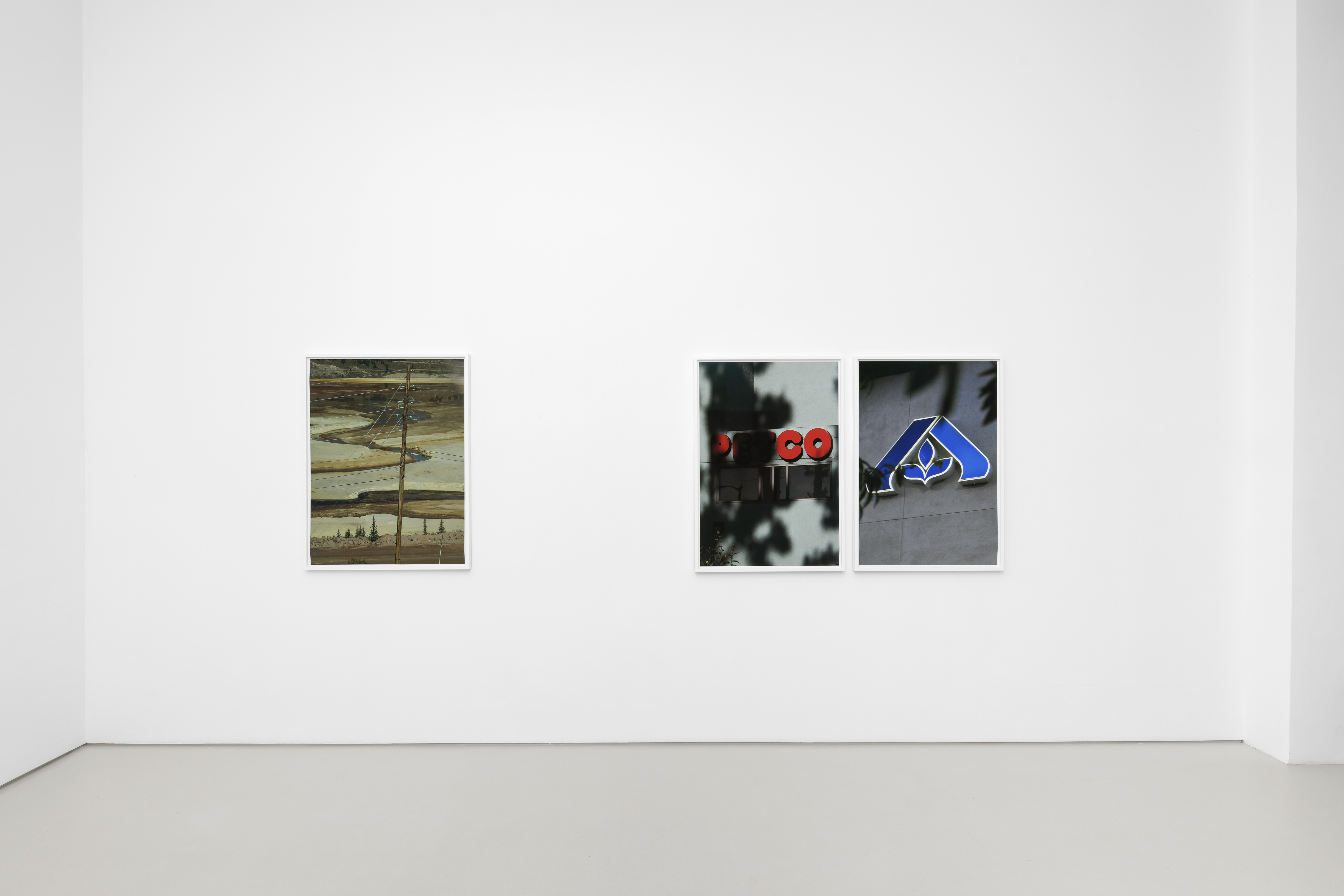 National Charter (Installation shot)
The distance which Colin imposes on his viewers—a voyeuristic spatial distance not unlike a temporal delay—marks his work less as documentarian, and more like the afterimage of an eventful constellation of processes. A core aspect of Colin‘s working methods is that the vantage point of the observer—along with the acculturated attitudes, perspectival habits, and semantic glosses this vantage point implies—dissociates from, rather than reflects, the unitary identity of the structures captured across each image.
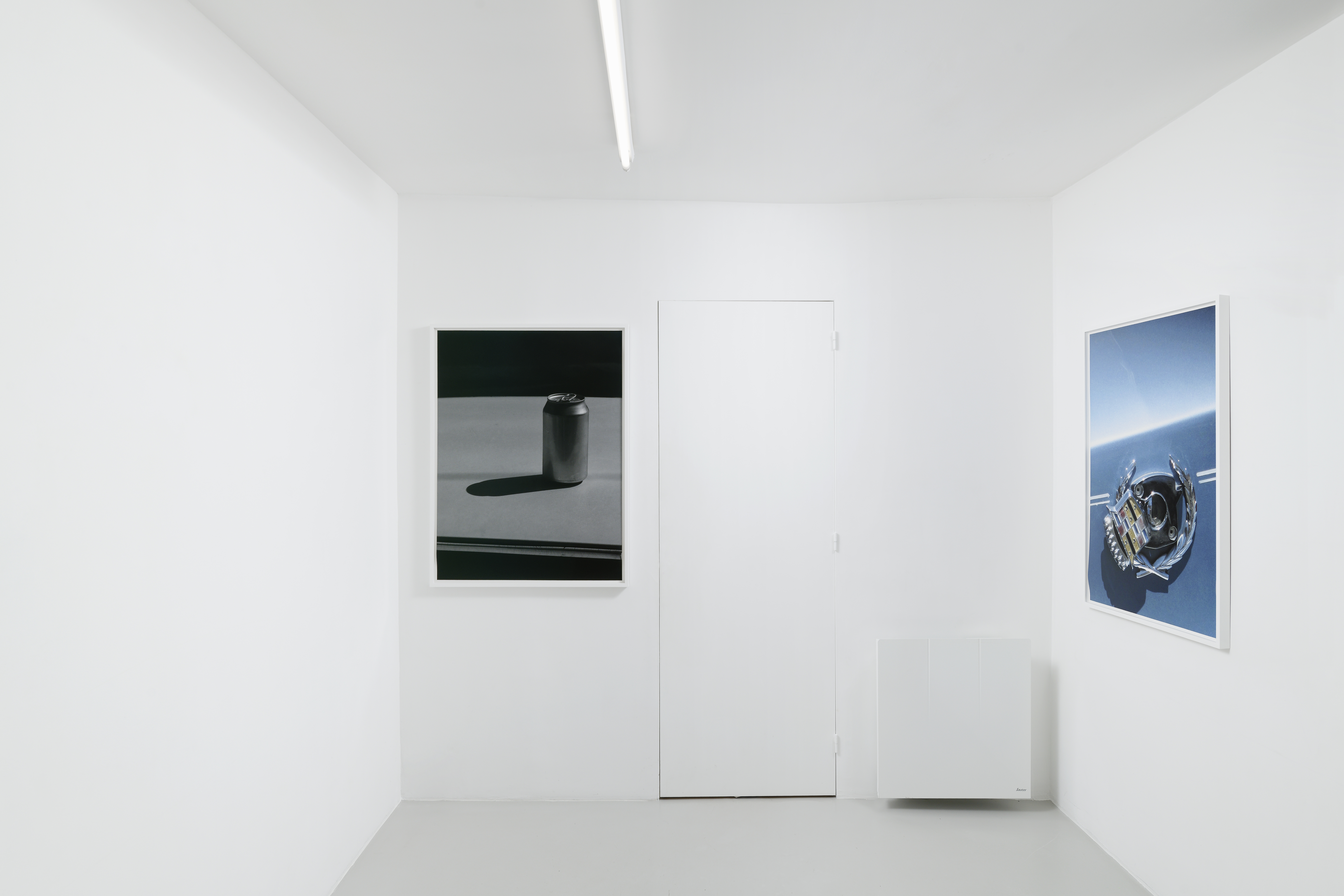 National Charter (Installation shot)
 Colin Snapp, Nataional Charter
The placement of the observer, in other words, the ideological techniques he has available for seeing past an image towards the object it captures, is irrevocably destabilized. But along with this, something happens in the reverse, which Colin's work also takes into account: and with more poignance than can be mustered by most photographers working today. The ideologies intrinsic to the enframing of the objects Colin captures equally define and stabilize how the observer can appear to himself. Colin captures situations that explicate their own possibility, mirroring the viewer in an already unfolding process of re-evaluation.
 Colin Snapp, National Charter
Colin's images are strays, countercultural ensigns which document that very culture they originate from, while also mysteriously standing apart from this same culture. Here, we're not speaking of monopoly capitalism, tourism, or, really, any other particular demographic that would easily fall in line with sociological analysis. Rather his photos exude an air of mystery, tracing out vestigial unknowns which swarm the positive phenomena specified by each image.
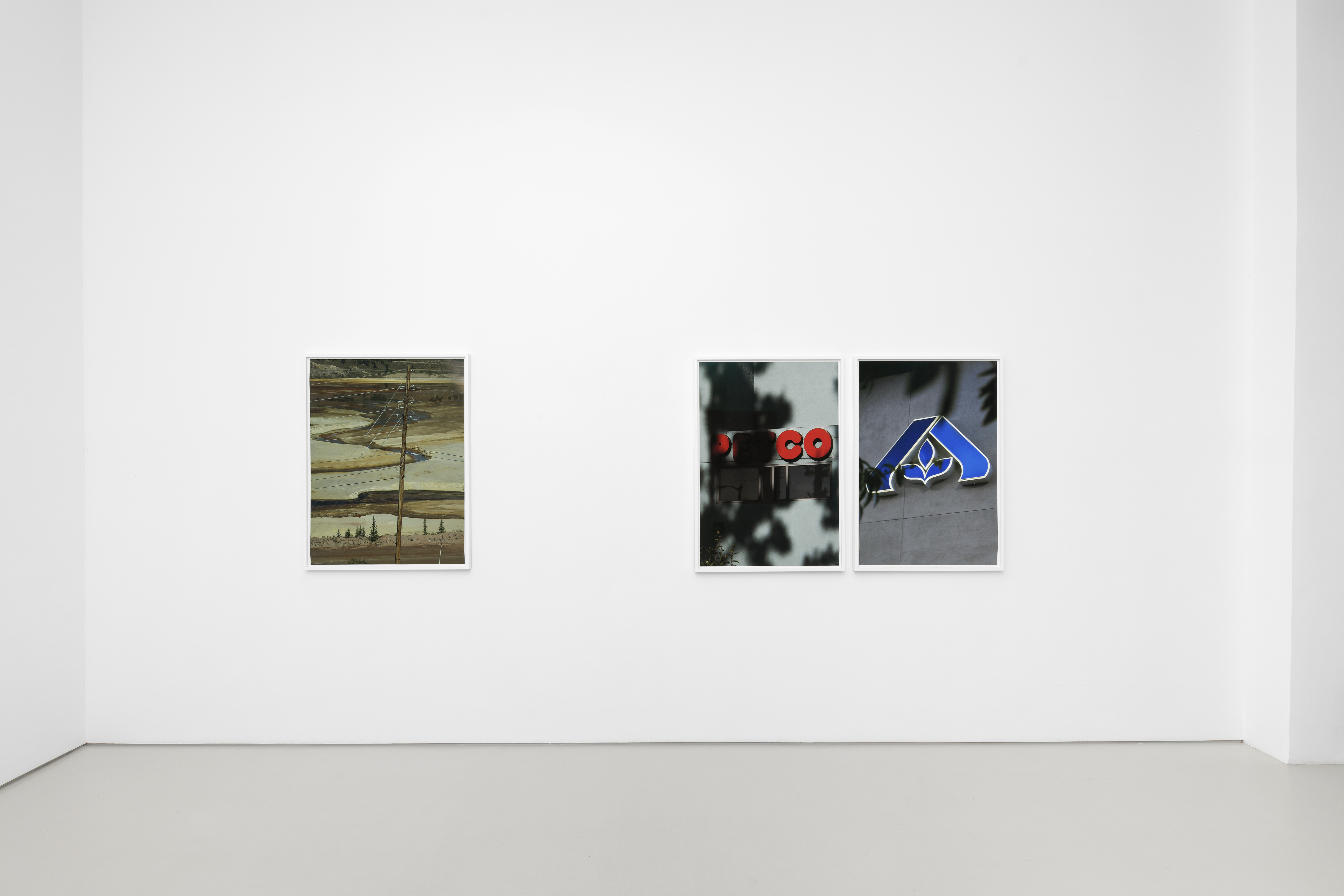 National Charter (Installation shot)
While Colin's work continues the pioneering intrepidity of American photography delineated by artists like Alfred Steiglitz, his work differs in its sheer contemporariness. The timeline he occupies is discontinuous from former efforts, for one reason, because his work occupies an uncanny ether wherein the photograph and the image (reality and its double) simultaneously converge and displace one another. They're displaced in that digital photography generally allows for a more nuanced, almost aleatory capture of any given situation. Similar to how CDs trump records when it comes to sound quality. But Colin‘s work also toys with allusions to the analogue precedents of photography. At his best, Colin's photos will draw a magic circle around the situated bulkiness, the dimensional universality of a structure like an office building or the branded logos which adorn its facade. But it’s beyond the limitations of this circle where the specific register of Colin's work takes effect. Unlike Steiglitz, who looked out into the world with a new medium, Colin everywhere pushes against the picturesqueness of the static image—a sort of banishment ritual where the limits of photography (conceived as an essentially voyeuristic medium) consorts with the mirage of something not directly visible, but which remains unambiguously articulate.
 National Charter (Installation shot)
The generation of artists Colin falls in line with inhabits the oceanic currents of the image like a Piscean grid. And however much I might be exposing myself to the criticism of being old fashioned for saying this, it’s to Colin's credit that his work does not, in fact, register as merely a collection of images, such that can be displayed on an IG account as much as anywhere else. His work requires a physical setting, the architecture of a gallery or museum, to be appreciated for what it truly is. This speaks worlds for what he has accomplished; as opposed to many of his less intrepid, more studio-confined brethren, whose works are readily disseminated by algorithms or artist books, Colin's output is always on the wing. Beyond the confines of a studio setting, his work most comfortably alights against the white walls of a gallery—if only because opposites attract.
The logic of non-containment, of space understood as something which overwhelms immediate perception with an infinitude of potential linkages, juxtapositions, and continuities, runs through the gamut of Colin's work. This is why so many of his photos quite literally thematize containers (offices, parks designated as natural preserves, buses and other modes of vehicular transport) while also touching on greater social realities that are totally different from the everyday rituals and routines we‘re accustomed to. This quality of difference envelops Colin's photos like an aura. Incorporating time as much as space, history as much as geography, acculturated symbols and their fixed or fluid meanings, Colin's vision seeks to explicate how context itself emerges: how rituals of social behavior become mapped out and interlaced with architectures designed to maintain a more or less friable status quo.
 Colin Snapp, National Charter
Colin's approach disabuses us of the illusion that what a photograph captures is somehow concrete, substantial, autonomous. One step removed from immediacy, showing how social "facts" within the world are mediated, while highlighting this very act of mediation, the insignia Colin‘s work revolves around doesn’t celebrate the inevitable expansiveness of industry and the mechanisms of profit, but effects a detribalization of the spaces, objects, and experiences upon which these ever obtrusive mechanisms are built. In terms of this alienating vantage point, our naive understanding of the relationship between experience and experiencer, subject and object, breaks down, troubled by images that foreground the process of their own unraveling. WM

Jeffrey Grunthaner
Jeffrey Grunthaner's work explores symbolism, memory, and perception across poetry, music, and art.
view all articles from this author