Whitehot Magazine
September 2026
"The Best Art In The World"
"The Best Art In The World"
September 2026
Interview with Kathryn Kampovsky on her solo exhibition, The Fade
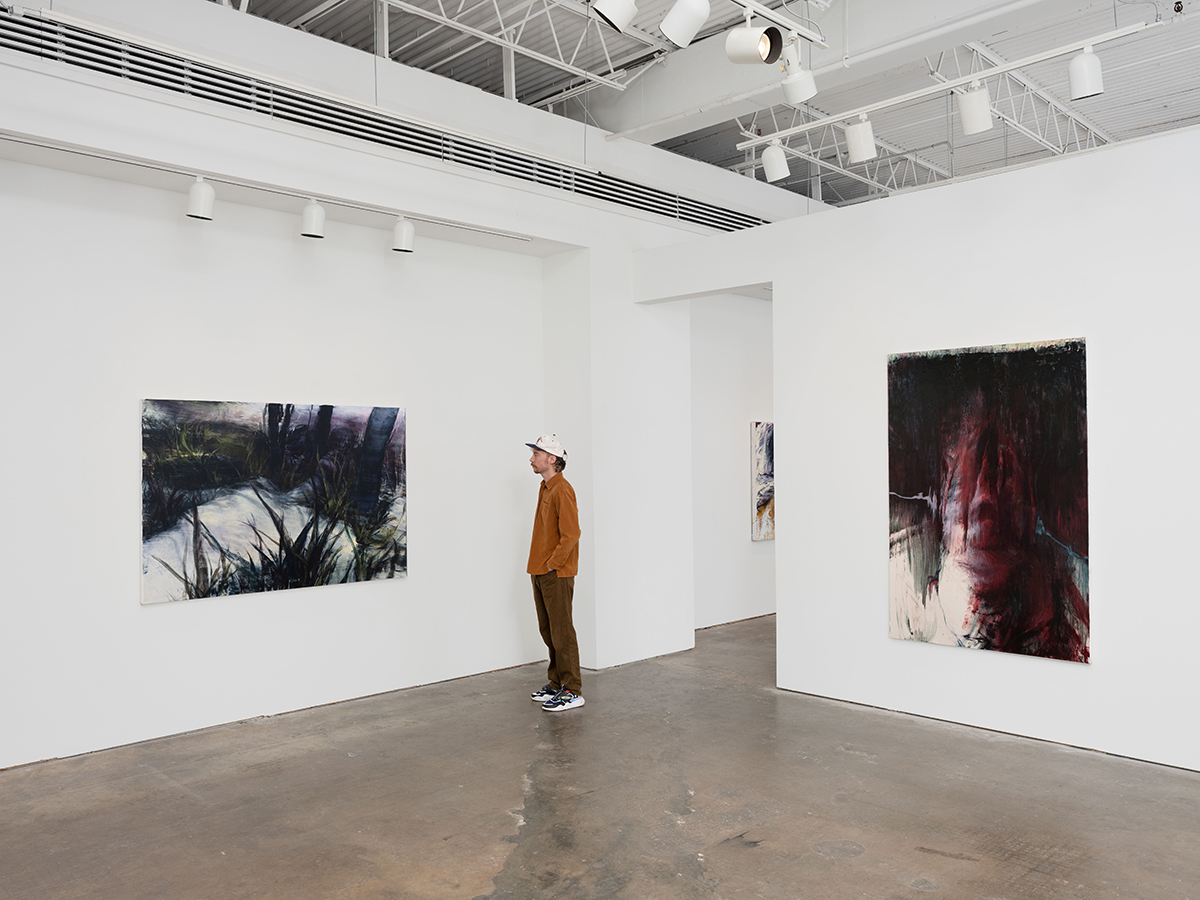 Kathryn Kampovsky. The Fade. July 24 - September 12, 2026. At Johnson Lowe Gallery, Georgia. Photo courtesy of Johnson Lowe Gallery
CLARE GEMIMA August 10th, 2026
Since this interview was conducted, The Fade has opened at Johnson Lowe Gallery in Atlanta, where Kathryn Kampovsky continues her investigation into painting as both corporeal record and psychological terrain. Built through weeks of accumulated gestures, abrasion, and revision, her paintings preserve the physical evidence of their own making, allowing earlier actions to remain visible beneath their final surfaces.
Figures poised between rest and collapse emerge through these layered histories, occupying a space where breath, mortality, vulnerability, and duration become inseparable. In the conversation that follows, Kampovsky reflects on painting as an event of the body, the necessity of preserving process, cinematic representations of women, and why disruption remains essential to keeping a painting alive.
The Fade is on view at Johnson Lowe Gallery, Atlanta, from 24 July through 12 September 2026.
Clare Gemima: Your paintings often begin through large physical gestures made before any figuration appears. You’ve described these marks as almost inseparable from exhalation itself. I’m curious what it means for you to think of painting not simply as image-making, but as a bodily event tied to breath, exertion, and release. At what point does a gesture stop being abstract movement and begin becoming psychological space?
Kathryn Kampovsky: When I consider paint as a medium, especially when it is used in a gestural manner, I think of it as a means to capture action and an event, tangibly. When I look at the gestures I've made, particularly at the beginning of a painting, it is clear to me that they were made in time with my exhalation. The pressure, the swiftness of the gesture, the way the paint lightens toward the end of a stroke —it all points towards a specific bodily presence. The painting and I are both experiencing that in real time. I think my action can be correctly imagined by looking at the result. I like to compare it to blood spatter analysis; seeing the pattern that blood makes can explain the event that caused it. Paint is the same, and the more movement and release of energy that's present in the initial mark-marking phase, the more compelling the visual trail becomes.
Clare Gemima: One of the most compelling aspects of your process is your insistence on preserving earlier layers of paint, allowing viewers to trace previous days and revisions within the finished surface. What draws you toward maintaining this visible accumulation of time, and does preserving those earlier gestures function emotionally, philosophically, or structurally for you?
Kathryn Kampovsky: A book I love called Art and Fear by David Bayles and Ted Orland puts this succinctly:
“The first few brushstrokes to the blank canvas satisfy the requirements of many possible paintings, while the last few fit only that painting —they could go nowhere else.”
I remember reading this long before I started working with paint in this manner, but it always stuck with me and I found it to be true, time after time. In order for me to look at a painting and see it as an object depicting an entire cycle of work, both the beginning and end must be visible. When that first day of accumulative gestures disappears completely, I have found that the paintings ultimately become less successful. I don’t want to look at my surface and see only the last days or hours that I spent with it. I want to see why the final brushstrokes are able to exist.
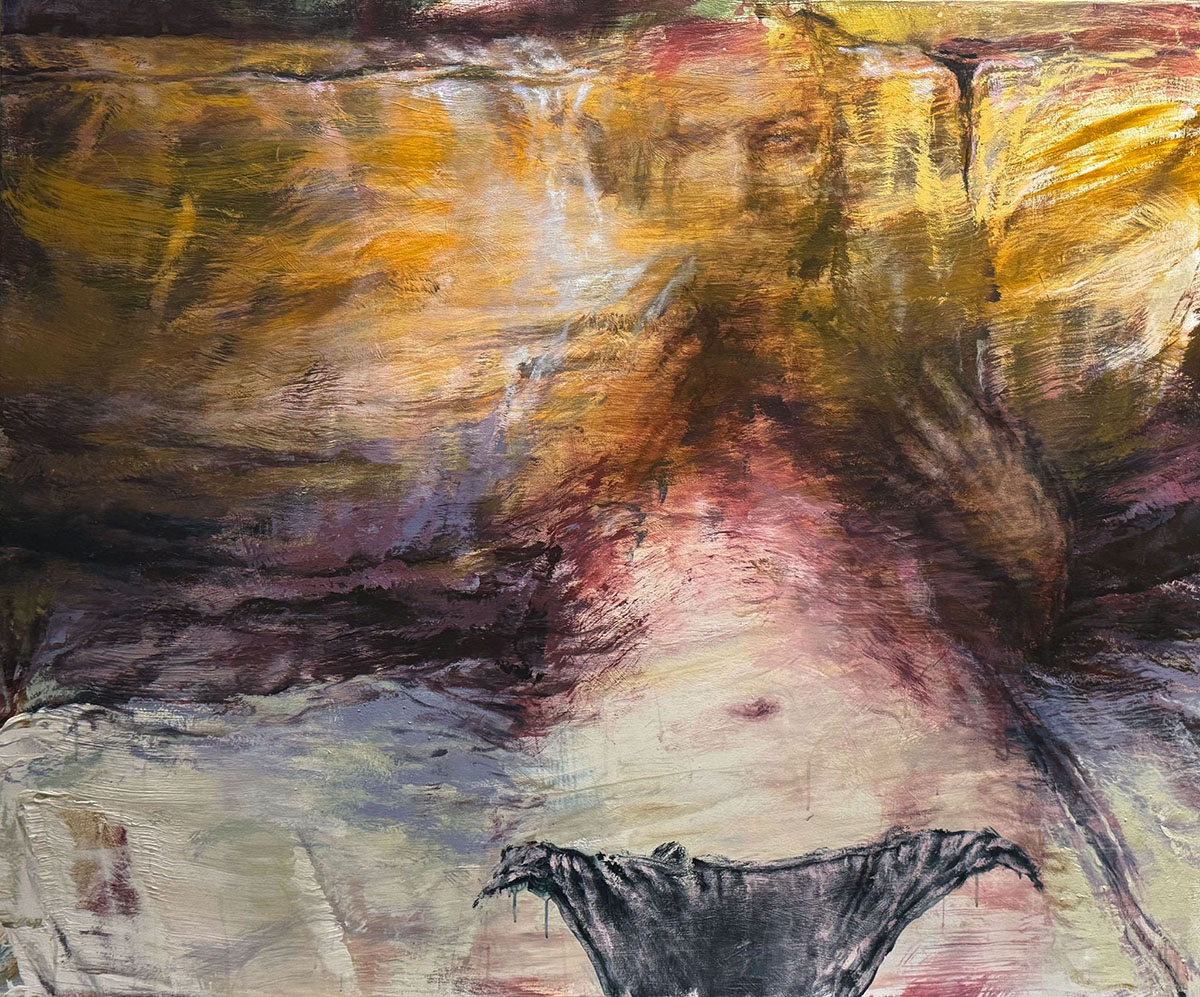 Sweet Rot, 2025. Acrylic on canvas. 60 x 72 x 1.5 in. Photo courtesy of Johnson Lowe Gallery
Clare Gemima: At the same time, the paintings are filled with gestures that feel energetic, forceful, and resistant. Do you see painting as a way of metabolizing fears surrounding mortality, or perhaps delaying them through the act of recording time materially?
Kathryn Kampovsky: I suppose my working theory about painting and art making in general is that it can be described more closely as a biological rhythm than an isolated, intellectual, or creative exploit. The process of working through a painting mirrors the steps of the life cycle itself, and some of those cycles influence the depictions in my paintings. The rhythm that hangs over everything is the cycle of birth–life–death. My paintings are finished, they have completed the cycle, so death is often depicted. When it comes to my personal relationship with death, I look at my desire to have each canvas hold a few weeks worth of my time in tactile eternity, and it’s hard to ignore the thought that I may be using painting as a way to remain on the planet in some fashion after death. I don’t really know, but I certainly wonder if that is part of the physiological urge to make art that sits in all of us.
Clare Gemima: You’ve spoken about the throat as a site of vulnerability, honesty, and instinctive protection. I’m interested in how this motif developed for you, and whether you think of the neck almost as an emotional register within the paintings?
Kathryn Kampovsky: The throat as a motif arrived over time. I noticed that in paintings where the throat of a figure was visible, it was one of the most highly rendered areas when compared to the other areas of the body. A throat can crease and depress like the folds of fabric, or it can stretch and expand as if it’s pushing into the viewer. I was visually interested in how I could use the neck to relay information about the figure at hand. A chin and body wrapped around a throat depicted in thick and energetic paint, shows a figure nursing a wound, or preventing access to its most vulnerable sites. A figure lying supine with their head reclined, has their throat on display, indicating a safety that could only exist in restful solitude.
In a literal sense, the throat is the breezeway between the body and the mind, it is also a point where the internal body and the external body are thinly veiled, making it a vulnerable site and one worth considering when painting certain fears of death.
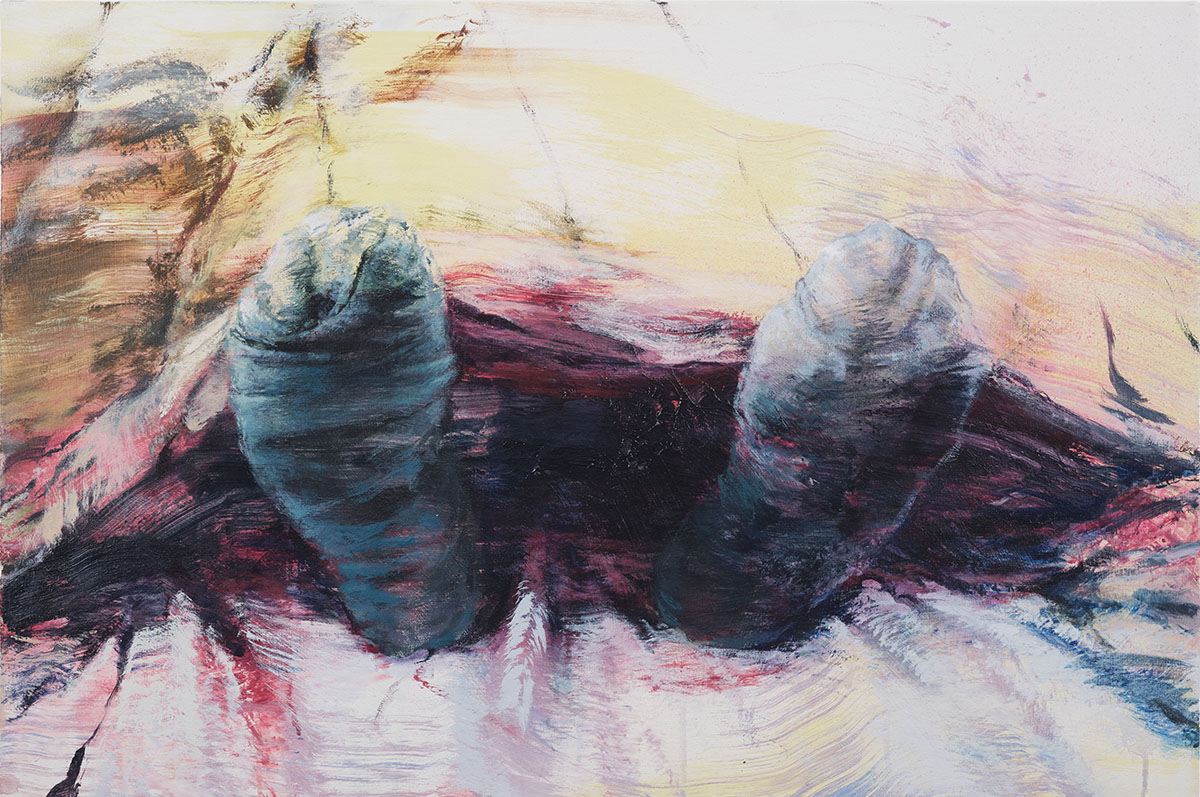 Gouge, 2026. Acrylic on canvas. 24 x 36 x 2.25 in. Photo courtesy of Johnson Lowe Gallery
Clare Gemima: Many of your source images come from film stills depicting actresses in moments of death or unconsciousness. You’ve said these images often feel “more truthful” than idealized depictions of women at rest. What do these cinematic moments reveal about performance, femininity, and the body that more conventional representations fail to capture?
Kathryn Kampovsky: When I began sourcing media of figures at rest, I noticed a significant difference in posing when it came to women. Namely, while it was easy to find a wide variety of men posing, women were depicted quite frequently either cartoonishly postured before a counterpart, preparing for and/or engaging in “sex”, or were seen battered, bloody, or discarded, depicting someone as good as dead.
I had an interest in both formats, because I’ve been interested in the cycle of arousal and the cycle of death as they pertain to the cycle of creating a painting. But the images of women during sex were so outlandish at times I could hardly consider them even pseudo-realistic. Even when the body was meant to be still or post-coital, the faces and bodies held an unnatural pose that not only failed to depict a body at rest, but also sex in its entire reality.
Overall, I found that the images of women who had been murdered in films were the images that resonated more with a post-climactic relief, and the figures were posed in a way that seemed to be truly relaxed. When the gore is stripped away, these ‘dead characters’ look peaceful and ambiguous, but decidedly alone and devoid of sexual performance. I gravitate towards them in my research.
Clare Gemima: There is a constant tension in your work between refinement and destruction. Just as a figure begins to emerge, another sweeping gesture may partially obscure or destabilize them again. You’ve described moments where a painting needs to be “fucked up” so the process can restart. How do you determine when a painting has become too resolved, and what role does disruption play in your studio?
Kathryn Kampovsky: I believe disruption is imperative. It is the best way to create a situation on the canvas that allows me to react in an unbiased way. Reacting in an unbiased way tends to lead me towards the most expressive and honest version of a painting. It’s hard to say exactly when a painting needs to be fucked up —it could be that the painting has lost movement, the composition looks muddled, perhaps the figure looks too rendered, or really any number of things. In my best moments, a disruptive movement is made out of curiosity. I want to make the painting better, and more often than not, making a movement or applying paint with bravado leads the work down a path I don’t regret, even if it can seem like a huge risk at the time. In the worst case, I begin again. A disruption in and of itself.
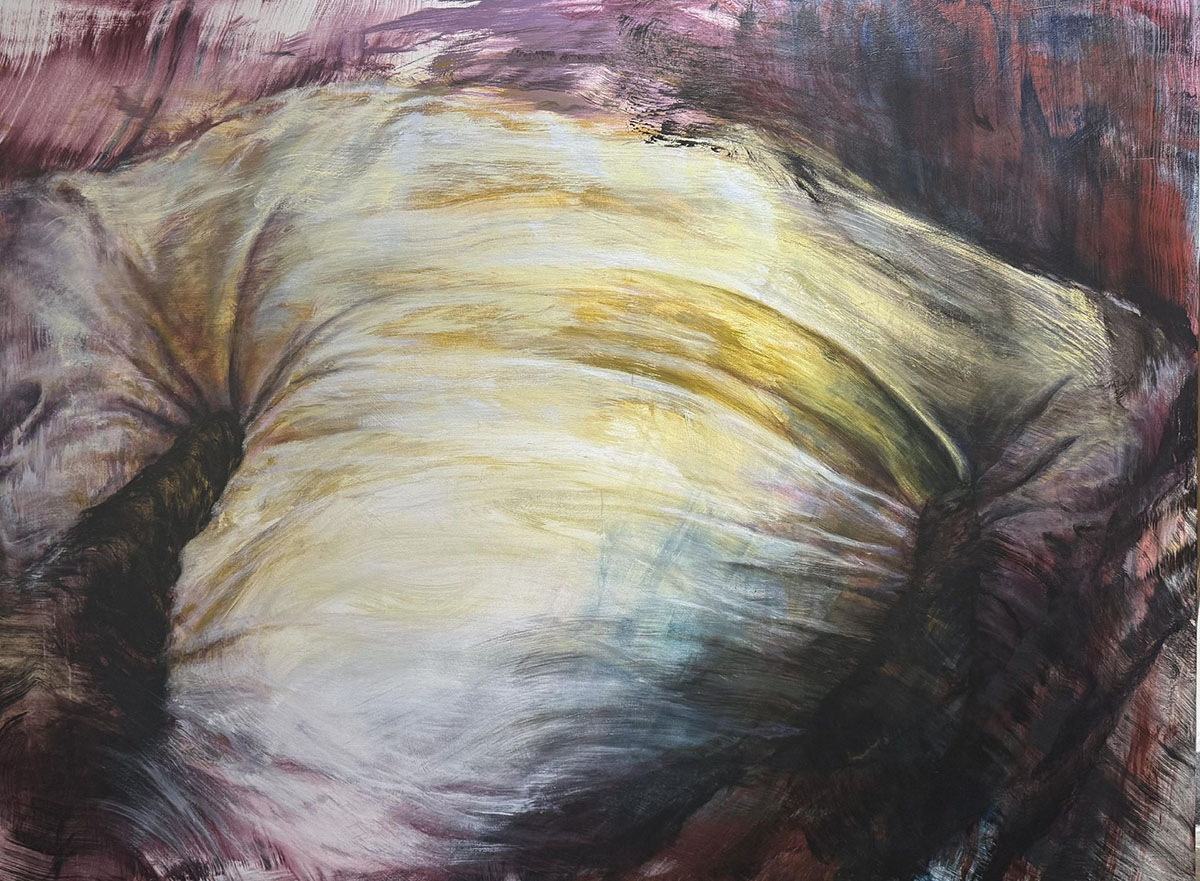 Timefold, 2026. Acrylic on canvas. 72 x 96 x 2.25 in. Photo courtesy of Johnson Lowe Gallery
Clare Gemima: John Keats’ Ode to a Nightingale and John Latham’s writing on time both seem to orbit your thinking in different ways. The former approaches transcendence through poetry and mortality, the latter through duration and event. How do these references intersect within your studio practice, and do you think painting offers a form of escape, confrontation, or suspension in relation to time itself?
Kathryn Kampovsky: Like Keats, I see art making as something representative of life that is longer lasting than death. Like Latham, I attempt to convey time spent being alive visually on an object (painting). My figures grapple with both sides of these artists’ philosophies. The bodies exist within the cycle of a day, resting or ending a section of life, and are also visually tied to each layer of paint that came before the last. As vessels, the canvas and I carry two types of transformation simultaneously. Eventually, I myself, as well as my paintings, exist as honest reflections of the exact same moment we overlapped in the process of their creation. WH

Clare Gemima
view all articles from this author