Whitehot Magazine
October 2026
"The Best Art In The World"
"The Best Art In The World"
October 2026
Object-Oriented Ontology and Time of Things
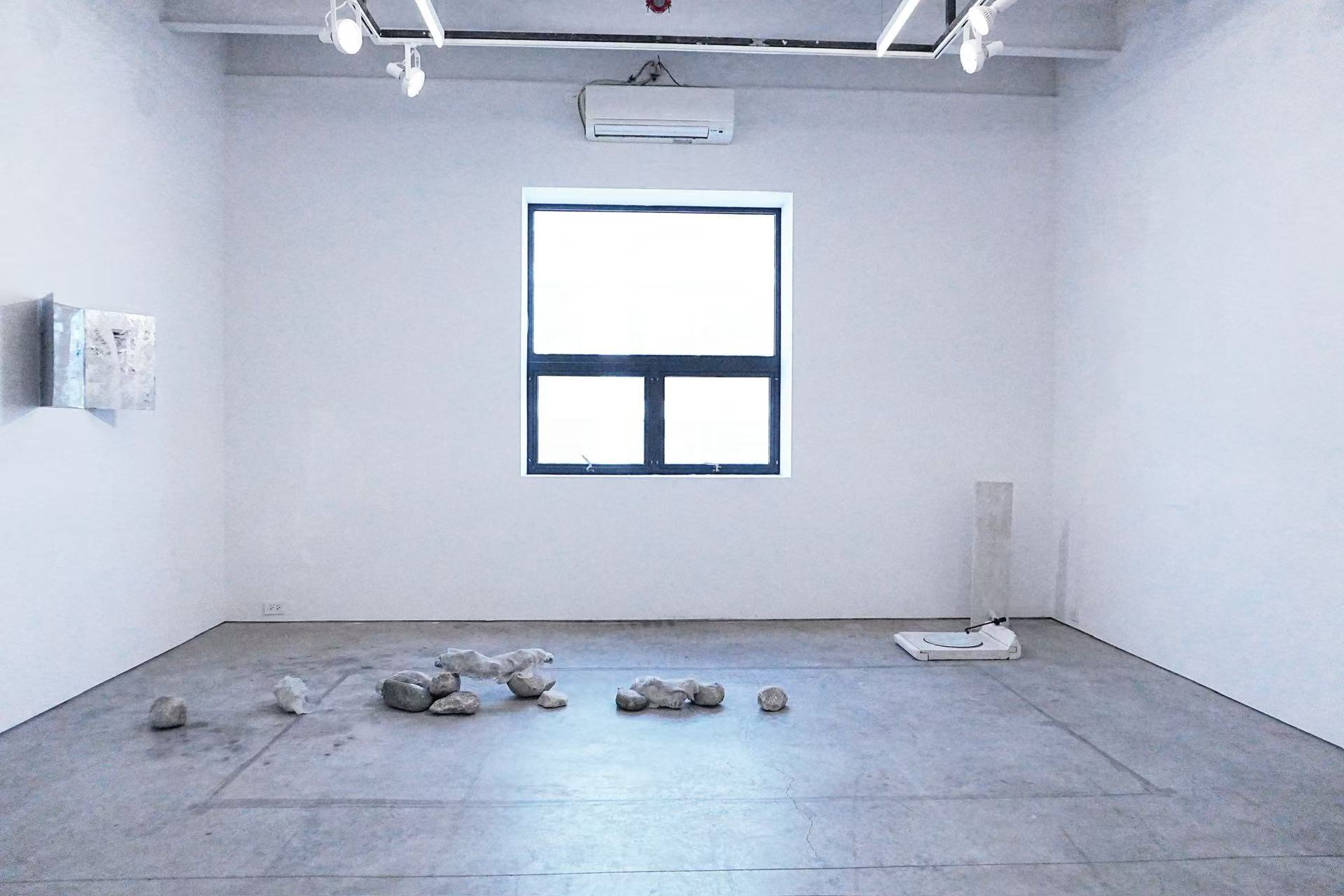 Installation view of Lithic Coordinates. Photo by Echo Xu. Courtesy of the artist and CHINCHINART.
BY SERENA HANZHI WANG May 5th, 2026
I’ve been keeping track of a philosophical idea that keeps resurfacing in contemporary art: object-oriented ontology. It appears in different forms, sometimes as an reference, more often as a shift in how works position themselves. At its core, it suggests that objects do not exist for us, nor do they become meaningful only when we perceive them. They withdraw. They remain partially inaccessible. They operate within their own structures of relation.
This shift is often linked to a broader post-human condition shaped by technological development, where the human is no longer the center through which meaning is organized. Like we increasingly encounter the world through equipment. But what interests me more is how this decentering gets staged. Many works informed by OOO want the non-human to feel autonomous. But if you stay with them long enough, you begin to see how much of that autonomy is still authored.
Animals make this even stranger. They’re often brought in to mark distance from the human, to suggest another mode of sensing. But they don’t quite hold that position. They feel close enough to invite identification, but never enough to fully cross over. Artists like Pierre Huyghe are often cited in this context, because his works place animals at the center while refusing to align them with human perception.
I found myself thinking about this while walking through Lithic Coordinates. The show never explicitly announces itself as being about object-oriented ontology, but it operates within a similar field of tension. Lifeless materials, environmental processes, and nonhuman systems are consistently brought to the center. Rocks, clay, rain, and other seemingly inert substances shape much of what the viewer encounters. If we read these works through an object-oriented lens, what emerges is not simply a decentering of the human, but a more uneasy question: whether these materials can ever truly escape human framing at all.
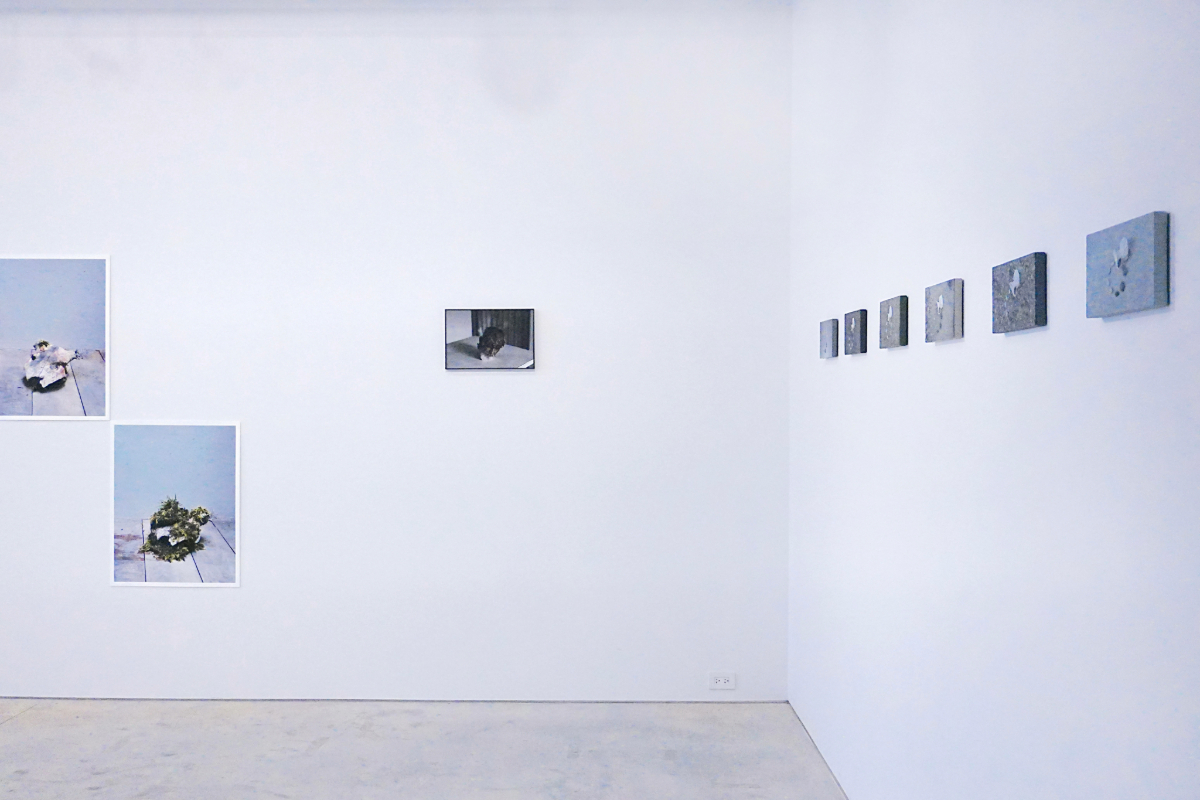 Installation view of Lithic Coordinates. Photo by Echo Xu. Courtesy of the artist and CHINCHINART.
At the center of the exhibition is Chuanduan Chen’s Arrow of Time (2019), a work by an artist I’ve been following for some time. Working primarily in photography, Chen returns to a restrained visual language, paired with subtle but uncanny phenomena. The piece consists of three photographs of the same stone, shot in the same setting, where moss gradually takes over its surface.
It feels almost impossible to think the stone on its own terms, not as something I look at, but as something that simply remains. Nothing announces itself. Nothing marks a change. It could persist for millions of years without registering any difference. Then the moss starts growing over, and suddenly something shifts. The rock can see it spread. The rock can feel it take over. And for the first time, The rock starts to feel time.
If I become the ice instead, everything sharpens. Suddenly everything is about time. I can’t ignore it. It’s no longer something outside of me. It’s in everything that’s happening. I’m losing shape, losing edges, slowly disappearing. Even when nothing else seems to happen, something is already happening to me. I can feel it in the way I’m no longer as solid as I was, in the way parts of me are already gone before I can even register them. The only thing I can really register is how time is working on me.
This is exactly what Huanzhe Hu’s Drifting Records (2023) is doing. It is a photographic work that records an ice cube melting through an instrument. Ice, concrete, electronic components, these materials expose different relations to duration. When placed next to Chen’s Arrow of Time, something starts to click. Both works deal with time, but in opposite ways. In Chen’s work, time arrives from the outside, through the moss. In Hu’s, time is already there, already working, already breaking things down. It’s not something you wait for. It’s something you are already inside.
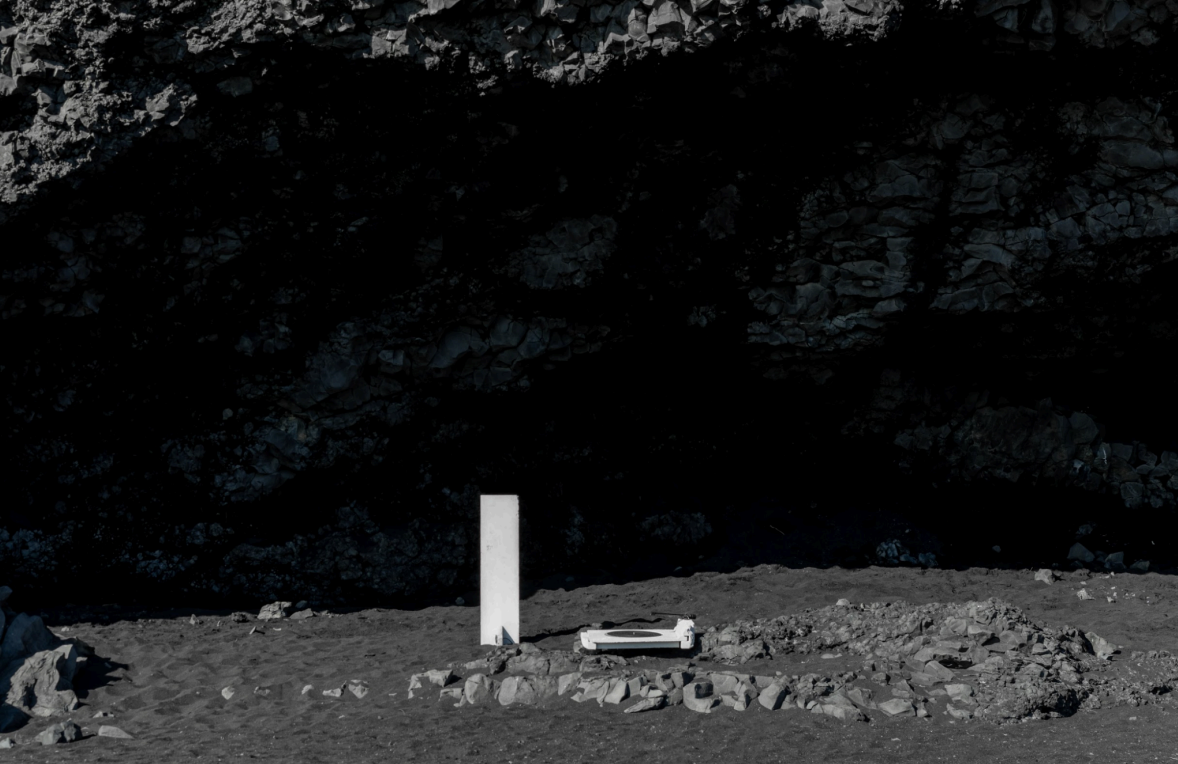 Huanzhe Hu, Drifting Records, 2023, Ice, Concrete, Electronic components, 35.4 × 7.5 × 5.5 inches and 23.2 × 16.1 × 2.8 inche
At some point, it becomes hard not to notice what this is doing. In both works, time doesn’t depend on us. It doesn’t wait to be seen, named, or measured. It just keeps working, whether we are there or not. That’s where the show starts to edge into a post-human, object-oriented sensibility, where materials seem to carry on entirely on their own terms. But staying with that for long enough, it begins to shift. It starts to feel less about the objects themselves, and more about us. The insistence on stepping outside the human no longer reads as a breakthrough. It begins to feel like something else, a sign that we are quite unsynced and unhappy with the world around us.
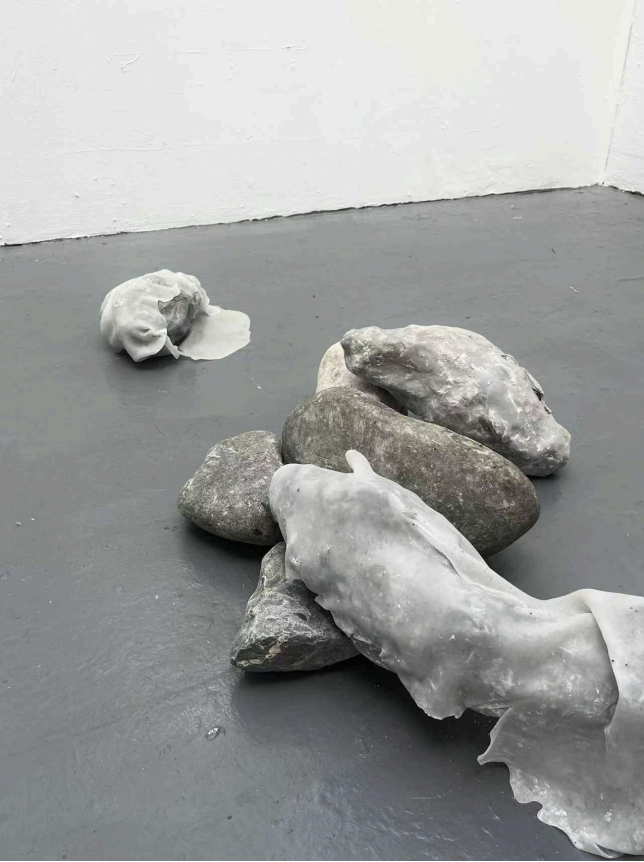 Kun Juliet Wang, Riverbed, 2025, Silicone, Clay, Stones, Mirrors, Acrylic, 63 x 80 inches
Another work I keep coming back to is Kun Juliet Wang’s Riverbed (2025). At first it reads as a cluster of stones, but something feels off. One “rock” is too smooth, too soft. Up close, the surface gives it away. What looks like a riverbed is actually silicone, clay, stones, mirrors, and acrylic. It doesn’t quite hold as imitation. It feels more like a test, how little it takes for something to register as an object.
The work keeps returning me to a question I can’t quite let go of. Object-oriented thinking asks us to imagine objects outside of human meaning, to take them on their own terms. But it’s unclear whether that move is ever really possible, or if it simply folds back into projection. These rocks sit exactly in that tension. They try to present themselves as objects, but everything about them is produced, staged, decided.
And maybe that’s where the work lands. The more we insist on objects as autonomous, self-contained, somehow beyond us, the more it starts to resemble something familiar. Karl Marx already pointed this out. We have a tendency to project life onto things, to treat objects as if they carry their own agency and mystery, while forgetting the labor, history, and conditions that produced them. That’s what makes commodities so seductive. What we see is the “magic” of the object, not the structure behind it. From that perspective, imagining objects as autonomous, alive, and self-sufficient doesn’t necessarily break away from human thinking. It may simply repeat one of its oldest habits.
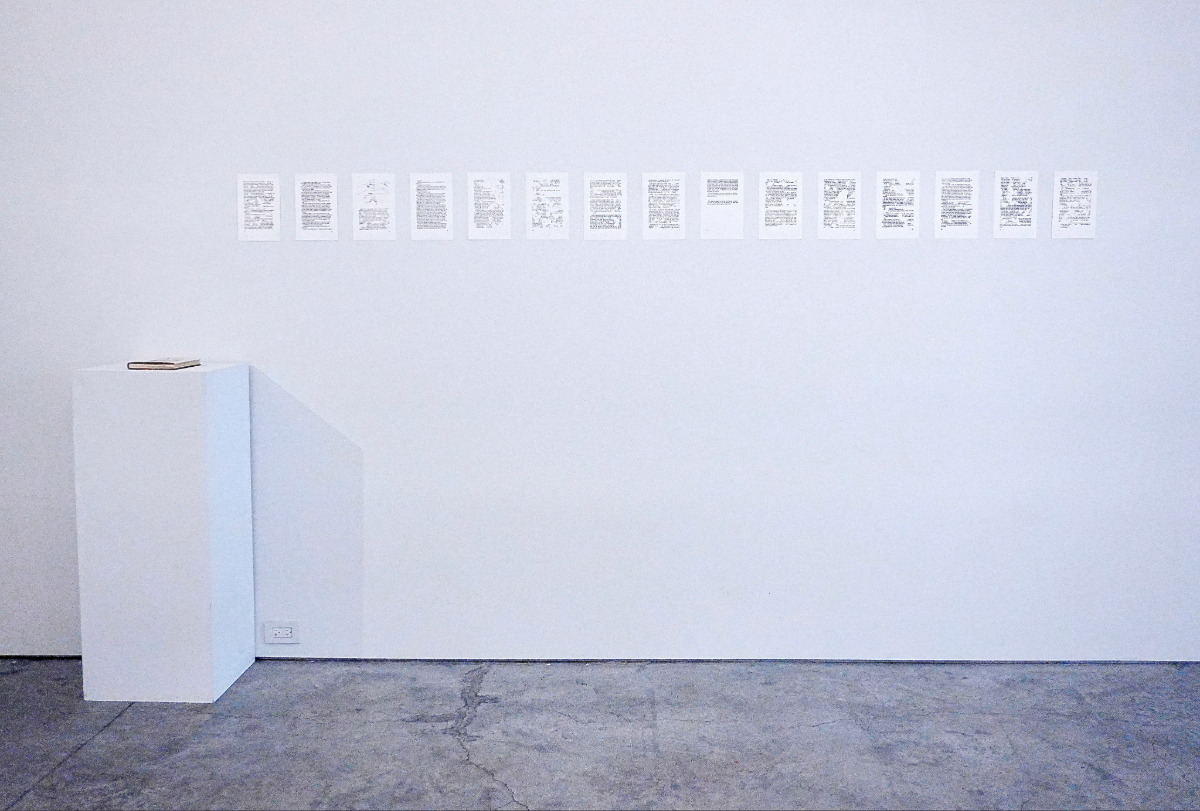 Installation view of Lithic Coordinates. Photo by Echo Xu. Courtesy of the artist and CHINCHINART.
2nd Floor Studio 10, 214 40th St, Brooklyn, NY 11232
Opening Reception: Friday, April 3, 2026 | 6-8 PM
Curated by Shuhan Zhang
Artists: Chuanduan Chen, Huanzhe Hu, Kun Juliet Wang, Tingru Chen, Yinghan Zhang, Zhanyi Chen.

Serena Hanzhi Wang
Serena Hanzhi Wang (b. 2000) is an award-winning art proposal writer, multimedia artist, and curator based in New York City. Her work spans essays, exhibitions, and installation Art—often orbiting themes of desire and technological subjectivity. She studied at the School of Visual Arts’ Visual & Critical Studies Department under the mentorship of philosophers and art historians. Her work has appeared in Whitehot Magazine, Cultbytes, SICKY Mag, Aint–Bad, Artron, Art.China, Millennium Film Workshop, Accent Sisters, MAFF.tv, and others.
view all articles from this author