Whitehot Magazine
September 2026
"The Best Art In The World"
"The Best Art In The World"
September 2026
For the 61st International La Biennale di Venezia, the Venice Pavilion presents Persistent Notes, curated by Giovanna Zabotti
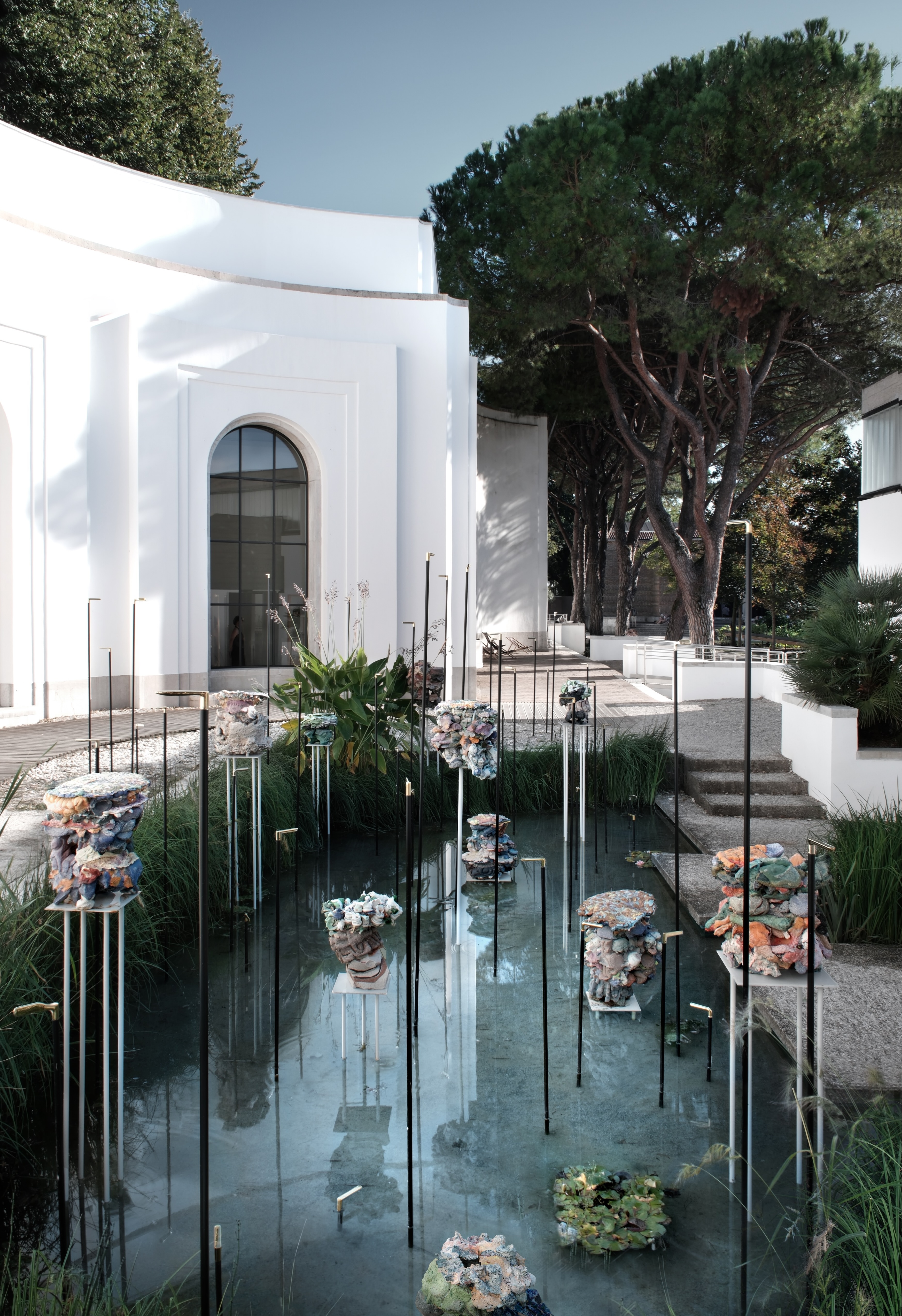 Alberto Scodro, Emerse Sommerse, 2026 Photo: Alberto Parise
By LUISA CALDWELL September 23rd, 2026 at 2:30am EST
The Venice Pavilion has always seemed overlooked within the world of exhibitions surrounding the Venice Biennale. Situated smack in the middle of the Giardini, among the national pavilions, it occupies a striking 1936 Art Deco building with tall, graceful arches integrated into the façade. Yet the pavilion operates independently of the Biennale organization, managed and curated by the City of Venice with a mission of promoting the city, its history, and its artistic culture. In past years I have wandered through unimpressed. It often felt more like a showroom for artisanal traditions than an exhibition of contemporary art.
This year is different.
For the 61st International La Biennale di Venezia, the Venice Pavilion presents Persistent Notes, curated by Giovanna Zabotti with the participation of Denis Isaia and Cesare Biasini Selvaggi. Importantly, the exhibition brings together the only Italian artists exhibiting within the Giardini and the Arsenale grounds, apart from Chiara Camoni, who represents Italy in the Italia pavilion.
The exhibition includes an AI-generated sound installation by Dardust that evokes the presence of water, along with a scenographic intervention by designer Paolo Fantin with a disassembled piano suspended in space. But I was particularly drawn to the work of Ilya and Emilia Kabakov and Alberto Scodro.
Longtime veterans of many former Venice Biennales, Ilya (d.2023) and Emilia Kabakov present Venetian Diary, a remarkable crowdsourced installation composed of objects temporarily on loan by Venetian residents. Each of the hundreds of objects - such as housewares, pottery fragments, nautical devices, clothing, costume jewelry, a box of pasta, everything but the kitchen sink, and it all stands in for a personal story.
The humble objects are made precious by the intimate written histories attached to them. Each is accompanied by the lender's account in both Italian and English and displayed inside exquisitely crafted, museum-grade glass and wood cases. The effect is important and archival, but what is being preserved is not some grand official history of Venice. It is the private history of its inhabitants.
In its scale and ambition, Venetian Diary feels like a direct lifeline to the real Venice: to the people and families who have lived there for generations. There is no spectacle and little connection to tourism. Instead, there are personal histories rooted in a magical city that these people actually call home. The installation is expansive—perhaps a thousand objects when including the related presentation at Palazzo Ca' Tron, which has since closed—and its accumulation becomes its own portrait of Venice.
Alberto Scodro's ambitious outdoor installation occupies the pavilion's outdoor shallow reflecting pool, a space that, in my experience, has never previously been used for an artwork. Scodro places medium-sized sculptures on pedestals rising out of the water, employing an experimental fused-glass technique original to his practice. Made from sands, glass, pigments, and material residues, the sculptures are sumptuous and elegant while retaining something casual, organic, and deliberately uncontrolled.
The sculptures set off a series of free associations for me: Giorgio Morandi's early paintings of flowers in vases, particularly in their palette and slightly awkward, endearing forms; Jeff Koons's Play-Doh; Ugo Rondinone's Seven Magic Mountains; Urs Fischer's Big Clay #4. But none of these references quite contains them. They seem to hover somewhere between bouquets, geological formations, and sea anemones.
Scodro's installation Emerse Sommersa, merges sculpture with landscape creating a beautiful aquatic garden. Fifteen-hundred kilos of Marmo Verde (green marble) lined the bottom of the pool to conjure the green water of the lagoon. The live lilies and aquatic plants placed alongside the sculptures create a complete world, as though the artwork had emerged from the pond rather than been placed into it.
Approximately fifty high-end bronze door handles also protrude from the water like reeds or cattails. Are they simply another material intrusion, or do they suggest something more? Handles imply entry, passage, access. Rising from the water, they seem to offer entrances into other worlds.
That sense of another world, whether intimately personal or fantastically physical, remains grounded in the reality of Venice and makes this year’s Pavilion worth paying attention to. It’s good to see this new direction with its understanding of contemporary art, and allowing the work presented to be in dialogue with the broader art world, even beyond the Venice Biennale.

Luisa Caldwell
Luisa Caldwell is an artist working and living between NYC and Italy. Known for large scale public art works, with recent installations at Hancher Auditorium at University of Iowa using 17,000 found and collected candy wrappers. Permanent projects include commissions from NYC Percent for Art and NYC MTA Art& Design. Autumn of 2019 Caldwell has residencies through CEC Back Apartment Residency in St. Petersburg, Russia and Guild House at Guild Hall, East Hampton, NY.
view all articles from this author