Whitehot Magazine
August 2026
"The Best Art In The World"
"The Best Art In The World"
August 2026
Blood as an artistic medium, a conversation with artist Jordan Eagles about his new exhibition Centrifuge (2025)
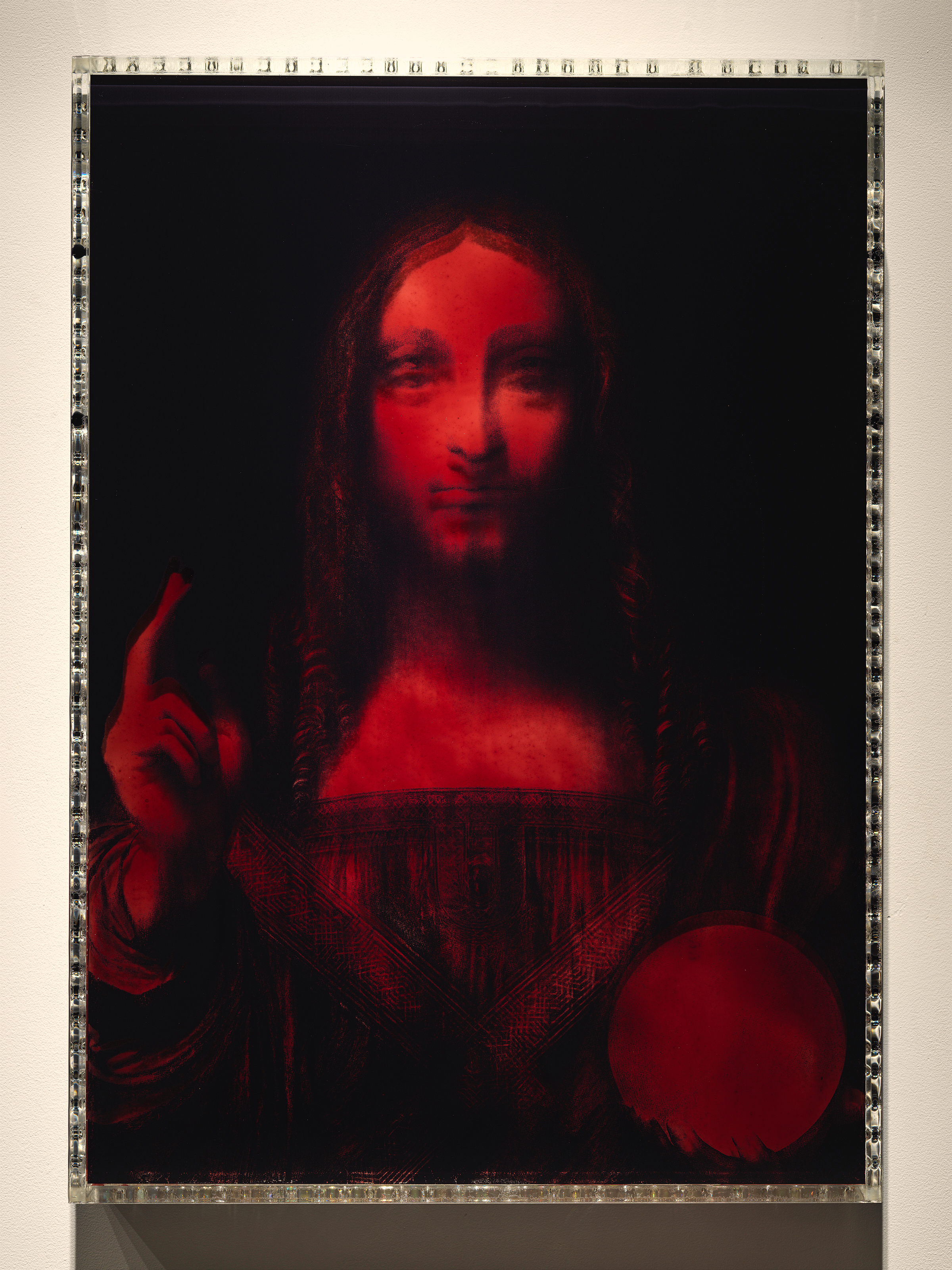
Jordan Eagles (born 1977; born New York, NY), Vinci, 2018. Grayscale image of Salvator Mundi, and blood of an undetectable HIV+ long-term survivor and activist in UV resin and plexiglass; 67.9 × 48.3 × 7.6 cm. Collection of Donald Capoccia © Jordan Eagles
BY EMMA CIESLIK January 21st, 2026
This past November 22nd, New York City-based artist Jordan Eagles opened his exhibition Centrifuge at the Princeton University Art Museum. Curated by Chris Newth, Senior Associate Director for Collections and Exhibitions at the Museum, this exhibition explores art created with blood donations from LGBTQI+ people.
From 1983 onwards, the US Food and Drug Administration (FDA) instituted a lifetime ban on blood donations from men who have sex with men. It wasn’t until December 2015 that the FDA allowed gay and bisexual men to donate blood but only if they were celibate for a full year. Partially because of massive blood shortages during the COVID-19 pandemic, the FDA allowed gay and bisexual men to donate if they were celibate for three months, and switched to an individualized risk assessment for all donors in 2023. Experts still argue that the policy does not align with current science and excludes men who have sex with men along with members of the LGBTQI+ community more broadly.
Eagles’ art has long explored blood as a lifegiving and sustaining force from his work with animal blood shortly after graduate school to art featuring human blood that explores these identity-based restrictions surrounding blood donation, including his most well known work Blood Mirror, created with 59 blood donations from gay, bisexual, and transgender men. In this most recent exhibition, he utilizes blood art featuring American pop culture ephemera and historical documents to create a visual anthology of discrimination and activism.
After Centrifuge opened in November, I sat down with Eagles to learn more about the inspiration and political activism of creating art surrounding blood donation with human blood itself, as well as the ethical and logistical realities of preserving and displaying human blood. One of the standout moments was when he discussed his work Jesus, Christie's (2018) recreating Leonardo da Vinci’s iconic work using the blood of an HIV+ activist.
Emma Cieslik: How did you first begin to create art with human blood, and what is the technical skill that goes into this work?
Jordan Eagles: I started experimenting with blood in 1998 when I was a student at NYU. I was really interested in ideas about body and spirit, and in questioning where, inside all this flesh and blood, the soul is located. I was also asking bigger questions about my connection to the universe. If you lose weight, there’s less of you; if you gain weight, there’s more physical mass, yet it’s still the same person inside. Those questions really fascinated me.
Around that time, I was in a debate with a close friend about life after death, and I came across images of childbirth in a medical encyclopedia. There were four black-and-white illustrations of a woman giving birth, and they were so sterile. There was no blood. I had always understood birth to be bloody and full of emotion, often depicted with pain. That sense of energy, especially the blood, was missing.
Birth is the moment where we enter the world, where you are becoming and entering life. I used those images as part of the dialogue I was having with my friend, dripping red paint over them to symbolize blood. I presented him with four pieces as my response. As I described the work, I kept calling the red paint blood, and he said, “Jordan, that’s not blood. It’s paint.” I wanted something more real, so I went to Chinatown, bought animal blood, brought it back to my dorm room, and dripped it onto the canvases. The pieces felt alive immediately. There was something very visceral about the actual blood. That first drip felt alive.
Over time, the blood shifted from red to brown, which led me to experiment with preservation. After a few years, I developed a technique with resin that allowed me to preserve the blood’s color and texture so the organic material would not change over time. That process opened up deeper questions about preservation, life, and death, and whether the body and soul are connected.
I spent many years working with animal blood, thinking about regeneration, life cycles, and from a technical side, learning about dimensionality, luminosity, and how light moves through materials. But around 2013, I began thinking about how my work could speak to social issues, and whether art could help change policy or bring awareness to things that weren’t being talked about, that affected me as a gay man and my community.
I was interested in whether my work could advocate for equality. Blood runs through all of us. Why do we discriminate against one another, and how can art be used to help change policy?
That’s when human blood came to mind.
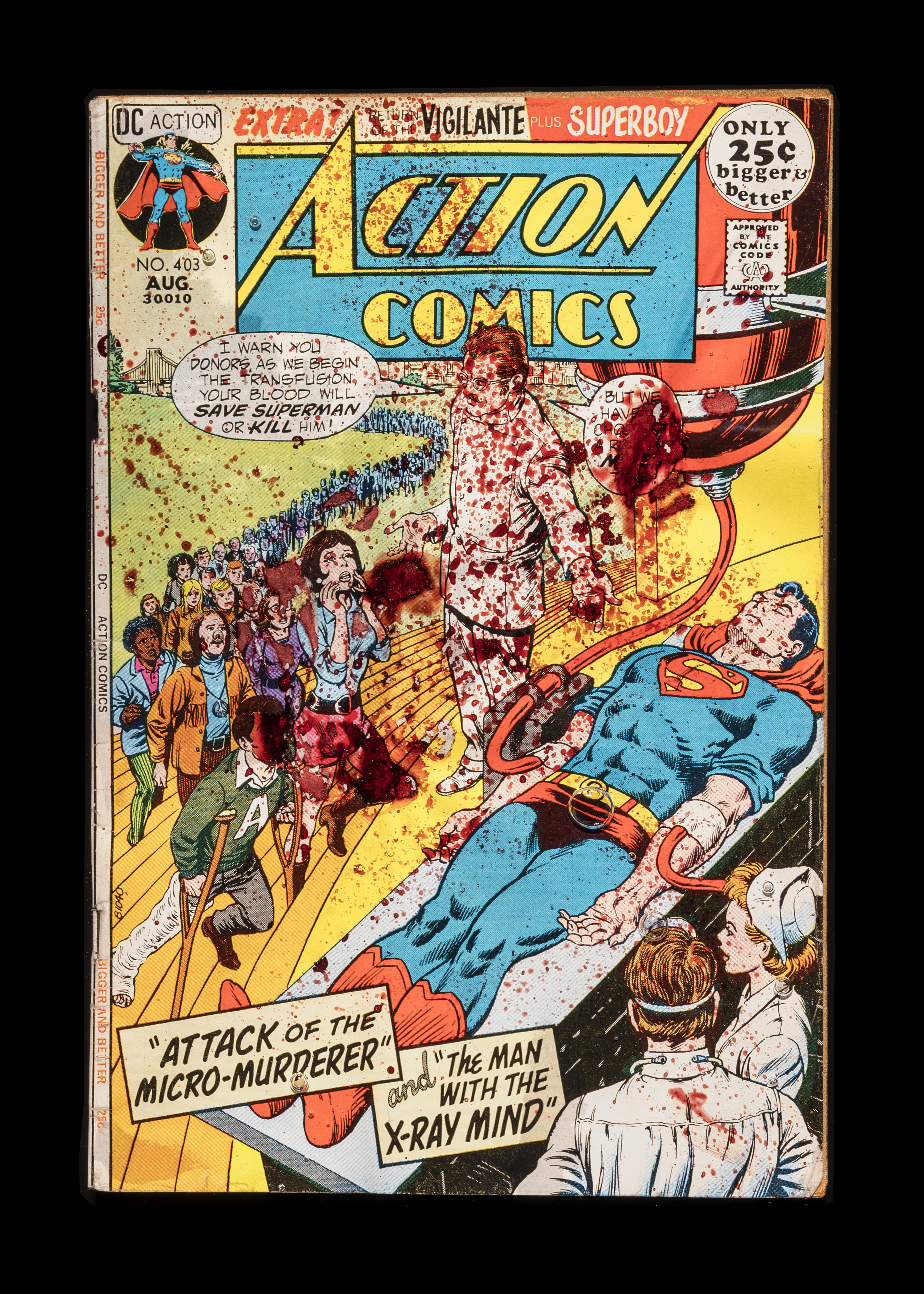
Jordan Eagles (born 1977; born New York, NY), Untitled, 2018. Original 1971 Action Comics, used blood collection bag with needle, and residual blood of a gay man on PrEP in UV resin and plexiglass; 208.3 × 71.1 × 7.6 cm. Courtesy of the artist and New Discretions, New York © Jordan Eagles
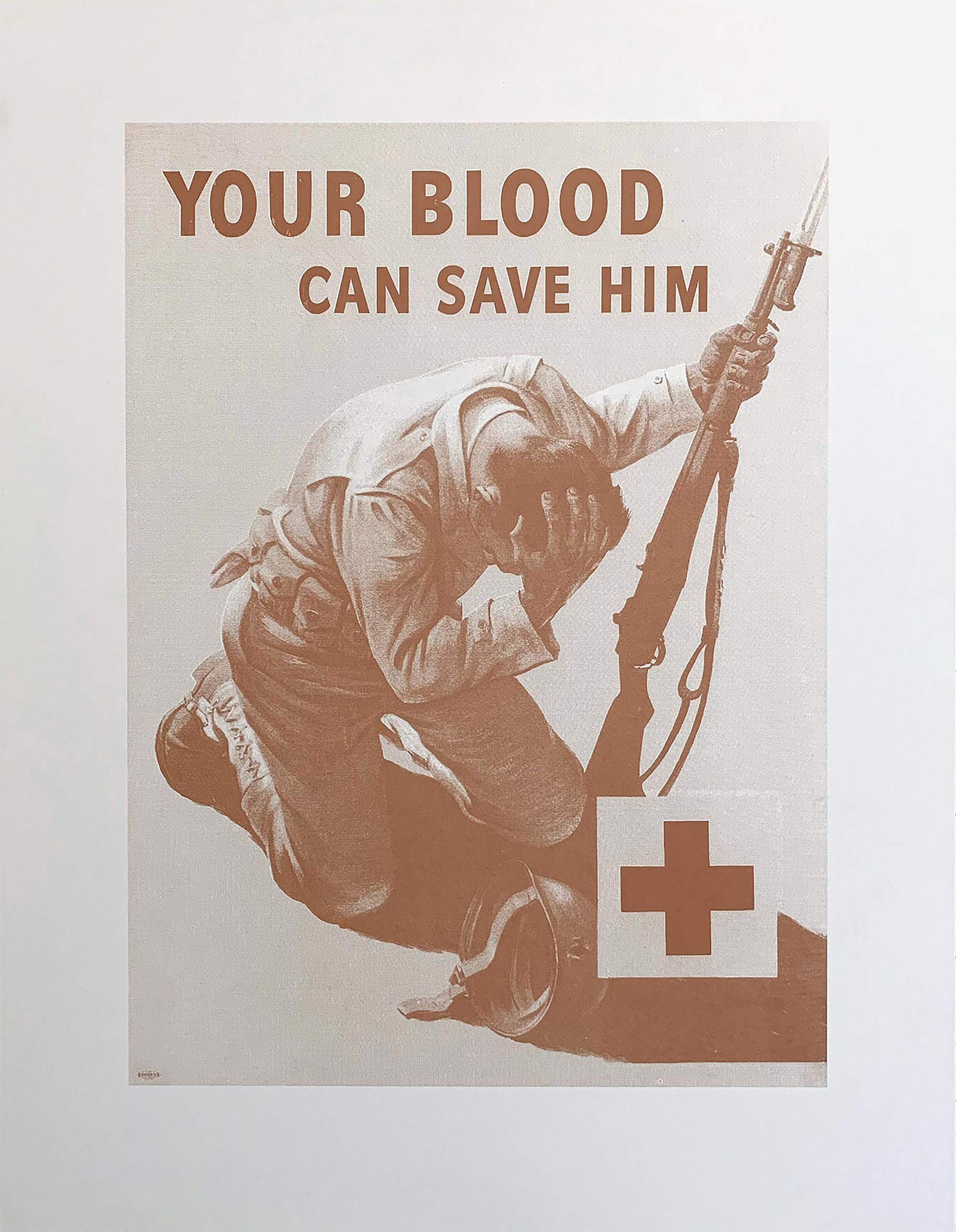
Jordan Eagles (born 1977; born New York, NY), Our Blood Can Save Them (4 from an edition of 12), 2018. Screenprinted with blood of a transgender, pansexual, and active U.S. Service Member on paper; 66 × 50.8 cm (each). Courtesy of the artist and New Discretions, New York © Jordan Eagles
Cieslik: What inspired the current exhibition Centrifuge that explores the politicality of donating and receiving blood?
Eagles: In 2014, I started working on a piece called Blood Mirror,which was my first project made with human blood. It is a seven-foot-tall freestanding sculpture that becomes a mirror where viewers see themselves reflected through the blood of 59 donors who are gay, bi, and trans men. Fifty of those men are on PrEP [a pre-exposure prophylaxis to stop the spread of HIV].
The work was shown in Washington, DC and New York in 2015. But by 2016, the policies around blood donation were not changing enough to be considered fair and equal, and we were still trying to start a conversation with the Food and Drug Administration. I partnered with Gay Men’s Health Crisis and an agency called FCB Health, and together we formed a collaboration called Blood Equality. It started as an awareness campaign rooted in the artwork in which most of the Blood Mirror donors participated.
One of the sculptures from the Blood Mirror series included 50 used blood collection tubes, each labeled with the donor’s name. It became very much about who these people are and their personal stories. Some are doctors. One donor was an openly gay priest. One was a co-founder of Gay Men’s Health Crisis. Another was an identical twin. He is gay. His brother is straight. They share the exact same DNA, yet one can donate blood and the other cannot. The work focused on those contradictions, using the lived experiences of these individuals to examine the nuances and hypocrisies of the policy.
Blood Mirror became the starting point for the human blood works, and it created opportunities to share that message publicly. Seeing the piece on view at the Birmingham Civil Rights Institute was especially meaningful to me.
In 2018, I decided to take a different approach for the next body of work. I began using pop culture, historical documents, and materials connected to blood donation and HIV, and combining it with queer blood in new ways. In these works, the donors remain anonymous, but it became about finding the appropriate donor for each piece.
That approach led directly to the works on view in Centrifuge at Princeton.
Cieslik: As someone fascinated with the spiritual and sacred dimensions of art, do you believe that works in Centrifuge have a living component? You mentioned earlier in the conversation your explorations about whether the spirit or soul exists in blood? Is this part of the way in which you create and display the art?
Eagles: With Blood Mirror, there is a clear sense of community when you mix blood from 59 people into a single structure. Sadly, one of the donors passed away a few years ago. He was far too young. Then last year, Reverend John Moody passed away as well. When I look at the piece now, I think about that moment when a group of men came together and stood for something. I believe that energy continues to live in the work, while at the same time it has become a kind of memorial to both the inequality of the policies and to the people who are no longer with us.
In 50, 60, or 70 years, none of the people who donated blood for these works will be alive. What does that mean for a work of art? There is definitely something spiritual about these works. Blood has an inherent energy. But for me, first and foremost, they are about standing up for equality.
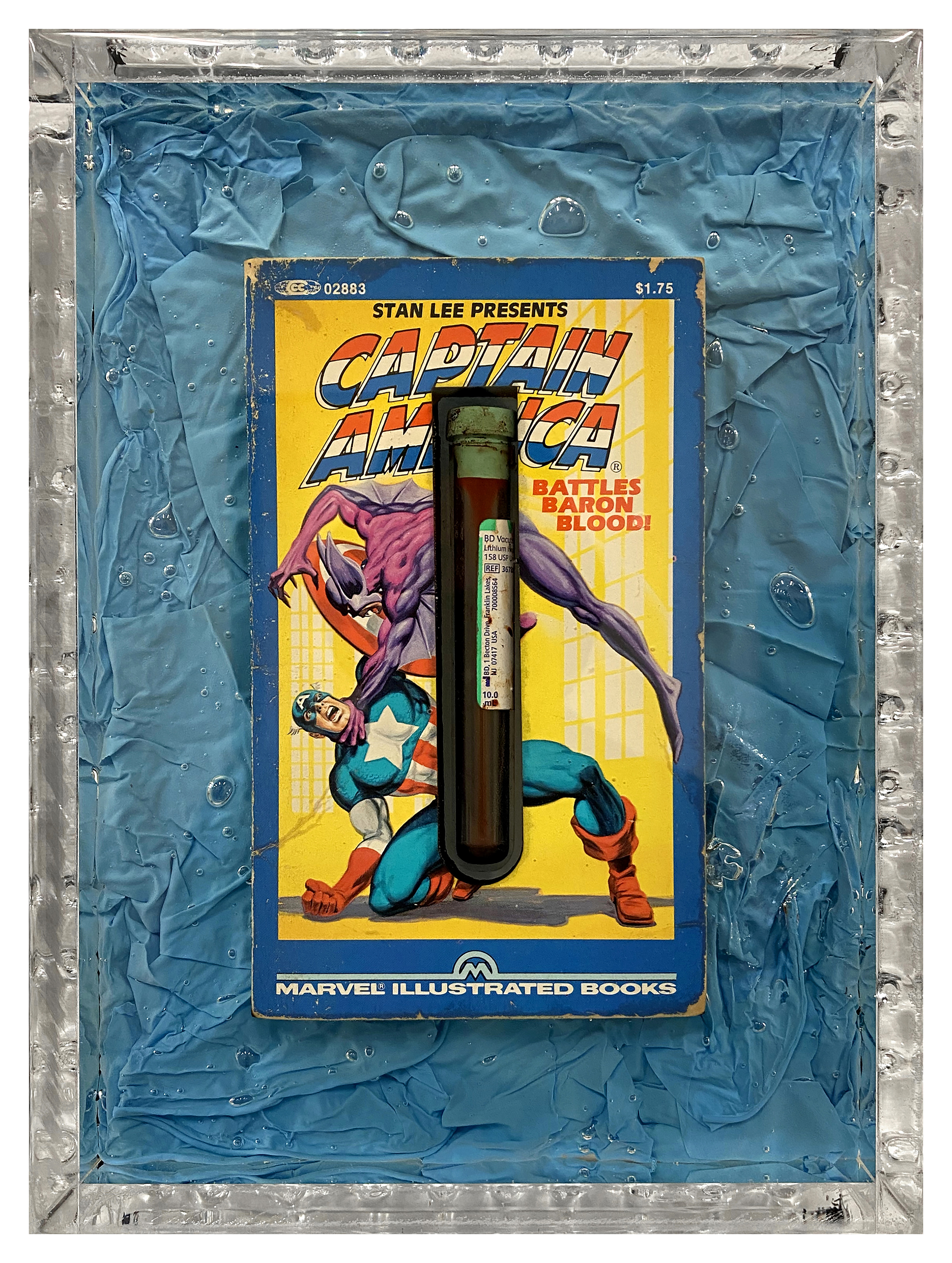
Jordan Eagles (born 1977; born New York, NY), Queer Blood America, 2021. Original 1982 Captain America, blood of a queer man, collection tube, and blue nitrile gloves in UV resin and plexiglass; 27.3 × 20.3 × 7 cm. Courtesy of the artist and New Discretions, New York © Jordan Eagles
Cieslik: I’m curious about the art that you’ve created and the logistical challenges of creating and displaying human biological material. I work in collections management, and I am curious--what does consent? What aspects of bodily autonomy are part of the process of collection and creation? I know for these works you mention maintaining donors’ anonymity.
Eagles: For everyone who’s donating blood, I either know them, have been introduced to them, or they’re reached out to me because they want to participate in something, or I’m looking for a very particular kind of individual.
For example, there is a sequence of screen prints in the exhibition that uses the blood of someone who, at the time of participation, was active in the US military and identified as trans and pansexual. It was important to me to work with someone who was both actively serving and transgender. I spoke with many people and eventually connected with a transgender veteran’s organization, which led me to a donor who was willing to participate.
[In another case], I was creating a work based on Leonardo da Vinci’s Salvator Mundi,, Jesus Christ, the Savior of the World. For that piece, I wanted a donor who was HIV positive and undetectable. The person who agreed to participate was also an activist and a long-term HIV survivor, and those aspects of his life felt deeply connected to what the work was trying to communicate.
When Salvator Mundi sold in 2017 for almost half a billion dollars, it felt like the entire world was captivated by the sale. I was thinking about Jesus in relation to blood. So often he is depicted on the cross. In that sense, he could be considered the world’s greatest blood donor, essentially shedding his blood for the salvation of all humanity. I was struck by the contrast between the astronomical value placed on his likeness and the stigma that still exists around blood and certain bodies.
And also, the fact that Jesus was someone who loved and accepted everyone, and did not ostracize people, so finding the blood of someone who is HIV positive and rendering these images with that blood felt like saying there should be no stigma. Jesus would love all people, including those who are HIV positive. Wouldn’t it be amazing if we could love everyone? We should not separate people based on their status.
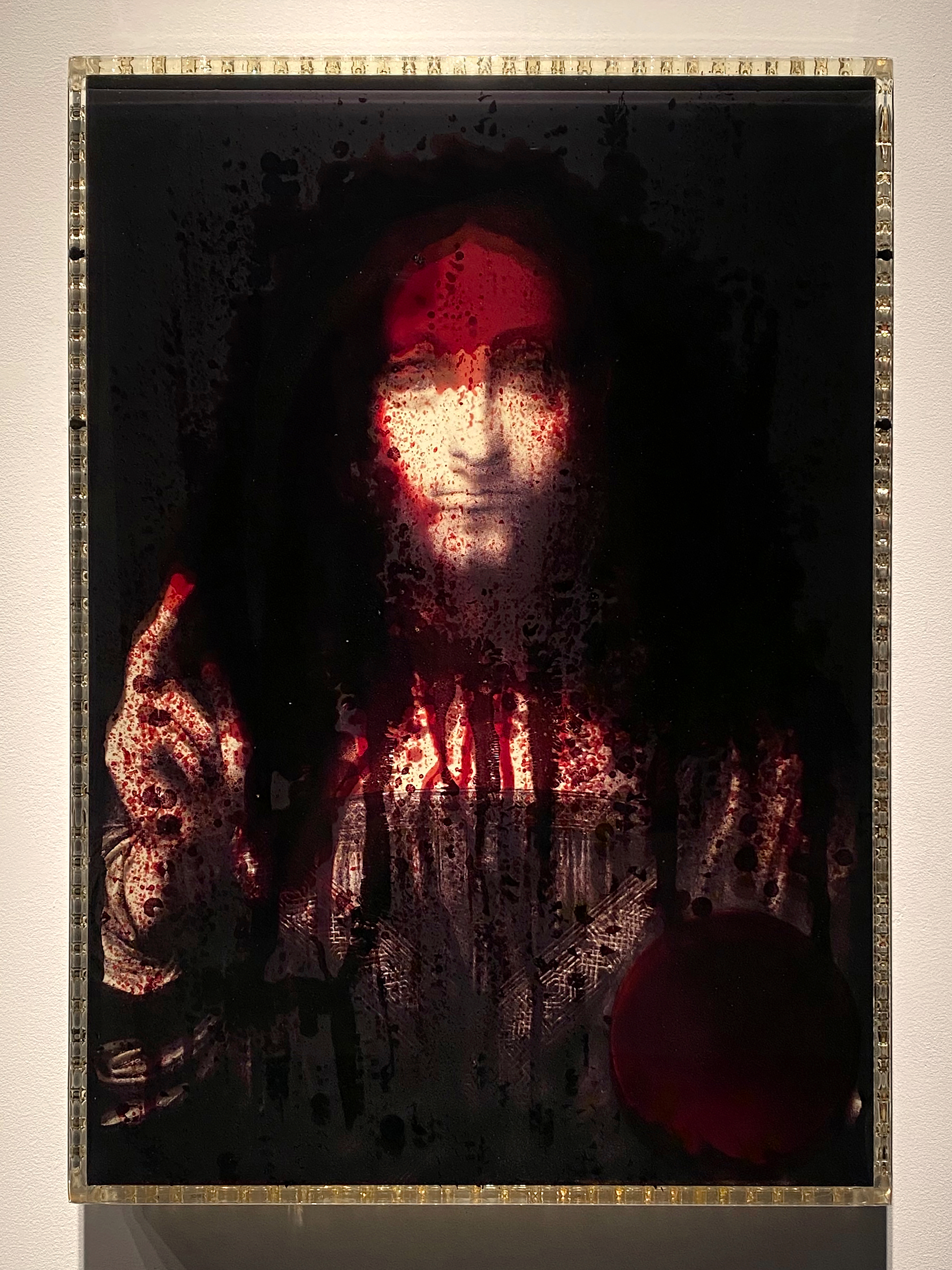
Jordan Eagles (born 1977; born New York, NY), Vinci, 2018. Grayscale image of Salvator Mundi, and blood of an undetectable HIV+ long-term survivor and activist in UV resin and plexiglass; 67.9 × 48.3 × 7.6 cm. Collection of Donald Capoccia © Jordan Eagles
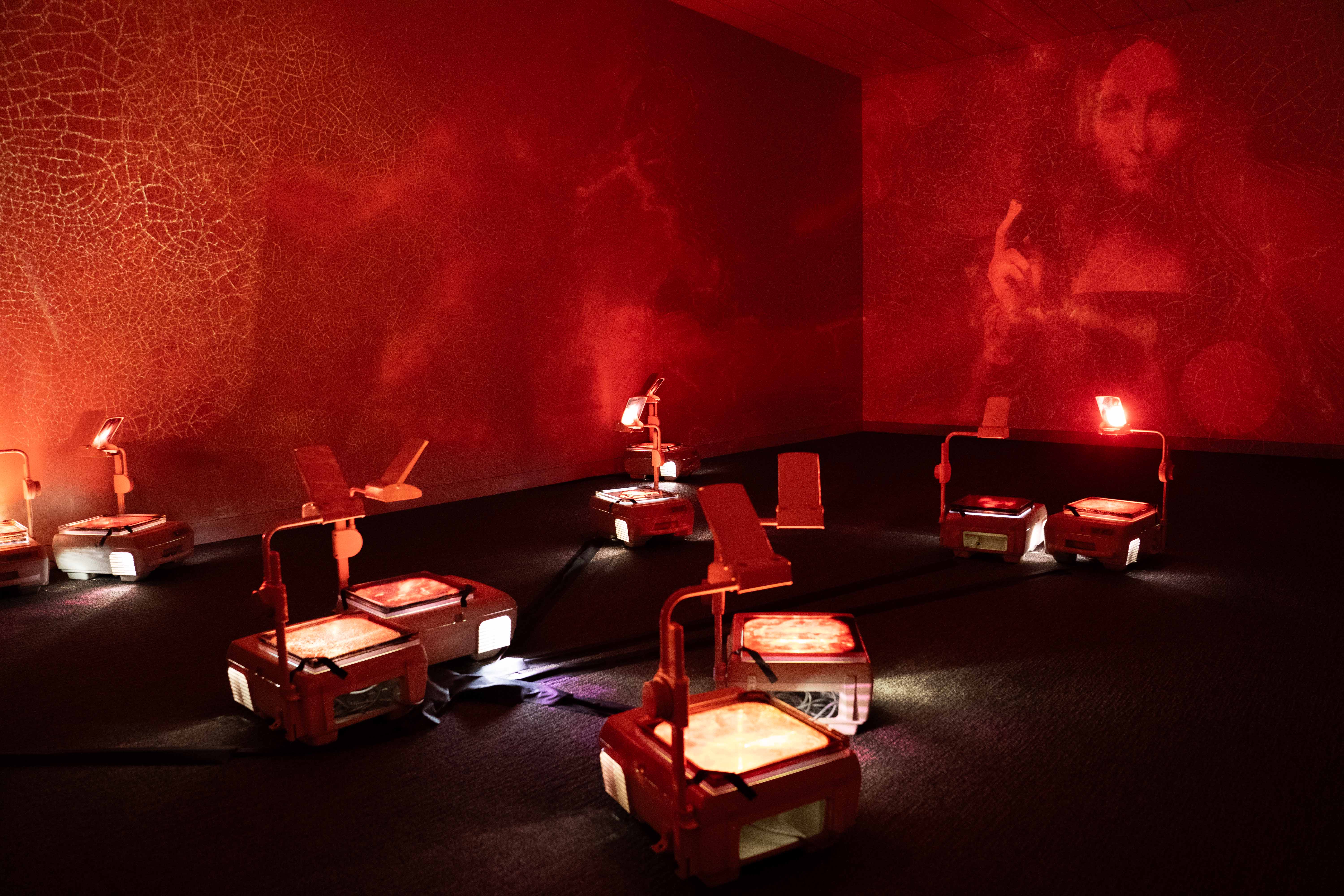
Vinci was projected in Illuminations, an installation presented on World AIDS Day. © Jordan Eagles
In some instances, it is a gay man on PrEP, very straightforward. It is really about the medical side of what is happening in the blood and how it connects to the source material. With this body of work, I was attempting to create more entry points into policy conversations by pairing iconic imagery with the blood of the donor. Superman, for example, is someone most people already have a reference point for and feel something toward. Seeing him lying lifeless on a gurney with needles in his arms, needing a massive blood transfusion from the people of Metropolis, and pairing that image with the blood of a gay man on PrEP who should be able to donate blood but cannot, carries a clear message and traces a bit of history.
When that comic was made in 1971, a gay man could donate blood. It was a pre-AIDS era comic book. When I began this project in 2018, and even today in 2026, policies still exist that prevent many, if not most, gay men, and men who have sex with men, from donating blood.
Cieslik: What do you hope people take away from the exhibition, whether it’s a message or an image or something powerful they bring with them?
Eagles: One thing I really liked about this exhibition, and about working with the curator, is that the space is divided into four separate galleries. The exhibition takes on four chapters within the body of work, which gives viewers multiple ways to enter the subject. Someone might be interested in AI and current technology, and there is a section focused on an AI project from 2023 dealing with HIV, stigma, identity, and blood donation.
Someone else might be drawn to religion and spirituality through the works based on Salvator Mundi. Others might connect through comic books and the idea of superpowers, and the way blood functions as a lifesaving force. The fact that the works are separated into distinct spaces gives viewers the opportunity to enter each chapter in their own way.
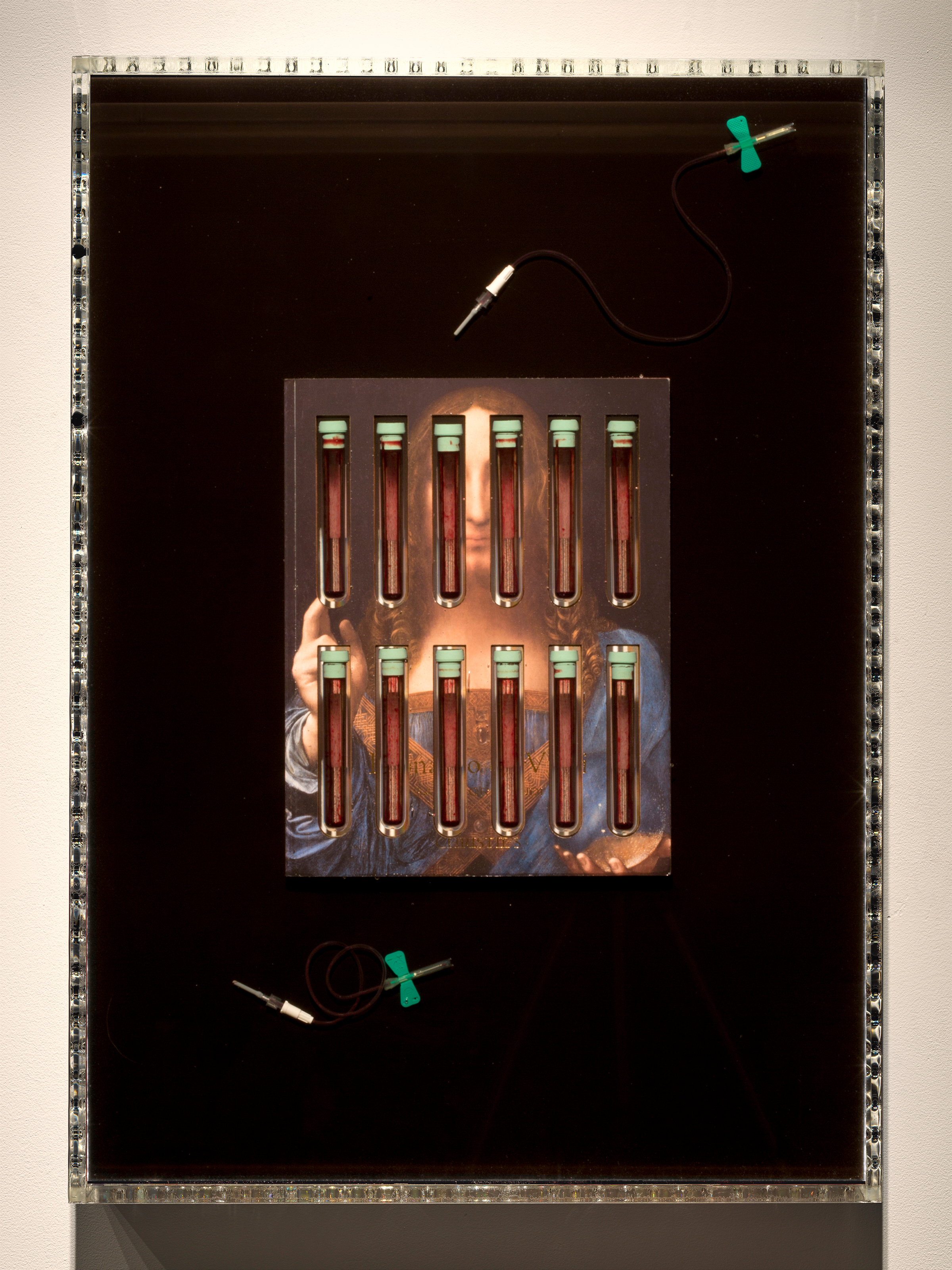
Jordan Eagles (born 1977; born New York, NY), Jesus, Christie's, 2018. Christie's sale catalogue, medical tubes, needles, and blood of an undetectable HIV+ long-term survivor and activist in UV resin and plexiglass; 67.9 × 48.3 × 7.6 cm. Courtesy of the artist and New Discretions, New York © Jordan Eagles
Taken as a whole, the exhibition focuses on the idea that blood is a life force that runs through all of our bodies, regardless of HIV status, sexual orientation or gender identity, and there should be no stigma. We should be treating everyone equally and trusting in science. Blood is crucial to our existence, yet it is often used to divide people by identity, and even to prevent participation in something as communal and healing as blood donation.
I hope this exhibition gives people a way to think more carefully about blood, policy, and identity. And in a moment when blood donation policy may not feel top of mind, especially as healthcare is being stripped away from millions of people, the exhibition can serve as a case study of one particular issue and its broader social implications.
Centrifuge will be on display until March 15, 2026.

Emma Cieslik
Emma Cieslik (she/her) is a queer, disabled and neurodivergent museum professional and writer based in Washington, DC. She is also a queer religious scholar interested in the intersections of religion, gender, sexuality, and material culture, especially focused on queer religious identity and accessible histories. Her previous writing has appeared in The Art Newspaper, ArtUK, Archer Magazine, Religion & Politics, The Revealer, Nursing Clio, Killing the Buddha, Museum Next, Religion Dispatches, and Teen Vogue
view all articles from this author