Whitehot Magazine
October 2026
"The Best Art In The World"
"The Best Art In The World"
October 2026
Antonius Roberts: New Beginnings at ICE Gallery
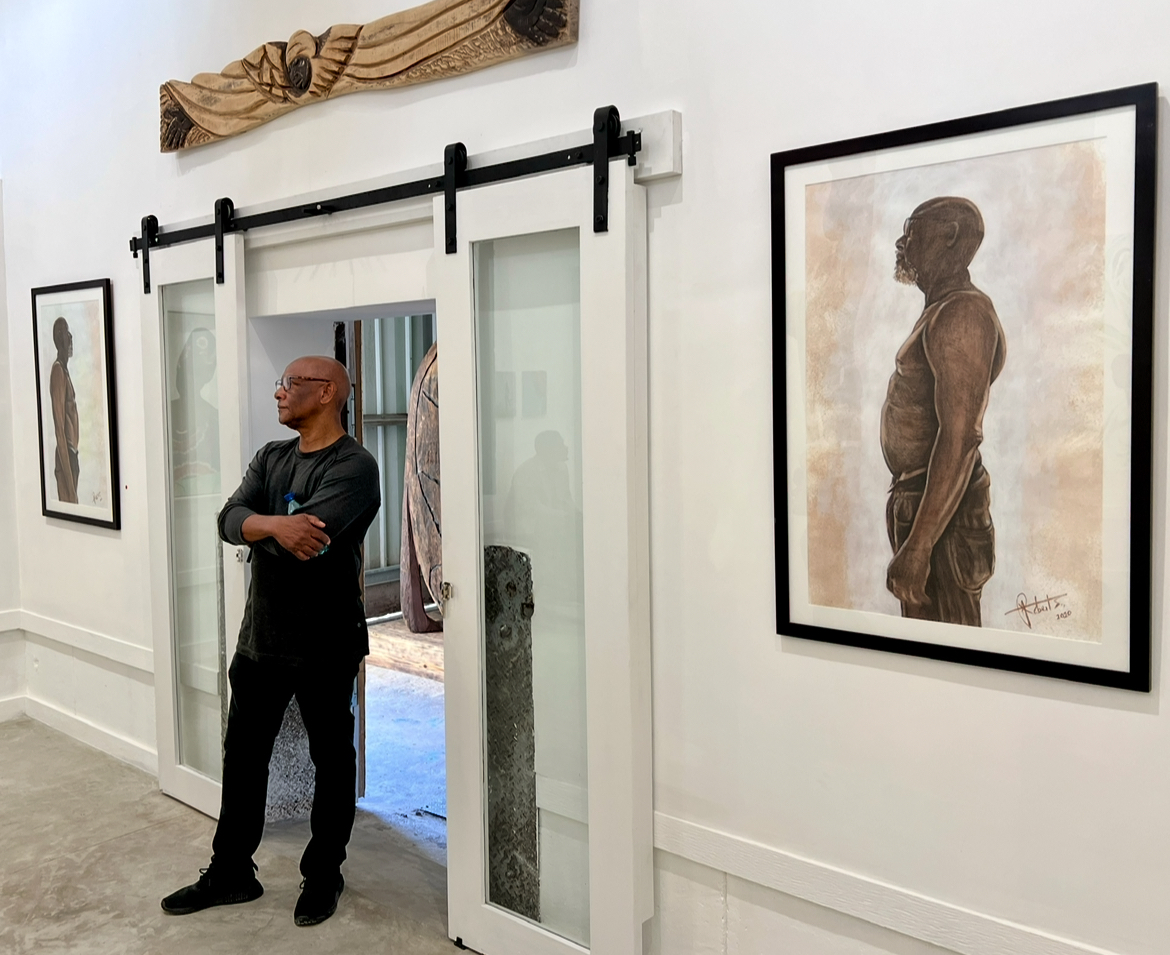 Antonius Roberts at ICE Incubator for Collaborative Epression | Artwork: SELF PORTRAIT Series (2020) 41.24 x 28 Conte and acrylic on paper. Credit: Judith Doyle
By BYRON ARMSTRONG February 24th, 2026
Assuming they haven’t been totally consumed by ego, there’s usually a point in an artist's life when the work stops being merely about making and becomes instead about meaning. Maturity demands the art created carries the weight of everything that’s come before. That includes everything that’s been lost and everything that might still be possible. For Antonius Roberts, that moment arrived with terrible clarity on April 14, 2025, when fire tore through the building adjacent to ICE, his Incubator for Collaborative Expression, creative sanctuary, and community arts hub in Nassau, Bahamas. The flames that scorched the neighboring structure also torched the grounds of ICE, the culmination of a forty-year career as artist, mentor, and cultural advocate. Vegetation blackened. The water system, destroyed. The roof, damaged. Inside, artworks by Roberts and the young resident artists he mentored were threatened by heat, smoke, and ash. Roberts’ “New Beginnings”, his solo/non-solo (I’ll explain later) exhibition, at the very gallery space that narrowly escaped destruction, opened on January 17, 2026 at ICE. It represents something far more profound than a typical artist's showcase. Launched within days of his birthday, it’s a meditation on what emerges after the flames; as curator Christina Wong-Turnquest describes them, works "shaped by loss, hope, and the possibility of renewal."
 Curator of "NEW BEGINNINGS" Christina Wong-Turnquest, Credit: Judith Doyle
To understand “New Beginnings” you must first understand Roberts' lifelong relationship with materiality. Born in Nassau in 1958 and trained at the Philadelphia College of Art, Roberts has spent four decades developing a visual language in which ‘surface’ carries meaning. The Instagram announcement for the exhibition captures this concept perfectly:
"In New Beginnings, Antonius Roberts' meticulous handling of surface reveals stories embedded in form, texture, and touch. The textures hold their own language, quiet, deliberate, and deeply considered. Each mark, layering, and material choice carries intention, inviting viewers to read the works slowly, as one would a carefully told story."
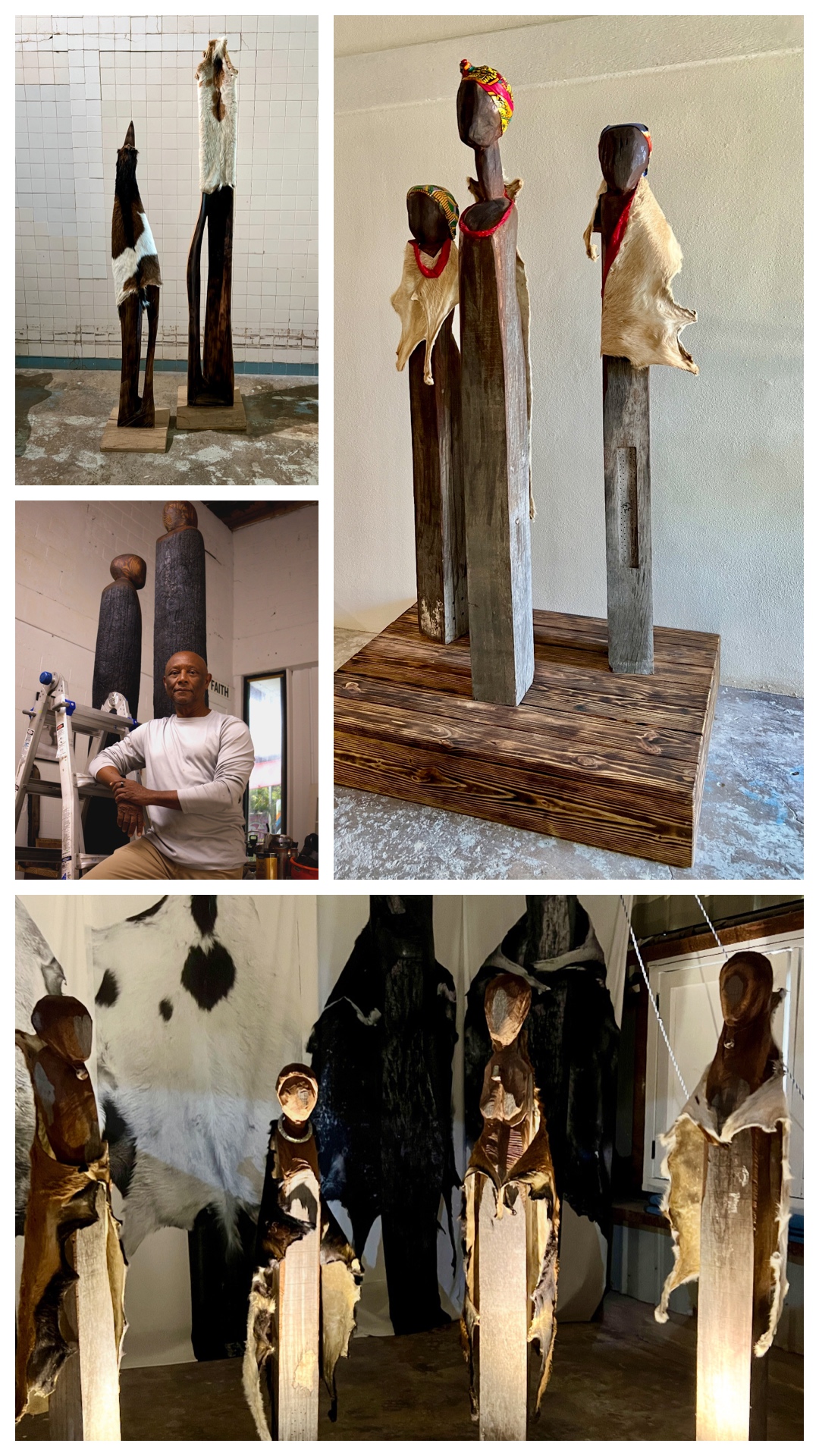 (Center l to r): Antonius Roberts in his studio. Credit: Christina Wong-Turnquest | TOTEM I & II (2020) Silk cotton layered with goat skin | Sacred Space (2025) Mixed Media on Wood | The Warriors Series (2024) Credit: Judith Doyle
Attention ‘to surface’ characterizes Roberts' practice, from his early paintings with their vibrant color palette and brilliantly thin and thick application, to his renowned “Sacred Space” sculptures, carved from hurricane-battered trees indigenous to the land. But in the current exhibition, the surfaces carry the additional weight of knowing what was almost lost in this transformed space representing one of his most significant achievements. Roberts' career has been defined by transformation. His first “Sacred Space” installation at Clifton Heritage Park in 2005 established a template that would shape his subsequent decades. Twelve female figures carved from dead but rooted casuarina trees on a site that had witnessed the arrival of enslaved Africans to the Bahamas. Those figures, standing sentinel on cliffs overlooking the ocean, became more than sculpture; they transformed into a place of pilgrimage, remembrance, and of protest against a development that threatened the site's historical remains. Expanded to other locations, Roberts wasn’t imposing form on nature but collaborating with it, revealing the figures latent in fallen trees. This approach embodies his philosophy of conservation, preservation, and restoration that extends from the natural environment to the cultural heartbeat of The Bahamas.
In 2012, Roberts opened Hillside House Art Gallery and Studio in a historic building dating to the 1700s. Over a decade, it grew into a welcoming hub for artists and the public." His "spiritual connection, his desire to record and honour his Bahamian heritage, as well as his commitment to conservation, preservation and restoration," as the Hillside House website notes, is "reflected in all his creative works and endeavours." Project I.C.E. represented the natural progression of this vision. Taking a ten-year lease on a dilapidated warehouse in 2019, Roberts proceeded to do what he has always done; conserve, preserve, restore. The renovated building received state-of-the-art solar power systems and yielded a thriving garden. It became a sanctuary for emerging artists, with residencies and mentorship from veteran Bahamian artists like Lavar Monroe and Roberts himself. It was also space for learning, with a STEM program teaching 3D printing to local youth. Even ‘the industrial warehouse as art gallery’ is a transformation that challenges the white wall institutional standard of what a gallery even is, or has to be. The 2025 fire placed all of that, all that transformational energy Roberts had imbued this rescued building with, at risk.

Antonius Roberts, RADIANT LIGHT (2025) 50 x 60 Mixed media on Canvas | Top photo Credit: Judith Doyle | Bottom Credit: Chappell Whyms
But even in devastation, Roberts saw possibility. The exhibition emerged from a year of reflection, rebuilding, and reckoning. They’re not documents of disaster, but explorations of what becomes possible when one has faced the worst and continued. For Roberts, the sacred isn’t separate from the everyday. It’s embedded within it. In the National Art Gallery of The Bahamas 2023 retrospective “Art, Ecology and Sacred Space”, Roberts explained, "The sacred is about celebrating something for what it is.”
This definition is simple and yet so profound. It’s manifest in everything he’s made. To celebrate something for what it is—nature, art, people—requires attention, respect, and the refusal to impose foreign meanings. It means working with the grain of wood, the decolonized history of a site, and the texture of smoke-stained surfaces. In “New Beginnings” this celebration takes on new dimensions. The works invite "attentive looking," as the Instagram announcement suggests, where "scale, weight, and presence can be fully felt." They are not to be experienced quickly but with intention, "as one would a carefully told story." The story is about how an artist who has spent decades cultivating community, mentoring generations, and transforming abandoned spaces into sanctuaries responds when his own is threatened.
 THE WARRIORS Series (2024), Azobe from West Africa and goat skin Credit: Chappell Whyms
At 67, Roberts is a worldwide exhibited veteran who has accumulated honors that would satisfy most artists' wildest ambitions: the Silver Jubilee Award, the E. Clement Bethel Award, the Ministry of Tourism's Cacique Award for the Arts, appointment as Officer of the Order of the British Empire by Queen Elizabeth II in 2017, a major retrospective at the National Art Gallery of The Bahamas in 2023 curated by Dr. Krista Thompson, and the respect and friendship of illustrious peers like Theater Gates, who contributed written text to his 2023 retrospective. And while his legacy is secured, Roberts seems more interested in what comes next. Roberts' life has been a series of beginnings as a painter, sculptor, curator, teacher, and community arts spacemaker who has enriched the lives of others.
New Beginnings speaks to the possibility that every ending contains a beginning, with every destruction leading to a potential renewal. It demonstrates the ongoing work of ICE, where emerging artists continue to find mentorship, community, and the offer to exhibit their work alongside Roberts’ at a show, another artist of Roberts stature would undoubtedly insist focus solely on them. Throughout the building, visitors can engage with artwork produced by emerging artists mentored at the site; they each have hung or installed work as an extension of Roberts primary exhibition.

Top Photo (l to r): Antonius Roberts CHARRED REMAINS I-V (2025) Charred wood remains, installation | A SPARK I-VIII (2025) Stained glass | BURNT REMAINS I-VIII (2025) Photography. Credit: Chappell Whyms | Bottom (Close-up) CHARRED REMAINS I-VIII Credit: Judith Doyle
Roberts demonstrates his oeuvre to powerful effect, which includes a multidisciplinary tour de force of paintings and sculptural installations. His practice has been less medium-specific and more idea-specific; the idea that art can heal, that creativity can restore, that beauty can emerge from ruin. The works carry within them the memory of fire but also the promise of regrowth and, like Roberts himself, are products of The Bahamas, with its history of hurricanes, resilience, loss and rebuilding. They speak to a worldview in which destruction is never final, in which ashes become fertilizer, in which new beginnings are always possible.
“New Beginnings” is a reminder that creating is sacred work that never truly ends; it simply transforms, like ashes into soil, like loss into art, like endings into new beginnings.
"Antonius Roberts: New Beginnings" is on view at ICE Incubator for Collaborative Expression
Curated by Christina Wong-Turnquest
BAIC Industrial Park, Nassau, Bahamas
January 11, 2026 through February 28, 2026.
For more information: porjecticebahamas@gmail.com

Byron Armstrong
Byron Armstrong is an award-winning freelance journalist and writer who investigates the intersections between arts and culture, lifestyle, and politics. Find him on Instagram @thebyproduct and on Linkedin https://www.linkedin.com/in/byron-armstrong
view all articles from this author