Whitehot Magazine
August 2026
"The Best Art In The World"
"The Best Art In The World"
August 2026
Joseph Nechvatal on the Continuity of Digital Mutation
 Joseph Nechvatal Destruction, 1981 Graphite on paper. Diptych, Overall 11 x 28 in.
By LARA PAN February 26th, 2026
Joseph Nechvatal is widely recognized as a post-conceptual artist and one of the pioneers of digital art, particularly as it related to painting. Both an artist and a theorist, his practice merges conceptual rigor with technological experimentation. Emerging from the radical 70s New York scene and associated with the No Wave movement, working alongside Rhys Chatham, he developed within a multidisciplinary environment where music, performance, film, and visual art intersected.
Nechvatal’s most significant contribution remains his Virus Project Paintings, in which custom-designed computer viruses “infect” the body of his prior work. The virus functions as both medium and metaphor, introducing mutation, decay, and unpredictability into the visual field. Rather than abandoning painting, he expands it into a digital post-biological realm. Drawing on thinkers such as Gilles Deleuze and Antonin Artaud, Nechvatal approaches infection not merely as destruction, but as a generative force; making his work strikingly relevant to our hybrid technological condition.
Having followed Joseph’s work for several decades, I felt compelled to conduct a special interview with him, focusing on two of his exhibitions that took place almost back-to-back: Information Noise Saturation, presented in the NYC Lower East Side during last November/December at Magenta Planes, and Le Bateau ivre (The Drunken Boat), an exhibition of his recent artificial life–assisted paintings on velvet currently on view through the end of February at Galerie Richard in Paris. This conversation seeks to explore the continuity and evolution within his practice, situating these recent presentations within the broader arc of his artistic research.
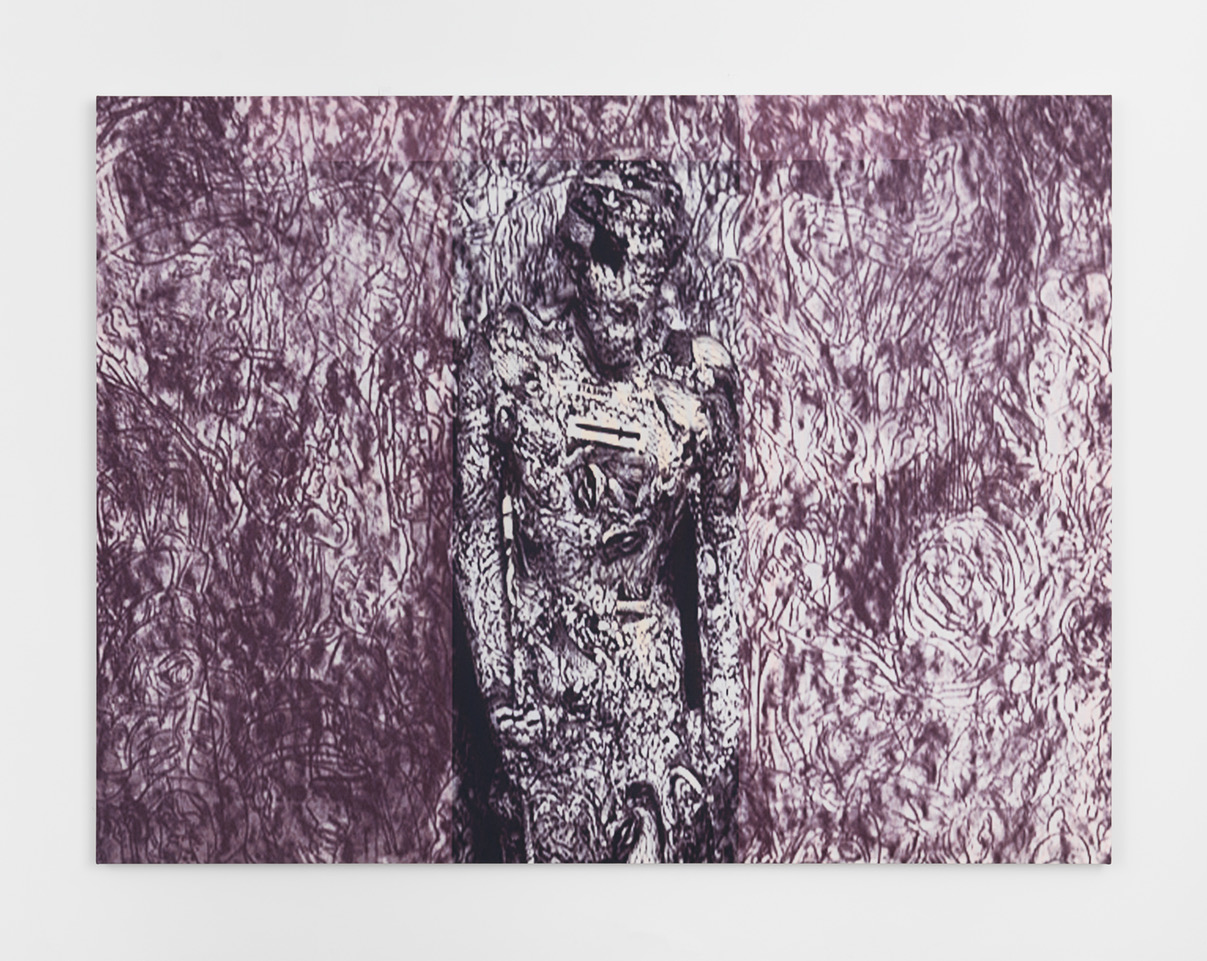 Joseph Nechvatal Profusely Informed Personage, 1986 Computer-robotic assisted acrylic painting on canvas 72 x 96 in.
Joseph, before turning to your recent exhibitions, I’m curious: were you familiar with Harold Cohen’s early experiments in San Diego, when he began working with the Fortran programming language in the late 1960s? Did his work have any influence on your own practice?
JN: Yes, some: conceptually but not stylistically. I think that I first became aware of Harold Cohen’s computer paintings from Roy Ascott. In 1995 I was first introduced to Roy, who was scattering brainy cyber-civility in Paris like fairy-dust. He had just launched his, what is now called, Planetary Collegium, where I earned a Ph.D. in Art and Technology Theory. It first appeared to me that Marcel Duchamp’s embrace of chance had seeded the bed of conceptualism where Harold Cohen and Roy Ascott took their pleasures. Simultaneously, most a-semiotic abstract painting (think Barnett Newman) had long renounced depiction and thereby jettisoned a good deal of form and content: something that only multiplied during the (so called) conceptual-based death of painting period. I certainly came to admire Harold Cohen pushing the algorithmic into painting, even as I was less than enamored with the visual results (which is what counts). But it was the audacity of the experiment that grabbed me just as painting became post-modernly phantomized because the internet was afoot. The web’s immaterial connectedness conferred a phantasmagorical dimension onto painting for me. I embraced that, even as many painters tried to deny that situation by producing faux-naïve results. As I interpreted it in my computer-robotic assisted paintings (1986 – ongoing), computers and the web inferred for painting aspect of Ascott’s cybernetic utopianism that stressed being “numinous and grounded.” This is a radical and giddying idea for art, and the perfect fluid response to “dead” painting.
Emerging from the radical New York scene and shaped by a multidisciplinary environment where music, performance, and visual art intersected, your work has always moved between conceptual rigor and technological experimentation. Looking back across the arc of your practice—from early digital interventions to your recent artificial life–assisted paintings on velvet—how do you understand the continuity within your research? What has remained constant, and what has fundamentally transformed?
JN: As I outline in my art theory book Immersion Into Noise, the relationship between signal and noise has been the through thread. Starting out during my No Wave post-punk period and the Tellus Audio Cassette Magazine project, this push-pull even today plays a strong role, as in my new novella Venus Voluptuous in the Loins of The Last God, the sequel to my 1995 cyber art novella ~~~~~~~~~~~~~~~~~venus©~Ñ~vibrator, even. This investigation of noise as a positive cultural form is perhaps most readily recognized in my noise music work, for example in the Ex Stasis 69 cassette recently released by Pentiments Records.
I’ve always sensed subtle continuities between your early and recent works, even when they aren’t immediately obvious. I see a connection between Information, Noise, Saturation and Le Bateau ivre (The Drunken Boat), though perhaps The Drunken Boat carries a more poetic tone. How would you describe the relationship between these two exhibitions? Do you see a shift, or an underlying continuity?
JN: Many years have passed between the two bodies of work, but my commitment to the importance of painting participating in our digital reality has only increased. The continuity is that the digital brought back from the dead the practice of painting, for me. It made it alive in the enthusiastic sense of the word alive as I began mixing my digital painting practice with techniques of AI artificial life (a-life). This liveliness allows me to work with my thoughts and emotions as connected to computer space where there is something so large, so astounding, and so pregnant with the darkness of infinite AI space that it excites and frightens.
Static art like painting, sculpture and books, enters the artist into a long chain of being that goes back deep into time. And, if Artificial General Intelligence doesn’t kill us all off first, this chain of art will continue far into the future. So being a link in that cultural chain is a form of immortality that started in 1987 when Deleuze and Guattari decoded for me the tradition of painting and proposed another tack which lead me back to Artaud’s Body-without-Organs, to swarms and rhizomes, to processes of de-territorialization and reterritorialization through the virtual where the result really is an embodiment of real yet abstract forces. That way painting became for me a new kind of instrument for modifying consciousness and organizing new modes of sensibility.
Even as our consciousness and sensibility is largely now molded by the AI virtual, the continuity of my intentional stance defends modernism’s tradition of valuing the opticality of flatness that was established in America just after World War II. What is valued in this tradition is the practice of so-called “pure” visuality over material texture when it comes to painting. This value is manifest through the strict flatness achieved in my computer-robotic assisted paintings’ paint application where an air-nozzle pigment delivery system (driven by a computer program) sprays and stains the canvas or velvet support. There is no 3D texture other than the minuscule one provided by the canvas weave or lush velvet surface. There is no “croute,” as the French say (which means crust). But in painting, the act of addition and subtraction has always been a large factor. So is it with this underlying continuity.
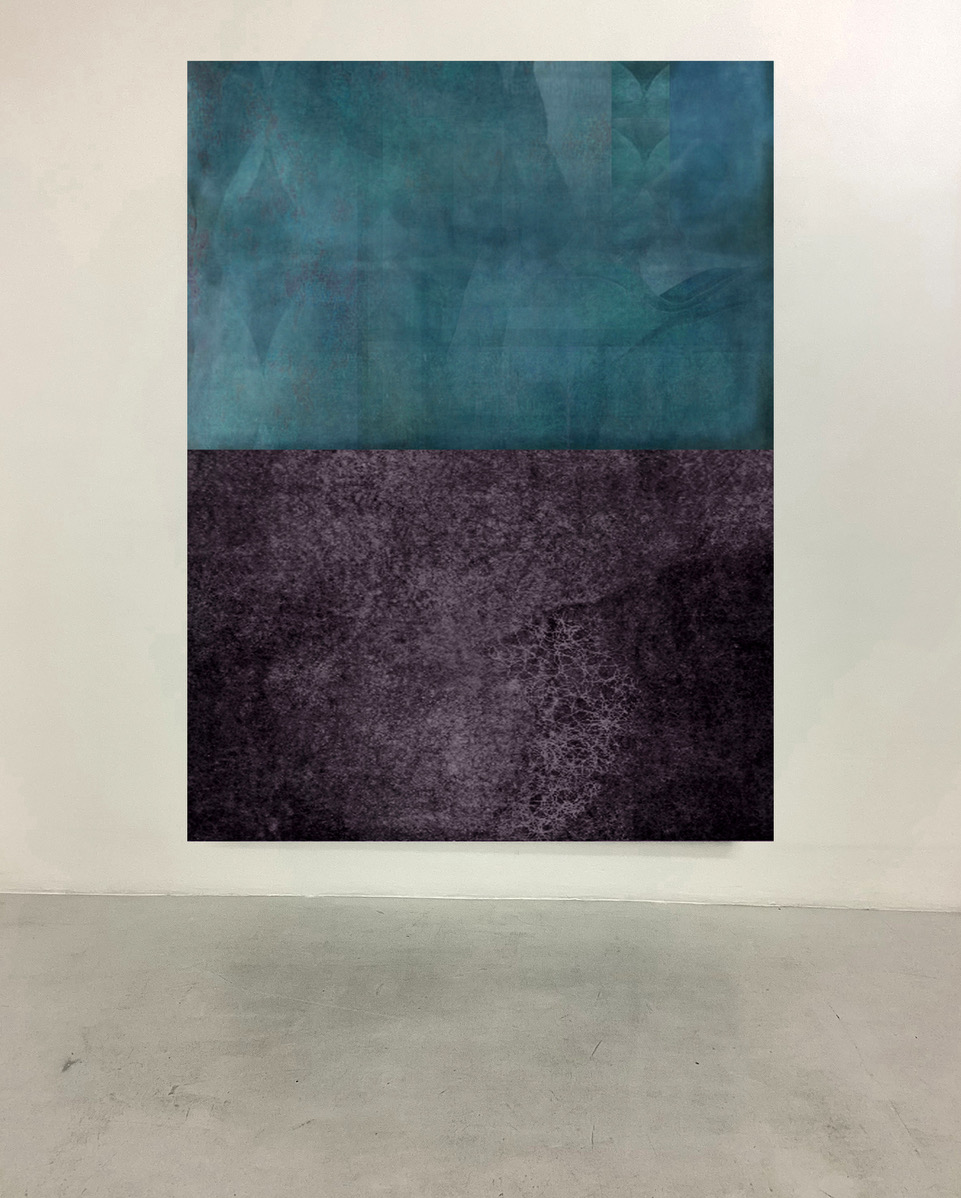 Le Bateau ivre III, 2025, 168 x 224 cm.
Your Virus Paintings introduced infection as both medium and metaphor, where mutation, decay, and unpredictability become generative forces rather than destructive ones. In your recent exhibitions, how has this concept of viral transformation evolved? Do you see these new works as a continuation of the same post-biological inquiry, or has your understanding of “infection” shifted in relation to our current technological and hybrid condition?
JN: I now consider myself a post-viral painter, but with qualifiers. I’d say I have been a continual transdisciplinary painter, because I have been using drawing, algorithms, and writing in my paintings for a long time now. That may not sound like continuation, but for me it is.
One of the paintings in my Information Noise Saturation show, Infinite Apocalyptic Messenger, has text I typed onto the maquette in 1987 before scanning it into a final digital file maquette. The text is a collision between Paul Virilio’s Pure War text and Jean Baudrillard’s Simulations, both published by Semiotext(e) in 1983. This is significant because French philosophy and conceptual art taught me that my motivating concepts are the machines that allow an artwork to find its necessary means of expression, and painting is what I know best. I’m obsessed with its history, but I try to be a nonconformist when it comes to painting and challenge some of its social conventions.
I read in the Galerie Richard press release the phrase, “No black box or boat is depicted.” In this context, how do you envision the future of artistic creation, the notion of freedom within it, and the influence of AI and other extraordinary technological discoveries available today?
JN: It’s more of the same. In 1985 I was introduced to computer robotics as a painting method and I jumped on it. Computers interested me ideologically, as tools of cliché production, of political manipulation. I saw computers quickly becoming the dominant ideological mechanism for the military, for the media, and for the manipulation of consciousness. I wanted to take a non-conventional approach, an almost perverse approach, to mixing painting with computers.
My stylistic goal was (and is) something along the lines of a palimpsest: where one image is superimposed upon another and another and another, so that they almost, but not quite, cancel each other out. That palimpsestic ambiguity fosters subjective visualization–what in magic is called divination. My goal is to enhance the powers of subjective divination in the viewer. And not to deliver pop or propagandistic readability, for poetry is fundamental to me. I began reading Rimbaud at 15 and it was my first experience of pleasurable estrangement. When I arrived in New York, I went to the Poetry Project at St. Mark’s and heard poetry read and I began to write some. I also began writing more and more theory and philosophy. Writing is integral to my intermedia approach, as with Venus Voluptuous in the Loins of The Last God that addresses the erotics of art and identity within the context of artificial intelligence.
The three large paintings at the Magenta Planes show each mark a different moment in this development. Profusely Informed Personage, from 1986, grew out of a work I made that was shown in Documenta 8 called The Informed Man. It is about problematizing the communicative processes and was very much influenced by post-structuralism: Foucault, Deleuze, Guattari, Lyotard. The central figure comes from a statue of Lazarus. I chose Lazarus because everyone was saying that “painting was dead” and Lazarus returned to life from the dead. My notion was that computer-robotics could revitalize the field of painting by offering an alternative technique that expanded the definition of what a painting can be.
Infinite Apocalyptic Messenger, was my first hands-on involvement with a computer in a computer lab and includes the typed text from 1987 I mentioned above. The third, Without Chains, was influenced by Caravaggio’s painting Narcissus. I was using here the water-mirror as a device for meditation on cybernetic circuitry and social mirroring.
Now, I’m deeply involved with and also critical of artificial intelligence, which I’ve used since 2000 in artificial-life form. As is beginning to be widely understood, AI presents a new apocalyptic potential that is circulating somewhat subliminally, much like the terror of nuclear war technology was in the 1980s. All of society needs to discuss this AI promise and threat collectively and art can help us think it through. WM

Lara Pan
Lara Pan is an independent curator,writer and researcher based in New York. Her research focuses on the intersection between art, science, technology and paranormal phenomena.
view all articles from this author