Whitehot Magazine
October 2026
"The Best Art In The World"
"The Best Art In The World"
October 2026
Last Week to See Halfway Out to Heaven: Nana Wolke at Management Gallery
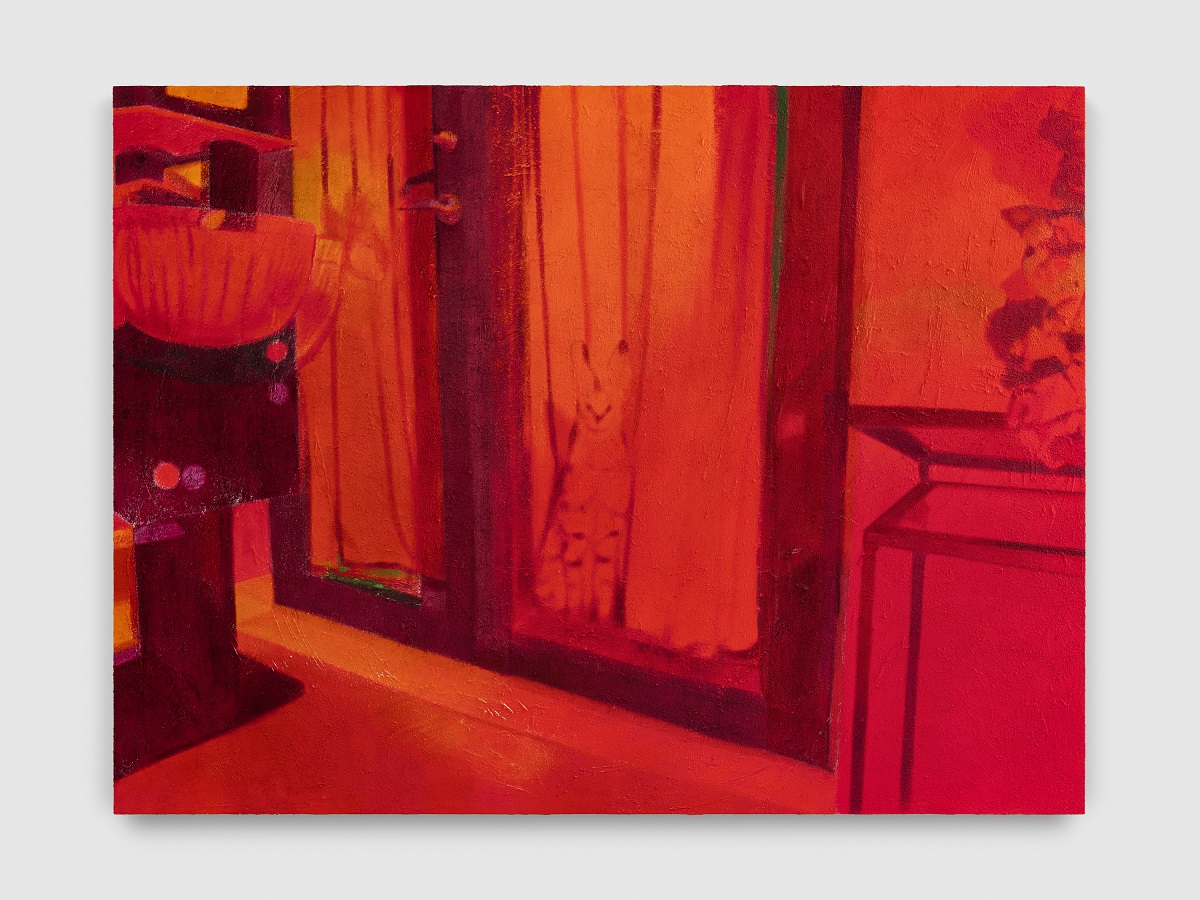 Nana Wolke
00:21:34,333 - -> 00:22:58,625
(Vodevil), 2026
Oil and construction sand on linen
72 x 96 inches / 183 x 243.8 cm
By LARA PAN October 21st, 2026
Nana Wolke draws inspiration for her paintings from experimental film and photographic stills. She examines how systems of access and visibility shape encounters with desire, power, and control. Her images emerge from raw video footage of prompted actions and unscripted events unfolding in environments defined by social and psychological thresholds.
Developed from footage recorded at a private property housing big cats in Homestead, Florida, the paintings explore the spectacle of exotic animal ownership alongside the intimacy of an encounter. The carefully staged wilderness introduces a complexity that extends beyond the Americana evoked by Tiger King. Translated into paint, the recorded image becomes a separate event, shaped by the material surface, color, and the thoughts present in the act of making.
Wolke’s paintings bring to mind some of the earliest artistic expressions: animal figures and red pigments on cave walls. Yet the colors produced through handheld lights and translated onto granular, worked surfaces give these echoes of prehistory an almost futuristic, science-fiction atmosphere. The animal enclosures become an unreal landscape, suspended in an imagined future resembling the deserts of Mars. Within this unfamiliar world, the animals return us to an enduring human desire: to approach the wild, to capture its image, and to possess something of its power. What does freedom mean when life is both protected and confined?
The enclosures introduce a tension between care and possession, protection and captivity. Their elaborate construction sustains an image of wilderness, while the shadows of their bars reveal its limits. Even the owner becomes captive to the demands of maintaining his own fantasy. Wolke’s paintings hold these contradictions within the image, allowing recognizable scenes to dissolve into color and texture as we approach. Looking becomes an uncertain process, caught between the desire to see and the gradual recognition of the structures through which we exercise control.
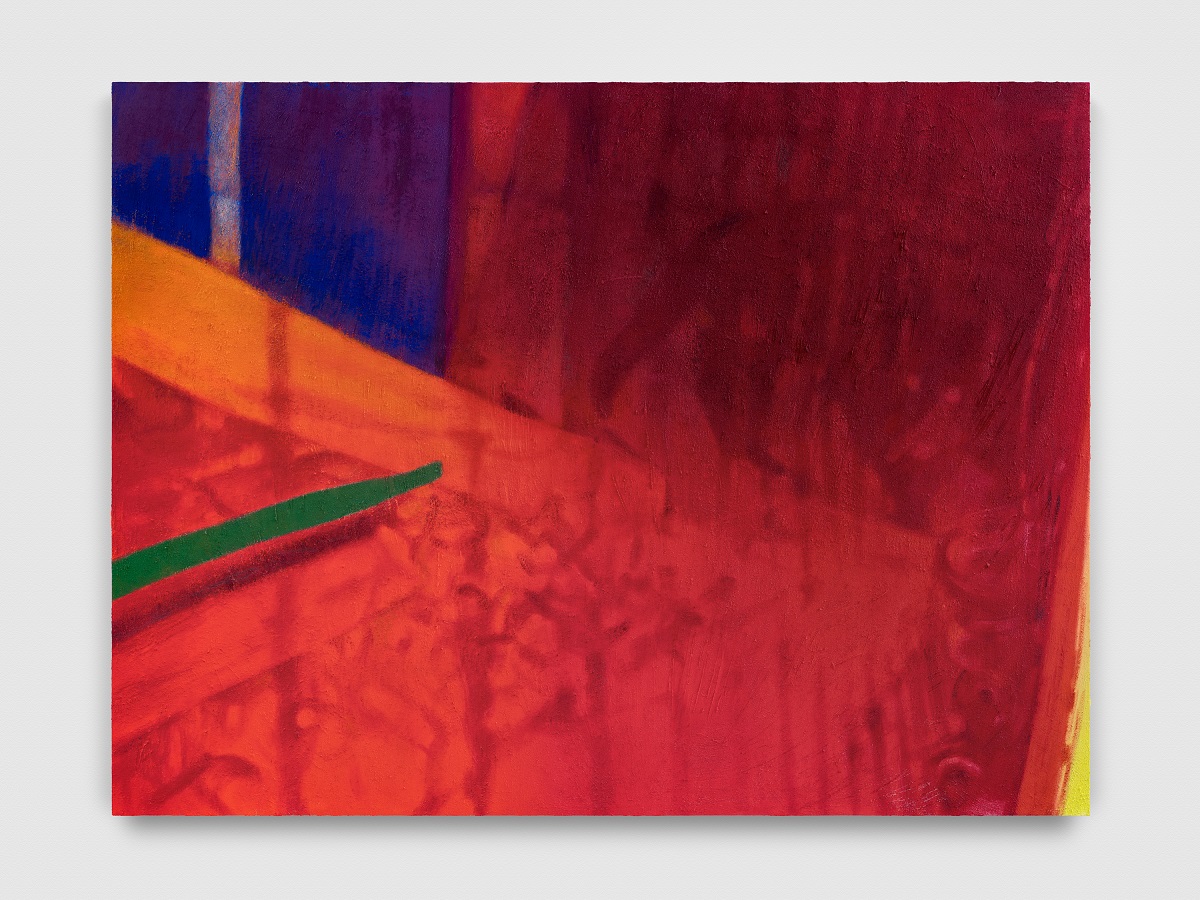 Nana Wolke
00:23:40,875 - -> 00:49:38,250
(Without past and without future, without provenance and without destination, without sender and without recipient), 2026
Oil and construction sand on linen
72 x 96 inches / 183 x 243.8 cm
LP: What drew you to the big-cat sanctuary in Florida, and how did your experience there change the images you wanted to paint?
NW: The show is based on footage recorded at a private property in Homestead, south of Miami. I was initially curious about the connection between some of the earliest drawings made by humans, found in Chauvet Cave and often depicting predatory cats, and the somewhat bygone era of exotic animal ownership in parts of Florida, especially places like Palm Beach, where this kind of collecting became another status symbol in the ’70s and ’80s.
There’s something fascinating about how proximity to danger can elevate a sense of luxury. Having a white tiger on a leash communicates power with much more force than a sports car. The owner of the big cats depicted in the show comes from that ’80s Scarface era; in fact, he inspired the film itself. I was initially suspicious of this kind of association with exotic animals, but once I spent time with him and his crew, I could see both sides of it: the instinct of a collector and the attachment of a family man that cannot be dismissed as sheer vulgarity.
The human aspect of it all is exactly what makes it tricky and complex. I think this is reflected in the work. It’s charged and very much my angle on everything I observed at the property. Still, it’s closer to an open question than a prescription for what you’re supposed to take away from my experience.
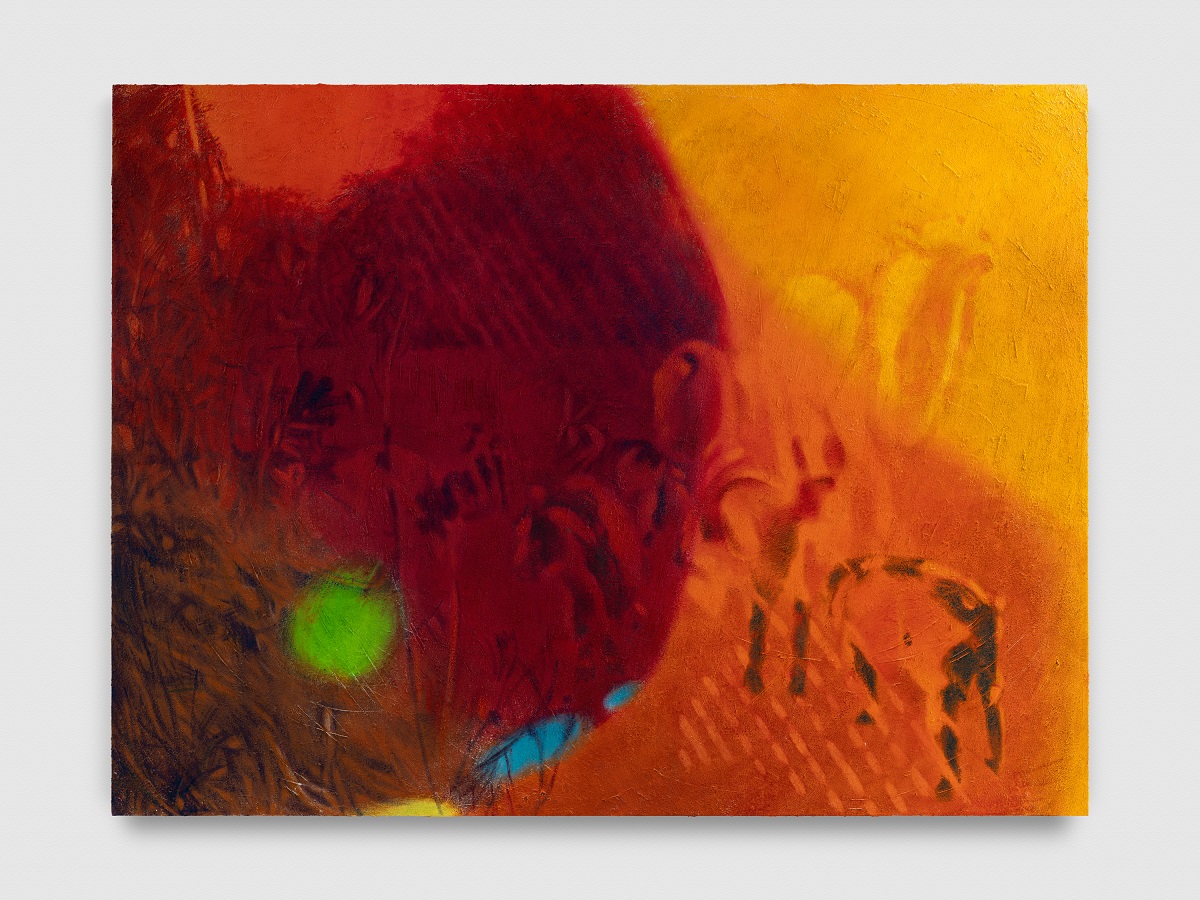 Nana Wolke
00:58:46,333 - -> 00:59:22,458
(The Gift), 2026
Oil and construction sand on linen
72 x 96 inches / 183 x 243.8 cm
LP: How do you choose a particular moment from your footage, and what happens to that image as you translate it into a painting?
NW: Each painting captures a scene that could last a few hours or a few seconds. This is indicated by the subtitle-style timecode in each work’s title. It’s often a combination of elements from that span of footage, but I’m always aiming for one captivating image. Sometimes it’s a direct translation of a single moment.
The way I treat the information from the film stills is very reductive, though. I’m primarily focused on color combinations that I achieve on set using small handheld flashlights. I start with a layer of gesso mixed with construction sand to achieve a granular surface that I scratch into, leaving thick accumulations of material in some areas. It feels like a process of charging the surface, both directing and obstructing the flow of brushstrokes and allowing the underlying layers of paint to show through the many layers applied later. This creates a noise effect reminiscent of the low-quality footage I’m working with.
I’m most interested in how the image develops over time as you stand in front of the work. Most of the paintings in the show read as abstract at first. If you step close, though, you lose the image again. When I’m painting up close, I sometimes feel like I’m navigating through a fog.
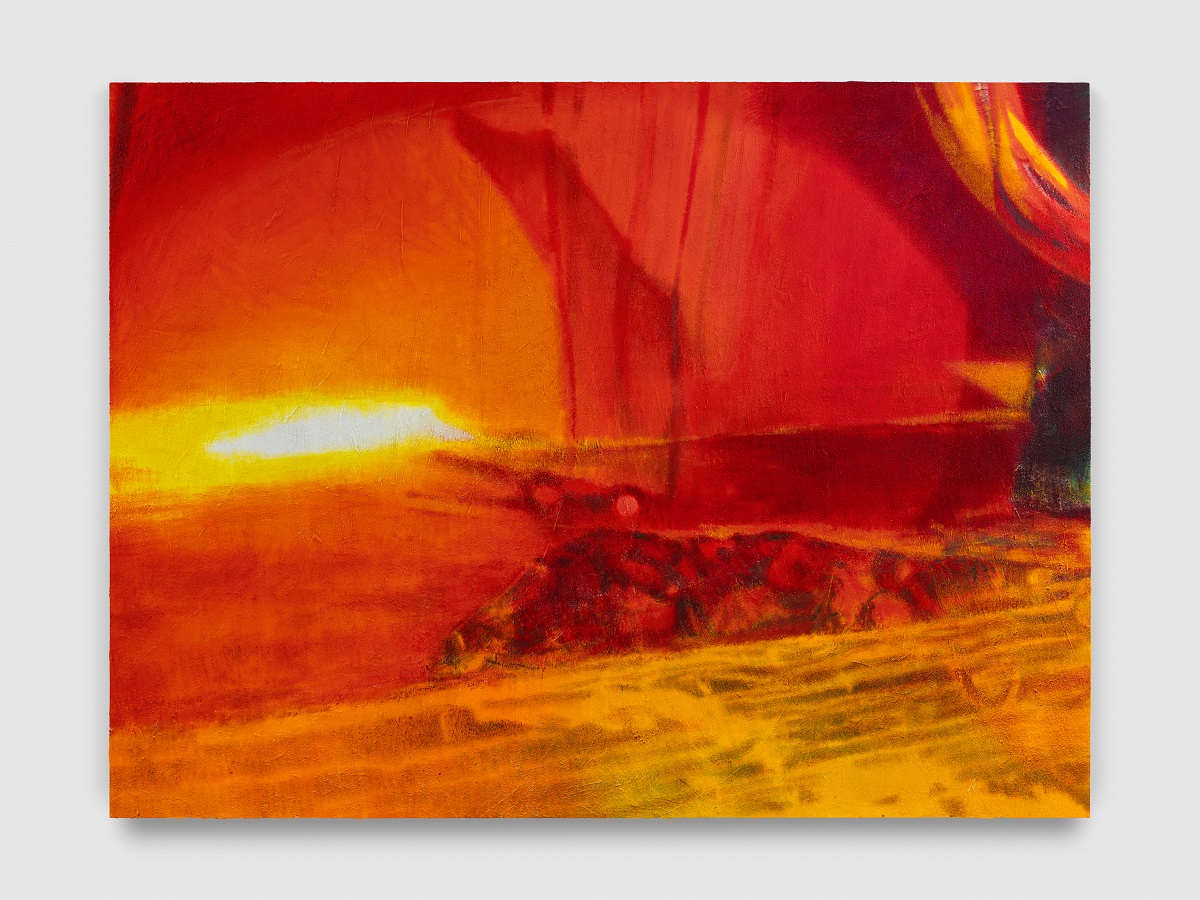 Nana Wolke
01:40:22,625 - -> 01:40:44,708
(Sunlight will drive you crazy), 2026
Oil and construction sand on linen
72 x 96 inches / 183 x 243.8 cm
LP: The animal enclosures hold a tension between care, captivity, and spectacle. How did these relationships enter the paintings?
NW: Florida is fascinating for its jaw-dropping flora and fauna, which have, in many ways, been turned into a monetized spectacle. Private zoos still offer close encounters with big cats and host private events on their properties.
The private home I visited has an expansive backyard with a number of animal enclosures built with incredible attention to detail and artistry. There is an obvious desire to stage a jungle-like wilderness. It feels miles away from the austere cages of Tiger King. Keeping all these different animal species on their required feeding schedules while maintaining their environments is an all-consuming activity—a life’s work.
The more I thought about it, the more I felt that these enclosures work both ways, keeping the owner captive to his own fantasy.
LP: What role does memory play in your practice? When you paint from a recorded image, how much do you follow what the camera captured, and how much do you follow what you remember feeling?
NW: To be honest, I don’t think a lot about memory. Painting feels like a separate event from the initial on-site recording. Reality is first manipulated when I choose angles and direct lights toward the action in front of me, revealing certain parts while obscuring others. I feel like something similar can be said even about documentary filmmaking.
Painting removes another layer of “reality”: suddenly, a bar of the cage reads as just a strip of yellow paint, a formal element of sorts. I enjoy how this process feeds into the construct of wilderness I encountered at the property to begin with, while retaining elements, like the shadows of the enclosures, that undermine that illusion.
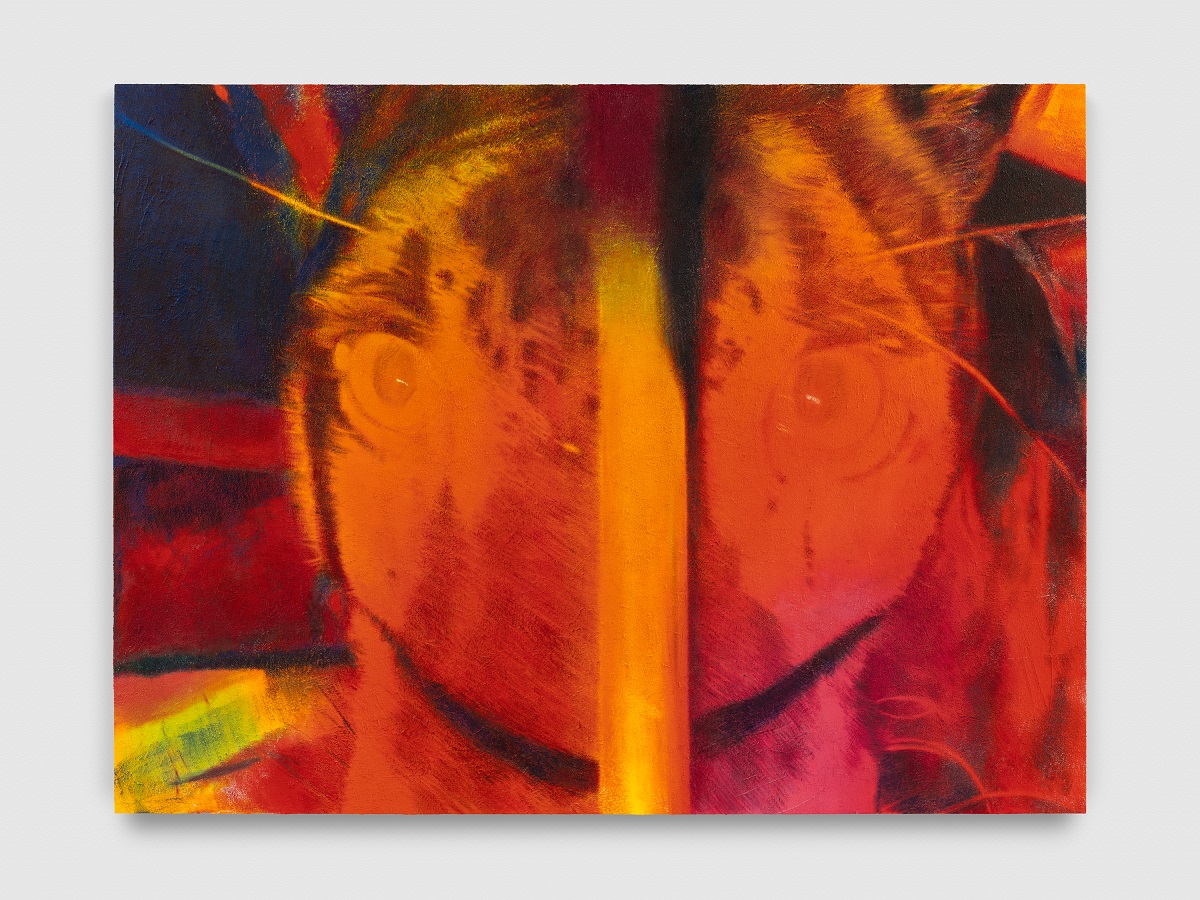 Nana Wolke
00:23:40,000 - -> 00:38:35,917
(Alles Gucci), 2026
Oil and construction sand on linen
72 x 96 inches / 183 x 243.8 cm
Even though the subject matter is very specific and speaks to my particular interests, and I spend a lot of time researching and preparing for the work, once I begin painting, the only thing that really matters to me is the charge of thoughts present in the moment of making, often completely unrelated to the subject.
So the work doesn’t set out to be about me in any direct way. But in those lucky moments when the hand starts guiding the gesture without me interfering, I feel the work ends up being very revealing.
LP: How has this experience influenced the direction of your work, and what projects are you planning next?
NW: One thing that has opened up with this body of work is a more playful side of my practice, which comes from fully trusting the process, even if it leads to moments of complete failure. I’m not afraid to let the footage almost fully fall apart in the painting process and cease to explain.
Both on location and in the studio, I’m seeking more of that “Oh my God, how am I going to pull this off?” feeling, understanding that only this will lead me to wherever the work wants to go next.
The two upcoming group presentations in the States before the end of the year will showcase more of the current Florida material. Meanwhile, I’m plotting something different and pretty damn exciting for my upcoming solo show in Tokyo in 2027.

Lara Pan
Lara Pan is an independent curator,writer and researcher based in New York. Her research focuses on the intersection between art, science, technology and paranormal phenomena.
view all articles from this author