Whitehot Magazine
October 2026
"The Best Art In The World"
"The Best Art In The World"
October 2026
Work in Progress | Nōvo Collective at The Blanc
By KEN KRANTZ June 28th, 2026
The contemporary art world is fundamentally about looking: looking at the work, looking at each other, looking for ways to feel a little less awkward.
Like a breath of fresh air, I found myself doing more than looking at "Work in Progress." Spanning four floors of The Blanc for a single weekend in June, this sprawling, multi-disciplinary takeover by Nōvo Collective on the heels of their blockbuster Mexico City debut completely subverted the traditional viewer-object hierarchy.
The show was a sanctuary for weird art kids. By centering interactive programming around tactile sensibilities, the organizers managed to make genuine human conversation the natural byproduct of the art itself.
Predictably, my favorite corner of the entire ecosystem was The Lab. The new-media annex of interactive, digital technology was packed with indie video games, algorithmic web haikus, and speculative, experimental research tools. I took my time exploring the neon-lit playground.
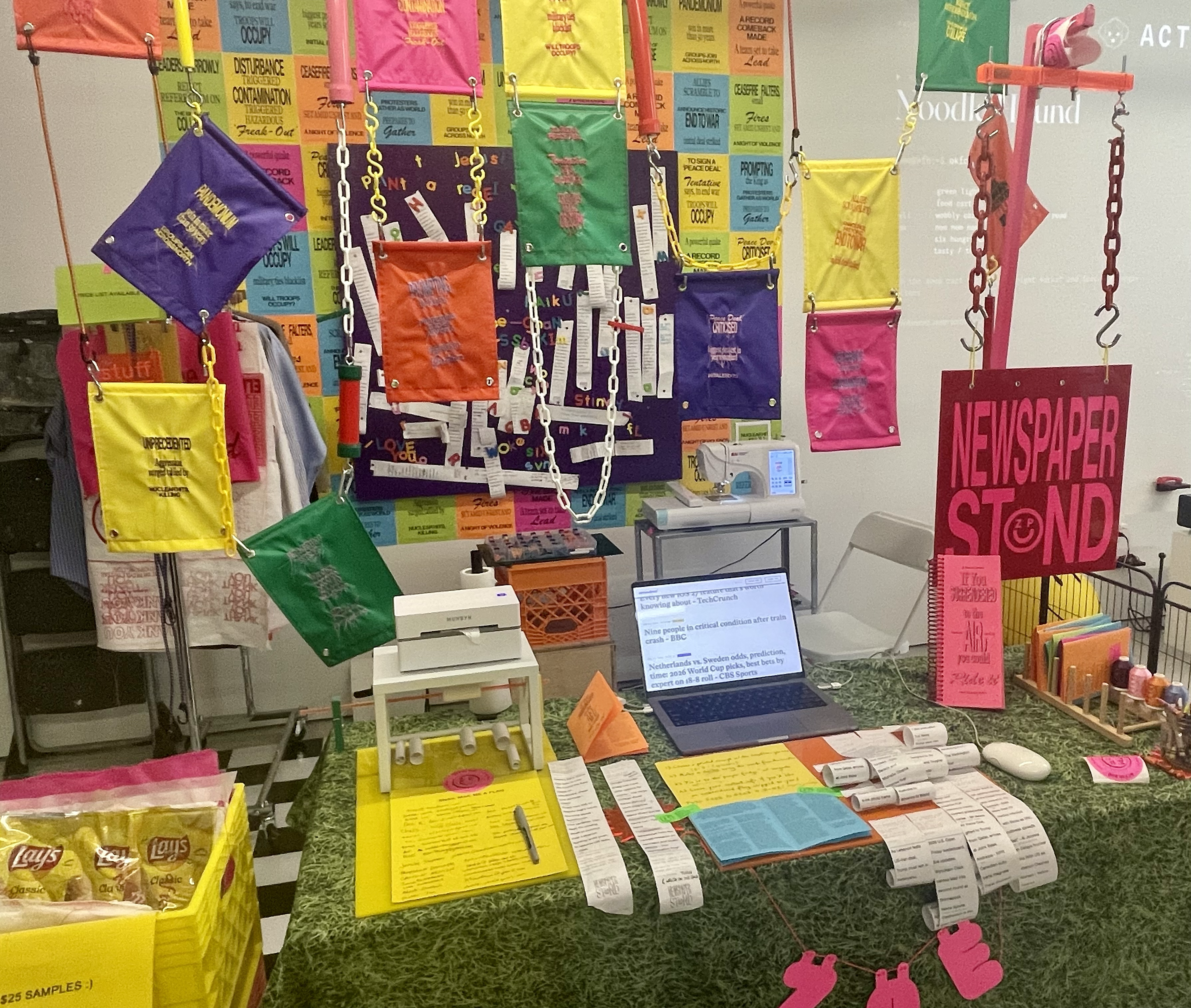 Zoë Pulley, If you surrendered to the air, you could ride it (2026)
Anchoring the room was Zoë Pulley’s unforgettable If you surrendered to the air, you could ride it, titled in reference to Toni Morrison’s Song of Solomon. At the makeshift newspaper stand, Pulley’s website uses an API to draw randomized headlines from news pages around the country and generates the haiku sent to the printers. The resulting text, printed on a receipt, could then be transfigured into fabric embroidery using children’s magnetic letters in a nod to the printed broadsides of the 19th century. The embroidered flags have a unique resonance: “I’m thinking about what it means to preserve an ephemeral text, like a news headline, onto fabric and what it means to make a public proclamation.”
Considering Lorraine O’Grady’s Cutting Out the New York Times, Pulley addresses a “new ecosystem” of media with both archival rigor and optimism: “How can we ride towards liberation amidst trial, terror, and trauma?”
The installation is a sister to her project currently on display at the Shirley Center’s “At the Edge.”
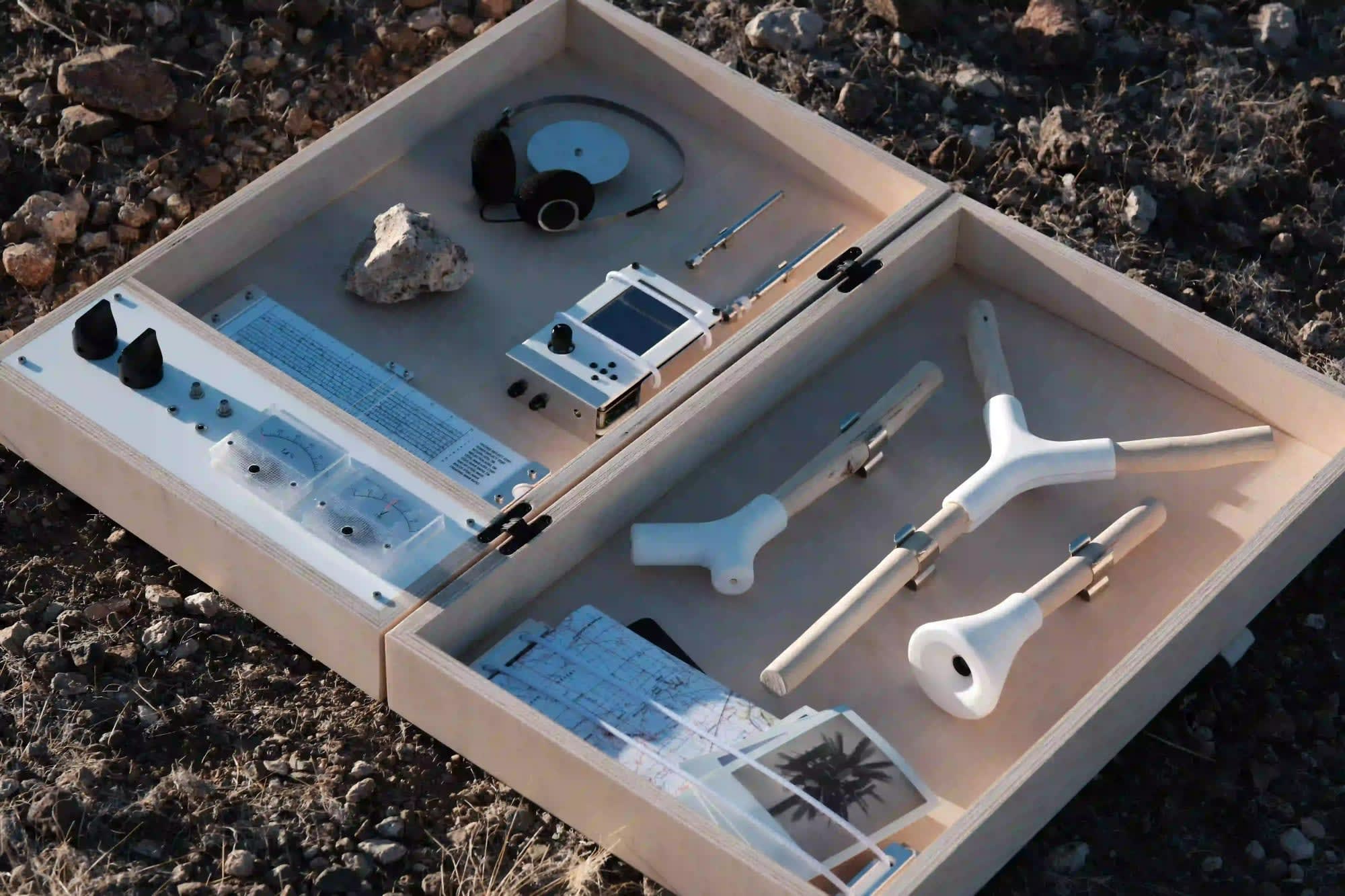 Pedro de Oliveira and Xuedi Chen, Future Organisms, (2026). Image courtesy of artists.
Just a few feet over, Pedro de Oliveira and Xuedi Chen presented Future Organisms, a scientific study of techno-biology. Documenting artificial species, such as antenna towers disguised as trees, they built bespoke field kits to investigate how inorganic beings fit into biomes around the world. They used the tools to listen to frequencies like electromagnetic spectrums (which impact bird migration) and ultrasonic resonances (which dogs can hear), considering how the plants “speak.”
“Maybe they’re affecting the other organisms in the environment,” considers Xuedi, showing the pine and broad leaves scavenged as samples. “It’s super poetic to think about how even these fake trees are decaying like real plants.”
The digital playground culminated in Caleb Leak’s Activities for Humans. Leak’s space was built into the corner office of a startup led by his dog, Momo. Stations featured avant-garde games vibe coded with Momo, including an interview simulator.
Ascending to the next floor felt like entering an all-you-can-eat buffet of creative technique. Booths were dedicated to the practices of metalwork, lithographs, ceramics, glassmaking, and more. It was here that I met mixed-media artist Lara Alcantara, who invited me to violently smash a piece of vintage pottery with a hammer. She used the pieces to guide a lesson in kintsugi, the Japanese art of repairing broken pottery with gold lacquer.
"I like my broken pieces," Alcantara shared, reflecting on the period of immense personal evolution which sparked the project. "They make me who I am." Together, we imperfectly mended and gilded the ceramic shards, reframing the destruction as a mirror for the self.
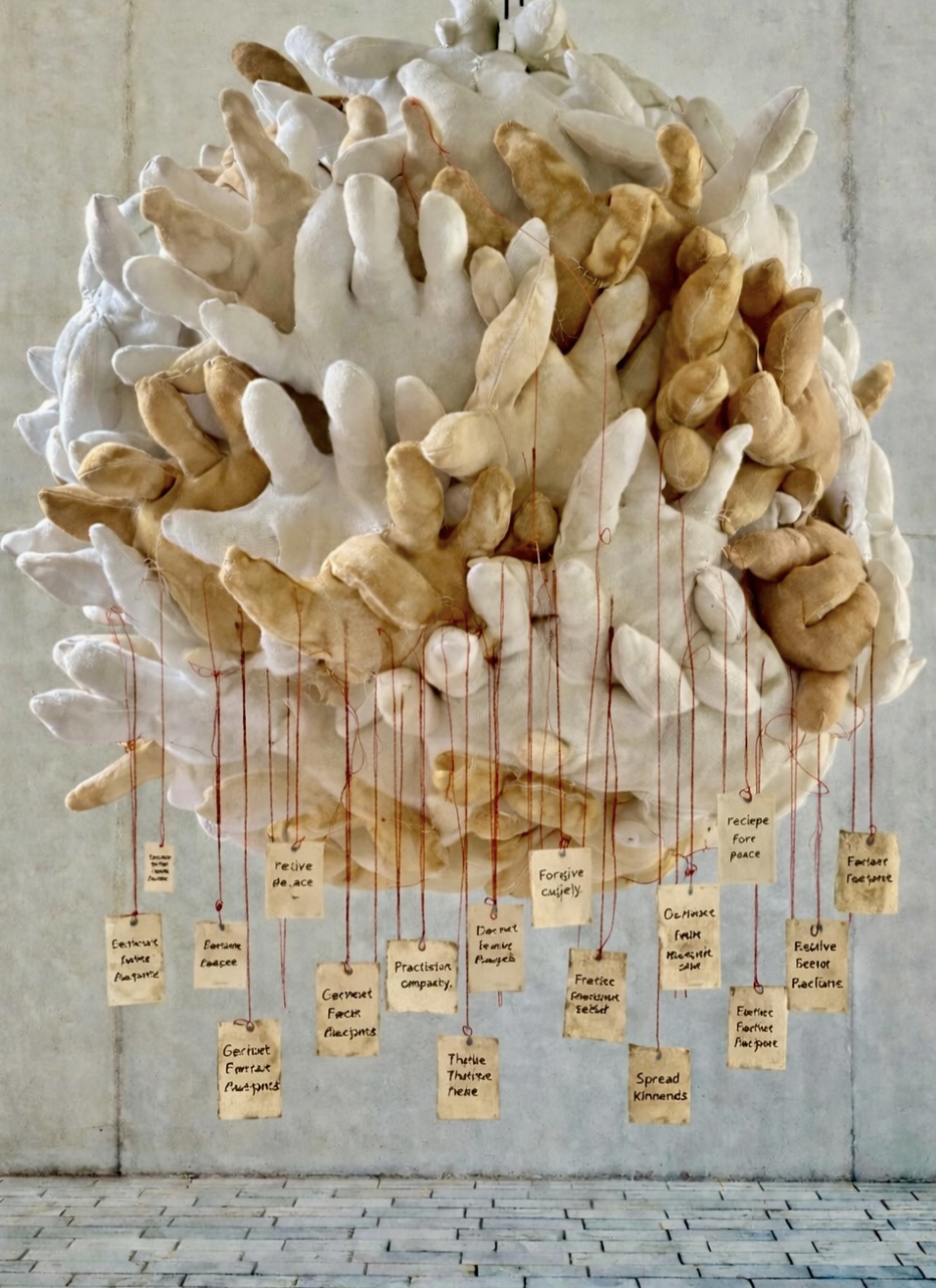 Marianna Baker, Wishing Well, 2026. Image Courtesy of Artist.
My afternoon ended at the Wishing Well, an installation by Marianna Baker, on the top floor. Baker constructed a tree-like sculpture composed entirely of fabric hands, gently instructing visitors to hang their written desires onto plush fingers. “I’m from Russia,” Baker shares. “There, we don’t express ourselves freely. Because we grew up in a totalitarian country, everything was censored, but everything had symbols.” For this reason, she seeks to steep all of her work in meaning.
The work showcased at "Work in Progress" was fleeting and beautiful. The artists were exceptional hosts, inspiring curiousity, sparking delight, and providing nuance to the exhibitions. Overall, it was a great experience.
I would be remiss not to mention that "Work in Progress" was made even better by acknowledging that art viewers possess human bodies. The venue offered creatively inspired cocktail and matcha bars. At these types of multi-floor marathons, I usually exit the building dizzy, dehydrated, and deeply suspicious that the entire attendee list is subsisting solely on wine, cheese and vapes. Tapping into the creativity of mixologists and chefs for popups is a huge plus for me.
By fueling the attendees in many ways, Nōvo Collective bypassed the typical art show march to exhaustion, transforming "Work in Progress" into a vibrant, living ecosystem where you want to stay and play.

Ken Krantz
Ken Krantz is interested in the intersection of business, culture, and bravery where great artwork emerges. He can be found on Instagram as @G00dkenergy or online at goodkenergy.com.
view all articles from this author