Whitehot Magazine
October 2026
"The Best Art In The World"
"The Best Art In The World"
October 2026
Out of Focus: Another Vision of Art from 1945 to the Present Day at Musée de l’Orangerie
 Thomas Ruff, jpeg ny01 (2004) Tirage chromogène sous Diasec, AP (edition of 3, 2AP), 253 × 185,1 cm Courtesy de l’artiste et David Zwirner Thomas Ruff © ADAGP, Paris [2025]
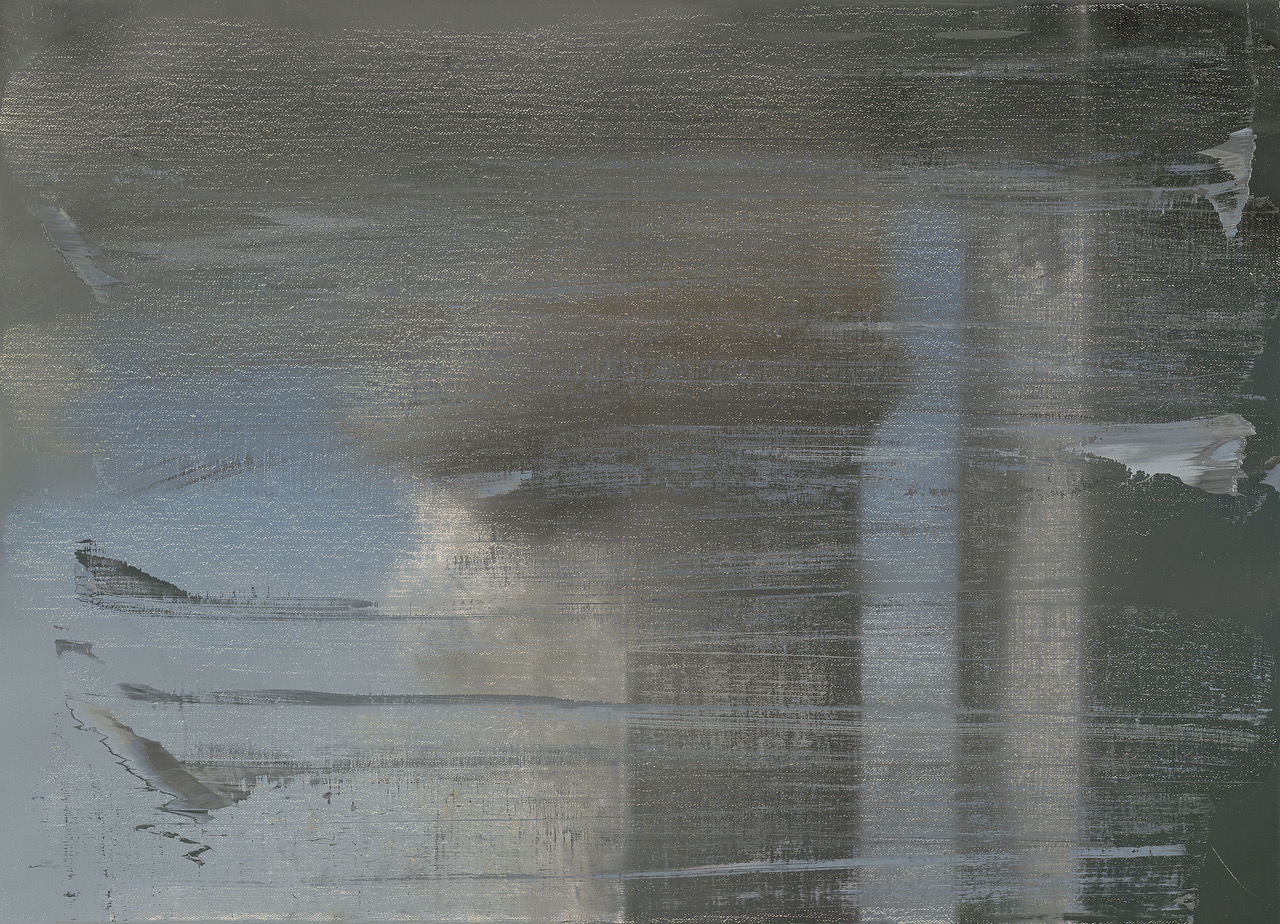 Gerhard Richter, September (2005) Huile sur toile, 52,1 × 71,8 cm New York, The Museum of Modern Art, Gift of the artist and Joe Hage, 2008 © Gerhard Richter 2025
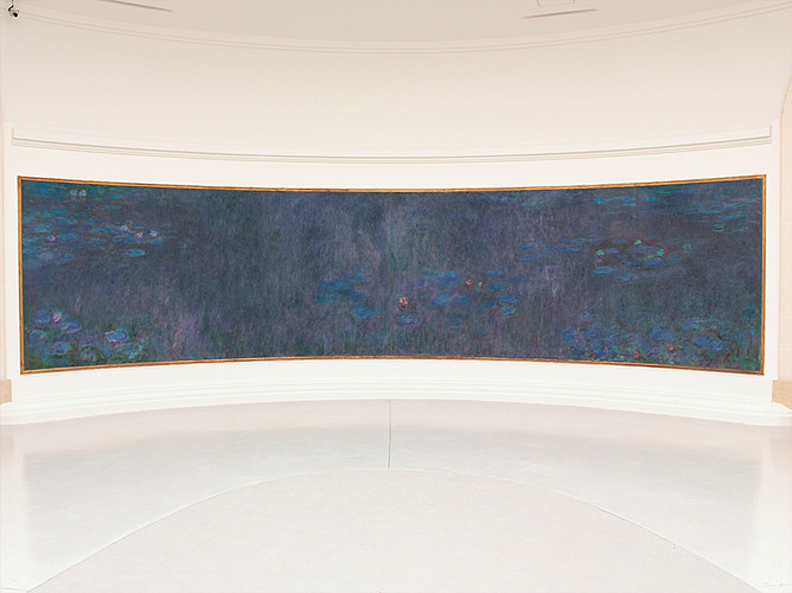 Claude Monet, Reflets d’arbres (1914-1926) deux panneaux à l’huile accolés sur toile marouflée sur le mur H. 200; L. 850 cm © RMN-Grand Palais (Musée de l'Orangerie) / Hervé Lewandowski
Out of Focus: Another Vision of Art from 1945 to the Present Day
(Dans le flou: une autre vision de l’art de 1945 à nos jours)
May 7-August 18, 2025
By JOSEPH NECHVATAL August 11, 2025
I think it safe to say that our uncanny and truthy media world has become increasingly a psychic smear without strong contour lines. Recognizing this juddering exactness, blurring and smearing as go-between states of pleasure-anxiety convert these ongoing artistic methods for reinventing the visually possible into the non-narrative sweet spot of sensation that oscillates between the actual and the virtual. So if you can enjoy lingering in indistinctness, you might become absorbed by the elusive qualities of blurred aesthetics in the multigenerational group show Out of Focus: Another Vision of Art from 1945 to the Present Day at the Musée de l’Orangerie. With its array of vague clouding, we can see the seeds of a visual counter-tradition in opposition to the crisp, detached, geometricized optics of high-resolution pop simulation.
Out of Focus offers this type of management of artistic vision consciously set in dialogue with Claude Monet’s Water Lilies—that are also at the Musée de l’Orangerie (on the above floor)—and so keys off of the indistinctness of Monet’s masterpiece while rebuking a narrow understanding of the blurriness of its vast watery surfaces that have been belittled by some as an effect of the cataracts that impaired Monet’s vision, late in life.
Though rendered almost mundane through the popular use of hashish and booze, blurriness in art first comes into tight focus here in 1945 as a result of the ruins of the Second World War. That and gestural engagements with the fluidity of smeared paint, as seen in an early (1948) painting by Mark Rothko, Untitled.
I find this argument compelling for those post-war artists like Rothko who dug that the vagueness of the blur can yield opaque and elusive abstract iconography. But indeed we can already see some of that in Turner’s Landscape with a River and a Bay in the Background (circa 1845). A medium sized painting that pretty much starts the show and defines its expectations that Bill Viola’s slow phantasmagorical video Chott el-Djerid (A Portrait in Light and Heat) (1979) satisfies. This low-res video tape has wonderful painterly/watery-like mirage imagery that was shot in the shimmering heat of the Tunisian desert.
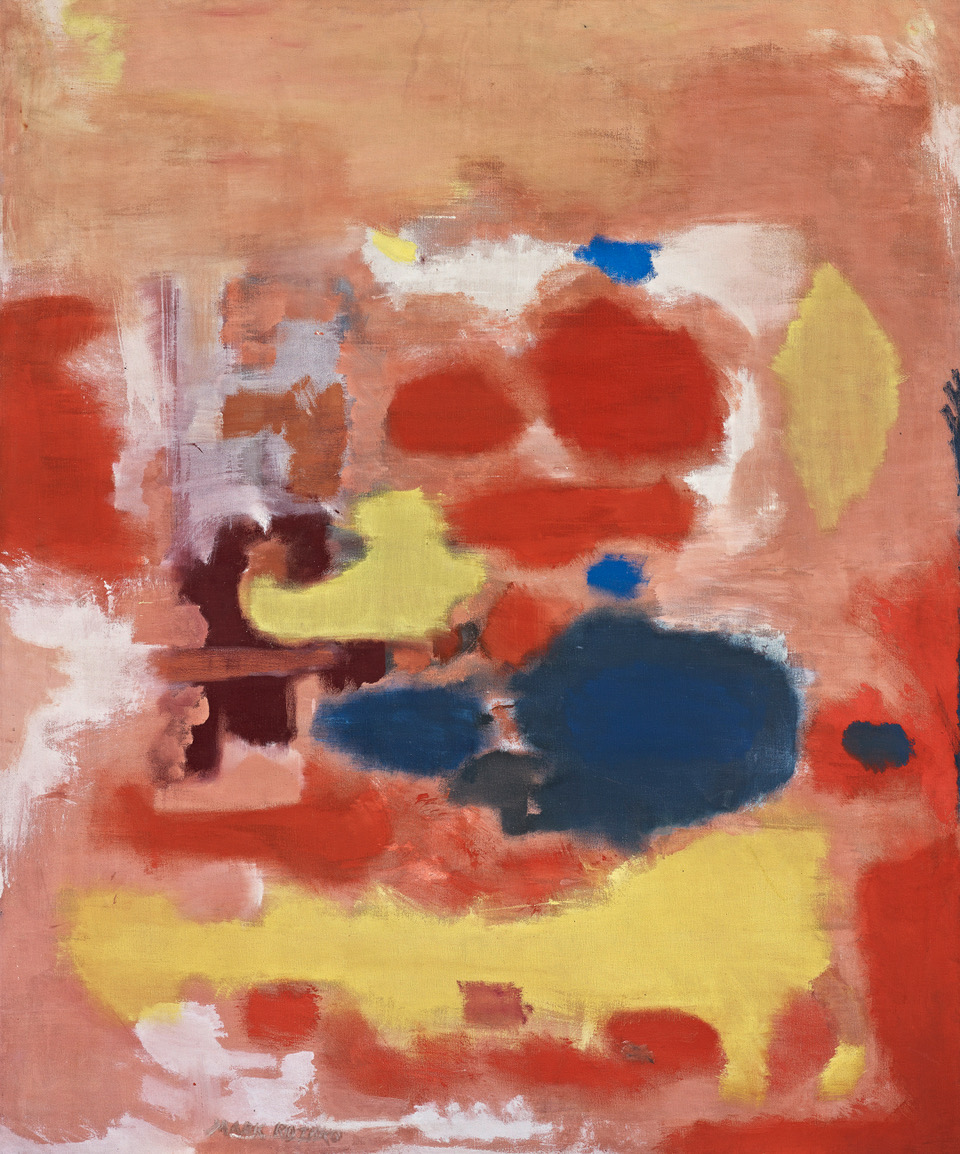 Mark Rothko, Untitled (1948) Oil on canvas, 152.7 x 126.7 cm Riehen/Bâle, Beyeler Foundation, Beyeler collection
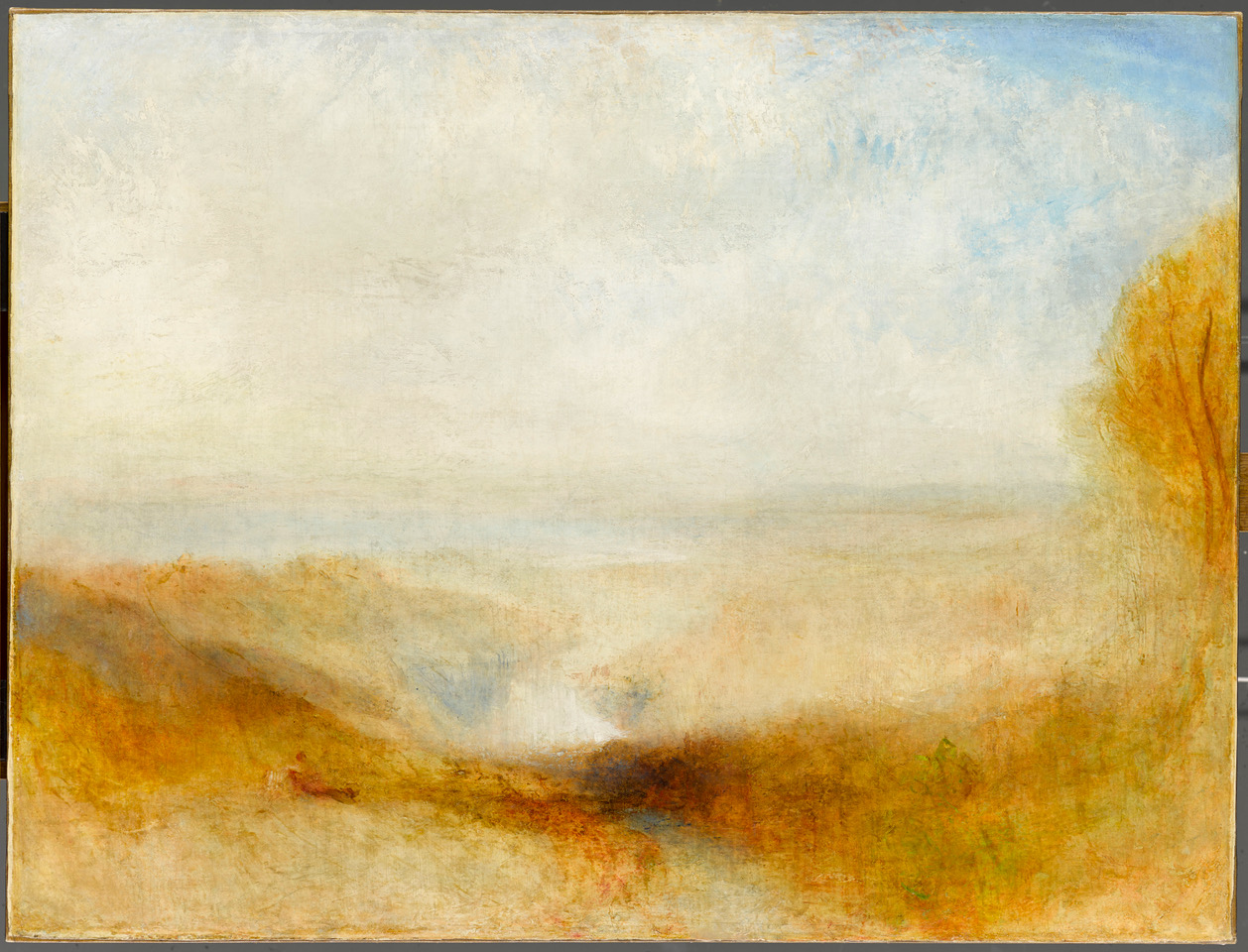 Joseph Mallord William Turner, Landscape with a River and a Bay in the Background (circa 1845) Oil on canvas 94 x 1163 cm Musée du Louvre, Paris Photo © 2014 GrandPalaisRmn (musée du Louvre) / Mathieu Rabeau
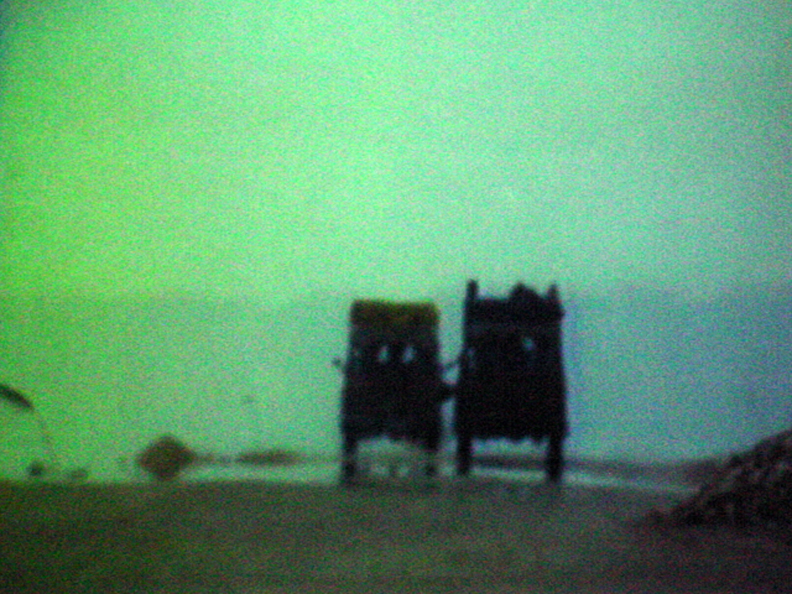 Bill Viola video still from Chott el-Djerid (A Portrait in Light and Heat) (1979)
Though ostensibly limited to art made from 1945 to the present (Gerhard Richter, Sigmar Polke, Christian Boltanski, Vincent Dulom, Hiroshi Sugimoto, Zoran Mušič, Hans Hartung and Thomas Ruff are some of the other highlights) Turner’s painting acknowledges that the aesthetics of blurring existed before the modern era. Indeed, as far back as in the Renaissance, with the ‘sfumato’ (smoky) painting technique that creates a unified visual effect typical of decreasing the separating dramatic force and physical presence of isolated figures by immersing them in a flurry of visual smoke. Sfumato is the seductive, subtle, smoothly imperceptible gradation of dark colors which approaches a smoggy unity useful in the creation of psychological atmospheric effects. Through sfumato, complimentary contrasts (contrapposto) find a unity previously absent.
This is so as sfumato invites and promotes an expanded, diaphanous, dilated focus associated with personal intuition and hence is outside of direct rational maneuvers of clarity. This principle and practice of sfumato, which brings artistic vision to a state of sympathetic languor, was taught by Leonardo da Vinci to his students in his Treatise on Painting, where he encouraged languid attention to the ambiguous grubbiness of cracks and smudges on decrepit walls (which may suggest faces and forms to the viewer) in order to aid artistic imaginative and visionary abilities.
Then too, the French term for blurry, flou, found in the French title of the show—Dans le flou—is derived from the Latin word flavus, that first appeared in 1676 in the writings of the historian Félibien to express the softness of a painting. Also before 1945, beginning with Dada and the First World War, artists have been adapting instability, the indeterminate and the allusive as they have offered new approaches to subjective vision and the objective image: making transience, disorder, incompleteness and doubt a formal mechanism.
Symbolists like Odilon Redon in his L’oeil au pavot (1892) (which suggests an eye as a poppy bud) used diffused fluidity to depict the destabilized gaze as the spirituality of our inner states; and soon some photographers, like Julia Margaret Cameron and Edward Steichen, experimented with blurriness as an artistic device that explores the inner self. For blurring can artistically reveal (or suggest) that normal banal clarity conceals something profound in our sub-consciousness. Symbolists artists use blurring to question our modes of perception, suggesting that we go back to the source of our gaze, encouraging us to break away from an unequivocal reading of reality. They question the limits of neural plasticity and collective perception.
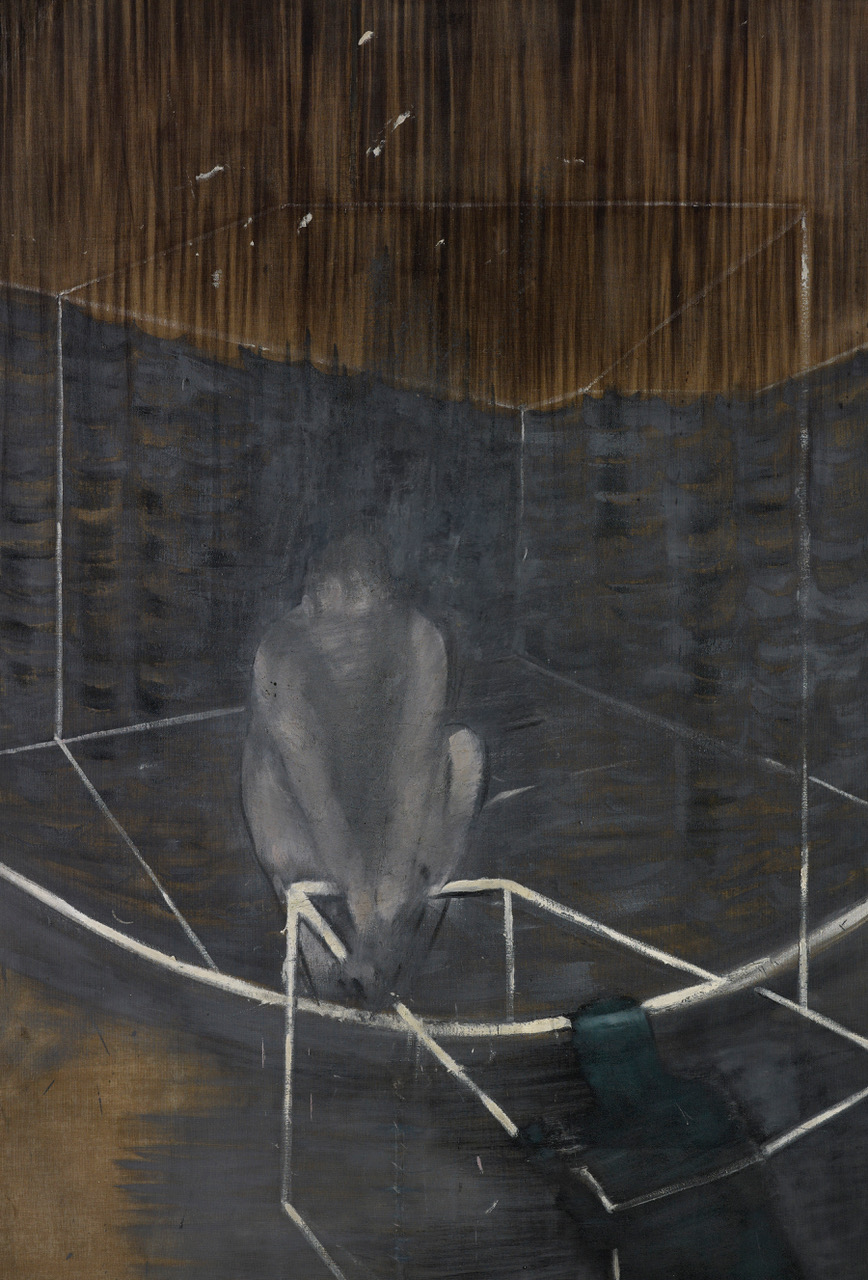 Francis Bacon, Figure Crouching (1949) Huile et sable sur toile, 180 × 122 cm Paris, collection particulière Photo © Courtesy of the Francis Bacon MB Art Foundation, Monaco © The Estate of Francis Bacon /All rights reserved / Adagp, Paris and DACS, London 2025
Bacon’s fine Figure Crouching (1949), what seems a predecessor of Portrait of George Dyer Crouching (1966), is remarkable in how it unlocks the valves of intuition and perception. The smeared figure seems related to some of Bacon’s monkey-related imagery that he developed in 1948, such as Head I (1948), so Figure Crouching naturally drew comparisons from me with Gilles Deleuze’s book Francis Bacon: The Logic of Sensation that stressed sensation’s cognitive component, but reproduced no Bacon paintings. I find Figure Crouching is typical of the asserted daimon unconscious urge within Bacon’s oeuvre as the scourged body delivers some compelling passages that stress the importance of Bacon’s memory-fueled-instincts that were blurred by booze.
Following Georges Bataille’s ideas about the limitations of visual acuity after the discovery of the concentration camps and the impossibility of representing the unpresentable, Christian Boltanski’s use of blurring attracts the eye even while it veils a reality that the eye cannot easily sustain. Questioning the value of the photographic image, Boltanski offers us a vision that is poetically disenchanted with the tragedies and technologies that marked the 20th century. In this way, his blurring reveals itself to be both a power of blindness, a mechanism for forgetting, and a way of bearing witness.
Blurring historical periods, an eye-popping 60s Op Art target painting by Wojciech Fangor called N 17 (1963) hangs next to a very similar work (but bigger) by Ugo Rondinone that was created thirty years later. So the visual signal/noise tussle underway at Out of Focus can be challenging and even a bit irritating at times, but it runs wide and deep. Blurry and ambiguous compositions can feel like a fuller rendering of human feelings than the sharpness of clarity. Hazy art rewards in that its sfumato approach lends greater flexibility in the viewer’s personal psychic use of the art. When it comes to flexing our powers of interpretation, Out of Focus shakes up the traditional reference points of representation, playing with indistinctness rather than the opposition between figuration and abstraction, and so exemplifies Andre Breton’s Surrealist declaration that “beauty will be convulsive or cease to be.” WM

Joseph Nechvatal
Joseph Nechvatal is an American painter/writer currently living in Paris. His book of essays Towards an Immersive Intelligence (2009) was published by Edgewise Press. He has also published three books with Punctum Press: Minóy (ed.) (2014), Destroyer of Naivetés (poetry, 2015) and Styling Sagaciousness (poetry, 2022). His book of art theory, Immersion Into Noise, was re-published in 2022 in a second edition by Open Humanities Press. In 2025, Venus Voluptuous in the Loins of the Last God, his sequel novella to ~~~~~~~~~~~~~~~~~venus©~Ñ~vibrator, even (1995/2023) was published by Orbis Tertius Press. In 2025 his art exhibition Information Noise Saturation was presented at the Magenta Plains in New York City and in 2026 he exhibited a series of new paintings called Le Bateau ivre (The Drunken Boat) at Galerie Richard in Paris.
view all articles from this author