Whitehot Magazine
October 2026
"The Best Art In The World"
"The Best Art In The World"
October 2026
The Refinement of the Senses as a Survival Strategy: reSENSE’s Multisensory Convergence at Rockefeller Center
By Manuela Annamaria Accinno June 2nd, 2026
In Roy Lichtenstein’s famous statement: “There must be something in art; almost all cultures have produced art. It is a refinement of the senses, which are there to keep us alive”, there lies a profound biological and evolutionary truth. Art has never been merely an aesthetic ornament, but rather a fundamental anthropological mechanism for calibrating our perception of the world. If the senses have evolved as tools of adaptation and survival to map the dangers and opportunities of the environment, art acts as a training ground for these very same sensory channels. In the contemporary context, characterized by a digital visual saturation that numbs our attention, the reSOUND New York exhibition, in its new iteration reSENSE curated by d’strict at HERO in Rockefeller Center (open until 18 October 2026), stands as the perfect empirical manifestation of Lichtenstein’s thinking. Through the convergence of sound, light, touch, movement and matter, this site-specific exhibition transforms the exhibition space into an ecosystem of sensory reactivation, demonstrating how the aesthetic experience is, today more than ever, an act necessary for the cognitive and spiritual survival of the human being.
To grasp the scope of reSENSE, we must deconstruct Lichtenstein’s insight. Why has every human culture produced art? The answer lies in the need to prevent our sensory apparatus from atrophying. Our ancestors survived thanks to their ability to detect the slightest chromatic variation in the undergrowth, an unusual whisper in the wind, or a tactile texture that revealed the presence of food or poison. In the hyper-technological society of the 21st century, dominated by the hegemony of the two-dimensional screen, we are witnessing a dramatic simplification of perceptual experience. Our sensory range has been reduced to standardized visual impulses and sterile digital scrolling. Multisensory contemporary art intervenes precisely at this point of rupture: it disrupts our daily numbness, forcing our biological receptors to reactivate collectively. Sharpening the senses through art means preserving brain plasticity, keeping the individual alert, empathetic and deeply connected to material reality. reSOUND is a hybrid and innovative cultural organization, distinct from both the traditional concept of a museum and conventional experiential formats: it is a space designed to host and bring together international contemporary artistic practices and emerging artists, working in hybrid fields such as video installations, interactive sculpture, immersive soundscapes, textile arts and object-oriented practices. The curatorial approach prioritizes dialogue between media and the coexistence of sensory and material devices, promoting modes of engagement that move the work beyond mere contemplation.
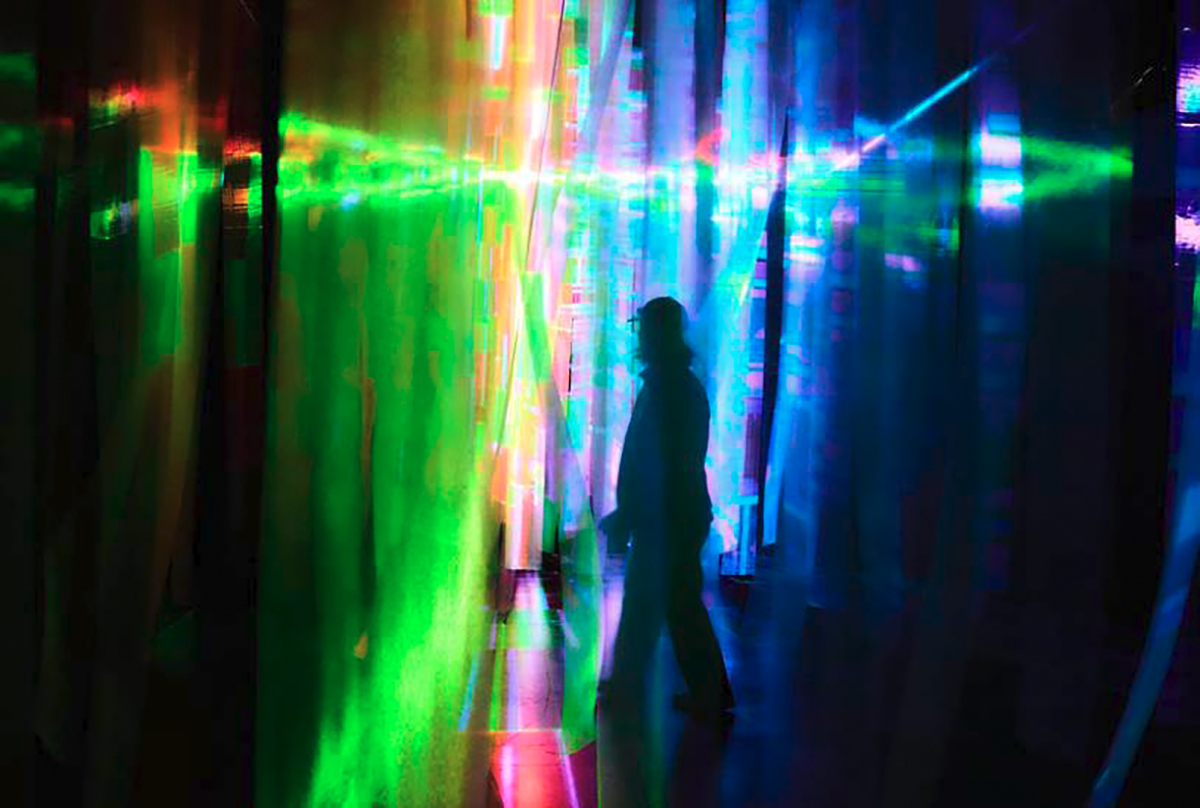
MASARY Studios, Glitche, 2023, Fabric, single-channel video projection, multi-channel sound, 10:30 min loop. Photo: MATTE Project
The four new features introduced by the reSENSE season offer a comprehensive overview of this process of ‘sensory training’:
Katie Scott’s animated short film, “Story of Flowers”, created in collaboration with James Paulley and floral artist Azuma Makoto, opens the exhibition with a monumental, immersive scale. Here, visual refinement is combined with scientific precision and ecological sensitivity. The viewer is not merely a detached observer; the life cycle of the flowers envelops them, fostering a profound understanding of biological vulnerability. The eye is trained to perceive the micro-evolution of nature, reminding us that the survival of the human species is inextricably linked to that of the surrounding ecosystem.
The installation by MASARY Studios, “Glitche”, explores the intersection between digital distortion and human memory. Through a complex psychoacoustic architecture, the manipulated sounds stimulate the inner ear and deep cognitive processes. Lichtenstein would speak here of a refinement of listening: in a world saturated with white noise, Glitche compels the visitor to decode the instability of sound, stimulating memory and the capacity for inner orientation in the face of technological disorientation. Perhaps the most radical expression of Lichtenstein’s philosophy within the exhibition is the environment created by SHOPLIFTER. Breaking the museum taboo of ‘do not touch’, Fathoms explicitly invites the public to touch, grasp and be physically enveloped by cascading synthetic forms. Touch, the oldest sense and one linked to immediate survival, is rehabilitated. Interaction with these hyper-natural textures restores the body’s awareness of its own boundaries and physical presence in space. Finally, WHISPER: Salon, the exhibition presenting 34 works by seven emerging Korean artists based in New York, grounds the experience in painting and object-based practice. The ‘whisper’ of these works represents a refinement of cultural and social sensibility. The objects and painterly materials engage with the history and identity of a community, demonstrating that the senses serve not only to perceive physical matter, but also the subtle nuances of human relationships and cultural migrations.
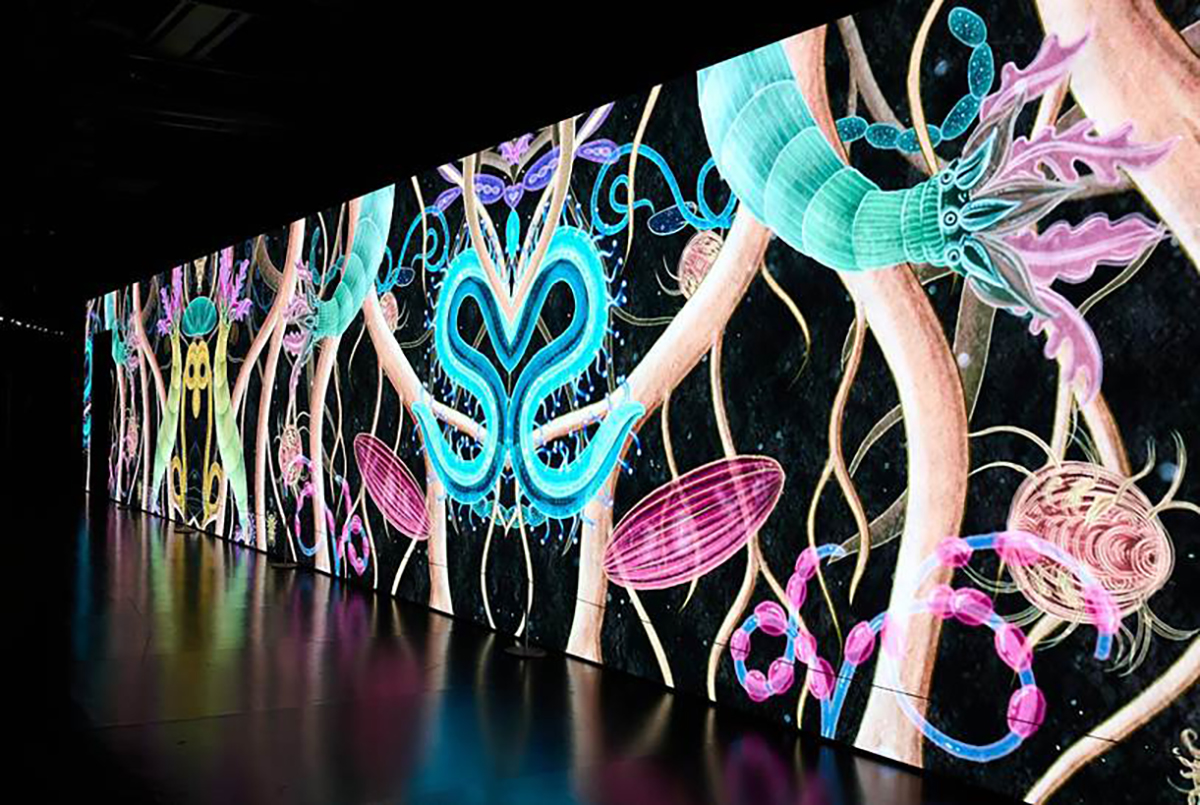 Katie Scott, Story of Flowers, 2017, Animated short film, wall-mounted LED display, sound, 3:28 min. Photo: MATTE Project
Ultimately, the evolution of reSOUND into reSENSE beneath the foundations of an iconic monument such as Rockefeller Centre takes on a deeply symbolic significance. In the beating heart of the metropolis of efficiency and visual capitalism, d’strict has carved out a space for decompression and organic reactivation. If the senses are there to keep us alive, the sensory desiccation of contemporary life represents a silent threat to our very humanity. Exhibitions such as reSENSE do not merely offer multimedia entertainment, but fulfil a mission of cognitive ecology. They remind us, just as Roy Lichtenstein theorized, that making and experiencing art is the supreme cultural act for preserving the acuity of our senses and, with it, our ability to inhabit the world in a vigilant, conscious and deeply alive way.

Manuela Annamaria Accinno
Manuela Annamaria Accinno, born and raised in Milan, is an art historian and critic with a degree from the University of Milan. She has been actively collaborating for several years with radio stations and magazines specializing in the field of art.
view all articles from this author