Whitehot Magazine
October 2026
"The Best Art In The World"
"The Best Art In The World"
October 2026
Saving the Bowery Wall: How Tomokazu Matsuyama Revived New York's Most Iconic Street Art Canvas
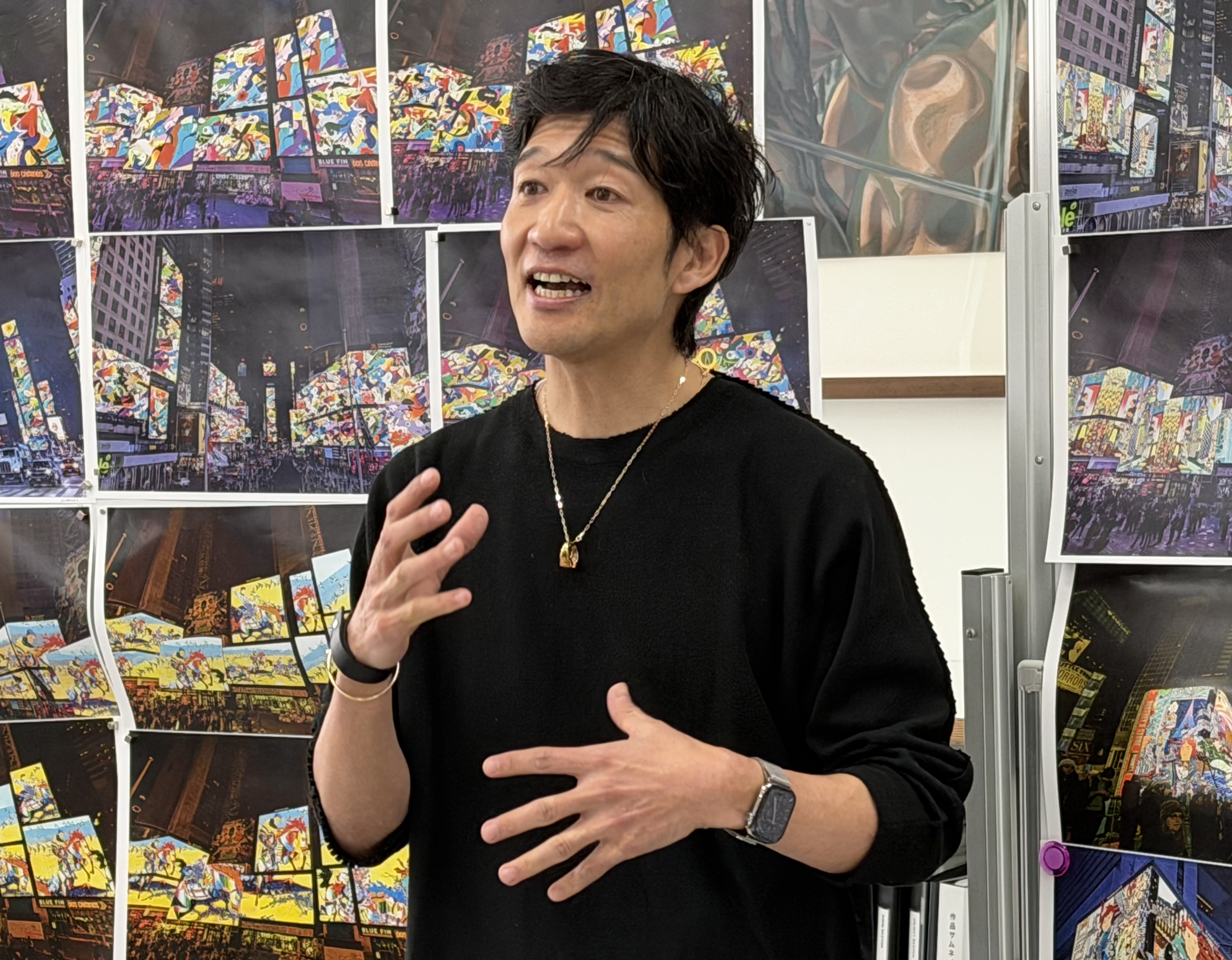 Tomokazu "Matzu" Matsuyama discusses his art during an interview at his Brooklyn studio. Photo by J. Scott Orr
BY J. SCOTT ORR April 18, 2026
After two and a half years watching New York's most legendary street art wall descend into chaos, Tomokazu Matsuyama decided he'd seen enough.
At first, the Brooklyn-based artist kept tabs on the aerosol free-for-all on the billboard-sized wall at the corner of Bowery and Houston Street but didn’t feel it was his place to act. "But the moment it hit two and a half years, I said—we're gonna go there," Matsuyama recalled during a recent interview in his sprawling Brooklyn studio.
The Houston Bowery Wall—what owner and curator Jessica Goldman Srebnick calls "the Oscars of street art"—had gone dark, surrendered to the anarchic and democratic forces of the street. After David Flores' delicate 2020 mural of a motorcyclist trailing red flowers was mercilessly tagged, Goldman Srebnick threw up her hands. The attacks had become personal. "It was getting tagged. It was terrible," she said during an interview in a coffee shop just one block from the wall. "And so I took a break, and then we just let it take on a life of its own."
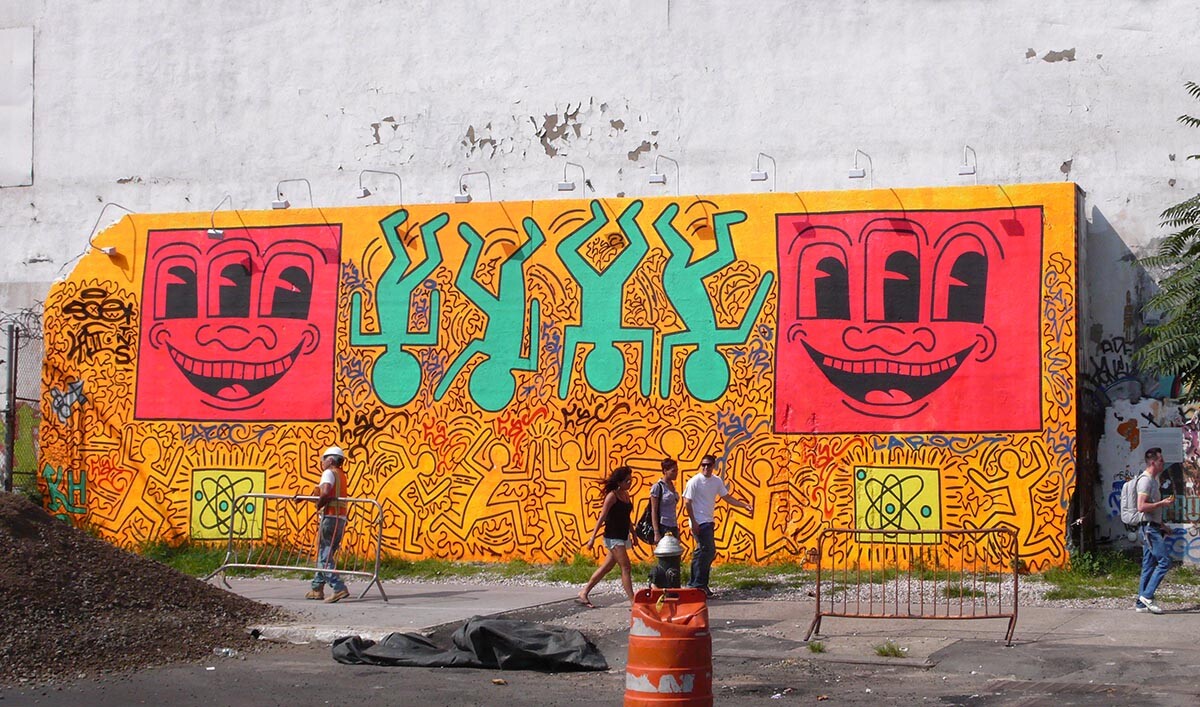 A 2008 recreation of the first Bowery Wall, which was painted by Ketih Haring in 1982. Photo courtesy Wynwood Walls
The wall—supported and curated by the Goldman family—was the site of Keith Haring's first major outdoor work in 1982 and later hosted a legion of street art rock stars from Futura, to Shepard Fairey, to Os Gemeos. Over the years, it has become a living embodiment of street art's central tension between writers who view public space as inherently democratic and open to all, versus those who believe collaborative curation can elevate individual works while serving the broader community.
Matsuyama had painted the wall before, back in 2019. He understood its sacred status among street artists. So in September 2023, without permission, he brought in scissor lifts and spent his own money to paint Color of the City—30 portraits of New Yorkers rendered in his signature cross-cultural visual language—in broad daylight.
"If it's an open graffiti wall, we're just gonna do it," he said, surrounded by dozens of monumental fine art canvases that were in the works in his 8,000 square-foot, 6th-floor Greenpoint studio. "Not in the evening. We're gonna do it in the daytime because this is not an illegal or legal activity—it's in between."
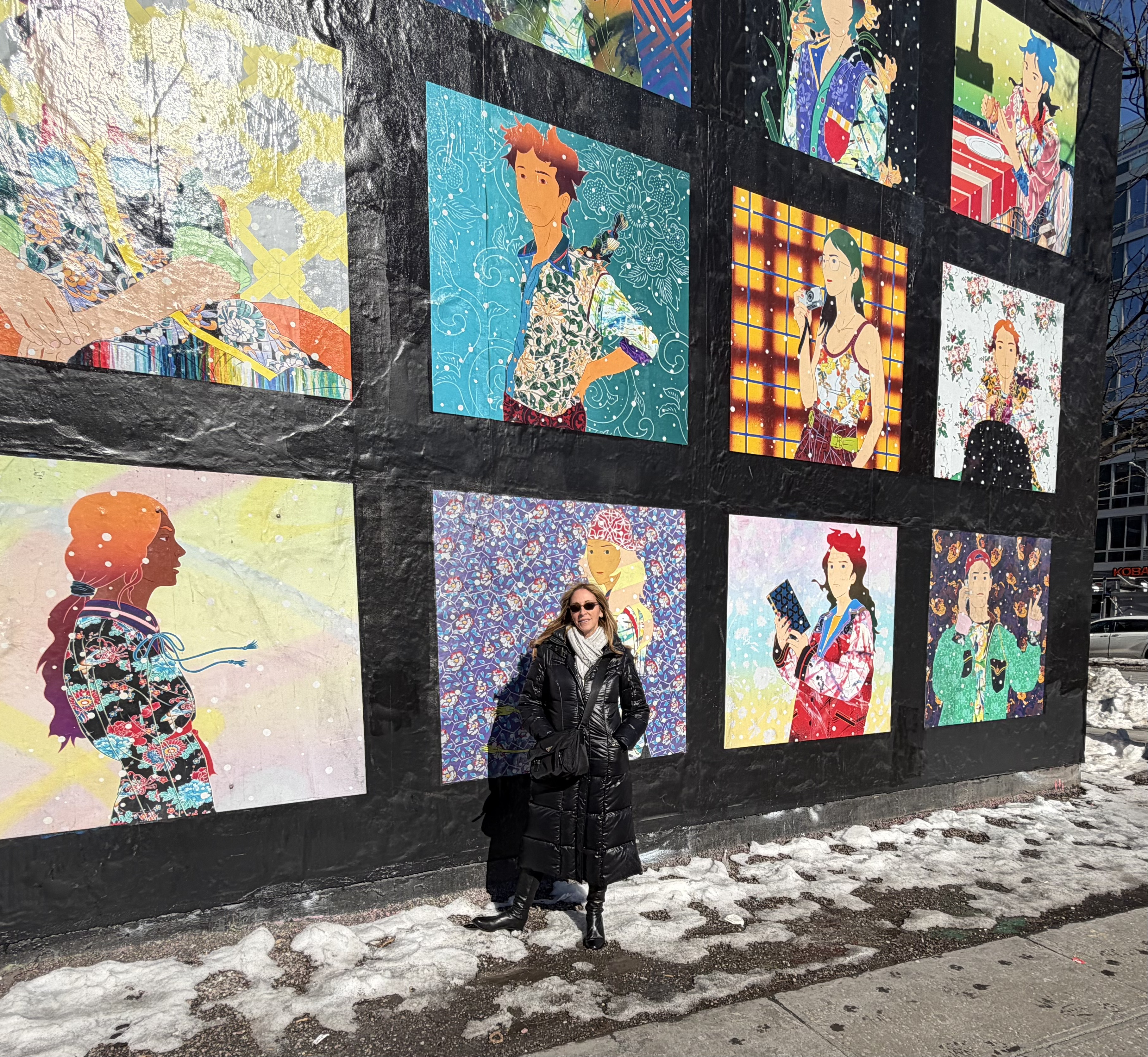 Jessica Goldman Srebnick standing before Matsuyama's mural on the Houston Bowery Wall. Photo by Lisa Freeman
Goldman Srebnick's response was swift: “She said the perfect words to me: 'I wish you would have discussed it with me first, but it's beautiful and exactly what was needed,'" Matsuyama said. He said he sensed Goldman Srebnick had lost some of her passion for the wall her father Tony Goldman purchased in 1984. "But we can recover that,” Matsuyama said. “Just because the two past murals didn’t have the type of outcome that we all wanted—that doesn't mean you can lose the legacy. Think of 1982 when Keith Haring started this."
During the free-for-all period between Flores' mural and Matsuyama's intervention, the wall reverted to a site of raw democracy. Optimo, one of New York's most prolific graffiti artists, painted it repeatedly over the course of a year—"Style Wars" homages, bold letterforms, layered compositions that spoke to graffiti's anarchic roots.
"I painted the wall for exactly one year, messed up my relationship due to my obsession with taking over the wall," Optimo said. "My dream was to be chosen to paint the wall someday. I believe I was chosen and it was by the streets."
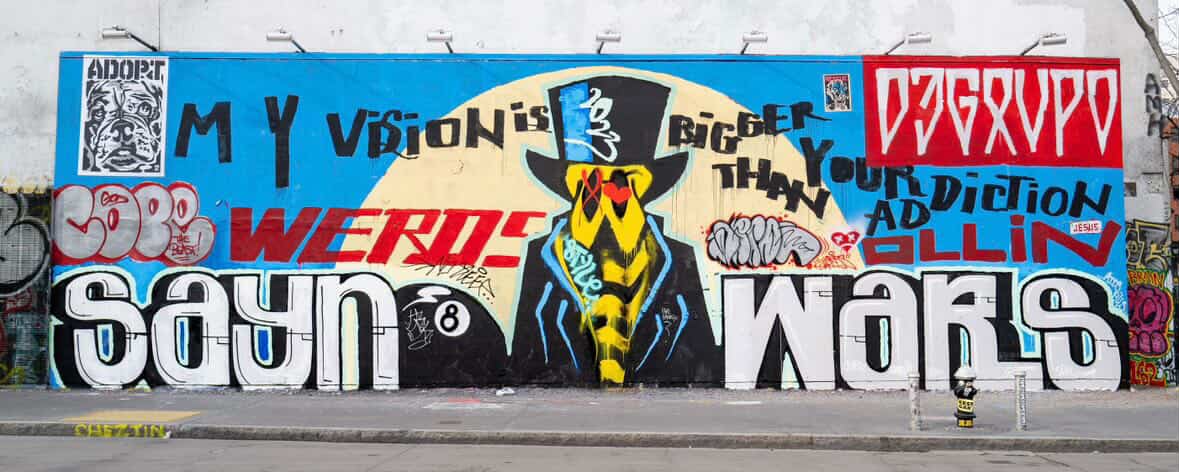 Optimo's unsanctioned art work on the Houston Bowery Wall. Photo courtesy Optimo
Optimo’s work during that period reflects a familiar graffiti paradox—fierce independence paired with a very real desire to be seen, documented, remembered. "Not to take away anything from these amazing artists, they're all legends on their own," Optimo said of the curated muralists. "The layout of a layered wall cohesively done illegally will always conquer a legal wall which is non-organic. Art galleries and the upper art world can gallery-block us, but they don't have the say on whose [work] belongs on the streets."
"This wall has been for the past half century something of our commons, the misshapen village square where a community communicates," says Carlo McCormick, an art critic and cultural historian who has lived blocks from the wall for decades. "To me, the tension inherent in this space is the problem of curating public art when it comes to less-hierarchical mediums that are intrinsically self-regulating and opposed to gatekeepers."
For Goldman Srebnick, CEO of Goldman Global Arts and Co-Chair of Goldman Properties, the constant tagging felt like sabotage. When she flies in international artists, provides materials and equipment, she's committing serious resources to public art. "When artists put their heart into creating something extraordinary for the public—it's a public artwork—it's really meaningful," she said. "It's challenging when the wall keeps getting tagged, which is disrespectful."
But to writers operating according to graffiti's oldest code, public space belongs to everyone, nothing is sacred. When Goldman Srebnick gives the wall over to a single artist, she's essentially saying, "This canvas is closed." To graffiti culture, that's a sellout move.
What makes this tension particularly fraught is that most established artists who have created murals on the wall—Fairey, Kenny Scharf, Barry McGee, JR, Logan Hicks, Ron English, Swoon, Crash—emerged from traditional graffiti culture themselves. They learned their craft in the same illegal spaces as the writers bombing their work today. They're running the time-honored gauntlet from streets to galleries to museum walls.
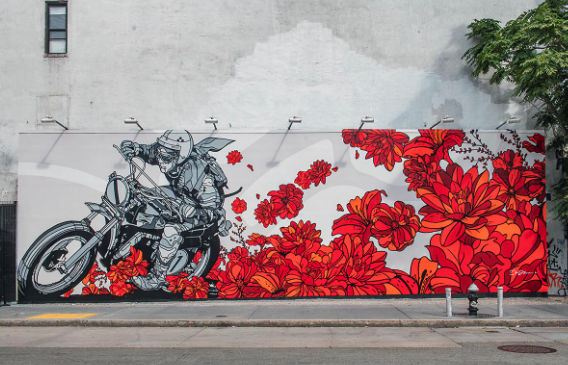 The Bowery Wall as it looked when David P. Flores took it over in 2021. Photo courtesy Wynwood Walls
Goldman Srebnick helped build that pipeline. Her Wynwood Walls in Miami model elevated the street art genre on to the global stage, launching careers and creating "multiple channels of revenue" for artists who might otherwise never escape the hustle. "Artists can take their work into so many different directions," she said. "Whether that's gallery work, fine artwork, corporate or commercial work, creating a retail product—it’s beautiful that they have the opportunity to reach audiences in different mediums."
But the Bowery Wall occupies sacred ground in ways Wynwood doesn’t. Since Tony Goldman gave gallerist Jeffrey Deitch the right to commission murals in 2008, the wall has been celebrated as a living archive of the form's evolution. When writers tag an iconic wall, they're not just hitting some curator's project—they're bombing history.
Matsuyama understood this when he launched his intervention. He wasn't trying to own the wall—he was trying to save it.
Goldman Srebnick won't say specifically what comes next for the wall, only that she's "exploring a lot of different options—like, what could be an option other than using it as a gallery?" Her tone has shifted—less defeat, more contemplation.
Whether that means returning to rotating curated murals, some hybrid model, or something entirely new remains to be seen. What's clear is this: The Bowery Wall has always been New York's most honest cultural mirror, reflecting the city's ceaseless arguments about who owns public space, and whether the scrappy kids who started this whole thing deserve a seat at the table they helped build. The wall isn't just the Oscars of street art. It's also a reminder that every anointed muralist was once a nobody with a spray can and a dream. WM

Scott Orr
Scott Orr is a career writer, editor and a recovering political journalist. He is publisher of the East Village art magazine B Scene Zine. He can be reached via @bscenezine, bscenezine.com, or bscenezine@gmail.com.
view all articles from this author