Whitehot Magazine
October 2026
"The Best Art In The World"
"The Best Art In The World"
October 2026
Stanley Whitney: How High the Moon Institute of Contemporary Art/Boston
 Stanley Whitney, portrait by Aundre Larrow
Stanley Whitney: How High the Moon
Institute of Contemporary Art/Boston
April 17 – September 1, 2025
By DAVID AMBROSE August 19, 2025
There is music
sometimes
in lonely
shadows
blue music
sometimes
purple music
black music
red music
but these are left from crowds
of people
listening and singing
from generation
to generation
- From Ballad Air & Fire Amiri Baraka For Sylvia or Amina
That the artist Stanley Whitney has stepped out of those shadows into the light should come as little surprise. His fifty-year commitment to a path toward abstraction has finally shown a light on a career steeped in color. These colors, and many more like them, blaze a path through the ICA in Boston like a sagging clothesline full of patchwork quilts airing out on a humid sun-drenched August afternoon. For Whitney, color has always been his principal subject: how color impacts perception, emotion, memory, and space.
Stanley Whitney: How High the Moon is a long overdue museum retrospective currently on view at the Institute of Contemporary Art in Boston until September 1, 2025. The exhibition originated at the Buffalo AKG Art Museum and was been curated by its Charles Balbach Chief Curator, Cathleen Chaffee, before traveling to the Walker Art Center in Minneapolis. Boston is its final stop.
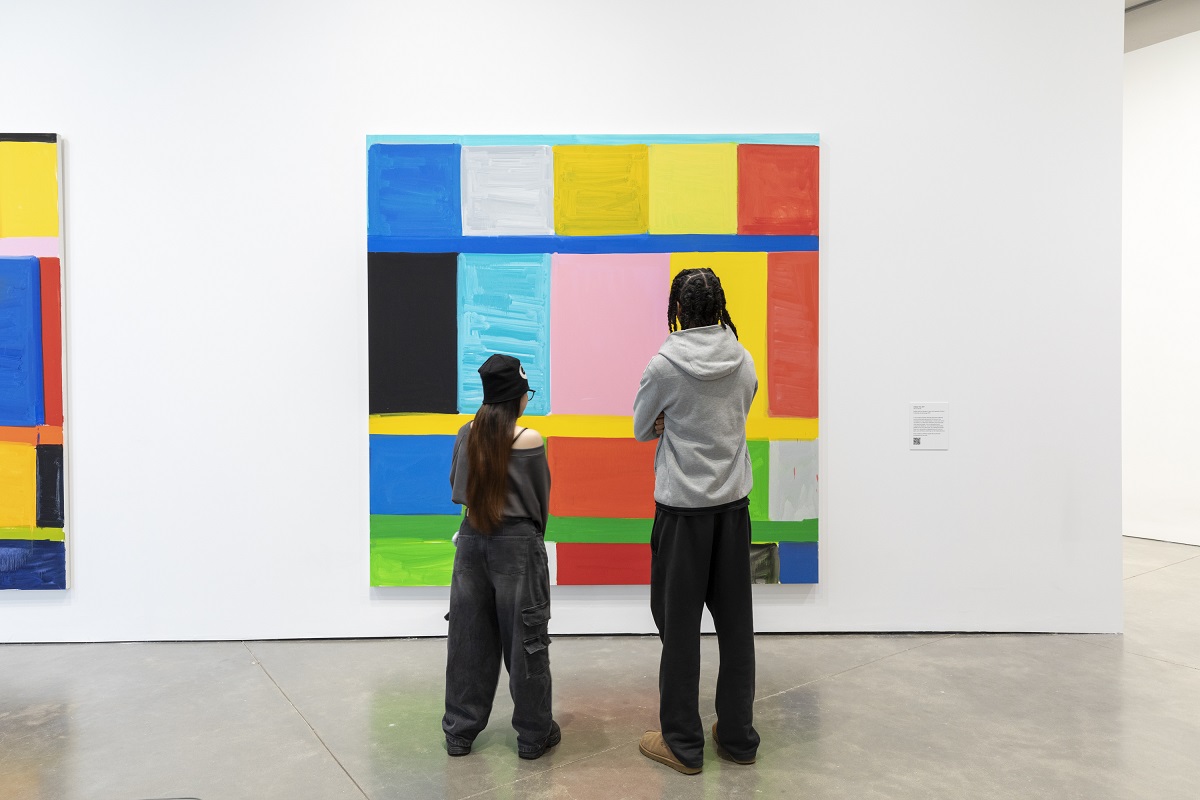 Installation view, Stanley Whitney: How High the Moon, the Institute of Contemporary Art/Boston, 2025. Photo by Mel Taing.
While color and the physical act of painting elevate the exhibition, it is Whitney’s drawings that anchor it; a fact reinforced by a wall of works on paper covering more than forty years of his graphic practice that greets you just inside the entrance to the exhibition. Whitney’s insistence on showing you so many of his drawings lets you know where he stands on its importance in an artist’s development; an act he refers to as “thinking on paper.” The drawings are arranged salon style in a staggered grid favoring formal concerns over chronological order. The arrangement also hints at Whitney’s decades-long reliance on the grid. Optically, one scales this grouping as if climbing the wall of a stone façade; an act meant to fortify the paintings to be found on the other side. The versatility of Whitney’s mark-making is on full display. From the dense, overlapping webs of crayon in Untitled (2019), to the exploding geyser of inky black lines in Untitled (1978) to the ethereal, saturated watercolor grid of Untitled (2020) where three rows of huddled, rectilinear forms gently kiss one another causing them to bleed beyond their intended borders.
 Stanley Whitney, Untitled 1978, Ink on paper, 22 × 35 inches, Private collection
While the exhibition does lean heavily on Whitney’s signature grid formatted oil paintings from the past three decades, one is first introduced to his painting practice with a selection of acrylic paintings from the Seventies and Eighties. In the monumental Untitled (1972), meandering, serpentine arabesques of sky blue, yellow, and black seem to float to the surface from a pale-yellow pool, which is ringed by a mossy green border. Any hint of space is extinguished by the plasticky matte surface of the acrylic paint. While in Untitled, (1979-80) one of Whitney’s “constellation paintings,” a group of smoky, atmospheric spheres jostles around an ambiguous space competing for attention only to be finally secured to the surface by short, vertical staccato strokes.
The core of the exhibition focuses on Whitney’s shift to oil paint around 1983. The move allowed him to mine a depth and range of color not available to him with synthetic polymer paint. At around this same time, his approach also shifts from working horizontally on the floor on unstretched canvas in the manner of Color Field painters such as Helen Frankenthaler and Morris Louis; to working vertically on a more organized space populated with ragged, circular shapes that settle into an implied grid like bales of hay in Sixteen Songs (1984).
Whitney also begins to attach occasional titles to his works, leaving clues for the viewer to process. In one early example, Pleasure or Joy (1994), horizontal lines arc across the surface dividing the diptych into four rows. Whitney then seems to stitch his blocky ground colors to the painting’s surface by overlaying nests of thick, interwoven brushstrokes. Occasional drips of thinned pigment cross those same boundaries forming canal channels resembling the trickling rivulets of water on the banks of the Nile.
 Stanley Whitney, portrait by Audrie Larrow
Whitney in fact, first visited Egypt in 1993 and has spoken of it having a profound influence on his approach to constructing a pictorial space in which he could “put it back together and not lose the air.” Travel, and particularly world travel, has played a major role in Whitney’s development since 1992, when he accepted a role as a professor at Temple University’s Tyler School of Art and Architecture in Rome, after spending the prior two decades teaching for Tyler in Philadelphia.
In 2003, a major shift occurred in Whitney’s work with the incorporation of a wobbly, hand- drawn grid that acts as the organizational spine of the paintings. Whitney begins each of these canvases at the upper left, working across and down the surface. The bones of his structure are now based on the architectonics of the grid with its repeated post and lintel patterns that read like an elevation drawing. The hints at fenestration create pockets of space: portals, windows, and doorways. Along with architecture, his process echoes two other art forms : literature and music - whether it is the travel of the hand across the surface from left to right in a written word approach, or the musical rhythm and syncopation of color and light across the surface.
Those musical connections become more pronounced in paintings such as Aretha and Mingus both from (2018), with their wonky 4/4-time signature grid, where beats register in color. These individual color choices hover like notes on a musical score and help define pitch and duration as he paints the mood, memory, and temperature each chromatic “note” might make. In James Brown Sacrifices to Apollo (2008), the dense, opaque, bright orange rectangles would have a higher pitch and intensity than say the transparent blue in the top row. The orange sears into one’s brain as a lasting memory while thin, blue brushstrokes open a window out onto a vista. One notices a compressed space where the top two rows of the canvas are the widest - the brain and the heart - symbolizing a row of thoughts and one of emotions. As a result, the intellectual and emotional weight flattens and compresses the lower rows as one travels down the canvas.
 Stanley Whitney, James Brown Sacrifices to Apollo, 2008, Oil on linen, 72 × 72 inches, Private collection
For an exhibition steeped in grand, large-scale paintings, one of the more revealing walls in the retrospective comes from twenty-four small-scale Untitled paintings made between (2001-2020); two rows of twelve canvases which were composed from the leftover paint from the day’s working palette. These paintings portend to be not as serious as the large-scale paintings from which they were born. Nonsense. They act as an important record mirroring the reduction and distillation of a day’s studio activity. While frugal and cost-effective, they prove to be emotionally and intellectually diaristic; worthy deposits in the memory bank, because no matter the scale, Stanley Whitney’s paintings reward a slow, dedicated eye. One that might catch a reflection gathering in the rhythm and syncopation of line to color, and breathe in their very existence like a ballad of air or the flickering of a chromatic fire. WM

David Ambrose
David Ambrose is an artist, teacher and critic living and working in Bound Brook, New Jersey. He has exhibited both nationally and internationally. He has taught at Parsons, The New School for Design, Pratt Institute, and the Fashion Institute for Technology. His work has been the subject of a mid-career retrospective, “Repairing Beauty” at the New Jersey State Museum.
view all articles from this author