Whitehot Magazine
October 2026
"The Best Art In The World"
"The Best Art In The World"
October 2026
Ain't Misbehavin' : Interview with Nicole Wittenberg
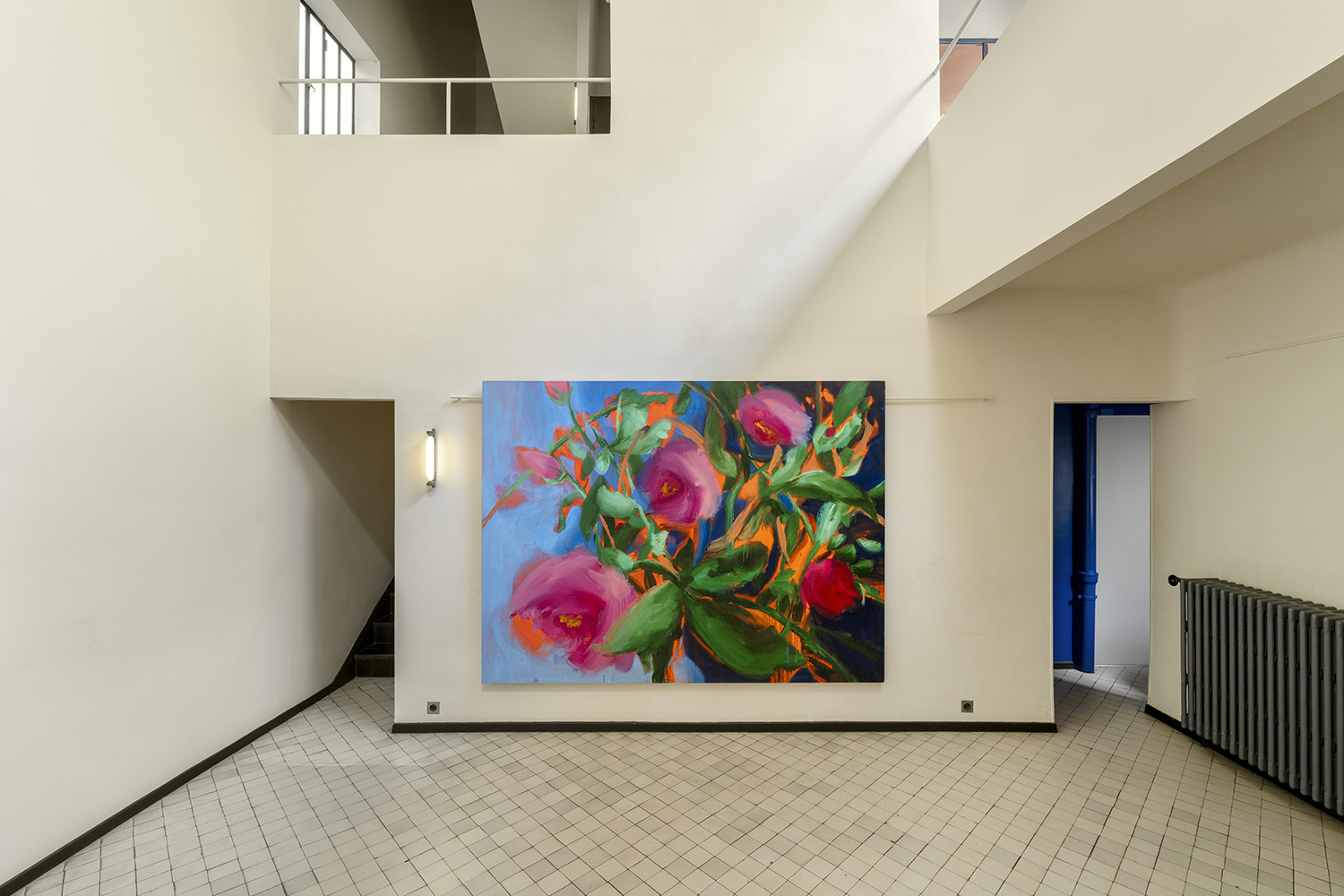 Photo by Nicolas Brasseur. Courtesy of the artist, MASSIMODECARLO, Fondation Le Corbusier
By LUCA AVIGO July 2, 2025
I arrive at the Fondation Le Corbusier, housed in Maison La Roche on the west side of central Paris, ten minutes before Nicole Wittenberg. This is where her exhibition Ain’t Misbehavin’, presented by MASSIMODECARLO gallery and open until July 19th, is taking place. It’s the first time either of us has visited the Fondation, so before we can begin the interview, we need a good hour to explore and take it all in: the paintings, the architecture, the paintings within the architecture.
The first thing I hear Nicole say is, “Did I do this?”—jokingly referring to Climbing Roses 4, which she finds looks completely different in the atrium Le Corbusier designed than it did in her studio. “It’s like I’m seeing this painting for the first time,” she admits.
Both unable to stop exploring the space, we decide to conduct the interview while strolling through the rooms—just as the French architect intended, having designed them to be experienced through movement.
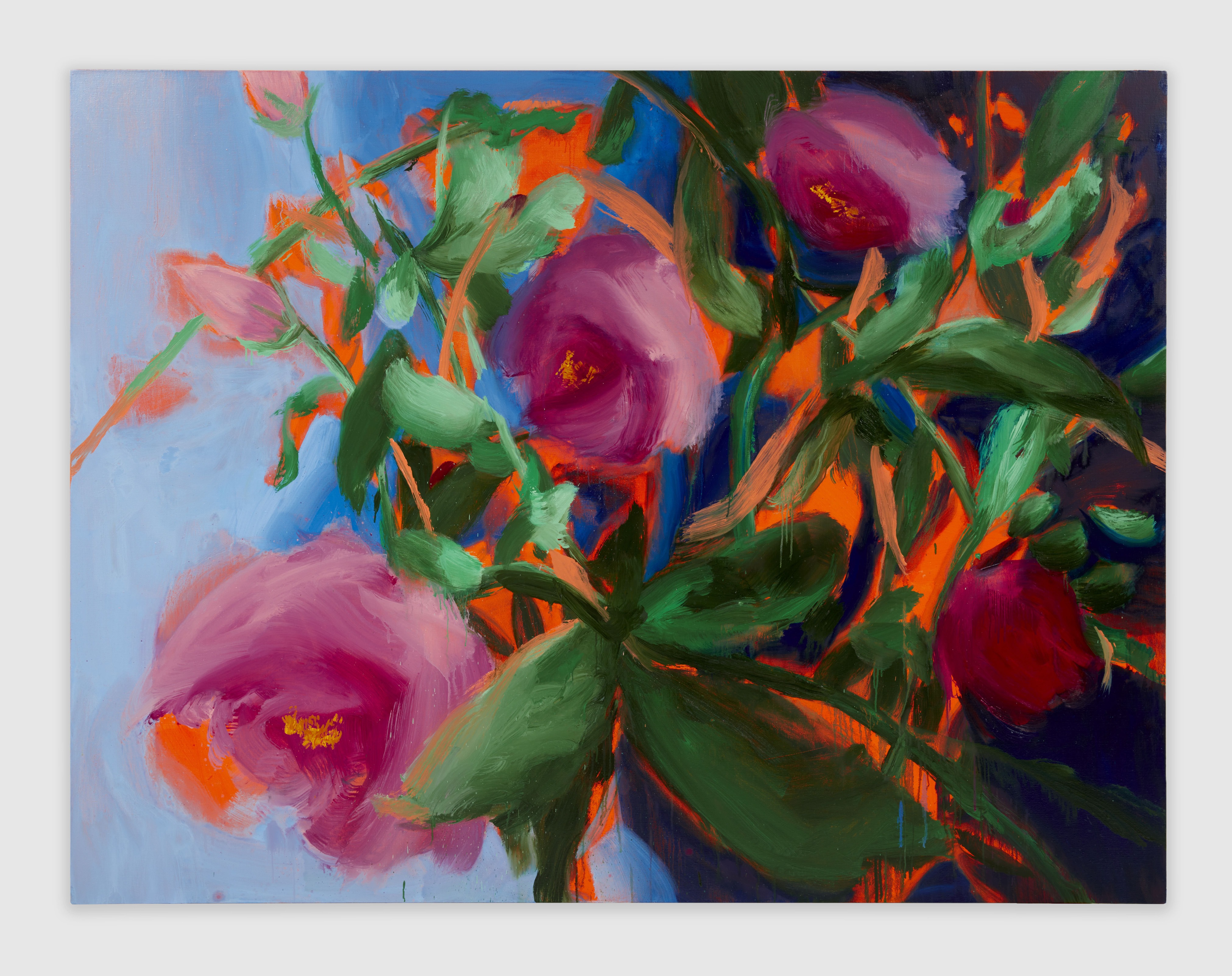
Nicole Wittenberg. Climbing Roses 4 (2024), oil on canvas, 72'' x 96''. Courtesy of the artist, MASSIMODECARLO
LUCA AVIGO: Last year you had an exhibition in Milan at MASSIMODECARLO Gallery in Piero Portaluppi’s Casa Corbellini-Wassermann. Now, Le Corbusier’s Maison La Roche is another highly connoted space to exhibit in. Do you have a way of reacting to the architecture of these locations?
NICOLE WITTENBERG: When I moved to New York, I was visually struck by the United Nations building, which was an architectural collaboration that Corbusier was a part of. This building presents itself as a line drawn vertically against the ground plane in the city. There are a sea of skyscrapers, but this one has a clarity that sets it apart. The building is a drawing, a sculpture, and a piece of architecture. And Le Corbusier was an architect but also a painter. His drawings, I think, are very important, so with Maison La Roche I asked myself: how do I coexist with such a strong sculptural form, one that uses mass, volume and light in such a particular way?
There is a sharpness to this form that I think artists of his time responded to, and modernism was all the rage, but I am not a modernist. And looking at the Maison La Roche my mind keeps turning to the Radiant City — this kind of utopian vision that was never fully realized, but which supposed that man would be served by technology rather than enslaved by it, and this vision is something that we are all coping with even now. We are all still trying to understand the relationship between man and nature, man and technology, how we exist alongside cars, railways, phones, artificial intelligence, all things we still haven’t figured out how to integrate.
This building is an interesting place to think about the elemental world entering architecture in slightly unexpected ways. His plan, and the pilotis that support the building, allow nature to weave through the space. So, I thought I would weave my images into the building. Rather than trying to bend the space within the picture plane, I tried to integrate the outside into the inside.
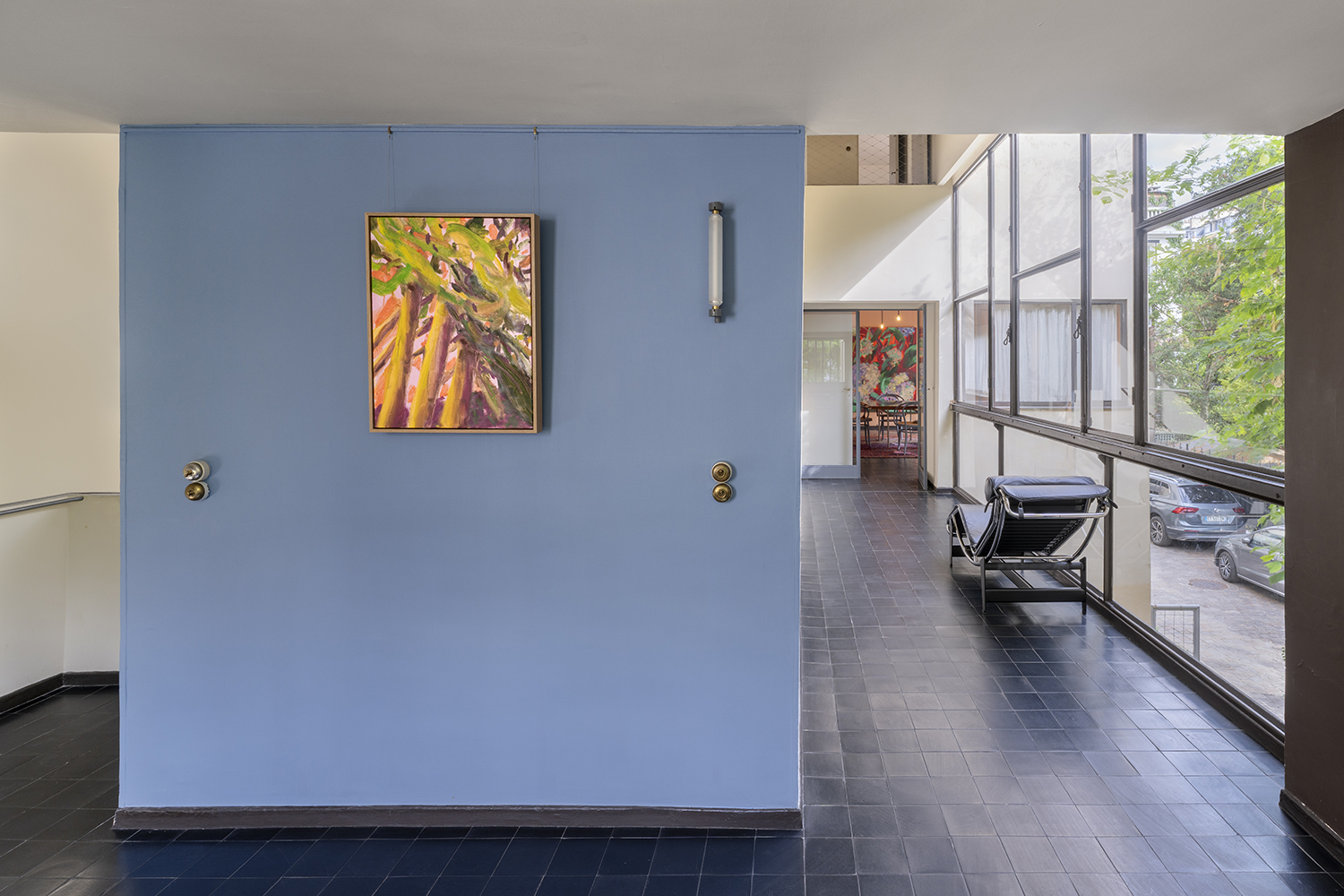
Photo by Nicolas Brasseur. Courtesy of the artist, MASSIMODECARLO, Fondation Le Corbusier
LA: So, following his ideas.
NW: Yes, following his ideas to my own place, rather than trying to emulate his choices. I wanted to take his ideas and arrive at my own resting place, which is quite divergent from his paintings or drawings, but still in dialogue with his thinking.
LA: Le Corbusier stated that “There are no sculptors only, no painters only, no architects only. The plastic event is fulfilled in a unique form in the service of poetry”. He was part of the Association for the Synthesis of the Art — presided over by Matisse, whom you greatly admire. What is your take on every form of art coming together?
NW: I am in great agreement. I think, at its best, it’s a possibility — something to hope for and aspire to. But oftentimes, it’s very difficult to achieve.
In that way, the paintings from the May show in Milan were about integrating the work into a space that is also domestic. It has both private and public-facing aspects, just like this one. These aren’t just spaces designed as galleries for private or public exhibitions; they are also meant to be inhabited, creating a different relationship between painting, architecture, and living. That’s the continuity between the two shows, even though the spaces are very different in their formulation and execution in terms of architecture.
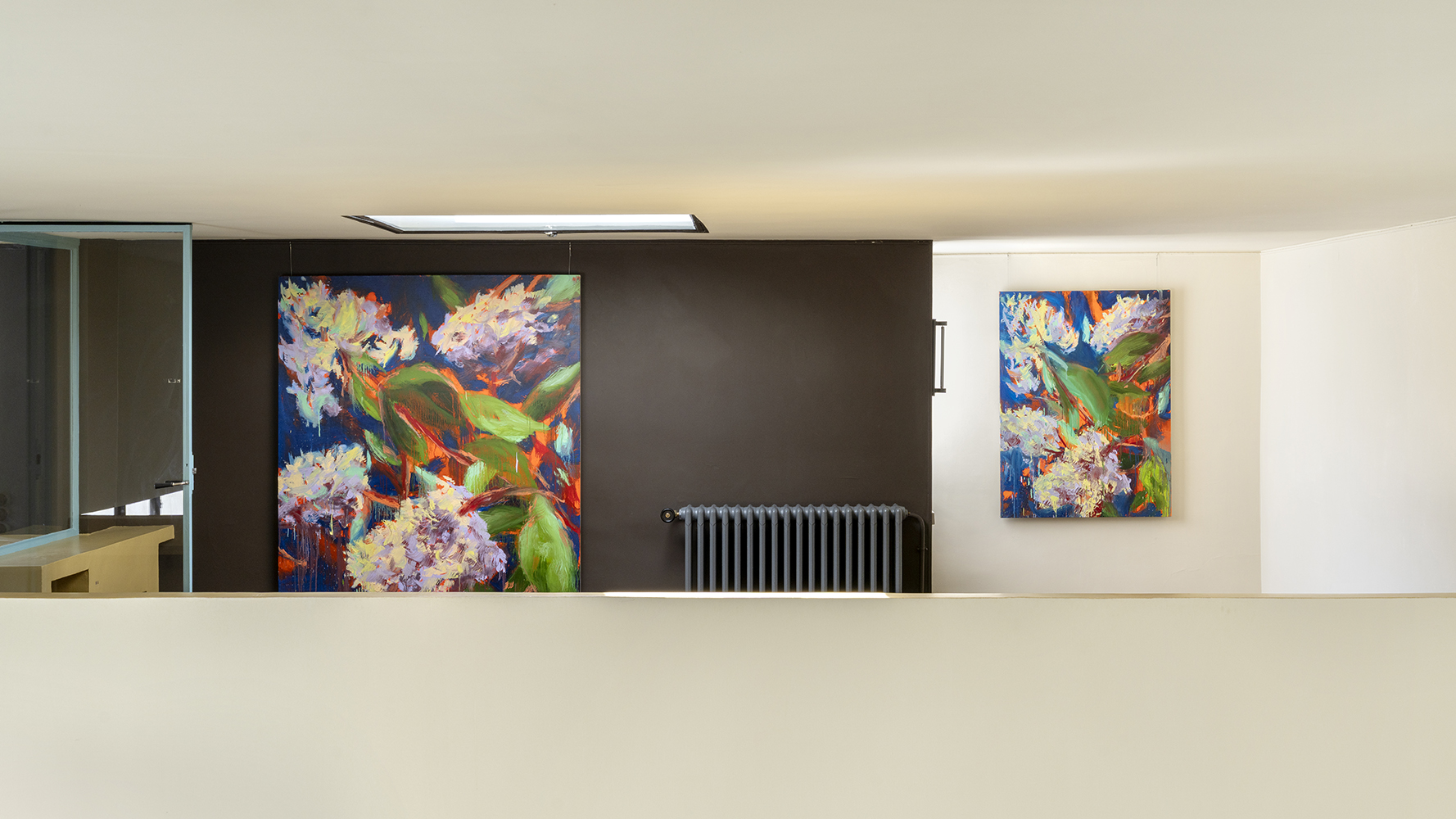
Photo by Nicolas Brasseur. Courtesy of the artist, MASSIMODECARLO, Fondation Le Corbusier
LA: Having seen both shows, it seems to me that the focus here is more on two-dimensional compositions: not exactly flat, but certainly less spatial.
NW: Yes, these forms are pressing against the face of the picture plane. Whereas the paintings in Milan had deeper space — space you could enter — these are images you can’t enter. They’re compressed toward the front of the painting. I think that’s what you’re referring to, and that’s how I conceived them.
LA: Is there a specific reason you chose this direction?
NW: Well, in some ways you respond to the architecture and history when engaging with a building like this or the one in Milan. But in other ways, everything is personal. When I was conceiving these images, feeling my way through them, that compression wasn’t an intellectual decision but more of a feeling about our time. I wanted an image that was more frontally facing, more of a complete exposure, a visual kind of pressing.

Nicole Wittenberg. Climbing Roses 2 (2024), oil on canvas, 72'' x 84''. Courtesy of the artist, MASSIMODECARLO
LA: It’s interesting that you went for something “more frontal”, especially since I read that you love the Venetian painters and one of the reasons you’ve mentioned is their tilted perspective, something you also explored in the webcam imagery of your earlier series. Would you say this is an evolution of that point of view?
NW: I think it’s something that stays with me. The Venetian paintings are very important for me. The way the figures emerge from the picture plane and lean into the room.
These paintings are a little different. The image presses and I can feel the limit of the confinement at the canvas’ edges. It was more of a response to the feeling of being alive right now, which didn’t allow for the softness of the “tipping outwards,” but instead gave me the feeling of being pushed to a moment of intensity.
LA: To a concentrated space?
NW: A very concentrated space. These paintings are an exploration of a new kind of space — new to me — and they speak to a certain kind of urgency I’m feeling right now.
LA: But this doesn’t compromise the subject — it’s still nature.
NW: Yes. There are so many ways to engage with nature as a subject matter. The content is different here from, say, botanical drawings or other contemplative representations of nature. I don’t think these works are necessarily contemplative; they are more active, more urgent.
The reading of the whole painting is meant to happen quickly. There are no recessive, meditative pauses; it exposes itself immediately and it's very forward in its progression. All I can say is that it was just a feeling I had when I started working on these about a year ago. This sense that we are living in a time of great change, when a decision needs to be made quickly, meant the paintings had to be made an almost violent way. I think that energy is present in this work.

Nicole Wittenberg. August Evening 4 (2024), oil on canvas, 72'' x 84''. Courtesy of the artist, MASSIMODECARLO
Going back to the “tipping outwards,” a few of these works actually have that, like this one here [August Evening 4, 2024] I would say does slightly tip out. But it remains constrained: there’s a tightening up, a compression on the axis and on the frontal progression. Of all of them, I’d say this one has the most weaving of forms, light, and space. When I was making this painting, I was thinking of that moment when evening becomes night.
LA: These are called August Evening, right?
NW: Yes. I was making studies for these quickly, because the light was changing fast. I knew I had 20 minutes to understand what I was looking at and to represent it. Once it’s night, it’s too dark to see. I tried to latch onto the moment to stop it. But no matter what, you can’t stop time from moving forward, so these two works in particular [August Evening 4, 2024 and August Evening 3, 2024] have a resonance that’s slightly different from the others.

Photo by Nicolas Brasseur. Courtesy of the artist, MASSIMODECARLO, Fondation Le Corbusier
LA: What happens in the process of reworking a study into a painting?
NW: The studies are really just ‘notes’ I take in a place, they are about specificity and are a way to engage with a moment quickly. They help me in the studio to connect to my memory.
LA: How much time do you wait between the study and the painting?
NW: Sometimes a very long time.
Some subjects feel like they can become something very big, while others do not want to accept that role and I have to accept what I get.
I have an idea, a feeling, a hope when I make a painting, and then there is the place where the painting takes me. Sometimes the painting is a surprise and sometimes it fulfills the vision. It’s not always clear what it’s going to be. So all of that process takes time-- to come to terms with my ideals or vision and then the actual painting.
And sometimes the final painting, for me, isn’t the resting place of that vision. I want to carry on, do another one, change it in some way. Like, “Oh, maybe that could be different,” and I want to revisit that moment of the study.
LA: So some paintings are very similar because they are from the same study?
NW: Exactly. It’s almost like a musician who writes the music and knows what they're going to play, but then each take is different. Sometimes you end up with a perfect take, and sometimes you want to do it again. They’re all independent works in their own way, even if the changes may seem subtle.

Nicole Wittenberg. August Evening (2024), oil on canvas, 48'' x 36''. Courtesy of the artist, MASSIMODECARLO

Nicole Wittenberg. August Evening 2 (2024), oil on canvas, 60'' x 54''. Courtesy of the artist, MASSIMODECARLO
LA: I might be wrong, but when I learned that you take notes on the spot, wait, and only later create a full painting, that process reminded me of Jeff Wall.
NW: Oh, interesting. I love that.
LA: Because he doesn’t photograph immediately. He waits days, weeks, months—then stages the scene and recreates the moment. But since your paintings are so painterly, they’re clearly not trying to be photographs.
NW: No. They don’t really relate to photography, and they’re not supposed to.
LA: I imagined as much. But I find it interesting that maybe some parts of the process—maybe just the importance you give to the moment, and then to the its representation—maybe that could be shared with photography, or vice versa.
NW: Yes, in terms of the thinking. The process of the thinking and the constructing of the thought. The execution couldn’t be more different, but the thinking... that’s very interesting. I agree with you. Thank you for that.
LA: You wrote in a 2016 Artforum piece about Carmen Herrera that “she hides the effort from us. The color is absolute, the image is never dull.” Those are qualities I clearly see in your work. I was wondering if, in some way, you relate your own work to this description.
NW: It’s something I’m flattered to hear, but I can’t speak to it directly. She is a brilliant painter and her images and color are so fresh and alive.
She is responding to modernism, and I’m not responding to modernism at all. But her version of modernism isn’t from the past: for some reason, her paintings always feel very present to me. I’m more involved in the gesture of paint. Even though she does have gesture in her paintings, they have a different focus. A different center.
LA: I also see the “hiding of the effort”. At first your works look very spontaneous, and only later you find out everything that’s going on behind that spontaneity.
NW: Yes, there’s a structure inside. A structure coming from many years of drawing and looking at classical drawings and copying them, that’s sublimated in the paintings. I think that’s how I’m able to make them feel spontaneous when they aren’t.
LA: Speaking of structure, you’ve described your work as Baroque, whereas Le Corbusier said of his own that it is “exactly the opposite of baroque architecture”, because “it is by walking, by moving that one discerns the underlying architectural arrangement”. I was wondering if you feel that contrast here, between the space and your works.
NW: I don’t know if Corbusier would approve of these paintings hanging in his architecture. I hope he would, but I don’t know. For me, Baroque forms are about moving and twisting and motion. It’s about getting away from hard edge painting. And our current time has opened up a great deal from when this building was conceived. We no longer have movements in the arts, now we have tendencies-- modernism or even post-modernism are no longer in the present.
So I can see that maybe, for him, Baroque architecture felt old-fashioned, something one should avoid. I don’t know how these paintings would behave in an old Baroque building. I think they probably feel better here than there.
LA: How do you think the space, especially with its wall colors, responds to your paintings?
NW: I think he had a very particular sense of color, Le Corbusier. It’s interesting to see the paintings transform in this space.

Photo by Nicolas Brasseur. Courtesy of the artist, MASSIMODECARLO, Fondation Le Corbusier
LA: As you said before, seeing them here is like seeing them for the first time.
NW: I’m noticing how the paintings respond directly to Le Corbusier’s color choices. The thing about color is that it is light. This building has a very specific relationship to natural light, and it’s harmonious. The color of this wall would look very different if the windows weren’t here and we had only artificial light. The colors of everything in this building are enlivened by natural light. So I think the paintings and the wall colors are both responding to the same condition: natural light.
LA: In very different ways.
NW: In very different ways, but they’re harmonious in that relationship. Not the same response, but a response.
There’s a harmonious quality in a building where the form is both radical and tranquil. It allows for radical division of space and radical movement through space, but there’s also a deep poetic tranquility in it, supported by the light. When you think “radical,” you think of violence. You don’t think “radical” and “tranquil” can coexist in the same building. But Le Corbusier achieves that here.
The wall color supports the radicalness of the decisions, and the light, the way he positions the windows, supports a kind of tranquility. Hopefully the paintings can move within those two opposing positions in a natural way.
LA: Do you see them as more radical or more tranquil?
NW: I guess I see them as situating themselves between. That’s what makes these works, that I made responding to this building or the idea of this building, what they are. Not to have necessarily a resolution of the thinking, but more of an engagement. Not a resting place, but a place to keep moving from, and moving around. WM

Photo by Nicolas Brasseur. Courtesy of the artist, MASSIMODECARLO, Fondation Le Corbusier

Luca Avigo
Luca Avigo is an architect and an independent art scholar based in Milan. His art criticism is published in Doppiozero, Artribune, Juliet Art Mag and Artuu. His photographs have been exhibited at MOCA Brescia and at the Ance itinerant exhibition and published in Perimetro and Atlas of Ruins.
view all articles from this author