Whitehot Magazine
October 2026
"The Best Art In The World"
"The Best Art In The World"
October 2026
Drunk on Discourse: Mirja Busch's Theory Distillates
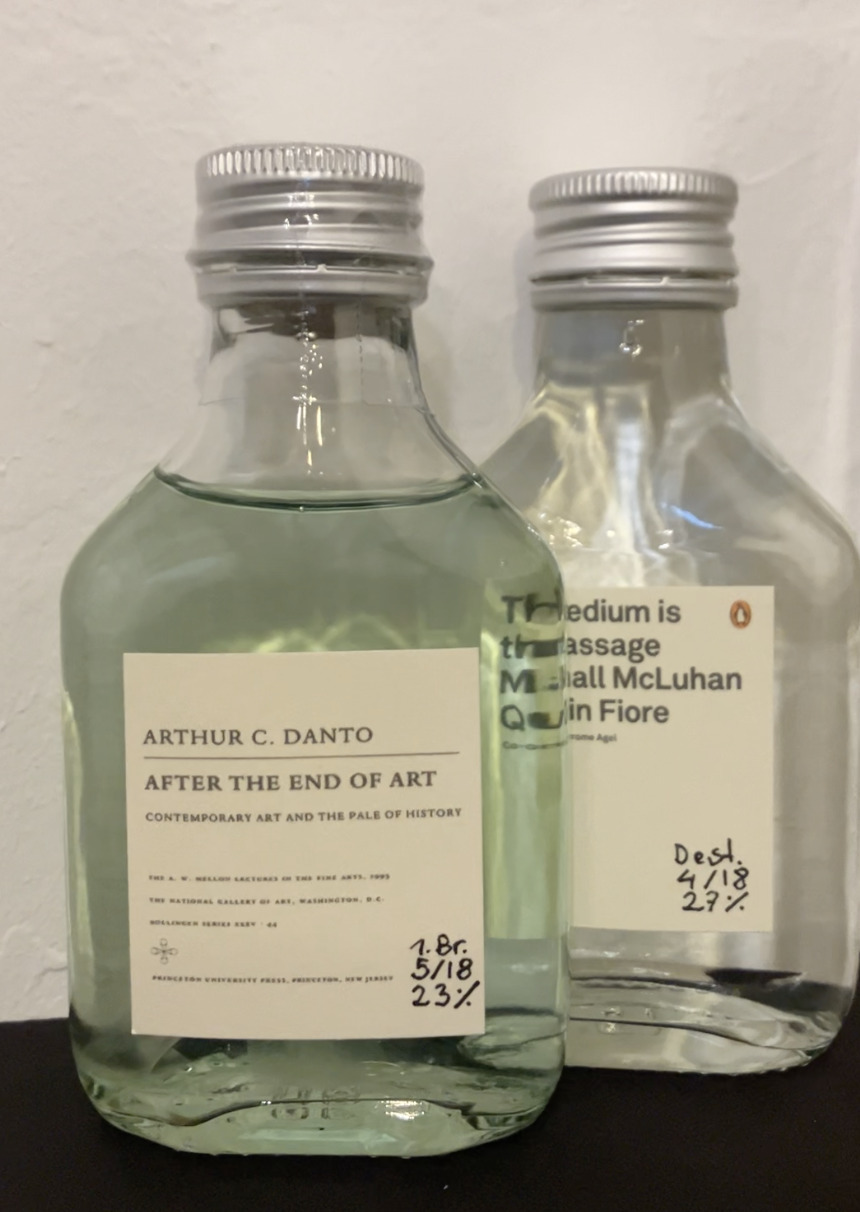 Berlin-based artist Mirja Busch’s ongoing project Theoriedestillate
By CAMILLE MORENO March 12th, 2026
What would Sigmund Freud taste like? Or Judith Butler? What if, instead of labouring over their prose, dizzy from discourse, you could just get drunk?
Berlin-based artist Mirja Busch’s ongoing project Theoriedestillate begins with a simple proposition: to expedite knowledge absorption and cultivation of taste — literally. Taking a familiar metaphor of distilling ideas to their essence, Busch follows it to its logical, if slightly absurd, conclusion. If concepts can be intellectually distilled, why not actually distil them too?
Her answer: a small distillery. In Busch’s studio, books of art theory and philosophy are transformed into liquor. The artist purchases second-hand editions — often the cheapest copies available — photographs them carefully, then shreds the pages by hand. Next, the fragments are soaked in a mixture of water and alcohol for days or even weeks, producing a dense liquid “must.”
The must is then filtered and repeatedly distilled in a small, self-built still until a clear(ish) spirit emerges. Each bottle is fixed with a label depicting the book’s original title page, accompanied by handwritten notes detailing the process, including distillation date, alcohol percentage, and whether the liquid derives from the first run, a second cycle or the final purified distillate.
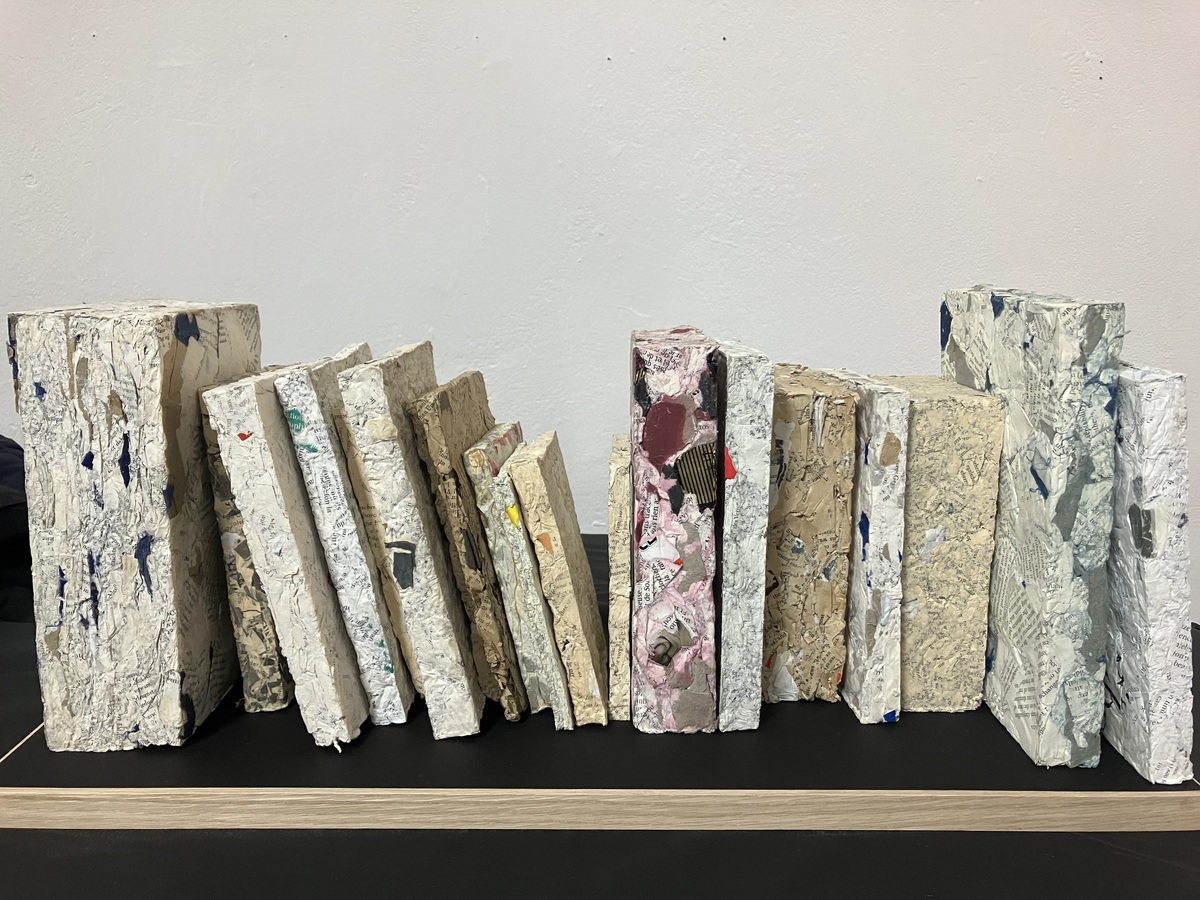 Berlin-based artist Mirja Busch’s ongoing project Theoriedestillate
Installed together, the bottles resemble a kind of bar. Shelves of amber and golden liquids catch the light, but the labels look like the reading list from an art-school syllabus. The theoretical canon appears not as a library but as a drinks menu, ready to be consumed.
In both English and German, spirit refers simultaneously to alcohol and to something less tangible: the spirit of an author, the distilled core of an idea. Distillation promises concentration—the extraction of something pure from a cumbersome whole. Intellectual understanding is often described in similar terms. A thinker who truly grasps a concept should be able to reduce it to its clearest form, separating the idea from the density of its language. Busch simply asks what happens when that metaphor is taken literally.
Yet Theoriedestillate quickly moves beyond wordplay. The installation exposes a familiar dynamic within contemporary art: the persistent fetishisation of theory, and vs. versa. Certain authors circulate with remarkable regularity in studio visits, exhibition texts, and curatorial essays. Their names appear almost automatically, signalling where an artwork might be situated within the wider conversation of contemporary art. To recognise them — and to know when to invoke them — has become one of the ways cultural competence is performed within the field.
In this sense, theory can function less as an argument than as an object of symbolic value — just like top tier bottles. References promise depth, seriousness or conceptual rigour even when the ideas themselves remain only partially engaged. What circulates is not always the argument but the name.
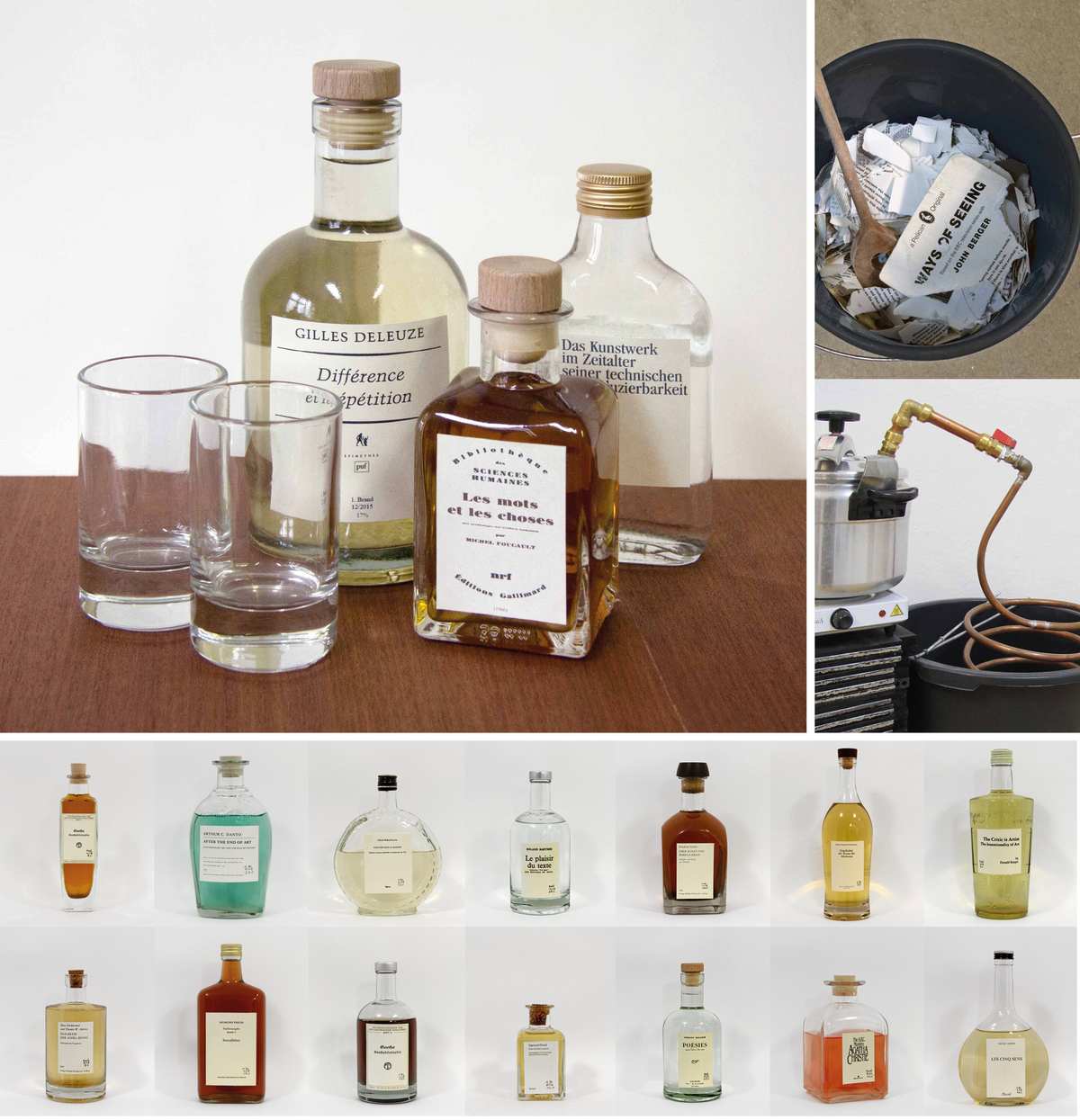 Berlin-based artist Mirja Busch’s ongoing project Theoriedestillate
In Sigmund Freud’s account of fetishism, an object becomes invested with disproportionate meaning, stabilising anxieties by concentrating attention on a substitute. Within art discourse, theoretical references often play a comparable role. The invocation of a thinker can stand in for the labour of interpretation, condensing complex intellectual traditions into a recognisable sign. Busch’s bar makes this process strangely literal. If theory functions as something to be appreciated — something cultivated, even refined — maybe it really can be tasted.
The canon she assembles is intentionally unstable. Since no definitive list of essential texts exists, Busch constructed one through a mixture of library catalogues, online sales algorithms, conversations with artists and curators, and her own reading history. The result resembles any bookshelf: part consensus, part accident, with a few peculiar inclusions sitting comfortably beside the expected classics. The canon emerges less as a stable intellectual lineage than a social formation assembled through habits of citation, recommendation, and institutional repetition.
Distillation renders this canon unexpectedly material. On one level, the transformation is straightforward chemistry: paper fibres, ink, and binding glue dissolving into alcohol. The colours of the liquids come directly from the pages themselves, and some spirits emerge in unexpectedly vivid tones, revealing pigments embedded in the paper, age, or even oils left behind from the readers. Theory, usually imagined as something immaterial, appears instead as residue, dye, and sediment.
Even so, the symbolic aura of the text proves surprisingly resilient. During tastings Busch has organised, participants have sometimes hesitated when confronted with particular authors. Rationally, the liquid contains nothing more than alcohol infused with paper. But the hesitation persisted, as though ingesting a favourite author might carry consequences beyond the chemical. The reaction suggests that fetishisation survives even the destruction of its object, long after the book has been shredded, dissolved and distilled. Somehow, the authority remains suspended in the glass.
Busch underscores this tension by preserving the paper residue. After distillation, the book’s pulp of is pressed into dense blocks that roughly resemble the original volumes. She calls them “theory blocks.” The blocks retain the mass and outline of a book, though the text is no longer readable. Fragments of words survive in the compressed fibres, but the arguments themselves have migrated elsewhere. Theory is deconstructed across several states: liquid spirit, compressed pulp, and the lingering memory of a text that once structured meaning.
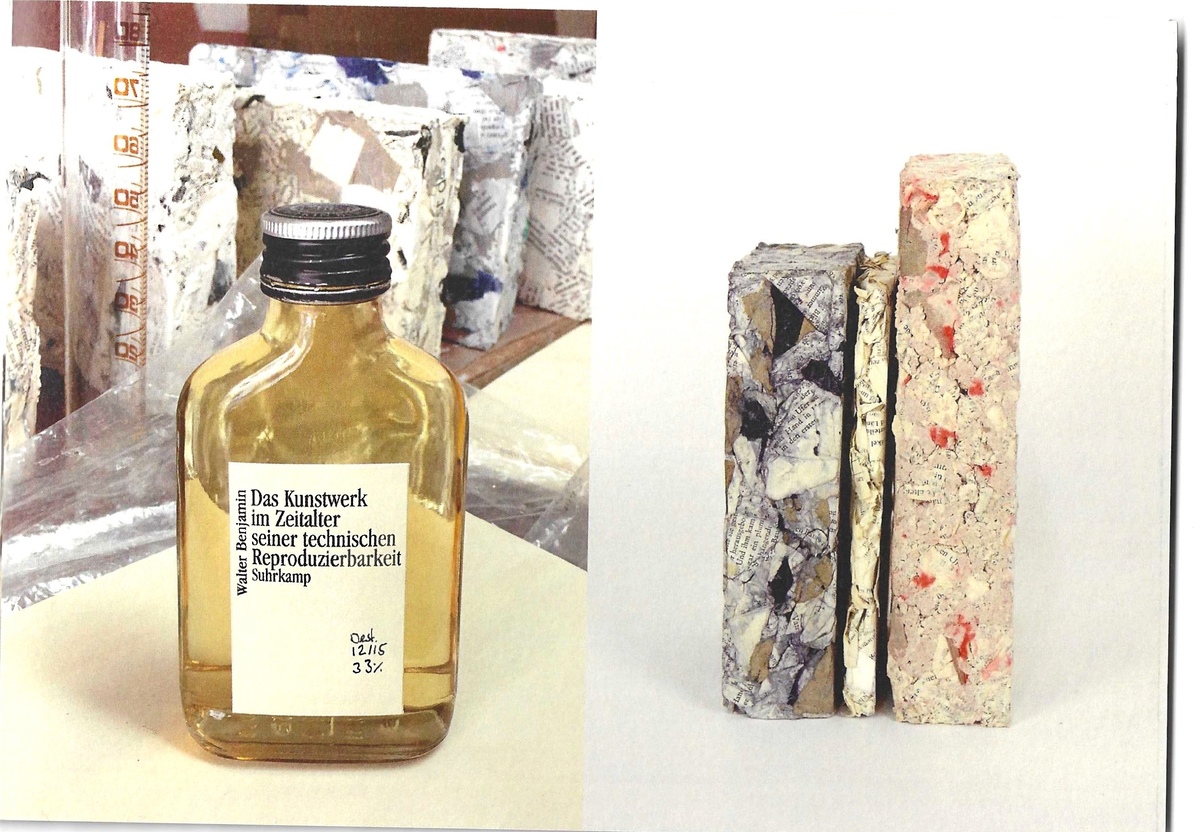
Berlin-based artist Mirja Busch’s ongoing project Theoriedestillate
The work also reveals a deeper symmetry between art and theory. Within contemporary art discourse, thinkers such as Theodor W. Adorno and Judith Butler circulate almost ritualistically through exhibition texts and criticism, lending artworks an aura of intellectual legitimacy. At the same time, theorists themselves have long relied on artworks to animate their own arguments — Adorno returning repeatedly to artistic examples to articulate aesthetic autonomy, Butler drawing on performances and cultural practices to elaborate the mechanics of identity.
Art and theory, in other words, continually lend authority to one another. Busch’s distillates expose this exchange with disarming clarity. By reducing theory to alcohol, she extracts its material substrate but leaves its symbolic charge curiously intact. Even once liquefied, the canon retains its peculiar gravity. The result is a bar where intellectual seriousness and mild superstition coexist.Viewers know perfectly well that the spirit in the glass contains nothing more than paper and ink, but the hesitation remains. Perhaps this is not surprising. Anyone who has spent long enough immersed in a particular thinker knows the sensation Busch describes as a kind of intellectual delirium: the moment when another author’s voice begins to inhabit your own thoughts, when arguments echo through conversation as if spoken through you — not by you.
Ongoing since 2016, the project has grown to comprise more than 300 bottles of theory distillate, ranging from small 10 ml samples to 750 ml bottles, with alcohol levels between 4 and 56 percent. With such a well-stocked selection on offer, the installation proposes a rather efficient (not to mention fun) route to intellectual immersion. Visitors might, in the most literal sense, end up drunk on theory. WM
Camille Moreno
Camille Moreno is a Costa Rican-American writer based in Berlin. Her writing investigates how art operates within social structures, foregrounding accessibility and the everyday as sites of critical and imaginative potential. She has written for cultural publications in Germany, the United States, and the United Kingdom.
view all articles from this author