Whitehot Magazine
October 2026
"The Best Art In The World"
"The Best Art In The World"
October 2026
Blur as Method: Memory, Perception, and the Instability of the Present
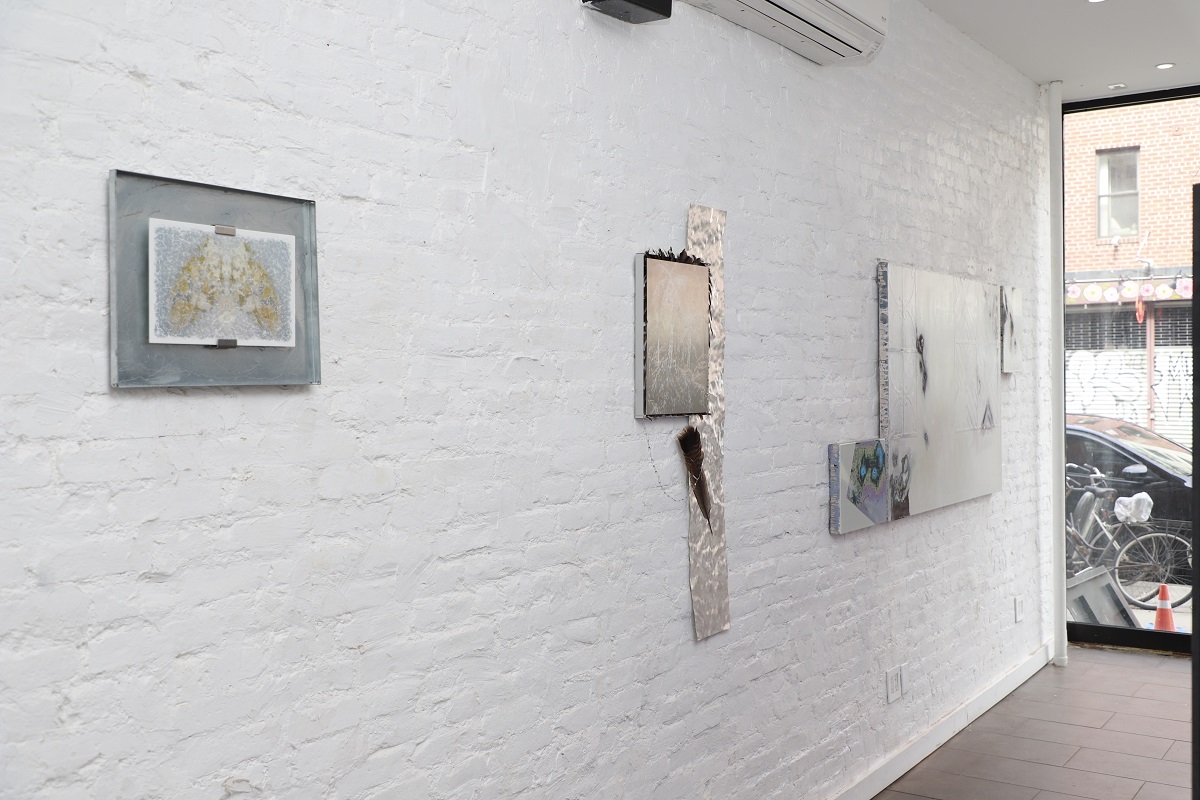 Installation view of When Blurry Memories Awaken. Photo by Haidong Yang. Courtesy of the artist and Symora Art.
By SHUHAN ZHANG April 1st, 2026
Curated by Jinyi Freya Xu at Nugyen Wahed Gallery, When Blurry Memories Awaken does not attempt to reconstruct memory as a retrievable archive of the past. Instead, it situates memory within an ongoing process of becoming. Here, memory is not an object to be preserved but a condition continuously reconfigured across perception, temporality, and materiality. Blur no longer signals distortion or absence; it becomes the very condition through which memory can exist.
The strength of the exhibition lies not in presenting “memory” as a fixed theme, but in constructing a perceptual field defined by instability. Boundaries between painting, photography, and installation are deliberately loosened, while surfaces, traces, and repetitions become the primary carriers of meaning. Viewing no longer directs attention toward a stable object; it unfolds as a movement across shifting visual cues. Memory is not displayed but activated, deferred, and misread in the process of looking.
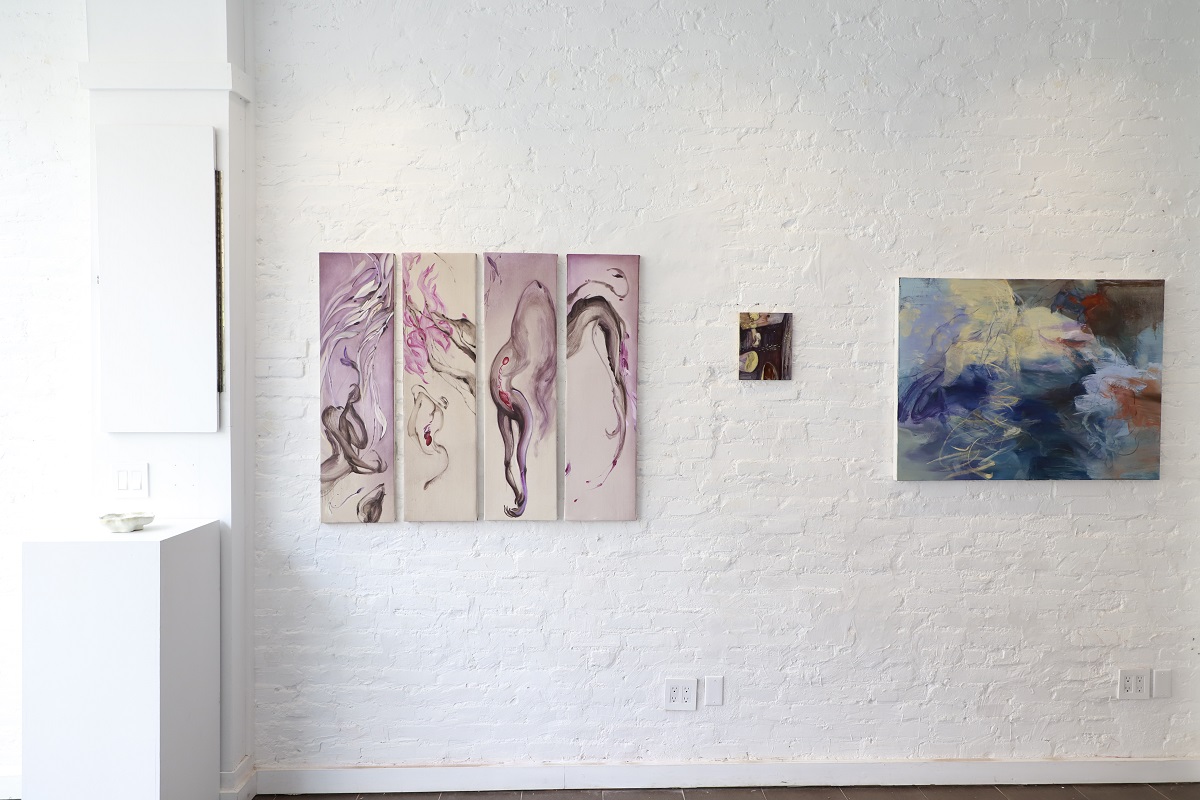 Installation view of When Blurry Memories Awaken. Photo by Haidong Yang. Courtesy of the artist and Symora Art.
Within this structure, the participating artists do not operate as isolated positions but as elements within a shared system of perceptual indeterminacy. Ruoyu Gong compresses psychological experience into unstable visual signs, allowing affect to emerge in near-distorted forms. Sharon Cheuk Wun Lee moves between image, archive, and cartographic logic, placing memory within conditions of historical rupture and medial displacement, where perception itself becomes uncertain.
Xinzi Luo extends this instability by weaving together real and imagined spaces, transforming memory into a relational structure that can be constructed and shared. Hafsa Nouman situates memory within thresholds between body and architecture, rendering it as something to be traversed rather than represented. Wandi Ni further expands memory into a system of co-existence between human and nonhuman forms, while Haidong Yang’s photographic practice oscillates between reality and fiction, positioning the image as an unstable act of translation. Jingyi Zhang, working through natural materials, renders memory as a tactile and temporal experience that resists direct articulation.
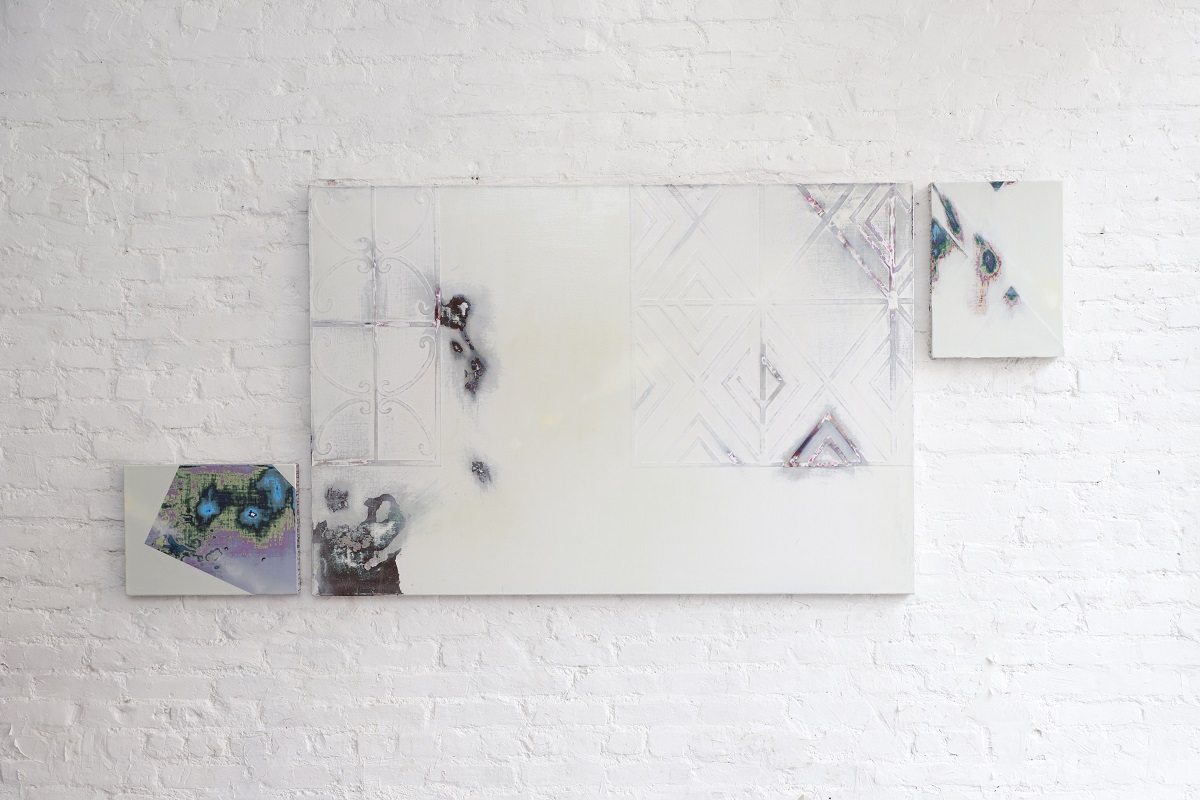 Installation view of When Blurry Memories Awaken. Photo by Haidong Yang. Courtesy of the artist and Symora Art.
In this context, the image no longer functions as representation but as interruption. Visual elements remain suspended between formation and dissolution, pointing toward experience while resisting fixation. Time is stretched and layered, such that the past no longer appears as a coherent whole but persists as fragments that continuously infiltrate the present. Viewing becomes an uncertain act. Recognition is constantly attempted yet never fully achieved. Memory no longer resides within the subject but circulates across bodies, environments, and media, emerging as a structure continuously produced in the present.
Against conventional models of memory that rely on clarity and recognizability, the exhibition mobilizes blur as a form of resistance. In a visual environment dominated by high resolution and rapid circulation, clarity often aligns with legibility, categorization, and consumption. Blur interrupts this logic by delaying comprehension and suspending meaning in a state of indeterminacy. The viewer is denied immediate resolution and instead compelled to negotiate their position within a shifting perceptual field. Familiarity and estrangement, attraction and distance, operate simultaneously. The tension of the exhibition arises not from narrative but from the instability of the viewing structure itself.
This approach resonates with Henri Bergson’s notion of durée, in which the past persists within the present through processes of compression and permeation. It also echoes Walter Benjamin’s concept of the “flash of memory,” referring to those experiences that resist full capture yet insist on momentary appearance. Theory is not explicitly stated but becomes perceptible through spatial and visual experience.
When Blurry Memories Awaken does not offer an explanation of memory. Instead, it constructs a way of being with memory. What remains after leaving the exhibition is not a specific image but a lingering awareness of instability, of layered temporality, and of how subjectivity is continuously rewritten within these blurred structures. WM

Shuhan Zhang
Shuhan Zhang is a curator and writer based in New York. Her work focuses on contemporary art, digital culture, and the politics of exhibition-making.
view all articles from this author