Whitehot Magazine
November 2026
"The Best Art In The World"
"The Best Art In The World"
November 2026
Anatomy of a Haunting: The Ruthless Material Psychography of Kaari Upson
By MANUELA ANNAMARIA ACCINNO, November 10, 2026
Kaari Upson’s (1970–2021) art asks for no permission: it cuts, flays, and dissects. To enter her universe is to move through a ruthless material psychography, in which the artist’s body is not merely an expository tool, but a radioactive transmitter of pain, obsession, and the rubble of contemporary experience. Upson transformed her own biological and existential trajectory marked by illness, loss, and an almost pathological hypersensitivity to the architectures of intimacy into a visceral surgery of the American soul and, by extension, of the capitalist human condition. At the heart of her work lies not catharsis, but the impossibility of closure.
“The Larry Project,” the monumental work that established her intellectual and formal stature, began as an act of psychoanalytic and archaeological stalking: the figure of an unknown neighbor is reconstructed, dissected, and reinvented through his material and symbolic remains. Upson transformed this stranger into a distorting mirror onto which she projected the ghosts of the self, failed masculinity, the collapse of the American Dream, and the delirium of possession. In Upson’s work, the search for the Other always culminates in a hallucinatory journey into one’s own shadow territories, demonstrating that identity is not a monolith, but a porous, perpetually haunted structure.
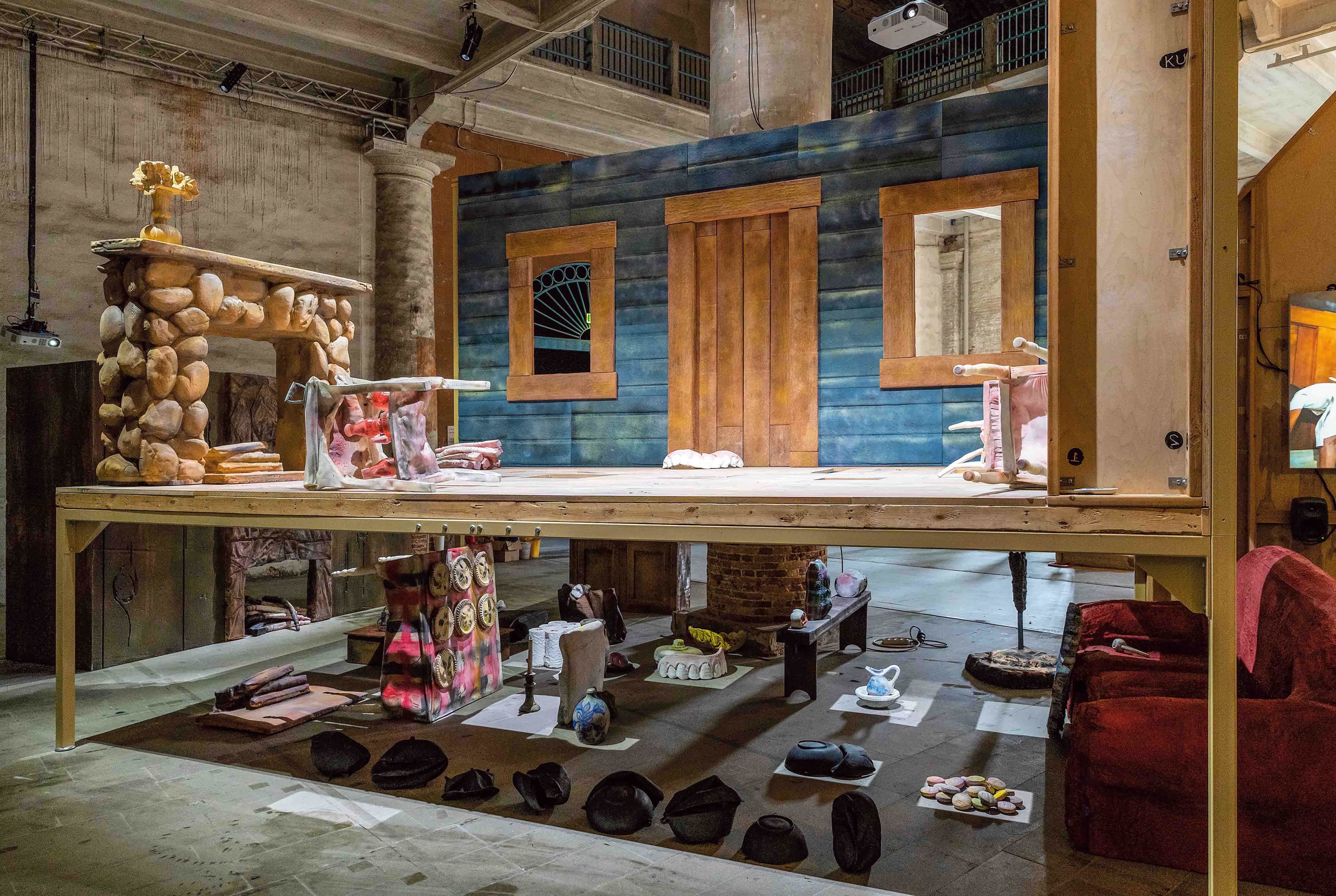
In her hands, matter rejects grace to become an organic synthesis of repulsion and desire. Silicone, polyurethane foam, latex, melting pigments, clothing, and cosmetics become the flesh of a sculpture in perpetual contraction and decomposition. The domestic environment, historically a place of refuge and control, is revealed as the theater of the unconscious and of trauma. This process reaches a fever pitch in the imposing installation “THERE IS NO SUCH THING AS OUTSIDE,” presented at the Venice Biennale in 2019. The title is a clinical and existential diagnosis: there is no “outside”; there is no escape from the inner world of obsession, from somatized memory, or from the cage of the biological body. The house becomes a diseased second skin whose walls are imprinted, flayed, and reproduced until they reveal the claustrophobic horror of inhabiting a space.
During her later years, marked by maturity and illness, her work reached new heights of razor-sharp clarity. In Upson’s art, pain was never portrayed as pathos or voyeuristic pity, but rather as a tool for epistemological understanding. The artist’s physical vulnerability served as a magnifying glass through which to examine the systemic fragility of a world obsessed with sterilization, appearances, and the repression of death. Her work remains an open wound: a jarring reminder of the truth of the flesh, the inescapability of trauma, and the desperate, sublime necessity of making art the only place where the abyss can be looked in the eye without succumbing to pretense.
“Kaari Upson. Dollhouse” is the first major posthumous retrospective dedicated to the artist. Produced by the Louisiana Museum of Modern Art in Humlebæk in collaboration with the Kunsthalle Mannheim and MASI Lugano—which is hosting the exhibition’s final stop until 10 January—the exhibition invites visitors to engage with an artistic legacy that is extraordinarily relevant, unsettling, and moving, as highlighted by curators Francesca Benini and Taisse Grandi Venturi. Below is my interview with Michael Benevento, a contemporary art gallery owner in Los Angeles, who shared a deep personal bond and a long-standing professional collaboration with Kaari Upson.
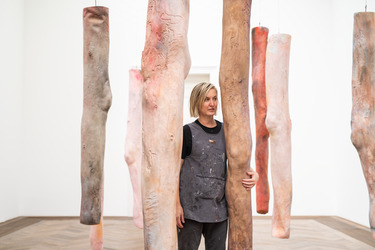 Kaari Upson, MASI Lugano
How did you meet Kaari, and how did your personal friendship evolve into a professional collaboration in Los Angeles?
I met Kaari entirely by chance in 2009. I had arranged a studio visit with another artist in North Hollywood, without realizing that they shared the space with her. When I arrived, Kaari answered the door.
I knew of her already and had seen her Hammer Project, and at the time, I didn't appreciate it. I thought it was excessive, almost self-consciously so. Which, of course, was entirely intentional. But there was one part of the exhibition that stopped me, a series of enormous photographs that I thought were extraordinary. Kaari had taken photographs from Larry's belongings, pinned and taped them into arrangements, photographed them, and then made tiny paintings from those images. She then photographed the paintings and enlarged them dramatically, revealing her fingerprints, stray hairs, and dust that were otherwise invisible. What began as an investigation into Larry had become forensic evidence of her own presence. I thought that was brilliant.
In 2015, I moved my gallery next door to her studio on Beverly Boulevard. Kaari even helped me develop the original floor plan. Our friendship and working lives gradually became inseparable, and I became increasingly involved in her studio practice, especially during the pandemic, when the studio was operating with very few people. As an art dealer, I wanted to understand what materials artists used and how their works were actually made. With Kaari, I had the rare opportunity to participate in that process, to see ideas take shape and change direction.
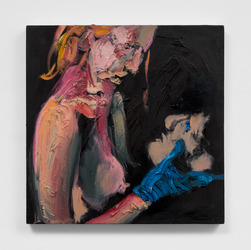 Kaari Upson, MASI Lugano
For Kaari, art did not seem like a career choice, but rather a genuine, biological, and inescapable condition. What was her day-to-day life in the studio like? Was there a clear dividing line between her private life, her domestic sphere, and her artistic creation, or was her entire existence a single creative endeavor?
Kaari had a dedicated studio routine. Maurizio Cattelan once asked her to describe her practice, and she said, “Steady.” He then asked whether making art was urgent, and she replied, “A steady urgency.” I think what she meant was that the urgency wasn't to finish something, but to keep making. She always had several projects underway, moving between drawing, sculpture, and experimenting with materials.
Drawing was particularly important to Kaari. She described it as meditative, something that grounded her when her sculptural work was unpredictable. She had a large area of her studio dedicated to drawing, where she would work on as many as ten drawings simultaneously. She even built a drawing studio onto her home so she could continue working after her daughter had gone to sleep.
Kaari was devoted to her daughter and had a rich personal life. I wouldn't say her entire existence was one creative endeavor. She had a life outside the studio, although the two were closely connected. Kaari made lunch for everyone working in the studio every day, and we would all sit down together to eat, laugh, exchange ideas, and gossip. That sense of community was an important part of her working life.
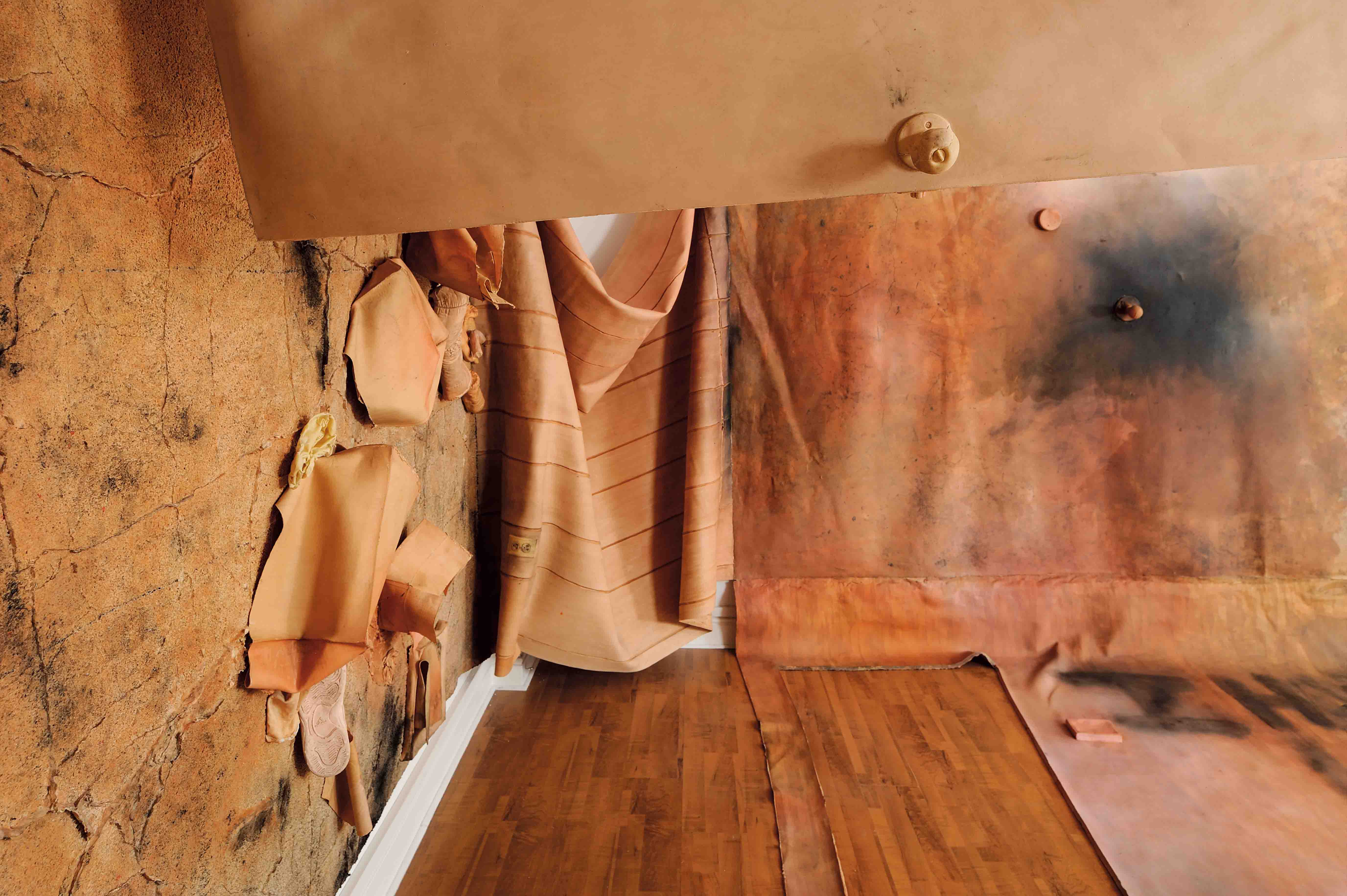 Kaari Upson, MASI Lugano
The famous 'Larry Project' left a profound mark on her career, revealing an almost diabolical ability to push beyond the boundaries of emotional and psychoanalytical engagement with her subject. Having followed her evolution closely, how did her relationship with this 'phantom' figure change over the years? Was there a moment when this obsession threatened to consume the artist before the artwork itself could?
Kaari's relationship with Larry was obsessive, probably. But I think we have to be careful about how we use that word. She was intensely focused on recording things, particularly the skins of things. That intensity was fundamental to how she worked, but it doesn't necessarily mean she was consumed by it.
Kaari was fascinated by the belongings Larry had left behind: his photographs, journals, and personal possessions. But these offered only fragments of his history. His diary recorded dreams from a particular period, and when she later lost that diary at CalArts, the missing information became increasingly important. She described the project as being about the slippages and the gaps. Rather than trying to reconstruct his life from incomplete evidence, she began inserting herself into those gaps, creating an imagined relationship with a man she had never met.
I think Four Corners (2011) was her attempt to bring that relationship to an end. Kaari constructed an eight-foot cube lined with paper and used a life-size charcoal and wax figure of Larry as a drawing instrument. She rubbed his body against the walls and floor, pushing and dragging him across the surfaces, intending to wear him down into piles of debris.
 Kaari Upson, MASI Lugano
Her sculptures, created using resins, polyurethane, silicone, and pigments, required immense physical effort—almost a hand-to-hand combat with toxic, heavy, and ever-changing materials. What sort of visceral relationship did Kaari have with these materials and with the physical exertion involved in the physical creation of her work?
Kaari had a remarkable understanding of materials, but she was also interested in what happened when she couldn't entirely control them. She developed unconventional casting techniques, often using molds that captured every detail of an object's surface. Once the mold was removed from the original object, especially with latex molds, she could suspend it, pull it, and manipulate its shape, using gravity to stretch and distort the form, allowing something entirely different to emerge.
She called this “anti-mold making.” Traditionally, a mold is meant to remain fixed, preserving the form of the object being reproduced. Kaari allowed hers to move.
The physical demands could be enormous. Making these sculptures was a collaborative effort, with several people working together to position and move the molds and apply the casting materials before they began to set. It required strength, concentration, and an almost instinctive understanding of how the materials behaved. Kaari described the process as athletic, a team sport. Sometimes the result was remarkable; other times it was nothing like what she had imagined. That uncertainty could be frustrating, but it was also what made the work exciting.
What I found particularly interesting was that she could be very precise in recording an object, yet deliberately introduce uncertainty into what that form would become. She wasn't simply allowing the materials to do whatever they wanted. She was creating the conditions for something unexpected to happen.
With 'THERE IS NO SUCH THING AS OUTSIDE', the installation presented in Venice in 2019, Kaari expressed a state of total spatial and mental claustrophobia. How did the genesis of such a complex and radical work unfold? In what way did she rework the themes of loss, the concept of 'home,' and the feeling of never being able to escape one’s own inner world?
THERE IS NO SUCH THING AS OUTSIDE brought together two different domestic worlds, one belonging to Kaari and the other to her friend Kris. Central to the installation were two dollhouses, one from Kris's home and another made by Kaari's mother for her daughter. Kaari used these two dollhouses as the starting point for a project in which their domestic environments, personal histories, and identities began to overlap.
Miniature objects from the dollhouses were scanned and enlarged into sculptures, losing information and becoming distorted in the process. Kaari was particularly interested in these transformations, in how something familiar could become increasingly strange through its reproduction.
The videos introduced another dimension. Kaari and Kris took turns playing each other. The sculptures and videos weren't simply illustrations of the same story. Through these performances, they blurred the distinction between self and other, extending the installation's exploration of domestic space into questions of identity.
The title opens up a much more interesting question about what is inside and outside, and where the self begins and ends. Can what is most intimate to us also be external? How do domestic spaces shape our memories and identities? You can leave a house, enter another person's world, even play someone else, but can you ever entirely step outside yourself? I think Kaari's work leaves that question open.
 “Kaari Upson. Dollhouse – A Retrospective” © MASI Lugano, photo: Gabriele Spalluto
In the final years of her life, the themes of bodily vulnerability, illness, and physical decline became an even more dominant feature of her practice, yet she never succumbed to sentimentality or self-pity. How did Kaari confront pain through her art? Was her work a shield, a tool for exploration, or a way of exorcising the end?
Kaari never lost her drive to make art, even in the final years of her life. I would never describe her work as a shield against illness or an attempt to exorcise death. Making art was simply essential to who she was.
One of the most significant developments during those years was her return to painting, something that had been fundamental to her beginnings as an artist. She developed a technique in which she applied paint to various surfaces, including sculptures, then pressed plastic against them to capture the impressions and transfer them onto canvas as a form of mark-making. Sometimes she repeated the process several times, building up layers of imagery. There was a real sense of discovery in this work, and she approached it with tremendous excitement.
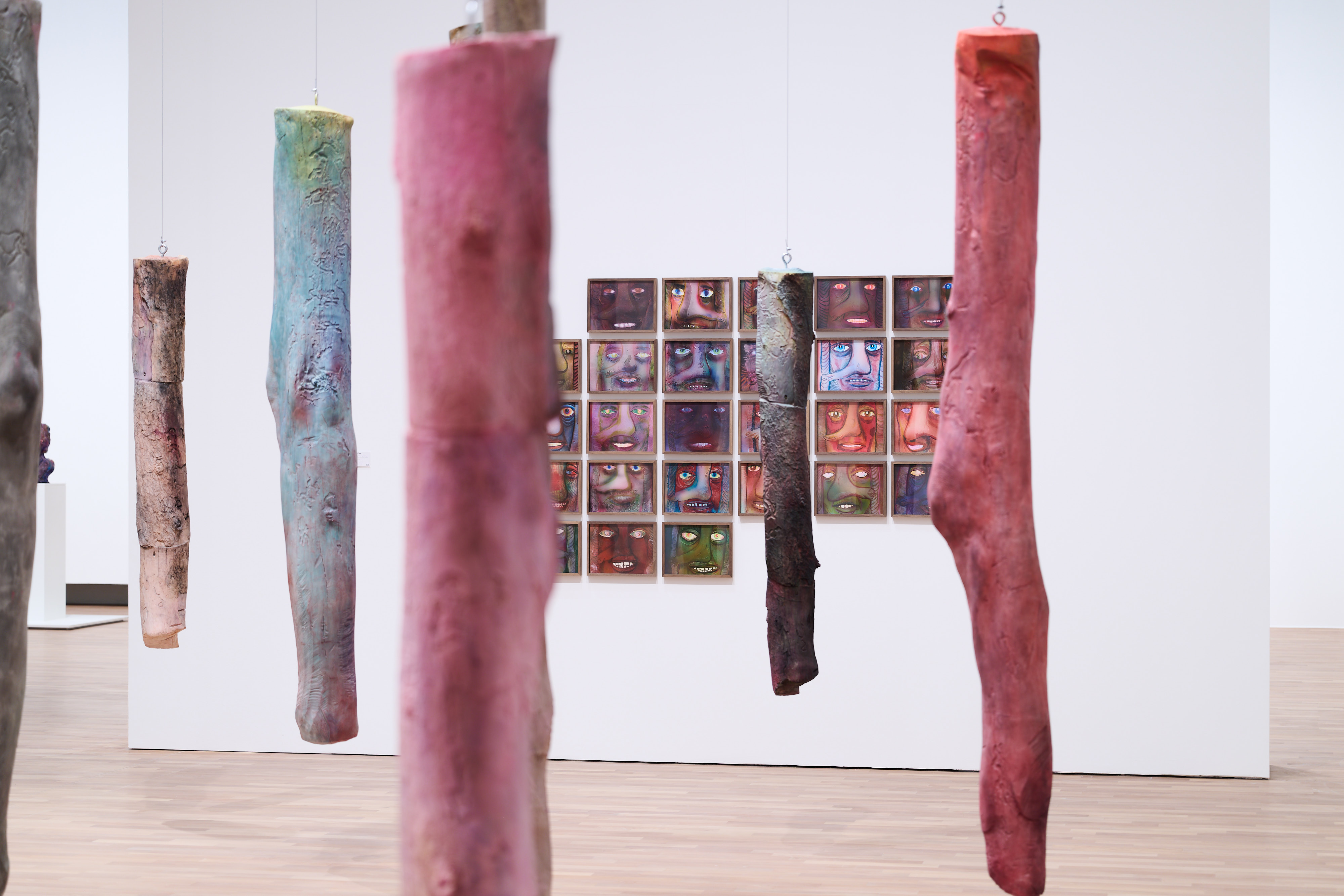
Among the most personal works from this period was Untitled (Foot Face), a series of drawings she made following her mother's death from melanoma. Her mother's big toe had been amputated because of the disease, and Kaari subsequently made a cast of her mother's foot, which she incorporated into a number of sculptures. In the drawings, the foot replaces the nose at the center of each face. The drawings brought together her mother's absence and Kaari's longstanding interest in repetition and recording. She intended to make one drawing every day for a year, returning to the same image throughout. She only completed 140 drawings.
Who was Kaari Upson away from the spotlight of the art world? Apart from the dramatic intensity of her work, which aspects of her character, such as her dark humor, generosity, or intellectual ferocity, do you believe are essential to truly understanding the greatness and complexity of her legacy today?
I think Kaari enjoyed the spotlight and knew how to entertain it. But what mattered most to her was being taken seriously as an artist. She was deeply committed to her work and expected the same seriousness from the people around her.
She was so funny. So fiercely intelligent, curious about almost everything, and wonderfully irreverent. There was often something unsettling in her work, but she could find humor in the very things that made other people uncomfortable. As she once said, “Humor and fear are the same, right?”
As for her legacy, I still think of Kaari as a person, not a legacy. Her work will continue to be interpreted in ways neither of us could have anticipated. WM

Manuela Annamaria Accinno
Manuela Annamaria Accinno, born and raised in Milan, is an art historian and critic with a degree from the University of Milan. She has been actively collaborating for several years with radio stations and magazines specializing in the field of art.
view all articles from this author