Whitehot Magazine
October 2026
"The Best Art In The World"
"The Best Art In The World"
October 2026
Foreign Tongues: Nathaniel Mary Quinn on The Rolling Stones
NATHANIEL MARY QUINN
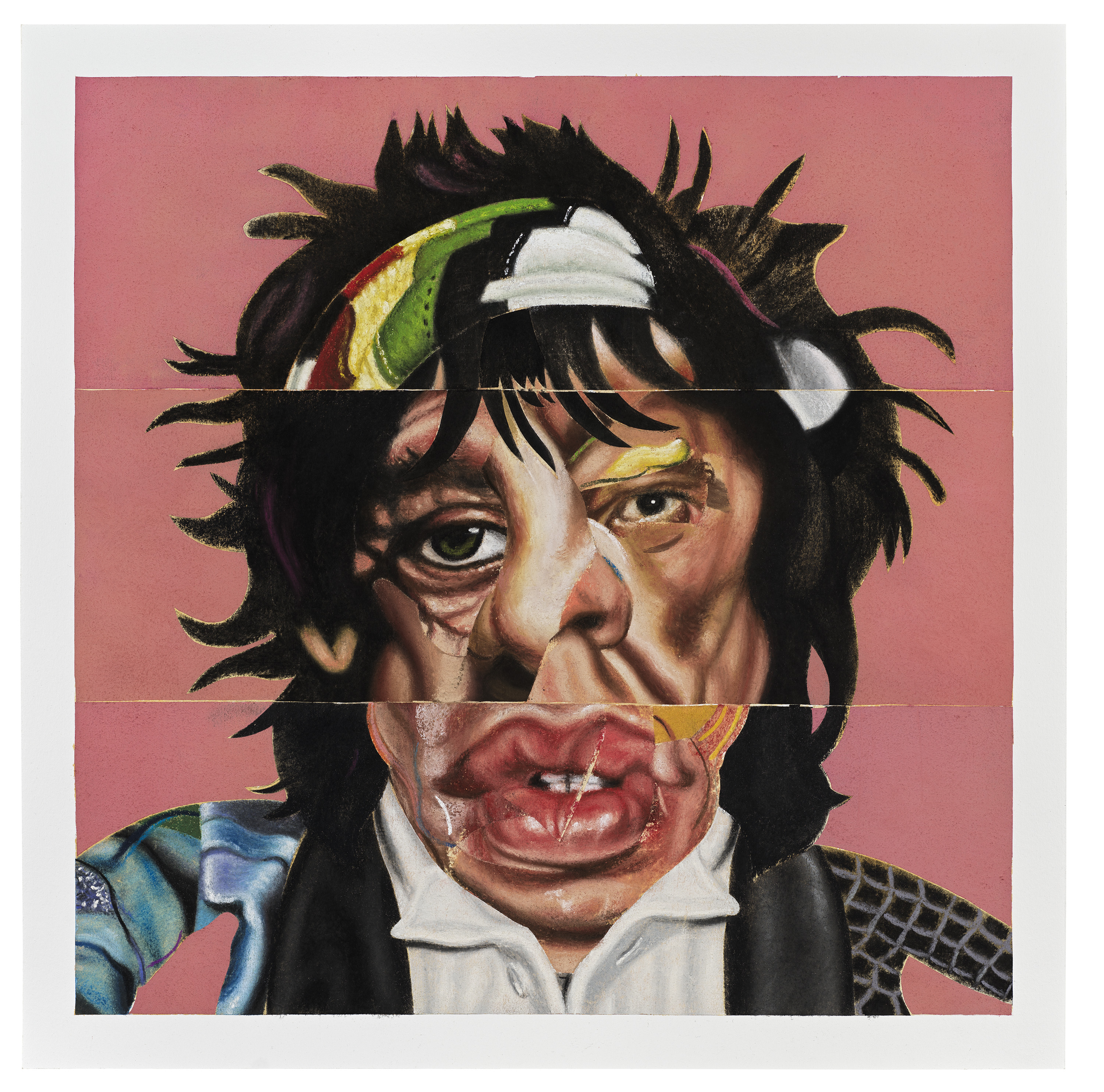
Stones Trinity, 2025
By AYSE SARIOGLU June 4th, 2026
Spirit is heard more clearly through distortion.
Rock’n’roll has never told a clean story, because no true story is ever clean.
Now, the artist known for rendering some of the most fragmented human faces in contemporary art, Nathaniel Mary Quinn, creates a new face for one of rock history’s most enduring myths: The Rolling Stones.
The Rolling Stones "Foreign Tongues" album cover is not merely a commission. It is a collision.
Between pastel and distortion. Between memory and riff. Between the fractured streets of Chicago and the rebellious stages of London...
Ayse Sarioglu : When you were offered the opportunity to create the album cover for a cultural icon like the Rolling Stones, what was your very first honest thought—excitement, pressure, or a sense of unfamiliarity?
Nathaniel Mary Quinn : I think my first thought was a sense of fear-like pressure. It was challenging wrapping my head around such an honor and opportunity.
Sarioglu : Did this project feel to you more like a “commission,” or more like a cultural encounter?
Quinn : The project felt more like a cultural encounter, as though some known or unknown force, like God, had charged me with the task of capturing the culmination of a historic era of music and mythology.
NATHANIEL MARY QUINN
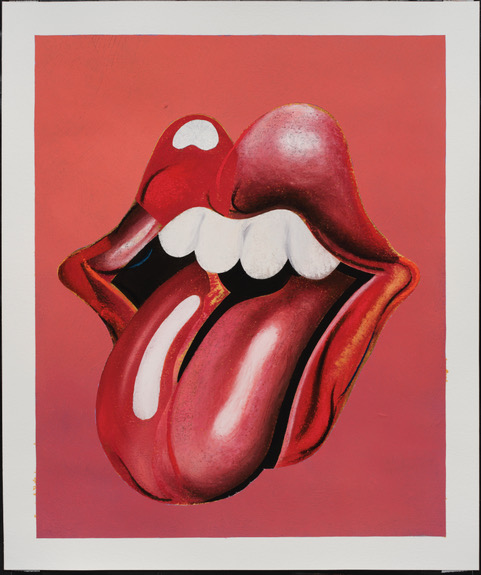
Stones Tongue, 2026
Sarioglu: Why do you think certain figures in the art world are drawn to specific projects ? Is it a coincidence, or some form of aesthetic resonance?
Quinn : I think a combination of numerous reasons compels certain art world figures to entertain specific projects, ultimately, perhaps, emotional or aesthetic convictions, or the chance to broadcast their artistic vision onto something deemed meaningful in some way. The introduction of such opportunities is often, in my opinion, coincidental, by chance, unless various inside connections are in motion.
Sarioglu : How do you interpret your own selection for a project of this scale—career advancement, fate, or a cultural collision?
Quinn : My selection for the Rolling Stones album cover was pure chance, although there were several people—extremely important people—advocating for me. As a result, I feel strongly that the album cover certainly introduces my work to a wider audience.
Sarioglu : To you, are the Rolling Stones simply a band, or something closer to a larger cultural form?
Quinn : The Rolling Stones transcends being a band at this point; they are a cultural pillar of human history, breathing the same rarified air as Muhammad Ali. They are as enduring as the atmosphere, achieving permanence.
Sarioglu : How do you see the relationship between their “energy” and the energy present in your portrait work?
Quinn : The relationship between their energy and that in my work is honest and sincere, rugged and raw. My portrait aims to capture both their status as Rock and Roll idols and their humanity, saying, “The journey toward enduring and incontestable greatness looks like this—not smooth or fantasy—but profoundly challenging, and most humans would undoubtedly crumble underneath its weight.
Sarioglu : In your work, faces are often fragmented and reassembled into new forms. In rock’n’roll, distortion alters sound in a way that makes it less “pure,” yet somehow more truthful. Do you see a similar process happening in your painting practice?
Quinn : Yes! Distortion, metaphor, and the rearrangement of language are more effective in conveying truth. In this way, it’s actually more pure because it's honest, like laying your wounds bare for the world to see. It’s courageous.
Sarioglu : When you created Stones Trinity, were you thinking in terms of individual identities or of a collective memory?
Quinn : I was thinking in terms of meshing the members into one flesh, where individual strengths and weaknesses find collective harmony with fitting together, like an unusual but necessary body, where varied parts that traditionally don’t fit find a way to fit, to embrace each other, to flow and vibe with each other, like one singular organism.
Sarioglu : Would you describe this work as a portrait or as a form of visual mythology?
Quinn : I would describe my work as a form of visual mythology, or rather as a truth of The Rolling Stones that challenges the mythology that many fans have in their heads because the Stones are, after all, composed of human beings—vulnerable, fragile, mortal humans—and I wanted to priclaim, “This, ladies and gentlemen, my great country men and women, is The Rolling Stones!”
Sarioglu : What does the title Foreign Tongues evoke for you?
Quinn : I am still investigating what the title “Foreign Tongues” evokes for me, although it strikes me as being otherworldly, uncanny, ethereal.
Sarioglu : Does it refer to literal foreign languages, or to internal languages that we are unable to articulate within ourselves?
Quinn : Internal languages—the unspoken sense of communication that we feel—sound more like it.
Sarioglu : Your personal history is marked by loss, rupture, and reconstruction. Do you see a connection between this lived experience and the survival ethos of rock’n’roll culture?
Quinn : I most certainly see a connection between this lived experience and the survival ethos of rock’n’roll culture.
Sarioglu : From your perspective, is there a fundamental difference between a guitar riff and a portrait, or are they simply different forms of the same creative process?
Quinn : A guitar riff and a portrait are the expression of a process that both traditions of creativity utilize, for both share space in the process, the journey, the need, and the strength to get something out into the world. It is the vital ingredient satisfying the criteria for being alive.
Sarioglu : In your work, the idea of a single, unified face is almost absent. Do you believe human identity is ever truly whole, or is it inherently fragmented and continuously reconstructed?
Quinn : Human identity, at first, upon birth, is non-existent; it forms as we embed into our families, our communities, into culture, the world, and into history, thus becoming inherently fragmented and continuously reconstructed. Human identity is the glasses we wear, shaping how we interpret the world and our lives. None of it is seamless; none of it is without blemish, and that is the so-called “whole” of human identity, including the lies we tell ourselves about how “perfect” and “flawless” we are.
Sarioglu : At this stage, what excites you more: further collaboration with music culture, or pushing the internal boundaries of painting even further?
Quinn : Pushing the internal boundaries of painting even further excites me more than anything else, for this endeavor fueled the creation of the Rolling Stones Album cover. As a result, I am, in effect, choosing to push the boundaries existing within, persisting with great enthusiasm by embracing my own fragility and vulnerability, for nothing I do entitles me to another day. Every waking moment sings with humility and gratitude; each day another to push the internal boundaries of painting—or whatever society and history have conditioned us to call this thing of making whimsical and thoughtful marks.
Distortion is the aesthetic form of truth. Quinn’s work never fixes the face in place. It disrupts it, cuts it apart, and reconstructs it. Like the sound of a rock guitar: it is never clean, but it is real.
My sincere thanks to Gagosian for their valuable support in facilitating this interview, and especially to Hallie Freer for her assitance.

Ayse Sarioglu
Ayse Sarioglu-Guest is a senior Turkish media executive, writer, and art critic based in Istanbul and New York. With over 25 years of executive experience in Turkey’s leading media organizations, including Sabah and ATV Group, she has held key leadership roles overseeing national newspapers, magazines, and television networks. Sarioglu-Guest was instrumental in the launch of MTV and Nickelodeon in Turkey and led the market introduction of Eurosport. She currently contributes to Vogue Turkey and Harper’s Bazaar Turkey, focusing on contemporary art, culture, and international creative industries.
view all articles from this author