Whitehot Magazine
October 2026
"The Best Art In The World"
"The Best Art In The World"
October 2026
Movement, Myth, and Ecology in Leonard Martin’s Painting at Templon
 Portrait of Léonard Martin © Laurent Edeline
By LARA PAN February 12th, 2026
Leonard Martin’s new exhibition, Untitled: Le Chef Menteur, is one of the most refreshing approaches I have encountered in recent years. Drawing on a form of contemporary archaeology rooted in the rituals of Mardi Gras, the young artist translates the past, history, mythology, and collective memory into the language of contemporary painting.
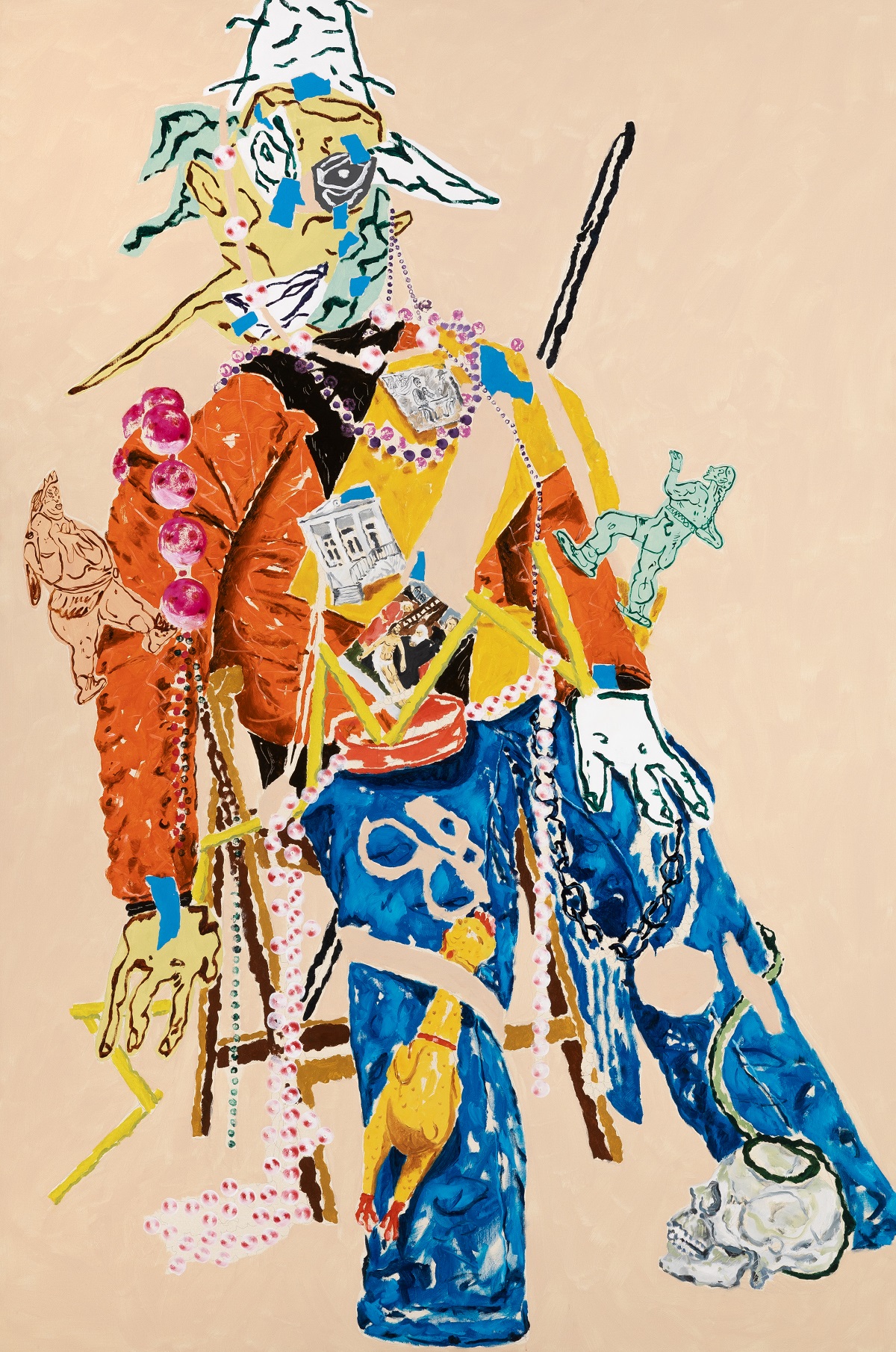 LÉONARD MARTIN, Chef Menteur II, 2025, Huile et acrylique sur toile, Oil and acrylic on canvas, 195 × 130 cm — 76 3/4 × 51 1/4 in. Courtoisie de l'artiste et Templon, Paris – Bruxelles – New York. Courtesy of the artist and Templon, Paris – Brussels – New York. Photo © Laurent Edeline.
Rather than excavating from a distance, Leonard Martin fully immerses himself in the Mardi Gras parade, absorbing its rhythms, symbols, and embodied energies. The artifacts he gathers are not unearthed but lived. They later reappear in a thoughtfully curated vitrine of objects that he carefully integrates into his new opus, allowing ritual, performance, and painting to converge into a single, layered narrative.
Movement is central to his paintings, palpable both visually and conceptually. Martin’s process of conceiving and structuring his work resembles that of a film director more than that of a traditional painter. He weaves multiple narratives and subtle metaphorical elements into each canvas, creating a dynamic visual choreography. The viewer becomes mesmerized, drawn into deciphering unspoken messages embedded in a metaphorical symbiosis sometimes overt, sometimes deeply concealed, inviting prolonged contemplation and repeated engagement. Ultimately, his work transforms the act of viewing into an experience of discovery, rhythm, and reflection, where meaning unfolds gradually, like a story revealed through layers of time and ritual.
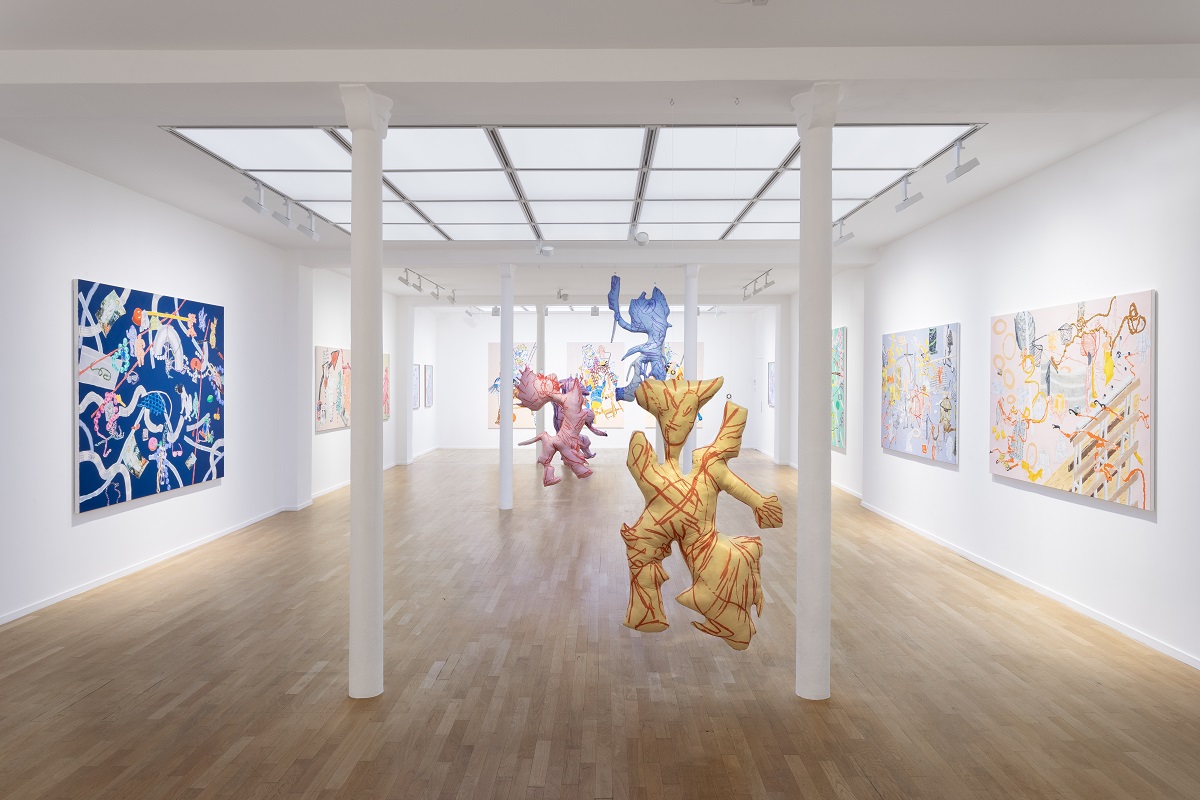 Léonard Martin - galerie Templon - © Laurent Edeline
LARA PAN: You spent more than a month in New Orleans while developing Le Chef Menteur. What were the most significant experiences or “souvenirs,” material or immaterial, from that time that informed the exhibition?
LEONARD MARTIN: I spent two months in New Orleans during carnival season. I wanted to experience its various events through the diversity of local cultures: Cajun, Creole, Caribbean, and African American.
What touched me most was each community's ability to march together despite the wounds of history, blending tradition and modernity in a grand celebration of pride and visibility.
To sum up the highlights of my residency, there were, in no particular order: the big Uptown parades, the alternative and satirical parades in Bywater and Marigny, meeting the Red Beans team and the concerts at Beanlandia, the Seconds Lines, Cajun running in Cankton (LA), the crawfish dinner at Aurore and Brandon Ballangée's Atelier de la Nature, waking up early on Mardi Gras to see the Northside Skull and Bone Gang, meeting Daryl Montana and Dianne Honoré through the dancer Smaïl Kanoute, the Black Indians jousting, Super Sunday, a Creole and Caribbean dinner at the musician Leyla Mc Calla's, the kindness and helpfulness of the people I met (Greg Lambousy, Kim Vaz Deville, Heather Hodges, Manon Bellet, Bruce Sunpie, etc.), the new friendships that were formed, etc.
Movement operates as a structuring principle in your paintings. Do you think of the image as a fixed surface, or as a temporal space unfolding like a cinematic sequence?
There is a word I like to use that comes from stop motion animation: keyframe. In an animated sequence, it is the key point toward which all the other images are moving. The rest is just transition.
I feel like my painting work is always in transition toward a goal that is constantly shifting. I work in series to try to capture moments, but ultimately it's just one and the same painting that is repeated or a series of images belonging to the same sequence.
In Watteau's Pèlerinage à l’île de Cythère (1777), there are three couples in the foreground in different poses. I like to imagine that it is the same painting captured at three different moments.
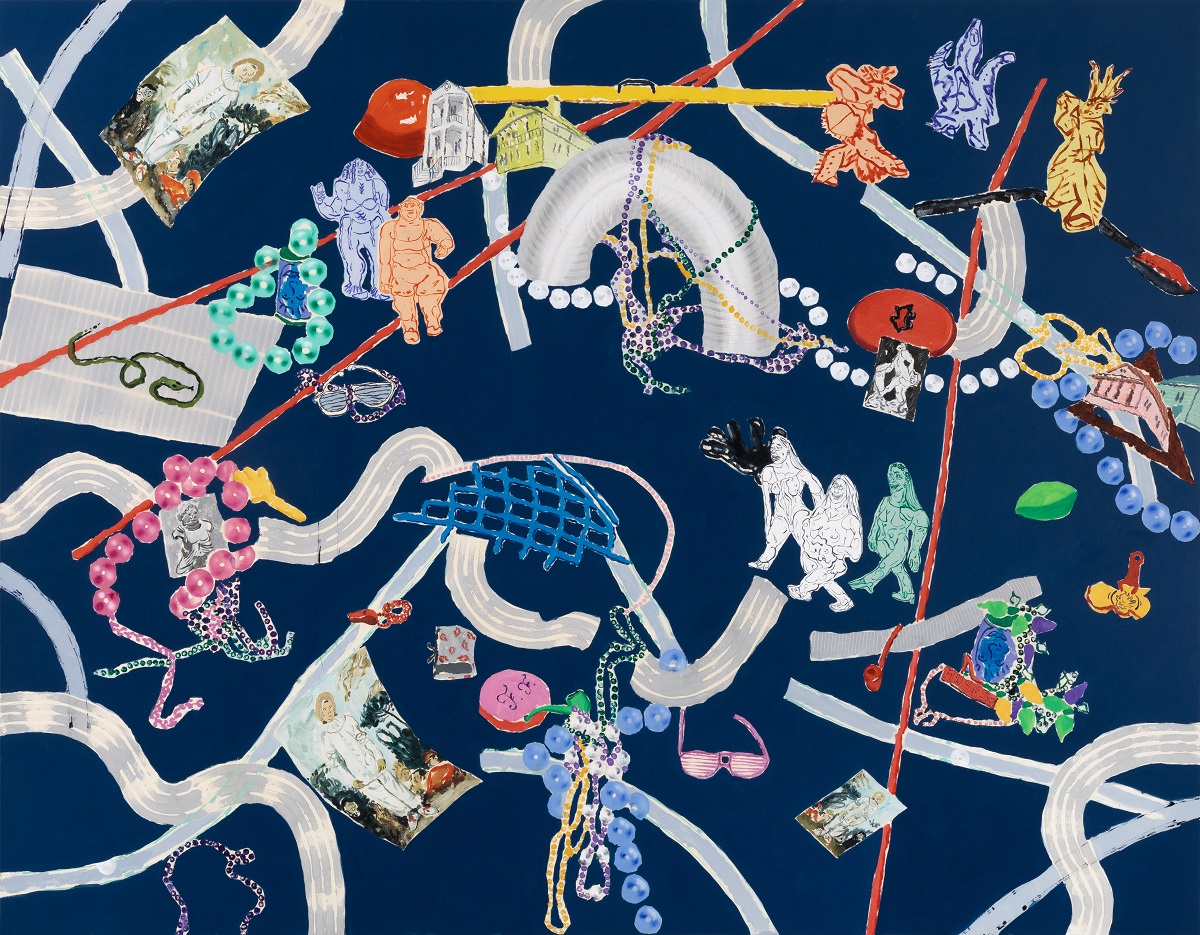 LÉONARD MARTIN, Parade Tracker II, 2025, Huile et acrylique sur toile, Oil and acrylic on canvas, 171× 219cm—671/4× 861/4in. Courtoisie de l'artiste etTemplon, Paris–Bruxelles–NewYork. Courtesy of the artist and Templon, Paris–Brussels–New York. Photo ©Laurent Edeline. Courtesy of the artist and Templon, Paris – Brussels – New York. Photo © Laurent Edeline.
You frame your practice as a form of contemporary archaeology rooted in living ritual. How does this shift—from excavation to immersion—alter your relationship to history and myth?
New Orleans allowed me to step outside the comfort zone of the studio. I was confronted with reality. Carnival is a place of survival where ancient figures and themes take on a new aspect, sometimes distorted as in dreams. I believe that artistic thought works in a similar way through the association of ideas and forms.
My own memories as a spectator were added to the objects I found and collected. And I saw the whole history of art through the lens of carnival! It leaves no one unscathed.
In this exhibition, you also address ecology. Could you share some thoughts on how ecological concerns influenced this project?
A few associations are trying to find solutions to limit the disastrous impact of the carnival on the city. But this is only a start, given the scale of the phenomenon.
This strange marriage between celebration and catastrophe has a tragic dimension, in the ancient sense of the term. I cannot forget the sound of pearl necklaces in the trees or the ground covered with plastic objects after the floats had passed.
These beads contaminated my paintings like a viral cell. I couldn't paint them like a 17th-century Flemish painter. That's why I used foam stamps. It was the most faithful representation of the gesture of throwing carnival beads. Something direct and irremediable.
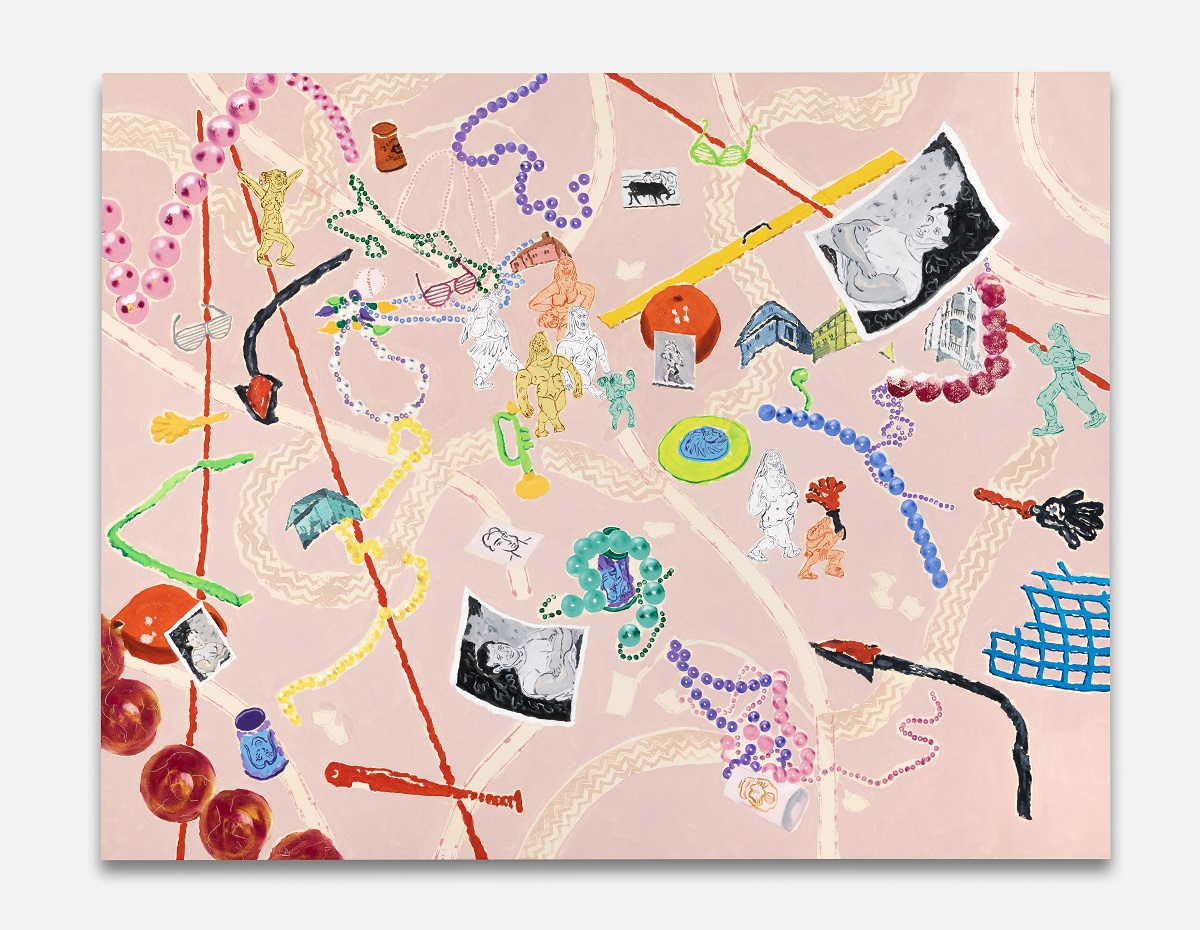 LÉONARD MARTIN, Parade Tracker III, 2025Huile et acrylique sur toile, Oil and acrylic on canvas, 171×219cm—671/4×861/4in. Courtoisie de l'artiste etTemplon, Paris–Bruxelles–New York.Courtesy of the artist and Templon, Paris–Brussels–New York. Photo © Laurent Edeline
Your work oscillates between legibility and opacity. What role does ambiguity play in activating meaning for the viewer?
Leaving behind the question of meaning and moving toward ambiguity (équivoque, aequus vox). That is to say, literally: with many voices.
In the context of carnival, it is no longer about the individual but about collective jubilation. I tried to find a carnivalesque language that escapes clear thinking that says everything. Joy and humor have this power that is both liberating and subversive.
During your stay in New Orleans, you collected numerous artifacts and documented materials. I was particularly struck by your book of preparatory drawings displayed in the vitrine. Could you share more about it, and reflect on how this rich cultural environment might shape or influence your work in the future?
In the evenings, I would draw the people I had seen during the day. I tend to exaggerate features, a bit like in comics or commedia dell'arte. But with the carnival theme, people became masks or iconic characters.
What I liked most was that street theater caught up with the theater I create in my studio. It's no longer just me distorting reality, but reality reflecting a distorted image of myself back to me. Paradoxically, this led me to reveal much more of myself. I questioned my legitimacy and my place as a spectator. With the necessary precautions, of course, as this is a culture that is not my own.
A carnival parade leaves you no choice; it carries you along. WM

Lara Pan
Lara Pan is an independent curator,writer and researcher based in New York. Her research focuses on the intersection between art, science, technology and paranormal phenomena.
view all articles from this author