Whitehot Magazine
October 2026
"The Best Art In The World"
"The Best Art In The World"
October 2026
Mark Manders: Translating Mediums
By RAPHY SARKISSIAN | June 14, 2026
With sculpture, I wanted to create a three-dimensional book—one that you read with objects, not words.
— Mark Manders
The body is our general medium for having a world.
— Maurice Merleau-Ponty
In Picasso's 1908 Bust of a Man of the Metropolitan Museum, the upper contour of the represented mask doubles as the semi-circle of the figure's hairline. One moment the mask conceals the hair and constructs the illusion of a receding hairline, and the next moment the head asserts that hairline as its own. The painting thus becomes a semiological riddle: a plethora of signifiers whose signifieds are as playful as they are suspended. This formalist playfulness often moves from the canvas into three-dimensional space within the work of Mark Manders, initiating an ongoing interrogation of visual form that he has methodically pursued over a forty-year practice. Entering his sixth solo exhibition at Tanya Bonakdar Gallery, the visitor discovers that the individual works resist remaining safely within their conventional mediums. The boundaries separating painting from sculpture, the visual from the bodily, are not erased; rather, they are reconfigured into a hybridity where phenomenology inevitably returns to the conversation. This hybridity slips past the clean, modernist assumptions about medium purity, recalling instead the foundational logic of antiquity. Greek and Roman polychromy reminds us that much of the white marble long mistaken for a classical ideal was, in its original condition, at least partially painted. Indeed, our historical understanding of sculpture has been colored from the start by the myth of pristine marble.
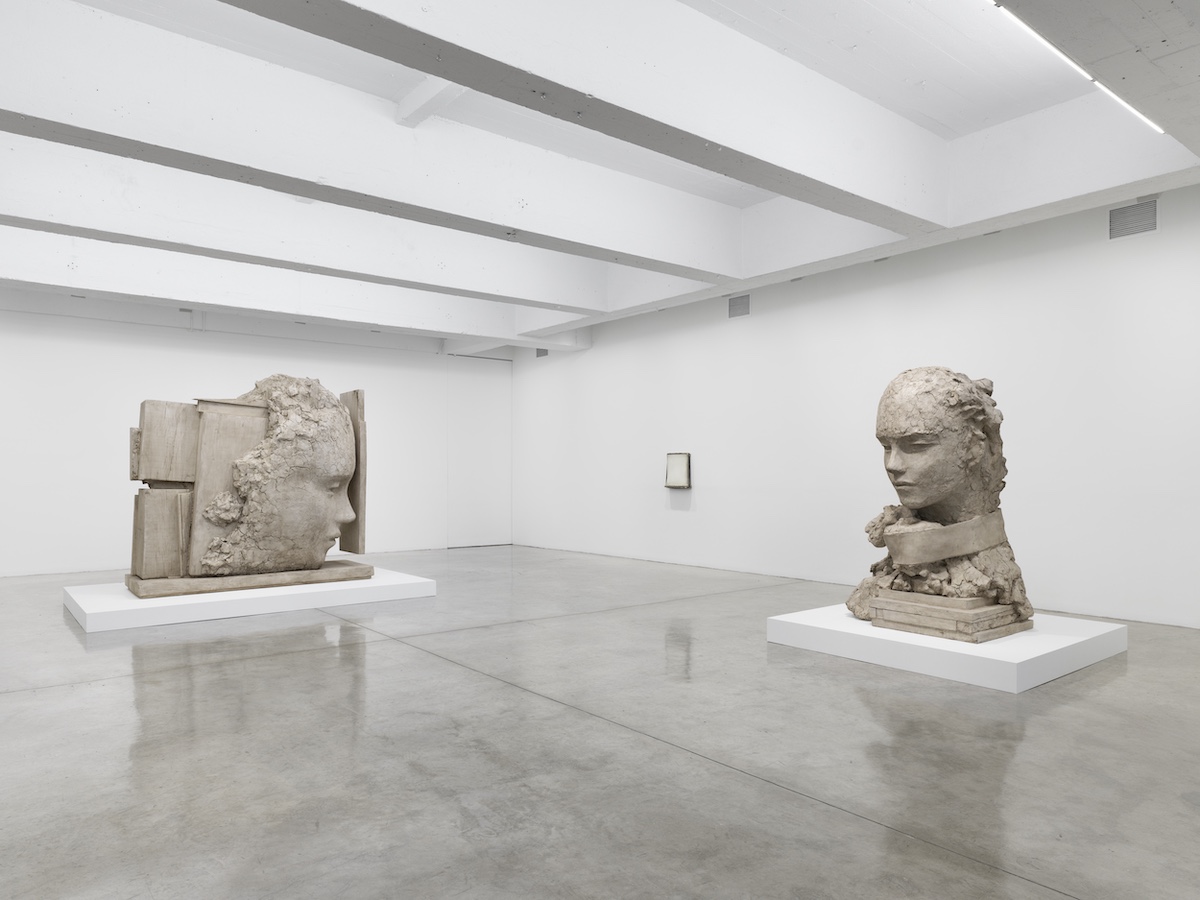
Mark Manders, Installation view at Tanya Bonakdar Gallery, New York, April 30 – July 31, 2026. Photo by Dan Bradica. Courtesy the artist and Tanya Bonakdar Gallery, New York.
Anchored upon the concrete gallery floor, the enlarged female head of Monument (2024–2025) is cast in bronze yet coated in a flat, chalky bone-white paint. This surface treatment drains the metal of its severity and classical authority, pushing it instead toward the vulnerability of unfired clay. Rather than sitting on a conventional plinth, the sculpture incorporates the likeness of four raw planks beneath it. These planes do not merely support the head: they duplicate the floor itself, unsettling the boundaries between the flat canvas of a painting, the base of a sculpture, and the architecture of the room. A truss around the neck functions as a rigidly constraining collar, failing to suppress the erupting, formless mass out of which sculpture is constructed.
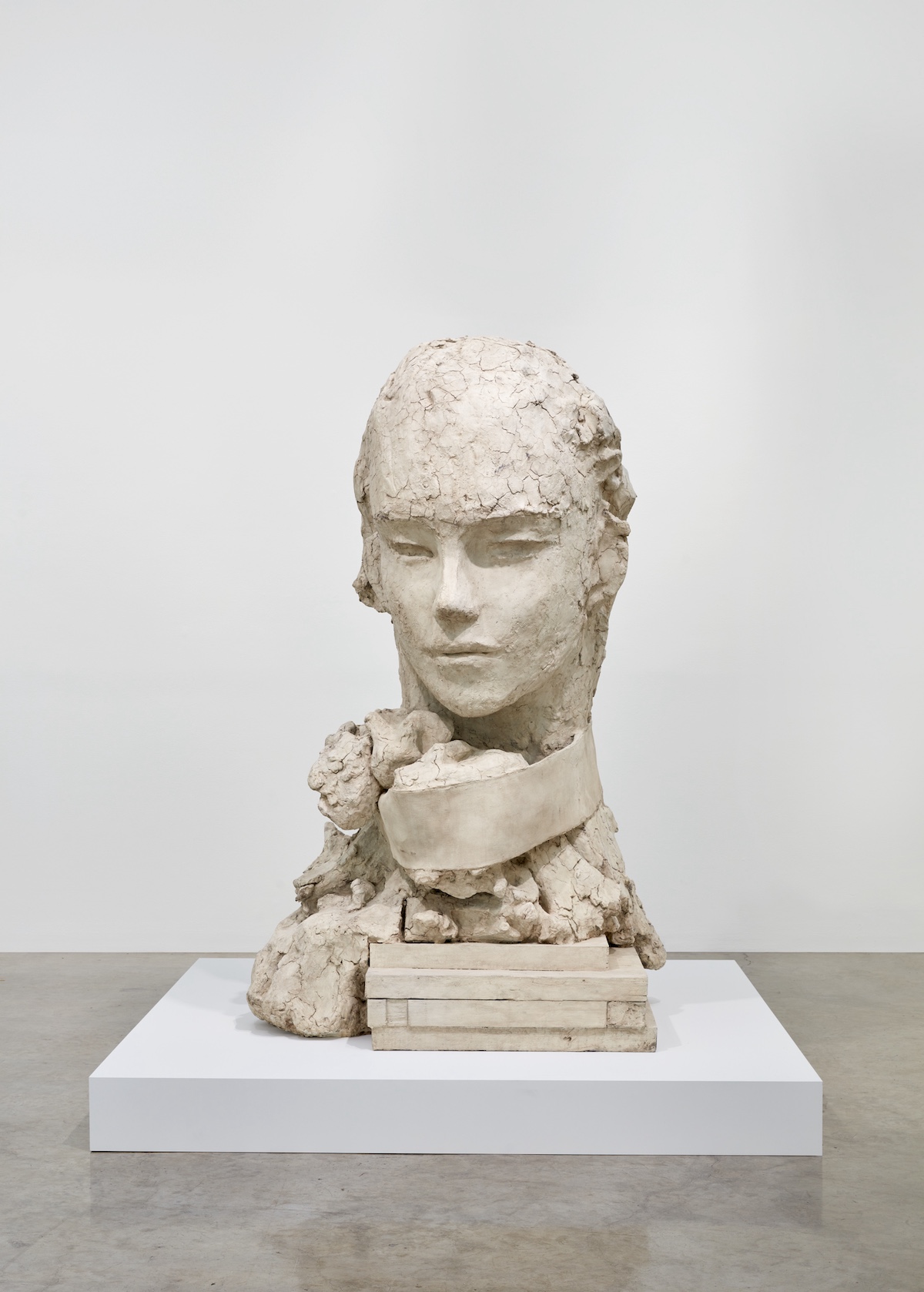
Mark Manders, Monument, 2024–2025. Painted bronze, 84 5/8 x 53 1/8 x 55 1/4 inches. Photo by Dan Bradica. Courtesy the artist and Tanya Bonakdar Gallery, New York.
Introspective, melancholic, and solemn, Monument channels the psychological interiority of the Euthydikos Kore of the Acropolis Museum, collapsing a temporal distance of twenty-five centuries. Yet Monument also echoes the classical features of the Roman marble head and torso of Athena of the Metropolitan Museum in Gallery 159. Whereas that ancient fragment reduces the goddess's protective aegis to a mythological collar, Manders binds the neck of his monument with a rigidly constraining one. By bringing to light his mother's bereavement, the loss of an infant who survived only days past birth, Monument functions as a place where biography and feminism interlock, without permitting autobiography to compromise the artwork's formal and historical depth. The collar at the throat can be understood as the anatomical site of grief for individuals who could not speak, what Hélène Cixous theorized as the muffled history of women who have lived "in silences, in aphonic revolts." And the formless masses erupting through the band enact Cixous' central claim: that the repressed of a culture resurfaces as an explosive, staggering force. [1]
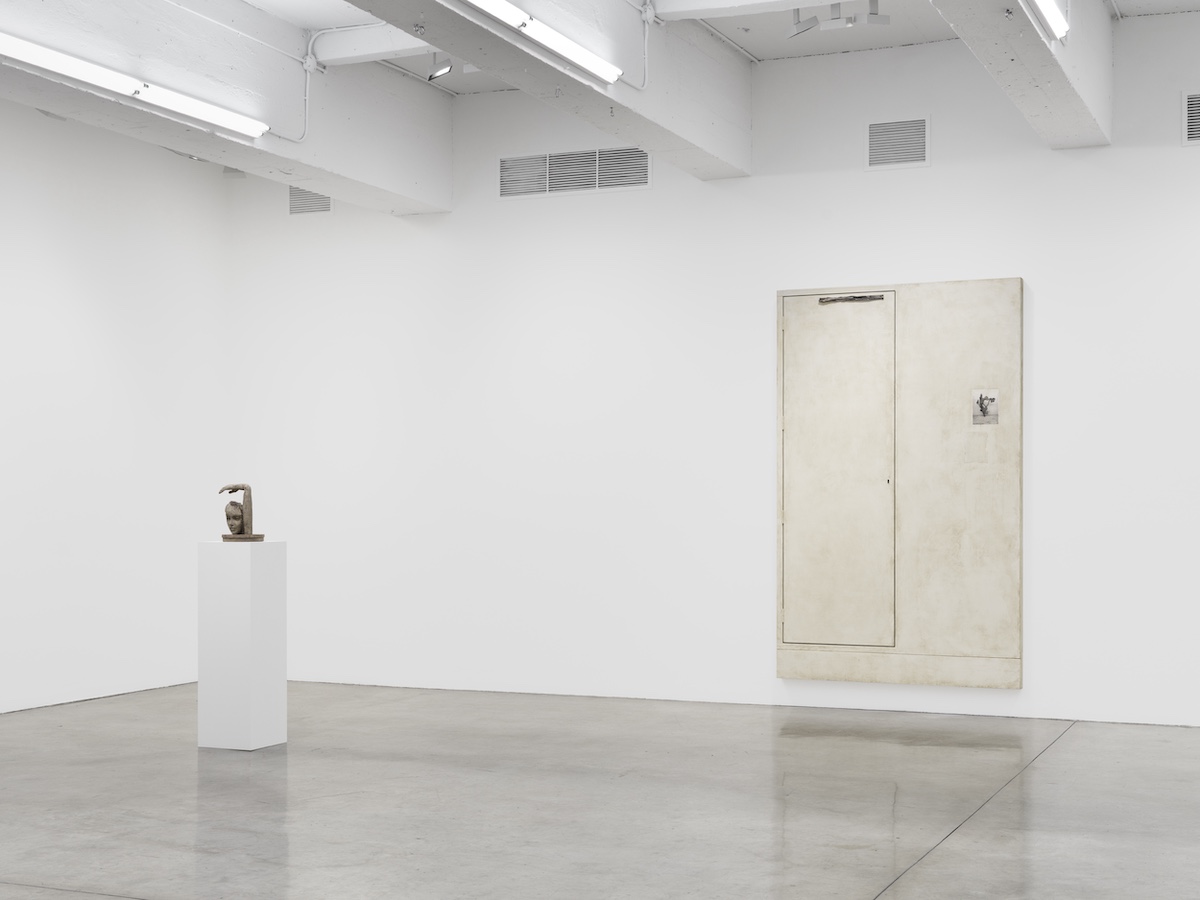
Mark Manders, Installation view at Tanya Bonakdar Gallery, New York, April 30 – July 31, 2026. Photo by Dan Bradica. Courtesy the artist and Tanya Bonakdar Gallery, New York.
Lifted from the floor and mounted flush against the gallery wall, All Words and One (2005–2026) is an expansive wall panel containing a door with a pair of physical hinges and a keyhole. Yet the work is a painting as much as it is architecture unmoored from its foundation. The hinges are real, yet they never turn. This is what Aristotle called potentiality held just short of the actual. The capacity is there; the actuality is not. Across this panel of considerable scale, a small offset print of a modernist sculpture lies embedded on the right, acting as a window into the archives of art history, while the door on the left remains forever shut. The nested architecture of the work, a door within a painting mounted to a wall, poses its own quiet question about the boundaries of reality and representation, as much as about those of painting and sculpture.
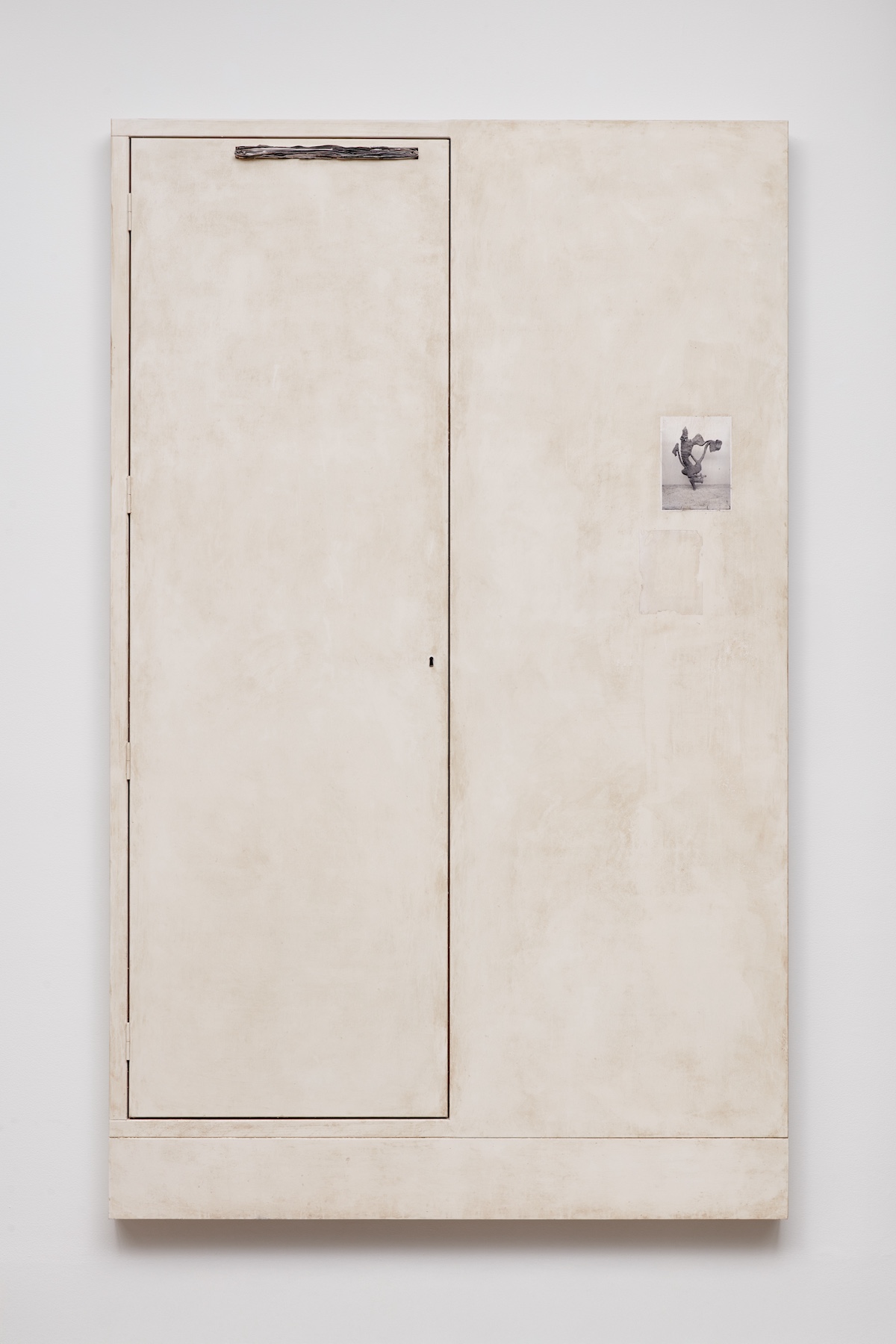
Mark Manders, All Words and One, 2005–2026. Painted wood and steel, offset print on paper, 106 3/8 x 65 3/8 x 4 3/4 inches. Photo by Dan Bradica. Courtesy the artist and Tanya Bonakdar Gallery, New York.
All Words and One stages a foundational opposition: the door functioning as an emblem of physical passage, the photographic print operating as a window onto abstract sculpture. Rembrandt posed such an opposition between pictorial and sculptural representation in 1653 by depicting a pensive figure's hand resting on a bust. This painting, now known by its debatable title Aristotle with a Bust of Homer, hangs provocatively at The Metropolitan Museum of Art in the gallery titled “Painters, Critics, and Rivals in the Age of Rembrandt.” Manders reactivates this simultaneity of painting and sculpture, where the door reveals itself as a threshold between the literal and pictorial, set within a sculptural wall. Yet the door withholds entry, and the beholder is left to confront the riddle of representation through the interlocking ontologies of architecture, sculpture, painting, and photography.
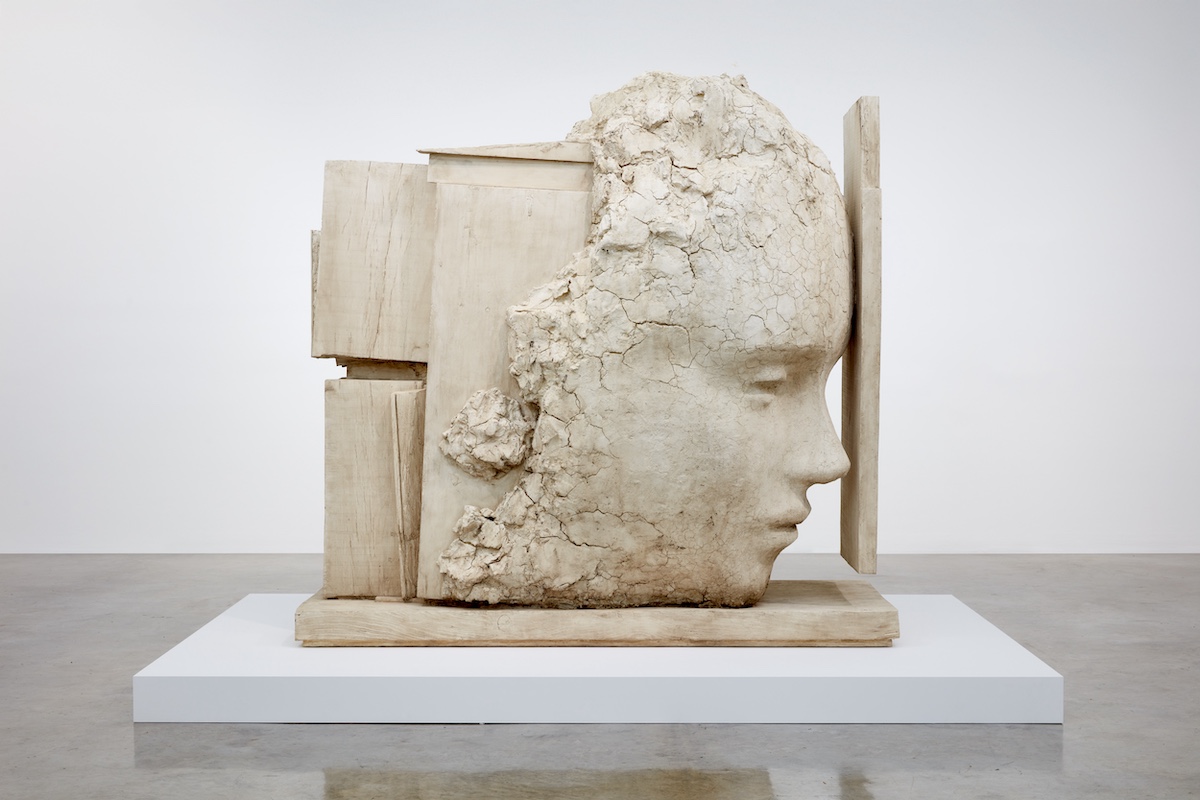
Mark Manders, Bonewhite Clay Head with Vertical Cloud, 2024–2025. Painted acrylic resin, fiberglass, aluminum, 95 1/4 x 97 1/2 x 60 2/3 inches. Photo by Dan Bradica. Courtesy the artist and Tanya Bonakdar Gallery, New York.
Constructed from painted acrylic resin, fiberglass, and aluminum, Bonewhite Clay Head with Vertical Cloud (2024–2025) resembles an archaeological find. Austere and imposing, the head holds what appear to be blocks of wood and architectonic objects crowding the cranial cavity, as if this entire assemblage possessed its own grammar of trompe l'oeil cast inside a trompe l'oeil. These architectonic masses press inward upon the skull like thought given weight. Placed directly before the face, a vertical plane hangs as a levitated canvas, where the pensive visage meets its limit at the flat surface of the panel.
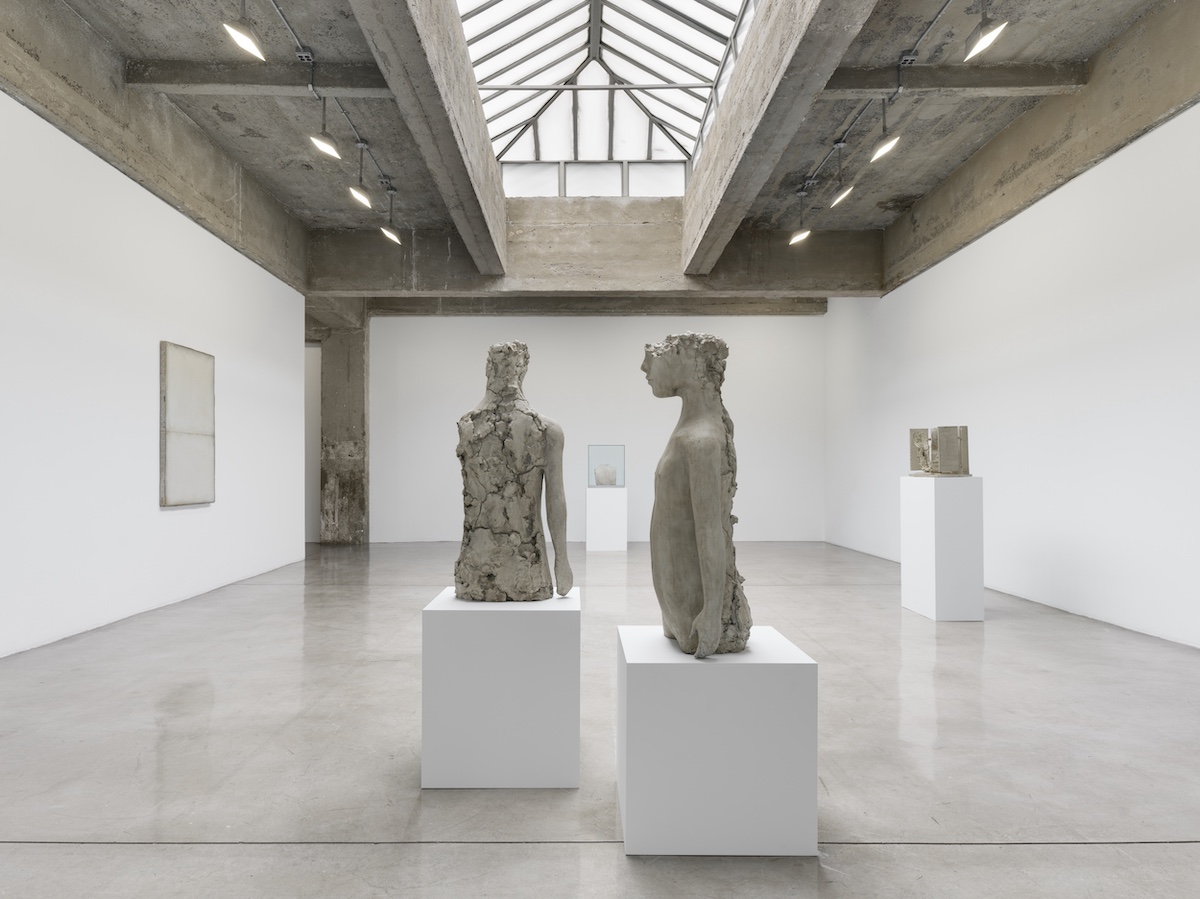
Mark Manders, Installation view at Tanya Bonakdar Gallery, New York, April 30 – July 31, 2026. Photo by Dan Bradica. Courtesy the artist and Tanya Bonakdar Gallery, New York.
Manders also activates the exhibition's references to antiquity through the fragmented form of Bonewhite Clay Torso (2026), a work that stages itself as a museum artifact. Measuring over three feet tall and elevated on a white cubic support, this partial human figure appears newly unearthed: its frontality rigorously resolved, its rear entirely formless, a single arm suspended from the left shoulder. Here the illusion of wet clay has transformed sculpture into a painterly subterfuge. By pairing near-identical sculptures with a monochromatic wall work and a relatively small architectural piece, the artist dismantles the boundary between the interiority and exteriority of the perceiving subject. Like Giacometti in his quest for a primordial sculptural language, Manders partly shapes the human figure as the place where the dialectic of verisimilitude and formlessness gives way to the phenomenology of the living body. Across the room, the scale shifts from large to intimate, as if governed by a vanishing point as indeterminate as the viewer's position. Through sculpture, he has translated the gallery into a theater of pictorial perspective.
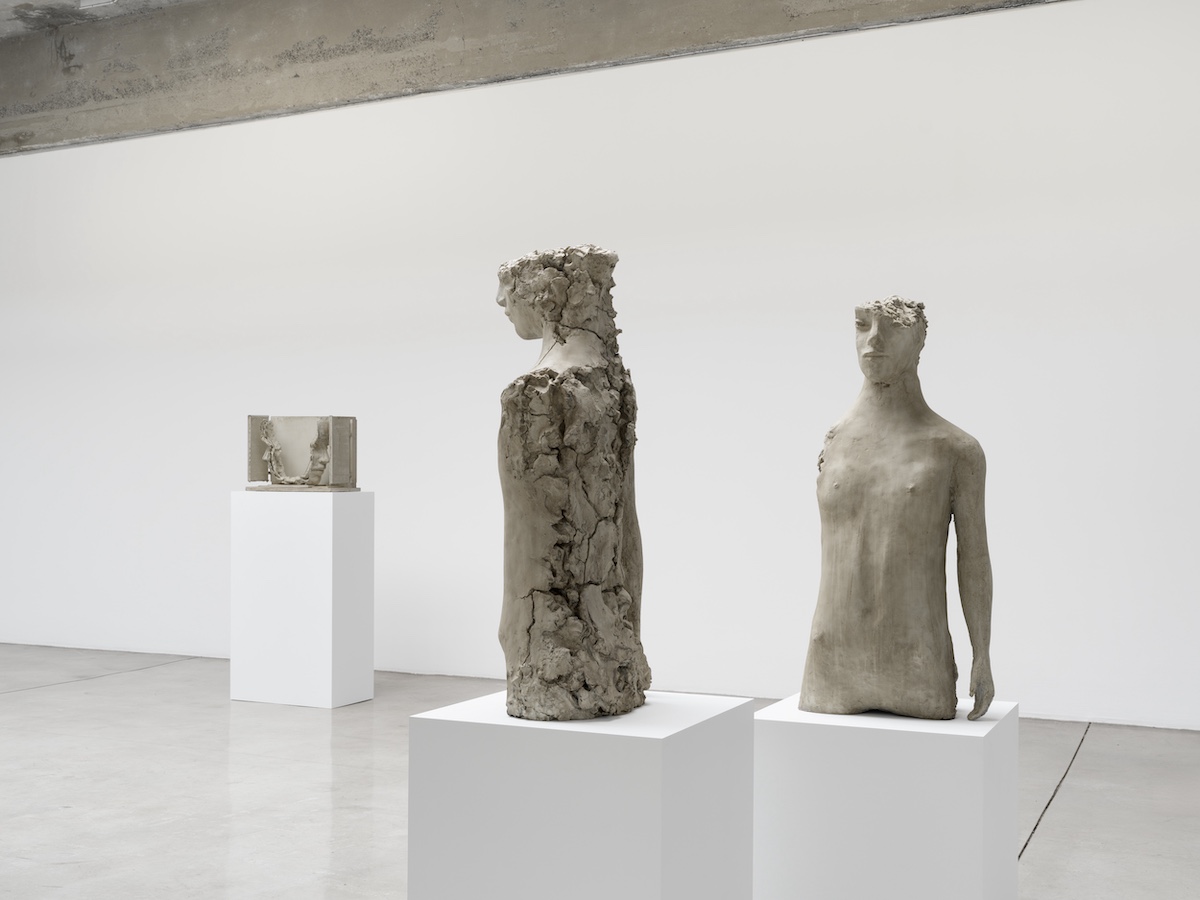
Mark Manders, Bonewhite Clay Torso (rightmost), 2026. Painted bronze, 39 3/4 x 18 1/8 x 14 1/8 inches. Installation view at Tanya Bonakdar Gallery, New York, April 30 – July 31, 2026. Photo by Dan Bradica. Courtesy the artist and Tanya Bonakdar Gallery, New York.
Positioned at the entrance that is also the exit, Short Sad Thoughts / All Existing Words (1990–2026) serves as both prologue and epilogue: two panels in painted canvas, wood, and offset print that read simultaneously as windows and grave steles. Their surfaces carry Curculio Bassos, a chimeric newspaper of Manders' own fabrication, whose pages contain words seemingly selected by chance. A moment of epistemological emancipation arises through these lexical units, stripped of logical syntax and coherent semantics. One headline reads: "Outdoer reaccessions Musician synectic overindulgence." Where Marcel Broodthaers mobilized and polemicized language as institutional critique, and Joseph Kosuth placed language as the sole arbiter of meaning, Manders simply empties it, collapsing the task of decoding into the necessity of intuition.
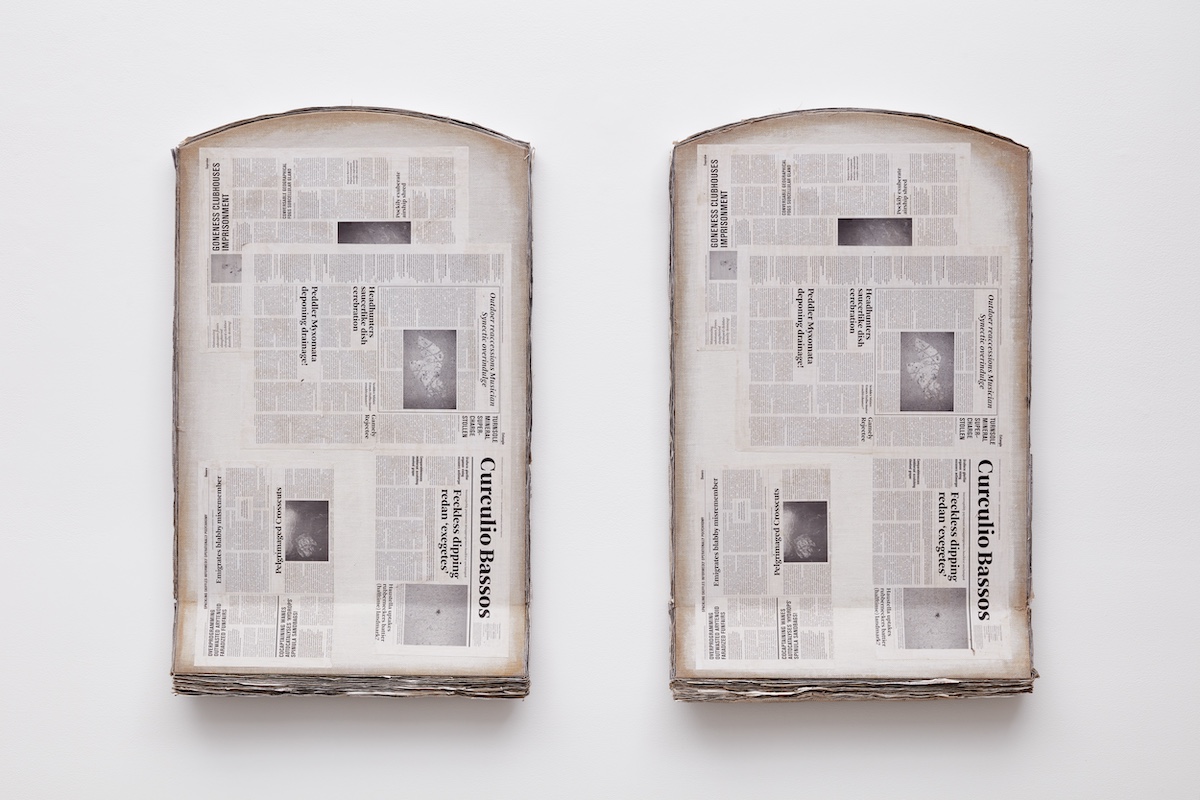
Mark Manders, Short Sad Thoughts / All Existing Words, 1990–2026. Painted canvas, wood, offset print on paper, nails, 39 3/7 x 24 5/8 x 3 inches each panel. Photo by Dan Bradica. Courtesy the artist and Tanya Bonakdar Gallery, New York.
By voiding the linguistic field, the exhibition redirects the Hegelian Aufhebung—the simultaneous canceling, preserving, and elevating of opposites—from aesthetic resolution toward the phenomenology of the viewer's own position in physical space. Each medium, each object, each scalar shift is governed by its own tripartite engine of canceling, preserving, and transforming. Yet here transformation does not claim to yield an elevated synthesis. Rather, it concerns itself with the perceptual conditions of vision based on the viewer's given standpoint, even as it carries the aesthetic weight of the history of sculptural representation. Within a single object, Manders layers medium, form, and surface into conditions of mutual cancellation and preservation, giving way to transformation. Within the gallery space, he extends this operation across scale and perspective. A small head can measure larger to the eye than a colossal one across the room, where the viewer's point of view is the unstable origin of all proportion.
On the level of medium, Manders alters the material identity of his objects through paint, replacing the metallic sheen of cast bronze with the illusion of clay, and the inherent color of clay with that of bronze. He preserves the raw texture of the modeled surface, transforming the object through the paint layer so that bronze appears as raw clay while clay assumes the density of cast bronze. Appearing as a sculptor's quick sketch in plaster, Head with Arm (2026) is in reality painted bronze, barely ten inches tall, as if recasting the Aufhebung in miniature.
On the level of form, figuration is canceled at the posterior and preserved at the anterior, just as abstraction is preserved in the rear and canceled in the front. The sculpture operates as a freestanding relief, staging an optical experience where the simultaneity of figuration and abstraction continues shaping the parameters of sight and perception. There is nothing unprecedented in the interplay of mediums, figuration, and abstraction. These have been the conditions of artmaking since antiquity. Yet Manders presses the human figure until paint, color, and perspective exceed the language available to describe them. It is at these representational junctures that phenomenology returns as the very means of addressing the limitations of language and thought.
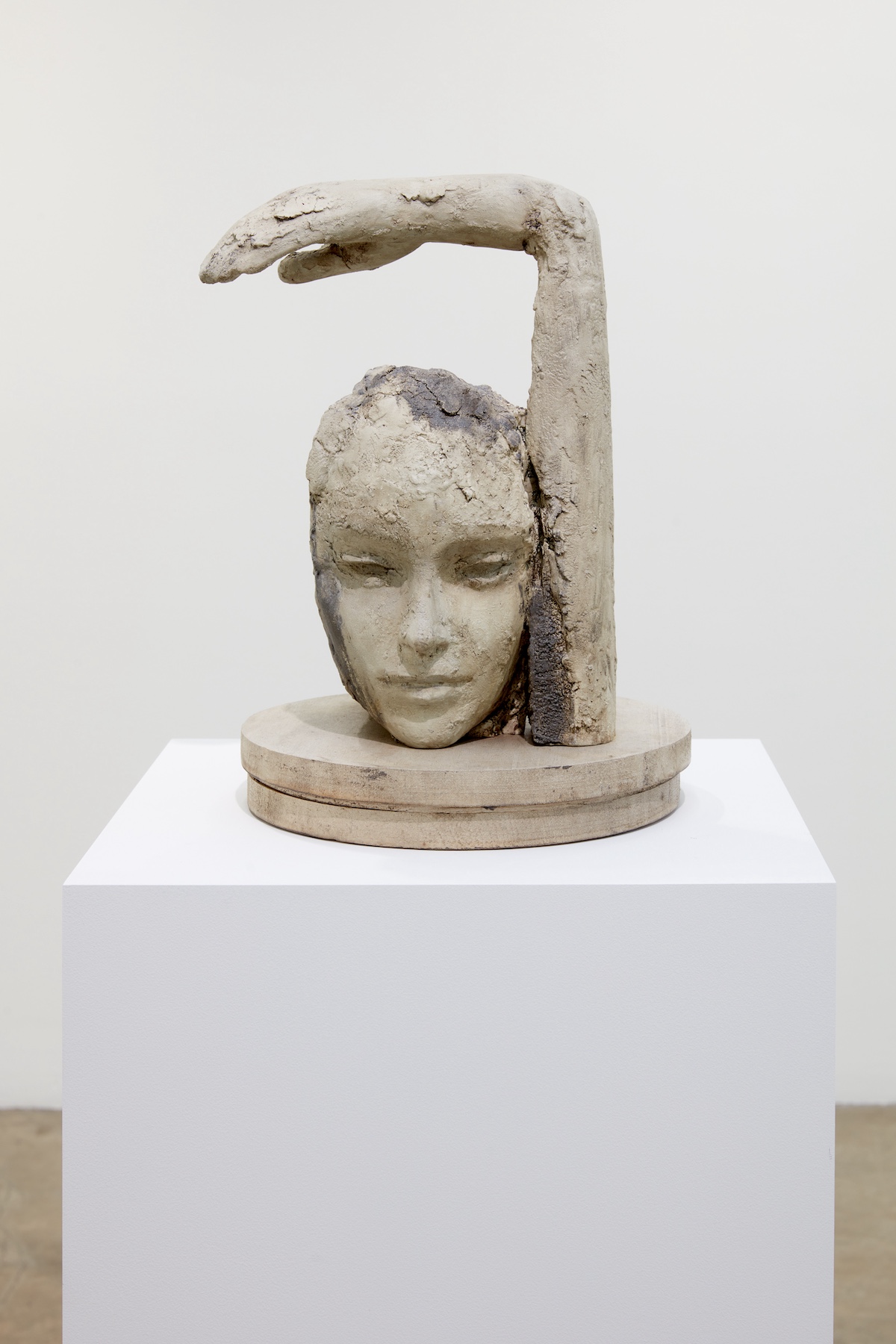
Mark Manders, Head with Arm, 2026. Painted bronze and wood, 14 x 10 x 9 7/8 inches. Photo by Dan Bradica. Courtesy the artist and Tanya Bonakdar Gallery, New York.
If modernism made medium purity a period's silent condition of what could count as art, an episteme in which abstraction and representation were assigned separate fates, Manders works the seam where that condition has lapsed. He treats the teleological histories of painting and sculpture as material for play, suspending each medium in perpetual transformation. For what is the ultimate sense of an art object if not a quest that language alone cannot complete, one where even phenomenology, that explicitly embodied critical framework, runs out of breath?
Notes
Citations: Mark Manders, quoted in Rajesh Punj, "Archaeology of the Self: A Conversation with Mark Manders," Sculpture 25, no. 3 (2026); Maurice Merleau-Ponty, Phenomenology of Perception, trans. Colin Smith (London: Routledge & Kegan Paul, 1962), p. 146.
1. Hélène Cixous, "The Laugh of the Medusa," trans. Keith Cohen and Paula Cohen, Signs 1, no. 4 (Summer 1976): pp. 875–893, here p. 886.
Mark Manders
Tanya Bonakdar Gallery
521 West 21 Street
New York, NY 10011
April 30 – July 31, 2026
Raphy Sarkissian
Raphy Sarkissian received his masters in studio arts from New York University and is currently affiliated with the School of Visual Arts in New York. His recent writings on art include essays for exhibition catalogues, monographs and reviews. He has written on Rachel Lee Hovnanian, Anish Kapoor, KAWS, David Novros, Sean Scully, Liliane Tomasko, Dan Walsh and Jonas Wood. He can be reached through his website www.raphysarkissian.com.
view all articles from this author