Whitehot Magazine
November 2026
"The Best Art In The World"
"The Best Art In The World"
November 2026
Tony Cragg’s Freestanding Wit at Marian Goodman Gallery, New York
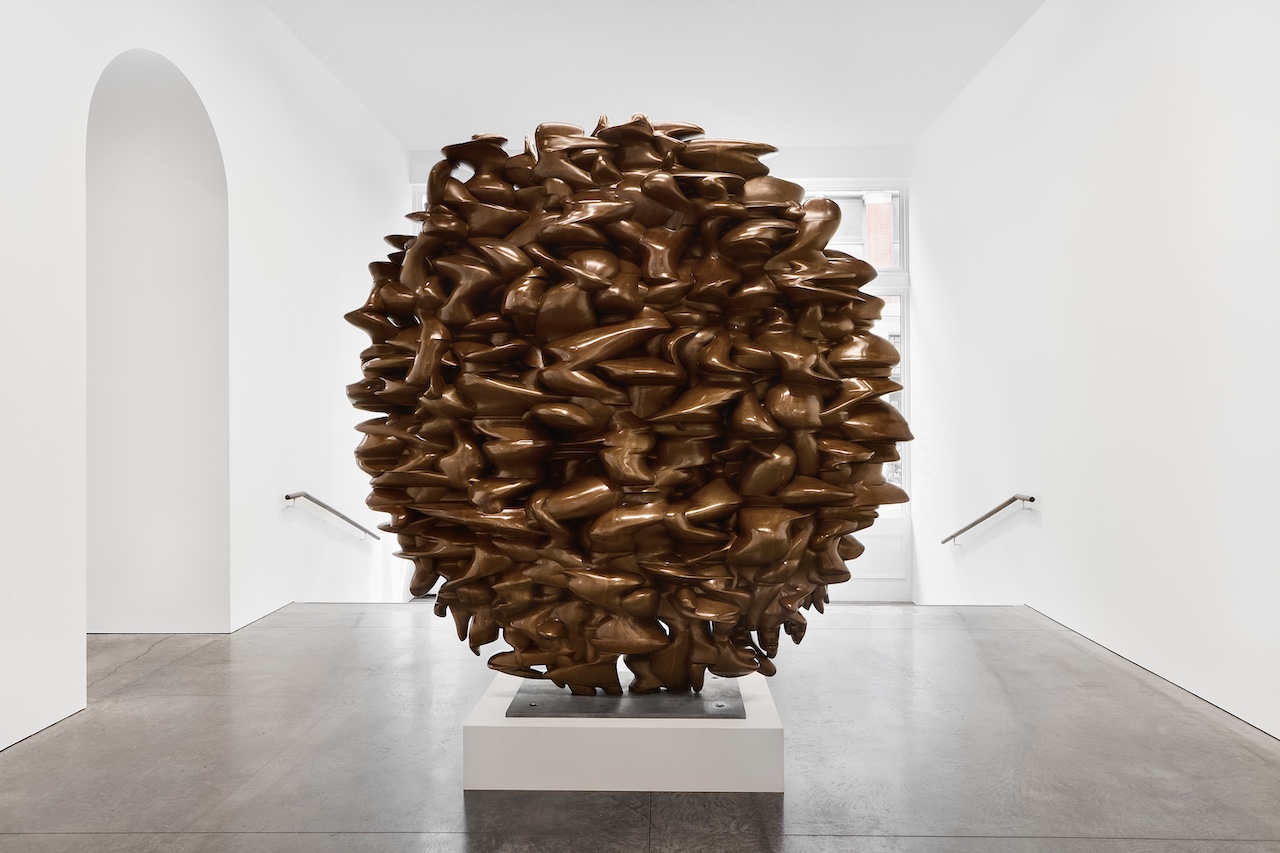 Tony Cragg, Versus, 2018, bronze, 104 3/4 by 103 1/8 by 30 1/4 inches. © Tony Cragg. Photo: Carlos Perez. Courtesy the artist and Marian Goodman Gallery.
By RAPHY SARKISSIAN | November 6, 2026
Tony Cragg’s exhibition at Marian Goodman Gallery in Tribeca opens with Versus (2018), a monumental sculpture in bronze standing at the top of the entrance steps. Head-on, it is a round mass of crowded elliptical forms, nearly nine feet tall and about as wide, spherical at its center and opening up toward its edges. Its parts, polished and folding as they twist, are multiplied in variations across the sculpture, like particles caught in a chain reaction. A step to the side shows that the spherical cluster is barely two and a half feet deep, making it a relief sculpture in the round. With each shift of position, the cluster opens onto new configurations. Thus Versus departs from the sphere in two directions. Seen head-on, the ellipses remain densely packed from center to edge until they flare out along the silhouette to admit light. Seen from the side, the sculpture is flattened into a formally exuberant discus cast in bronze.
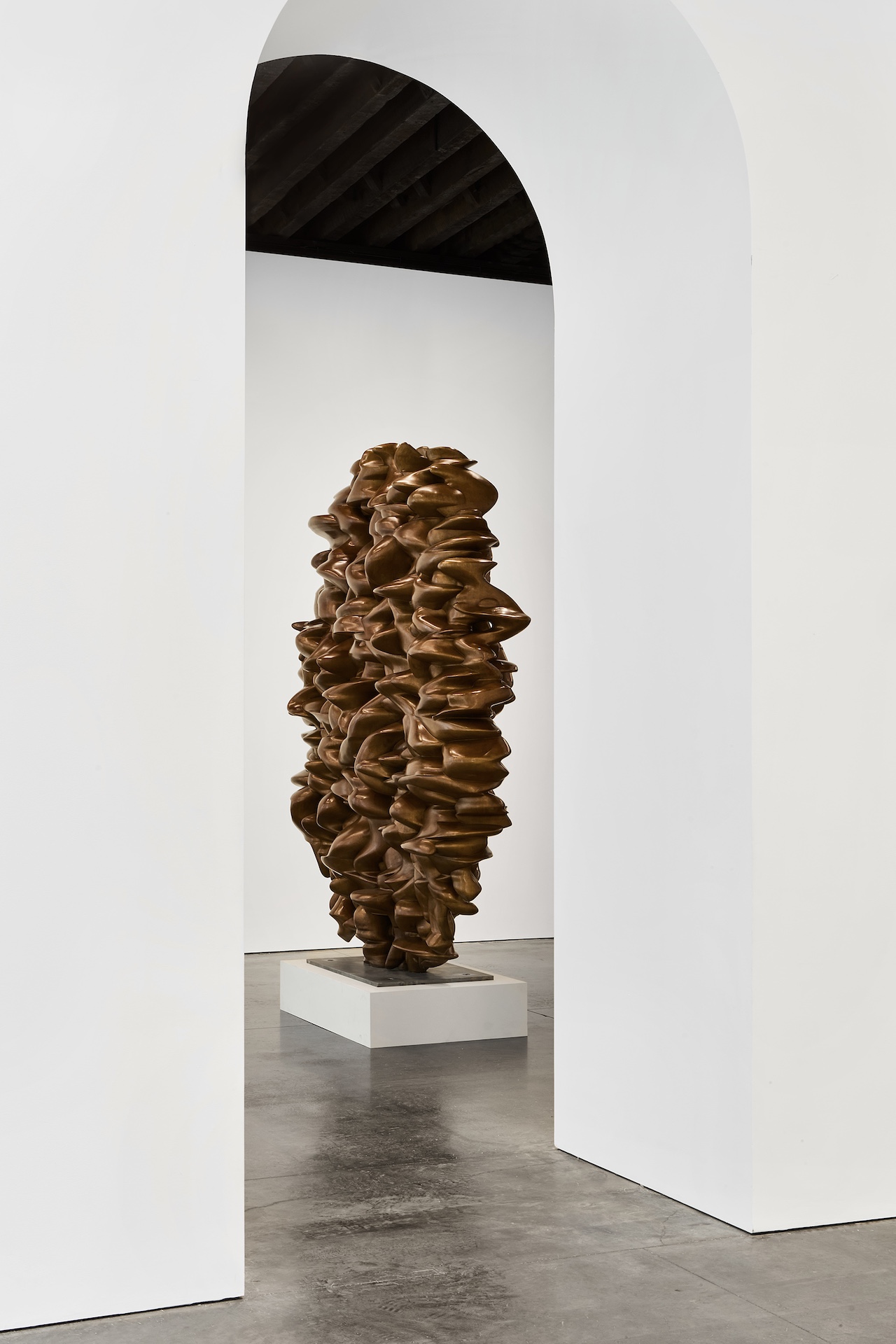 Tony Cragg, Versus, 2018, seen from the side. © Tony Cragg. Photo: Carlos Perez. Courtesy the artist and Marian Goodman Gallery.
Edmund Husserl wrote that the perception of an object aims “to accomplish something that, by its very nature, it is not in a position to accomplish,” for every glimpse of that object leads the mind to anticipate the whole while the object itself reveals only a single side. [1] Walking around an ordinary object confirms that anticipation, yet walking around Versus refutes it, for either face promises a composite sphere while the edge withdraws the promise. Neither view can claim to manifest the whole sculpture at once. The Greeks called such an impasse aporia, literally “no way through,” and Versus gives it a body in bronze: an object that can be described from every point of view, apprehended from each, and reconciled into a single form from none.
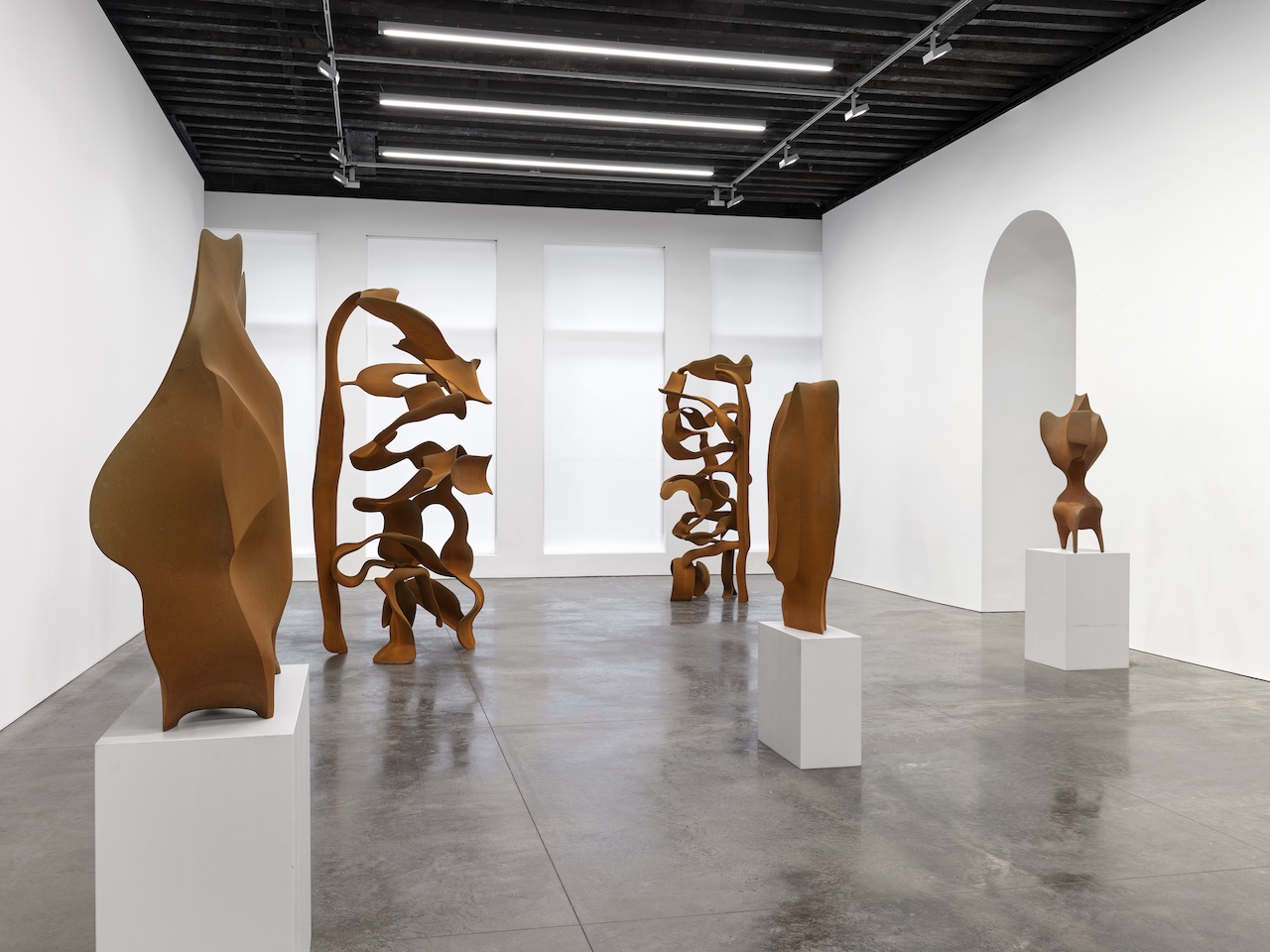 Installation view, background, left to right: Tony Cragg, Recall, 2025, and Path, 2026, Corten steel; foreground, left to right: three Stand works, 2025, 2025, and 2023, Corten steel. © Tony Cragg. Photo: Alex Yudzon. Courtesy the artist and Marian Goodman Gallery.
In the room beyond the arch, Path (2026) and Recall (2025) stand as open forms in Corten steel. Each rises along a vertical core resembling a spinal column that loops back downward, metamorphosing into serpentine contours and leaf-like forms that recall the ribbon-like strokes of Willem de Kooning’s late paintings. Rusted metal arches into an inverted U that drops a smooth, continuous axis down one side while the other entwines into a succession of twisting bands climbing like Roman vine scrolls. Many of these bands operate as biomorphic Möbius strips, yet multiplied and knotted. Their openness invokes Anthony Caro’s welded steel, though Cragg sets an organic, stem-like spine in counterpoint to undulating bands that loop laterally. Structurally, both works align more directly with Isamu Noguchi’s Kouros, in the Met’s collection, which shows what holds it up: flat slabs of pink marble slotted into one another, a truce with gravity worked out in advance. Upstairs, Incident Stance (2021) and Incident (2023) read as continuations of Path and Recall, standing on a triangulation of limbs, their stems grown into body parts.
Executed some twenty-six centuries before Cragg’s sculptures, the New York Kouros in the Metropolitan Museum stands free: strictly frontal, left foot advanced, fists clenched at his flanks, rising on two slender marble legs without a strut. Springing directly from the floor on their own stems, with no plinth, Path and Recall forgo the equilibrium of the Kouros on two legs alone, distributing their weight across several points of contact. In these works, the twoness of the Kouros is in the throes of transfiguration: each pairs a bare stem with a tumbling cascade of foliage, like Bernini’s Daphne caught mid-flight, taking root as she flees Apollo. Where the New York Kouros is fixed for eternity in a stance inherited from Egyptian statuary, Cragg’s ribbons of steel hardly settle, reconfiguring themselves with every step around them.
Not far from Path and Recall stand their formal opposites, three works titled Stand, rust-brown masses, closed and talismanic, that must be walked around to be grasped in full. Set on plinths, they turn standing itself into a variable, the first rising on three legs, the second resting on a flush base, and the third standing on four. They are among the most elemental works in the show, free of striation. If Path and Recall are skeletons, these are pure flesh, skin concealing undefinable living bodies or modernist icons in disguise.
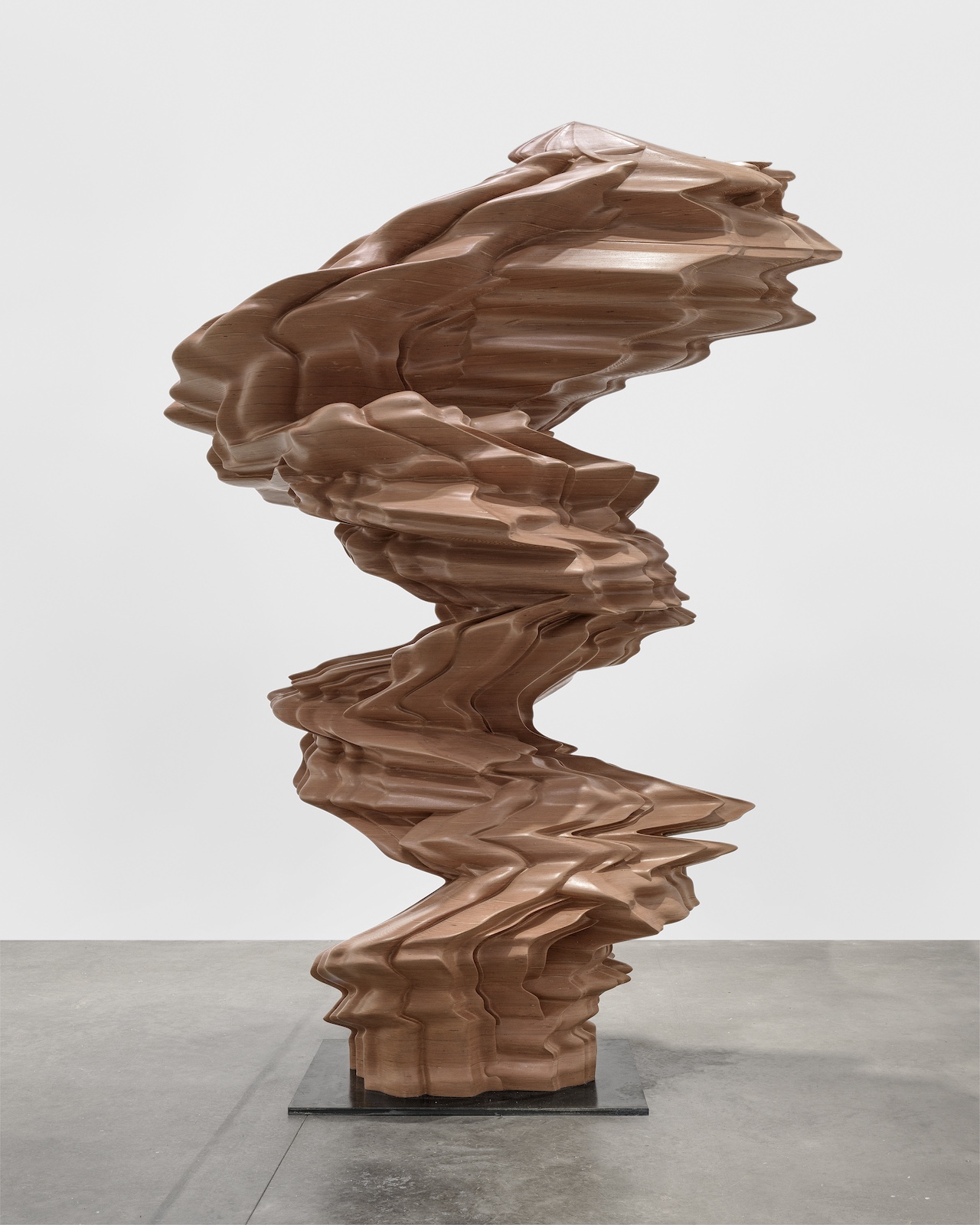 Tony Cragg, Stack, 2024, wood, 114 1/8 by 81 1/2 by 54 3/8 inches. © Tony Cragg. Photo: Alex Yudzon. Courtesy the artist and Marian Goodman Gallery.
Stack (2024) rises over nine feet, built from horizontal layers of wood, a method Cragg has transformed into a grammar of form since the 1970s. Its contours billow upward like Futurist lines of force, exposing the laminated grain. Sharing the gallery space with Stack, the bronze In No Time (2018) redefines the layering of its wooden neighbor, its inclined, conjoined masses crossing and overlapping like a geological formation or an archaeological find. Its satin surface catches the ambient light along its rippling contours as the metal sheds some of its visual weight. In this subtle sheen, the cast bronze seems to borrow the look of the layered wood beside it, as if going by an alias, while the wood, from a distance, reads as poured rather than layered.
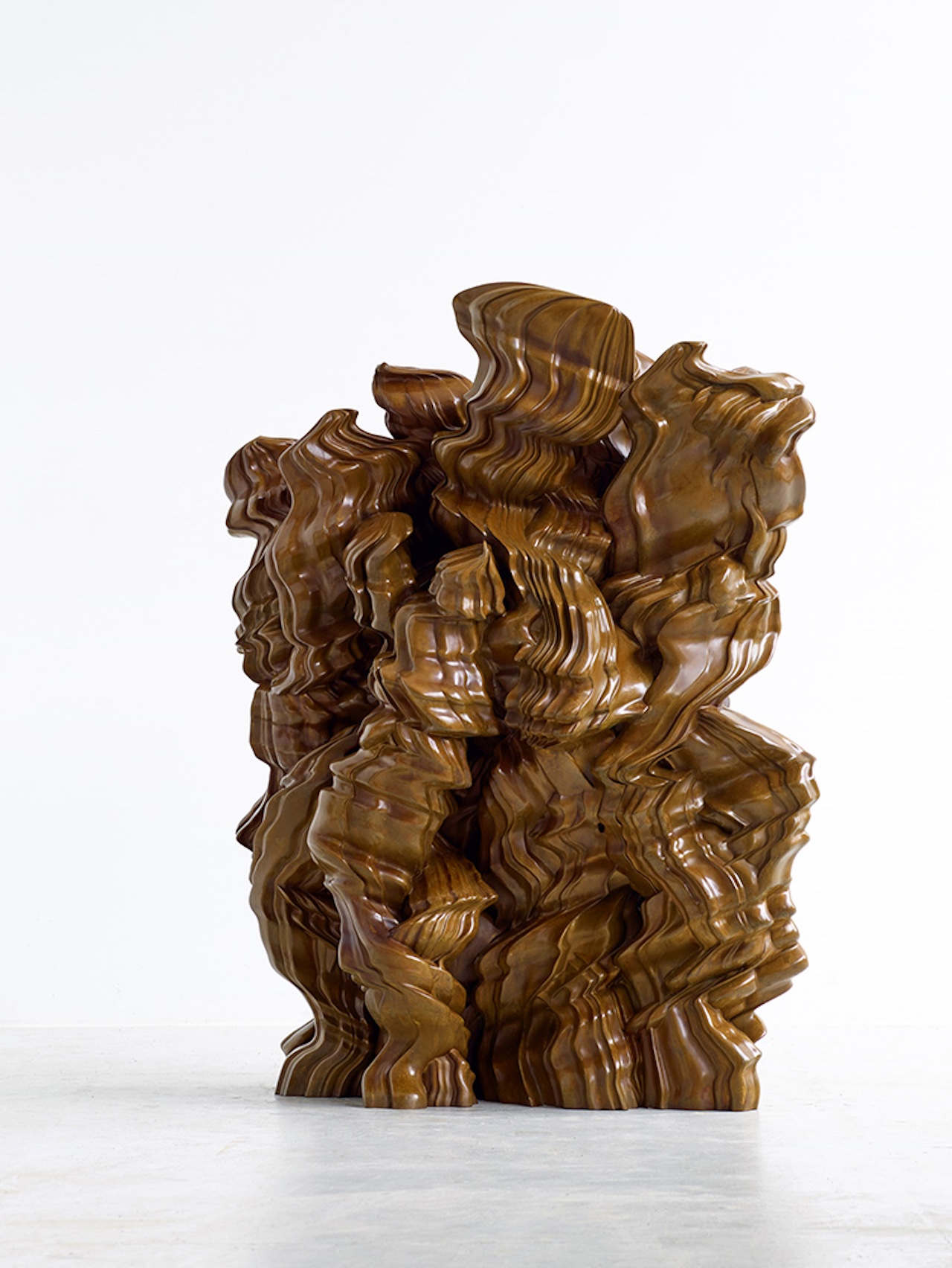
Tony Cragg, In No Time, 2018, bronze, 55 1/8 by 42 1/8 by 26 3/8 inches. © Tony Cragg. Photo: Michael Richter. Courtesy the artist and Marian Goodman Gallery.
In No Time can be seen as a ghost of the Laocoön, the father and his two sons confronting death in the serpents’ coils, with the conjoined masses standing in for bodies. Lessing’s Laokoon (1766) held that sculpture, unlike poetry, cannot unfold in time, and the Laocoön had long since met that limit by twisting its bodies so that front and profile, along with the suggestion of movement, coexist in a single moment. Cragg’s forms evoke instead a continuous wave whose flow holds from every side, as if movement could do without a moment at all, which may be what the title names.
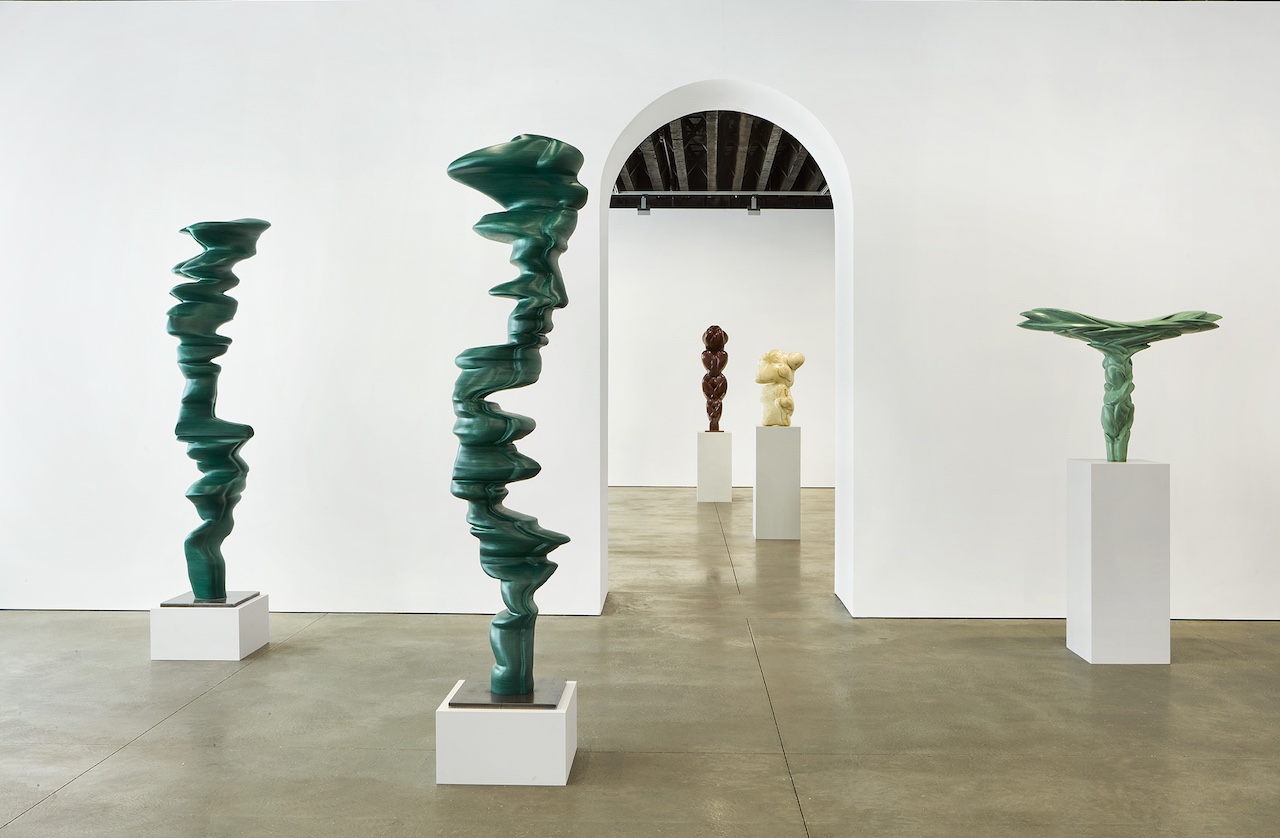 Installation view, foreground, left to right: Tony Cragg, two works, both titled Eclipse, 2025, wood, 78 3/4 by 15 3/4 by 15 3/4 inches and 78 3/4 by 19 3/4 by 19 3/4 inches; Over the Earth, 2025, bronze, 31 1/2 by 43 1/4 by 12 1/4 inches. © Tony Cragg. Photo: Carlos Perez. Courtesy the artist and Marian Goodman Gallery.
Upstairs, the two wooden versions of Eclipse (2025), each about six and a half feet tall, twist so freely around their axes that it is hard to see what holds them up. The contours of each swing out into separate orbits as the eye circles them, and no single view yields a definitive stance. Both are Cragg’s signature columns, as though set spinning, a motion that the Masks sculptures carry into head-like forms across these upper rooms.
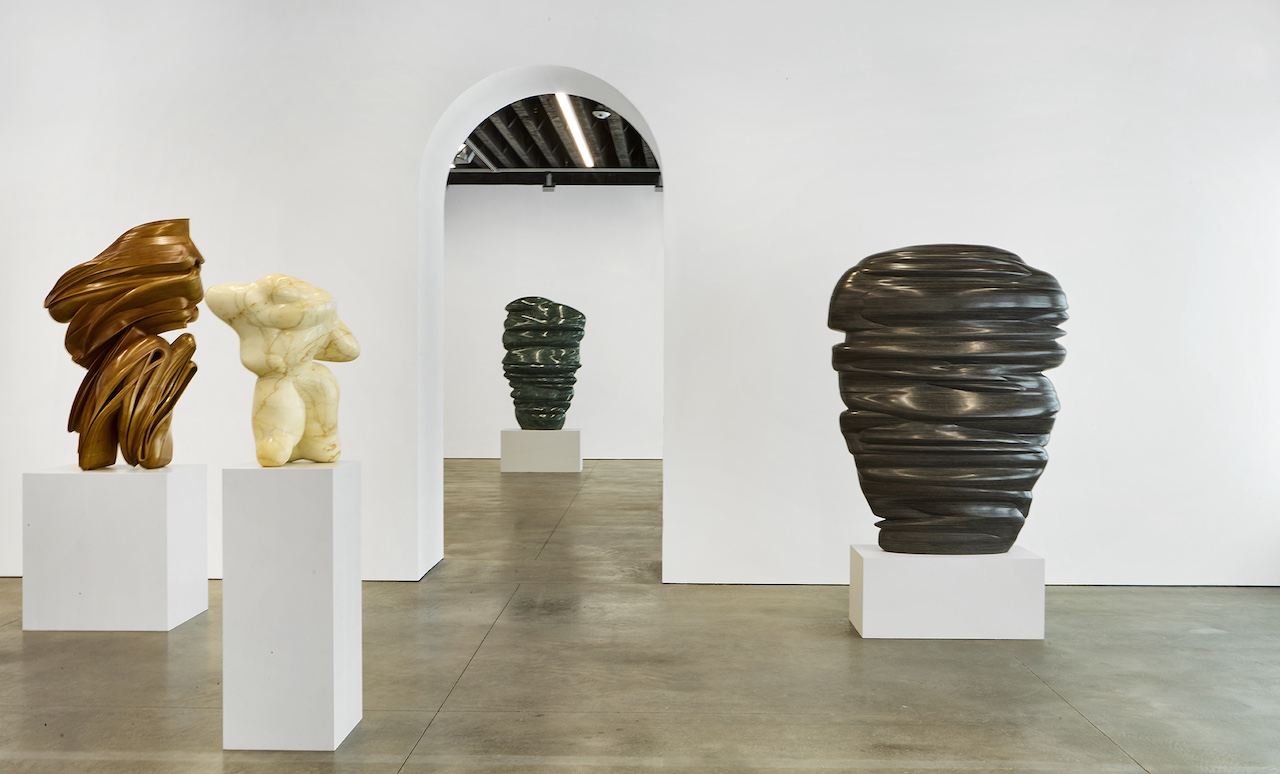 Installation view, at right: Tony Cragg, Masks, 2023, bog oak wood, 63 by 20 7/8 by 48 7/8 inches. © Tony Cragg. Photo: Carlos Perez. Courtesy the artist and Marian Goodman Gallery.
The black version of Masks (2023), one of three in the show, is carved from bog oak wood, darkened by centuries spent buried in peat. One thinks of the Vatican’s Janus Bifrons head, its two faces gazing in opposite directions. Yet rather than locking such faces back-to-back, Cragg drives opposing profiles through one another to create a single, shifting mass. This abstracted head uncannily summons both Picasso’s planar fragmentation in Head of a Woman (Fernande) and Boccioni’s churning movement in Antigraceful. Across the passage, two 2021 versions in stone—one in dark green Guatemalan stone, the other in white Statuario marble—translate the motif into darkness and light, their veined, polished surfaces accentuating the rippled contours.
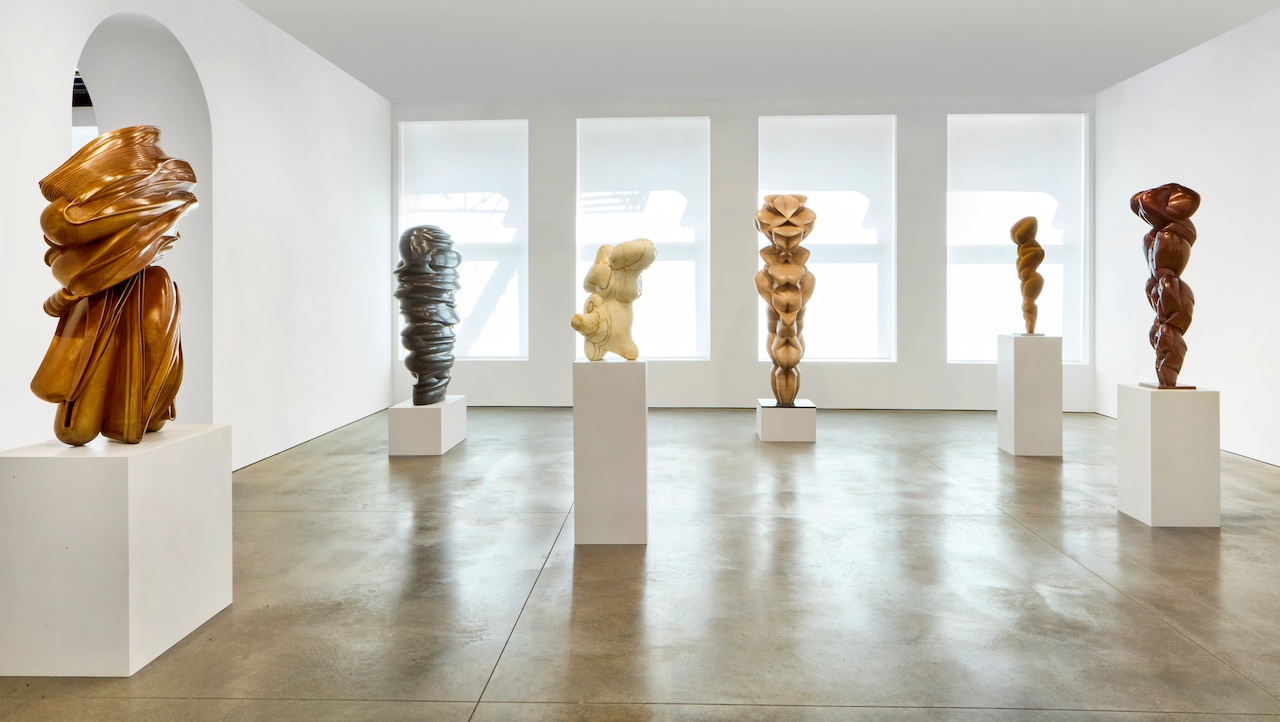 Installation view: Tony Cragg, Marian Goodman Gallery, New York, 2026. © Tony Cragg. Photo: Carlos Perez. Courtesy the artist and Marian Goodman Gallery.
Titles recur across wood, stone, bronze, and Corten, with Symmetries appearing in five versions, Stand in three, and Eclipse in two. By contrast, Integers (2023), in the room with the bog oak Masks, stands alone. Carved in Giallo Siena, a yellow marble from Tuscany, it merges two rounded volumes into a single body, suggesting an abstracted figure cradling a child. The work extends the biomorphic vocabulary of Arp’s Human Concretions toward a more explicit figuration, aligning Cragg with a broader postwar lineage of sculptors who adapted organic form: Felícia Leirner in Brazil, Alicia Penalba in France, and Alfred Basbous in Lebanon.
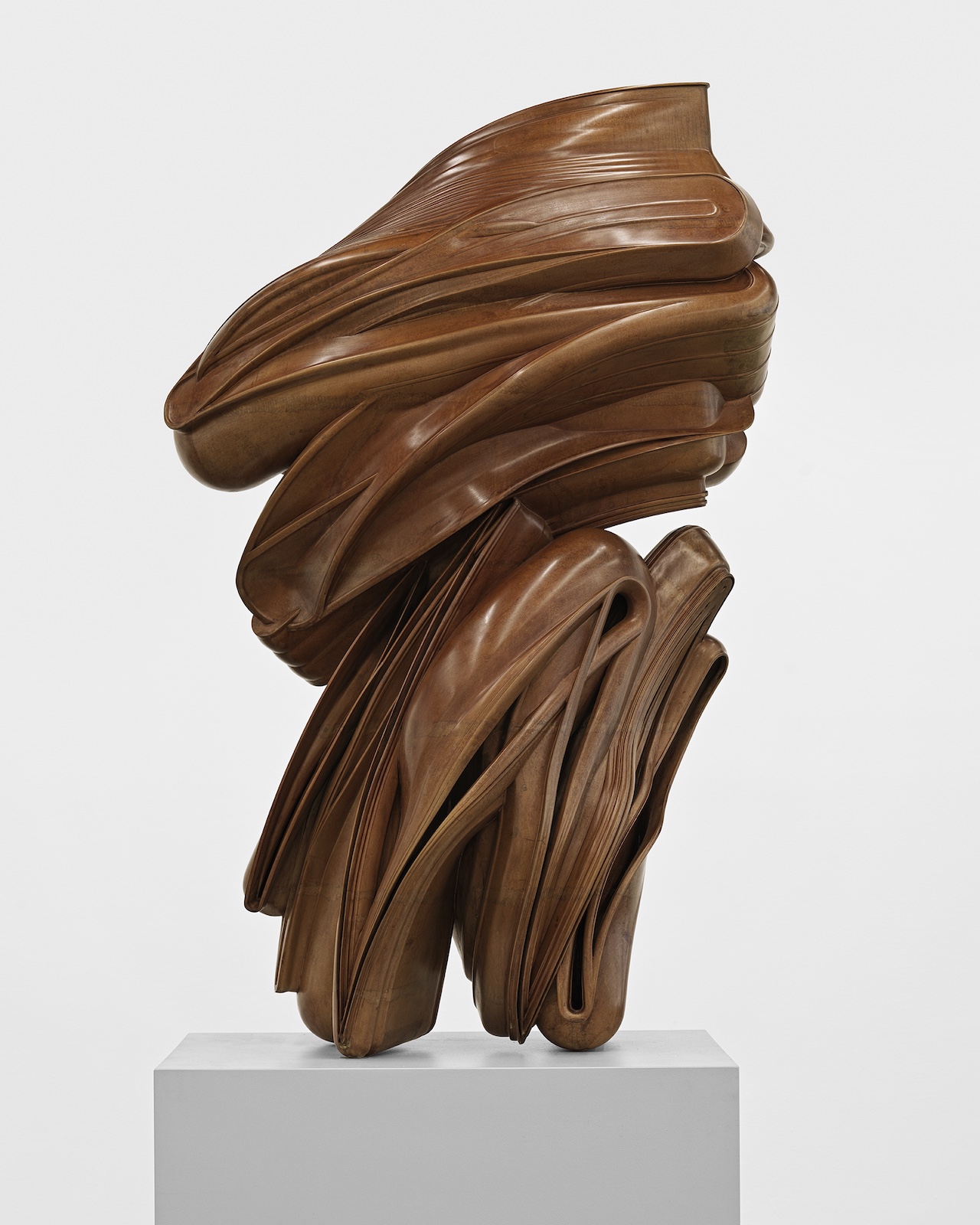 Tony Cragg, Stroke, 2024, bronze, 53 1/8 by 33 1/2 by 16 7/8 inches. © Tony Cragg. Photo: Alex Yudzon. Courtesy the artist and Marian Goodman Gallery.
In Stroke (2024), matter gives way to gesture. The title comes from a Roy Lichtenstein painting of a brushstroke, itself a cartoon of the Abstract Expressionist mark. The bronze thus becomes a copy of a copy of a spontaneous gesture. What begins as the quotation of expressive brushwork ends as an essential mass. In the same room as Stroke stand five sculptures, each titled Symmetries (2026). These appear as columnar torsos in materials both age-old and industrial, all formed by mirroring a profiled silhouette across a central vertical axis. The one in wood replaces a continuous vertical sweep with a doubled, bilateral stack, sharing the symmetrical, upright orientation of Louise Bourgeois’ series of carved wooden sculptures titled Personages. The Corten versions extend this logic, their mirrored curves carrying a charge of sexuality that Bourgeois would have recognized.
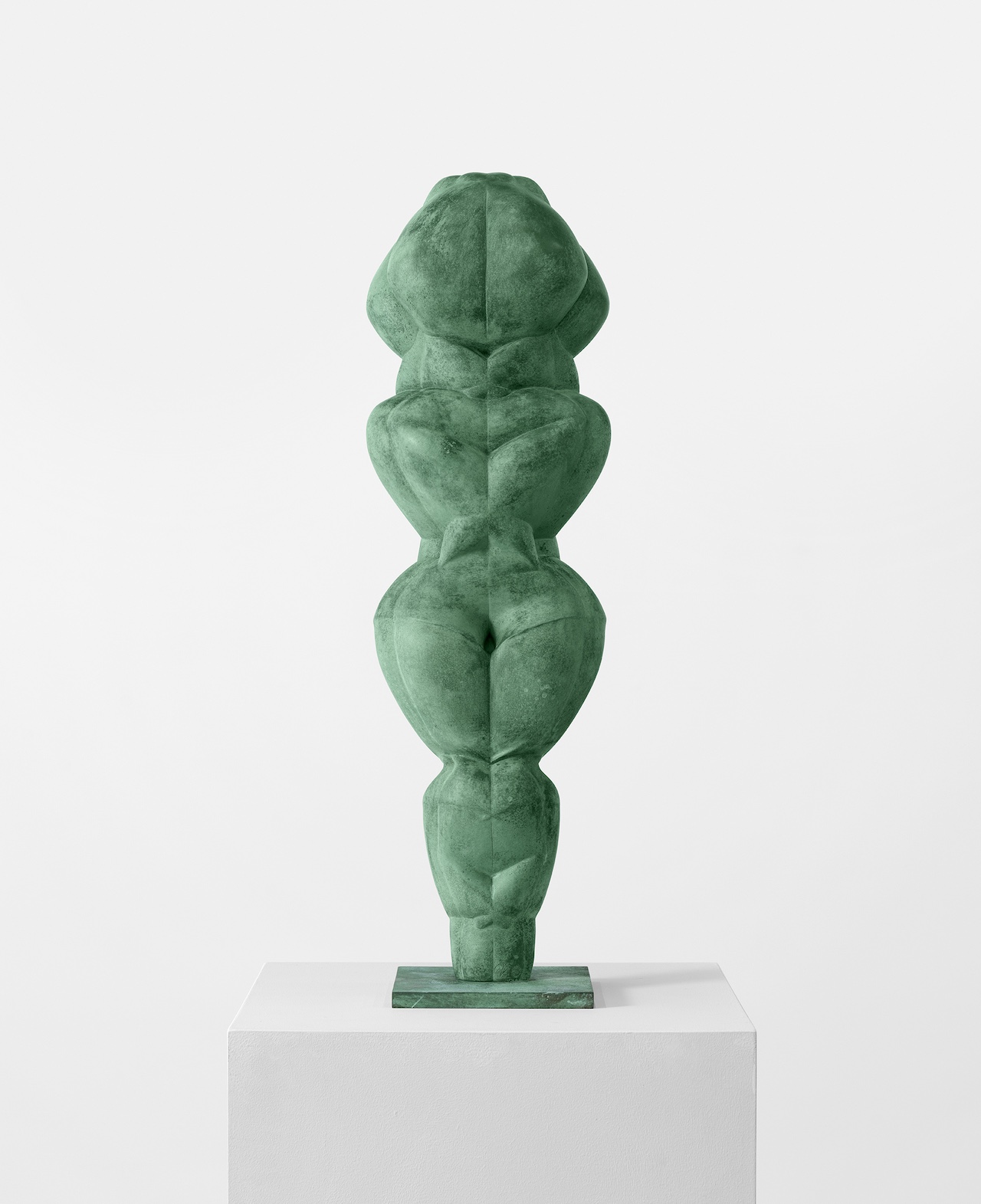 Tony Cragg, Symmetries, 2026, bronze, 33 1/2 by 10 1/4 by 7 1/2 inches. © Tony Cragg. Photo: Alex Yudzon. Courtesy the artist and Marian Goodman Gallery.
The smaller of the two bronze versions of Symmetries (2026), finished in the green patina of weathered copper, stacks its mirrored convexities like iterations of the Venus of Willendorf. This 30,000-year-old motif is multiplied into a single column, revealing that stacking, one of Cragg’s earliest methods, can now yield the female body. Through this vertical repetition, the Symmetries take up the iconography of femininity, recalling the Greek caryatid, the embodiment of architectonic support. The T-shaped bronze pair Over the Earth (2025 and 2026) crowns this structural logic with a horizontal axis. The larger work on the first floor, spanning nearly twelve feet, elevates a sweeping mass upon a twisting central shaft, as if externalizing the musculature of a body to reveal its interiority.
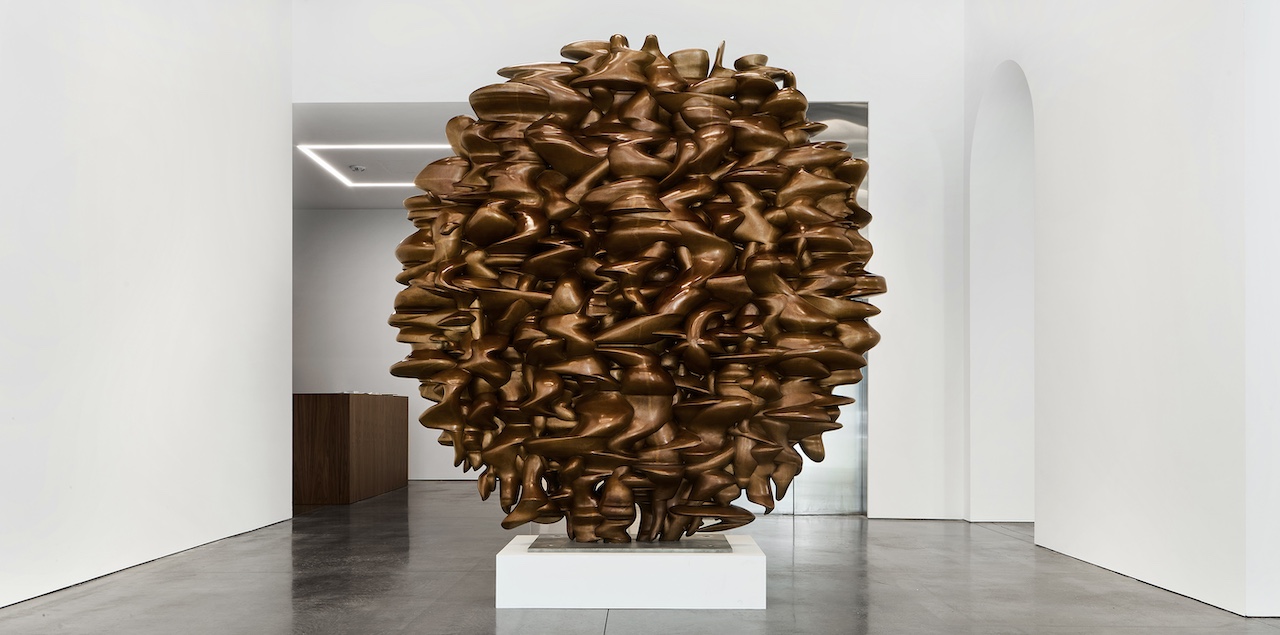 Tony Cragg, Versus, 2018. © Tony Cragg. Photo: Carlos Perez. Courtesy the artist and Marian Goodman Gallery.
Facing Versus again on the way out, toward Broadway, one sees a golden-brown bronze whose densely woven ellipses initially mimic polished mahogany. Yet the light shearing across its surface reveals the metal, as does the intricacy of the form. Where the sculpture meets its plinth, all that mass rests on a surprisingly slender point of contact. Its endlessly iterated motifs evoke software-generated profiles, while its ornate surface rivals the Louvre’s late Roman sarcophagus Selene and Endymion (ca. 230–240 CE). The drill of Late Antiquity excavated rhythmic channels of light and shadow in marble, a transformation Alois Riegl, writing in 1901, identified as a historical shift from the haptic to the optical. Versus operates at the same threshold, between haptic mass and optical rhythm. [2]
Tony Cragg’s sculptures hold two aporias: how to make the new out of the old, and how to make form at once recognizable and unknowable. His resources are human anatomy and the archaeology of culture. He does not simply break with the past, as the avant-garde demanded. He takes forms that have been made for centuries, from the archaic kouros and the Laocoön to Brancusi, Arp, and Bourgeois. He makes them again, differently each time. Sculptors of Cragg’s time embody two ways of addressing the aporia of perception. Cragg’s work moves between them. Anish Kapoor, his peer in the New British Sculpture of the 1980s, turns the problem inward: his pigment-lined voids and mirrored bowls swallow the gaze and hand it back as a psychological event, closer to vertigo or perceptual instability than to looking. Richard Serra’s Torqued Ellipses go the other way, outward into the body, where walking between leaning steel walls becomes a lesson in phenomenology. Perception is felt in the legs before it reaches language.
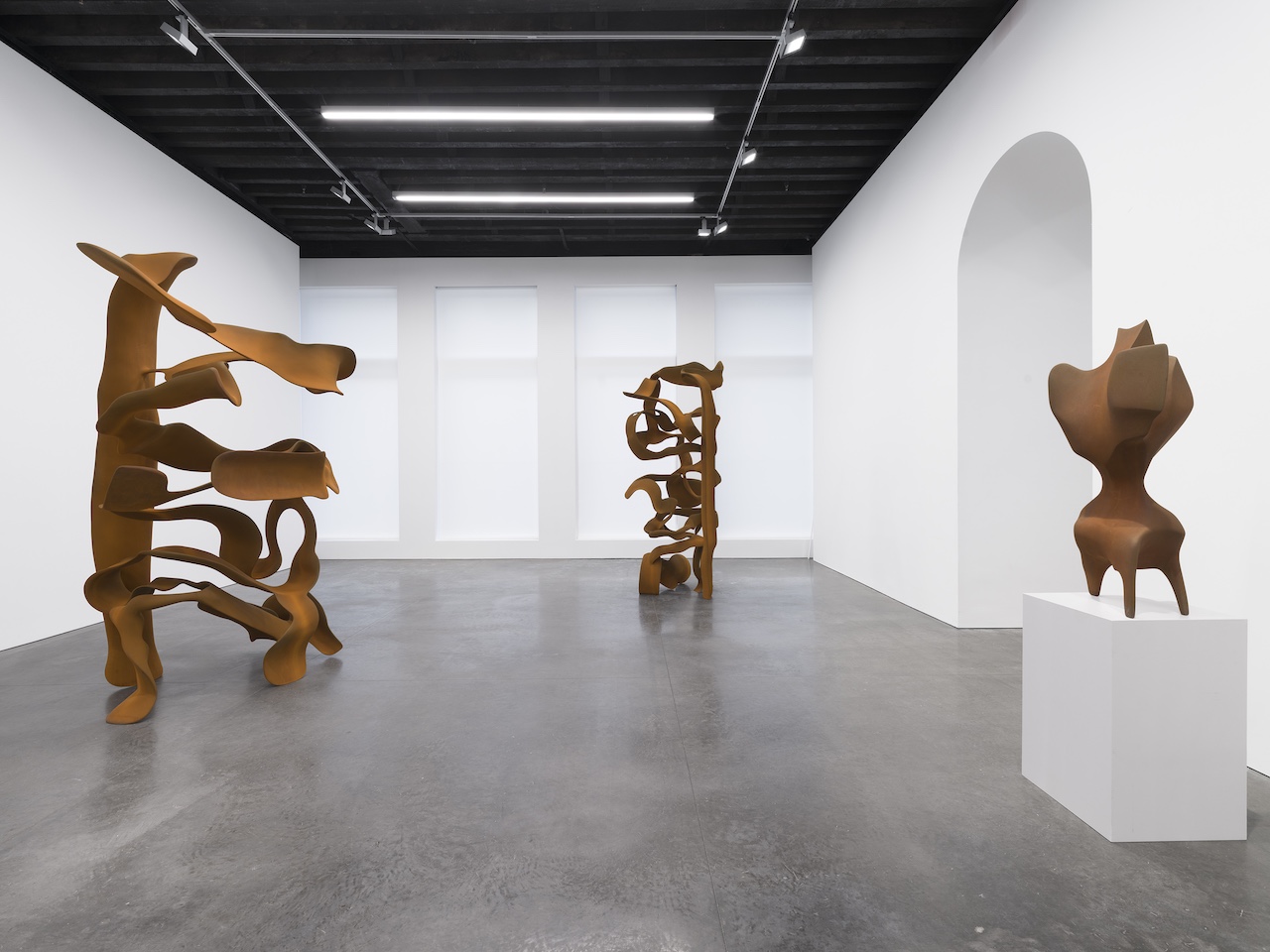 Installation view: Tony Cragg, Marian Goodman Gallery, New York, 2026. © Tony Cragg. Photo: Carlos Perez. Courtesy the artist and Marian Goodman Gallery.
Between Kapoor and Serra, Cragg occupies a position that partakes of both. His works enact a conceptual contrapposto, recalling the pose that emerged in Greek sculpture after the archaic kouros, when the body’s static frontality gave way to a shifting balance of weight. In Cragg, the weight shifts not from one leg to the other but between mind and body. His elliptical forms solicit the bodily movement of the viewer, as Serra’s do. Yet they keep generating faces and profiles, as in Masks, inviting the mind to project human likeness onto them. Neither the psychological nor the phenomenological dimension prevails. Wittgenstein wrote that “The limits of my language mean the limits of my world,” and Cragg’s sculptures inhabit that limit: the eye continues to circle, seeking a name that never quite arrives. [3] The checklist identifies the materials as wood, stone, bronze, or steel but leaves unresolved whether the forms are columns or faces. They are freestanding in more than the literal sense. What, after all, allows these sculptures to stand free if not their own aesthetic gravity? WM
Notes
1. Edmund Husserl, Analyses Concerning Passive and Active Synthesis: Lectures on Transcendental Logic, trans. Anthony J. Steinbock (Dordrecht: Kluwer Academic Publishers, 2001), 39.
2. See Alois Riegl, Late Roman Art Industry, trans. Rolf Winkes (Rome: Giorgio Bretschneider Editore, 1985).
3. Ludwig Wittgenstein, Tractatus Logico-Philosophicus, trans. C. K. Ogden (London: Kegan Paul, 1922), proposition 5.6 (emphasis in original).
Tony Cragg
Marian Goodman Gallery
385 Broadway, New York
10 September to 24 October 2026

Raphy Sarkissian
Raphy Sarkissian received his masters in studio arts from New York University and is currently affiliated with the School of Visual Arts in New York. His recent writings on art include essays for exhibition catalogues, monographs and reviews. He has written on Rachel Lee Hovnanian, Anish Kapoor, KAWS, David Novros, Sean Scully, Liliane Tomasko, Dan Walsh and Jonas Wood. He can be reached through his website www.raphysarkissian.com.
view all articles from this author