Whitehot Magazine
October 2026
"The Best Art In The World"
"The Best Art In The World"
October 2026
Henri Rousseau The Ambition of Painting - Musée de l’Orangerie March 25 – July 20, 2026
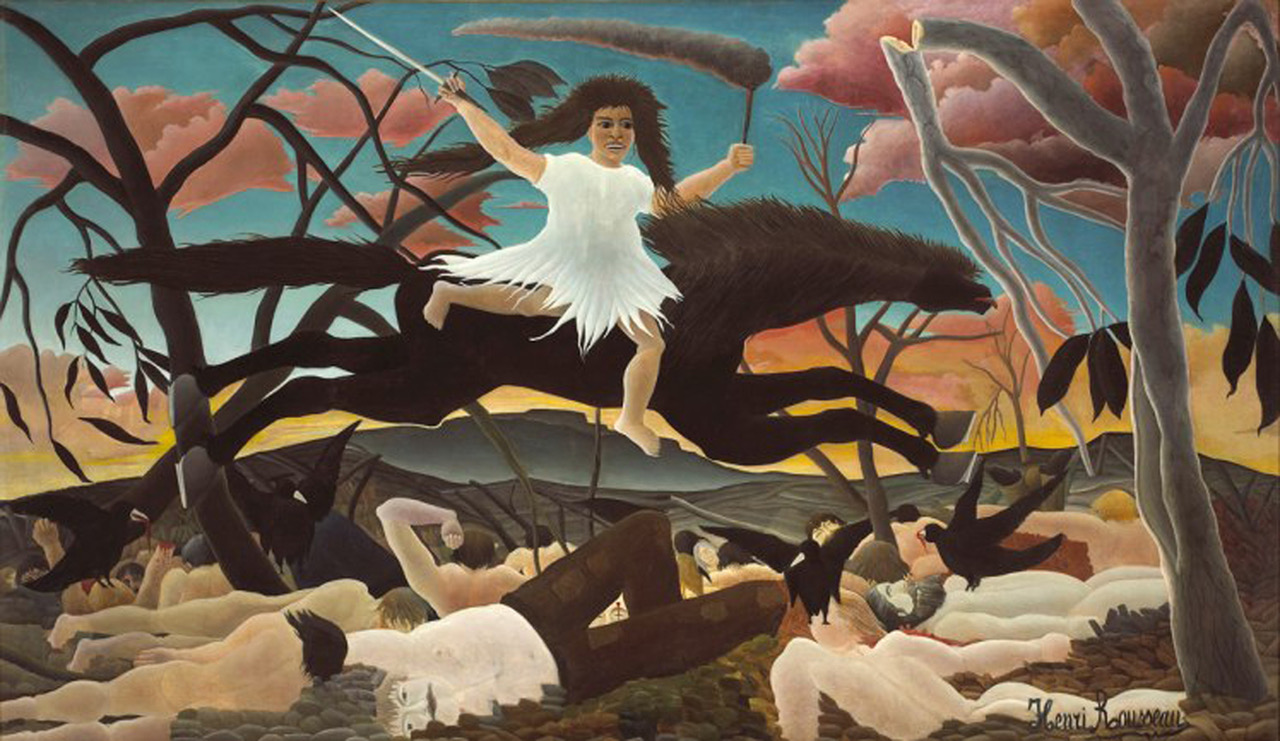 Henri Rousseau, La Guerre (The War) (circa 1894) Oil on canvas, 1,145 x 1,95 m Paris, Musée d'Orsay, purchased 1946 Photo © Musée d’Orsay, Dist. RMN-Grand Palais / Patrice Schmidt
By JOSEPH NECHVATAL June 8th, 2026
The current Musée de l’Orangerie’s show of Henri Rousseau (aka ‘Le Douanier Rousseau’ (toll collector Rousseau)) (1844-1910) is unique in that it’s been achieved in collaboration with the Barnes Foundation in Philadelphia. This following Barnes’s recent change in status which now allowed it to lend nine Rousseau paintings to l’Orangerie.
But The Ambition of Painting is not only a celebration of Rousseau’s ambition to leave toll collecting behind and become a fine art painter of notoriety, it is a salutation to his use of the flattened picture plane that pretty much went on to define the goals of Modernist painting.
It is also a tribute to the acumen of art dealer Paul Guillaume, who advised and supplied these nine Rousseau paintings (and many other) to Albert C. Barnes. Indeed, Guillaume’s art collection is the core of Musée de l’Orangerie’s collection and Paul Guillaume acted as an intermediary for Barnes when Barnes purchased eighteen of Rousseau’s paintings. Guillaume was himself an avid collector of Rousseau’s work and owned up to fifty paintings by the artist. Nine of these paintings are now held in the Musée de l’Orangerie’s collection. So the exhibition is a testament to the close collaboration between a Parisian art dealer and an American collector.
Moreover, The Ambition of Painting goes beyond the legend of naivety that has been constructed to define the art of Le Douanier Rousseau. Curated by Christopher Green of the Courtauld Institute of Art in London; Nancy Ireson, curator at the Barnes Foundation; and Juliette Degennes, curator for the Musée de l’Orangerie; The Ambition of Painting looks back on Henri Rousseau’s move to Paris from his native hometown of Laval and his decision at age 49 to retire from his job as a customs officer and to devote himself entirely to painting. Far from uninformed Rousseau soon began sending his canvases to the organizers of the Salon des Indépendants, though they were regularly rejected. But Rousseau started receiving government commissions to decorate town halls in the Île-de-France region, to take on portrait commissions by his friends and family, and paint landscapes that he intended for easy sale.
The result being that Rousseau, with a singular style of hyperrealism that is immediately recognizable, is perceived as Modern Art History’s best-known ‘naïf’ painter. Yet it must be remembered that it was the sophisticated avant-garde Cubists, Dadaists and Surrealists who were among the first to appreciate his hyperreal art brute aesthetic strengths, starting when Pablo Picasso stumbled upon a painting by Rousseau. Lacking conventional trompe l'œil representational skill, it was being sold on the street as a toss-away canvas to be painted over.
Picasso bought it as a cheap caprice, loved its anti-classical modern aspects and sought out the unsuccessful artist who had painted it. Picasso would come to own four paintings by Rousseau and held a half-serious, half-burlesque banquet Rousseau at his Le Bateau-Lavoir studio in Rousseau’s honor: enshrining Rousseau as a father of his and Georges Braque’s proto-cubist art, known then as their African period. Rousseau’s work would influence Fernand Léger, who took his inspiration for his The Mechanic (1920) from Le Douanier’s Portrait de Pierre Loti (1891). The fête included Guillaume Apollinaire, Jean Metzinger, Juan Gris, Max Jacob, Marie Laurencin, art critic André Salmon, Maurice Raynal, art dealer and historian Daniel-Henri Kahnweiler and collectors Leo Stein and Gertrude Stein. For many of them Rousseau became a sort of home-grown ‘primitive’ whose paintings captured something of the abstract verve they admired in African Art.
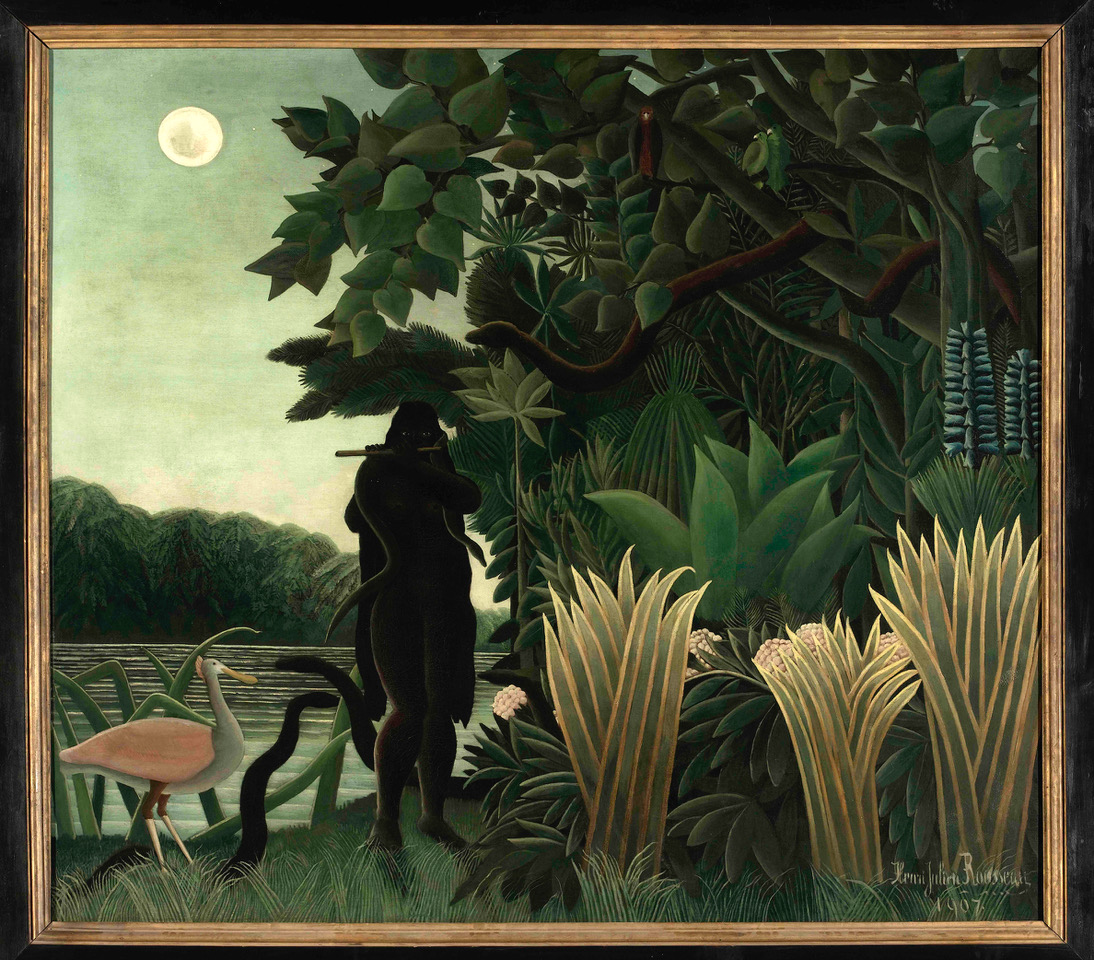 Henri Rousseau, La Charmeuse de serpents (The Snake Charmer) (1907) Oil on canvas, 167 x 189,5 cm Paris, musée d’Orsay, legs Jacques Doucet, 1936 Photo © musée d’Orsay, dist. Grand Palais Rmn / Patrice Schmidt
Rousseau’s more enigmatic paintings, like La Charmeuse de serpents (The Snake Charmer) (1907) stands up well here, producing an obscure empathy in me that generates bonds with the profound mysteries of natural transcendentalism.
Though he very often painted the foliage of the jungle, as in La Charmeuse de serpents, Rousseau never visited one. Rather, he looked at books and went to the botanical garden in Paris and studied the plants and zoo animals there. Also, instead of making the plants their actual size, he would make them bigger than real so that they came to suggest a drug-fueled fantasy world. Yet he had a very real, and hard, personal life. With his first wife Clemence, he had nine children. Clemence died young, as did his second wife after they had been married for only four years.
As the title of the show, The Ambition of Painting, indicates, Rousseau wanted to be known as a great painter. He was unappreciated for most of his life and died in 1910 at the age of 66 from a leg infection. Reportedly, only seven people attended his funeral, including Paul Signac. But a year later, a tomb stone was set up by the painter Robert Delaunay, poet Guillaume Apollinaire and a Monsieur Queval, who was Rousseau’s landlord. Shortly after Rousseau’s passing, New York City saw the first one-man exhibition of the artist’s work ever held at Alfred Stieglitz’s gallery 291. It was organized by the American artist Max Weber.
In 1913, Constantin Brâncuși, and the painter Manuel Ortiz de Zárate engraved on Rousseau’s tomb stone this epitaph that Apollinaire had penned:
“Hear us, kindly Rousseau.
We greet you,
Delaunay, his wife, Mondieur Queval and I.
Let our baggage through the Customs to the sky,
We bring you canvas, brush and paint of ours,
During eternal leisure, radiant
As you once drew my portrait
you shall paint The face of stars”
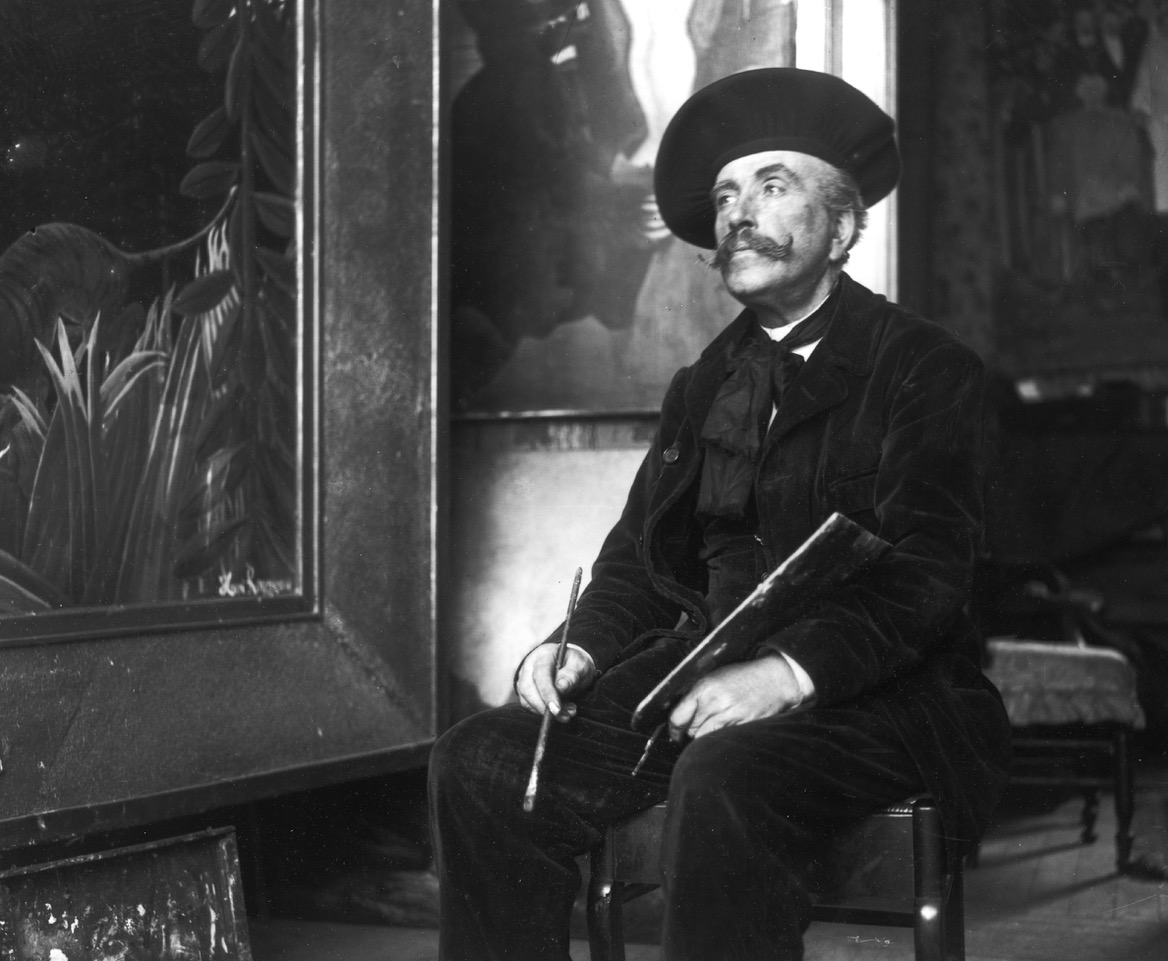 Paul François Arnold Cardon, known as Dornac (1859-1941), Henri Rousseau seated next to Scouts Attacked by a Tiger, Bad Surprise, and The Wedding in his studio at 2 bis, rue Perrel in Paris, 1907. Photograph: Larousse Archives, Paris, France/ Bridgeman Images
Rousseau is highly regarded by me based on his symbolist painting La Guerre (The War) (aka The Ride of Discord) (circa 1894). The painting depicts a woman-at-arms sitting side-saddle on a pin-headed horse (or running next to it). They both are floating—suspended in time and gravity—over a pile of dead corpses, mixed in with a peck of picking black birds.
It rewards slow looking with an uncanny creepiness. There are bent and twisted arms and legs to be relished, along with the beautiful dark twisted fantasies found in the left eye of a doomed man staring out at us. That despondent eye is matched with another left one, closed and enclosed in a triangle at his crotch—with a small but lethal bullet hole above it.
The pink sunset colors of the clouds, and warm yellow backdrop, gives this flat painting an attractive, if ghastly, splendor that is rewarding, particularly given the context of the not-so-distant Russo-Ukrainian war.
Such a painting reminds me that veritable art is that art which is neither decoration, illustration or speculation.
At the end of nineteenth century, Europe had developed a fascination for the exotic, thanks to the expansion of colonial explorations, but with Rousseau’s Le Lion, ayant faim, se jette sur l’antilope (The Hungry Lion Attacking an Antelope) (1898/1905) we are far from the “trouble-free” jungle which Jean-Jacques Rousseau thought the natural state of human happiness. But even those people like Le Douanier who never left France couldn’t buy into that delusion for long—and Henri Rousseau transmuted to canvas all sorts of hairy activities less than ideal in his fake jungle. Eventually resulting in twenty-five jungle-based paintings, such as the unlikely masterpiece with female nude called Mauvaise surprise (Bad Surprise) (1899-1901).
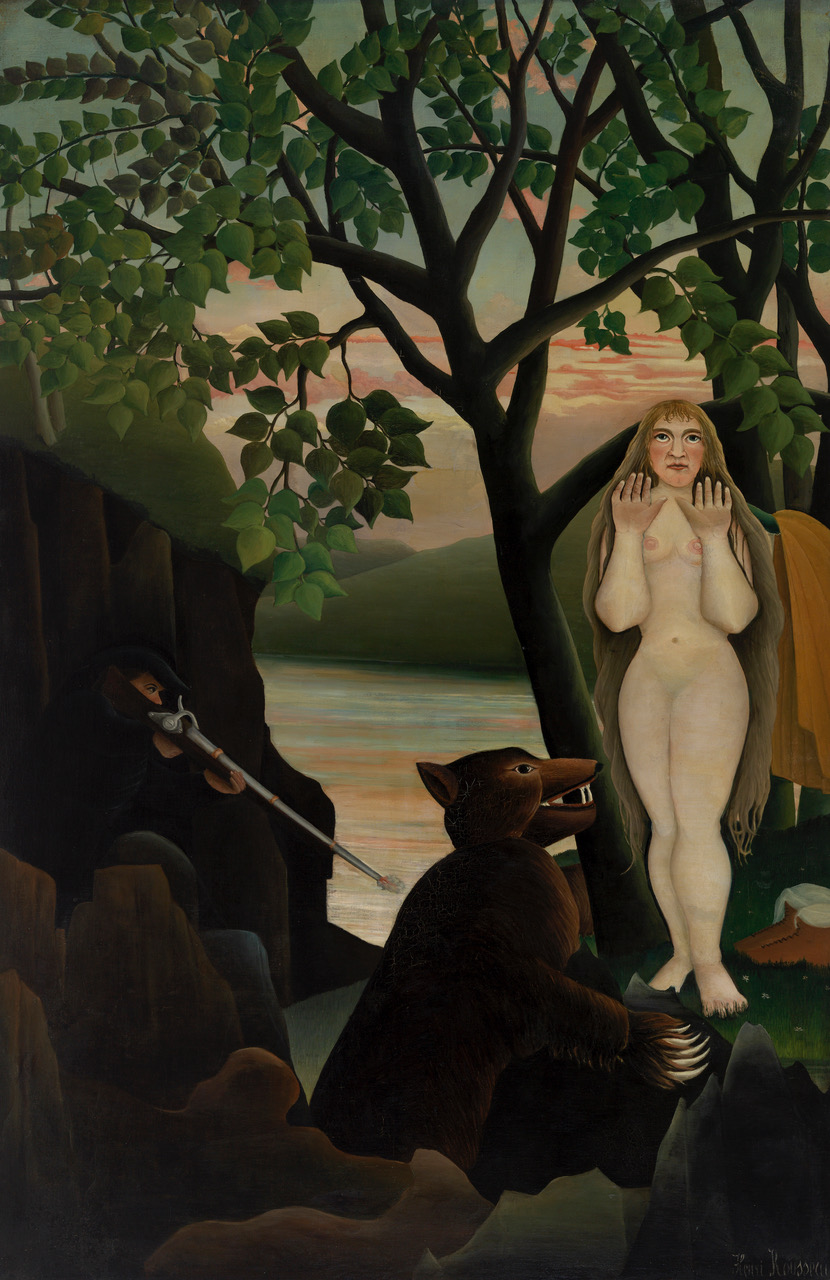 Henri Rousseau, Mauvaise surprise (Bad Surprise) (1899-1901) Oil on canvas, 194 x 6 x 129,9 cm Philadelphia, The Barnes Foundation Photo © 2026 The Barnes Foundation
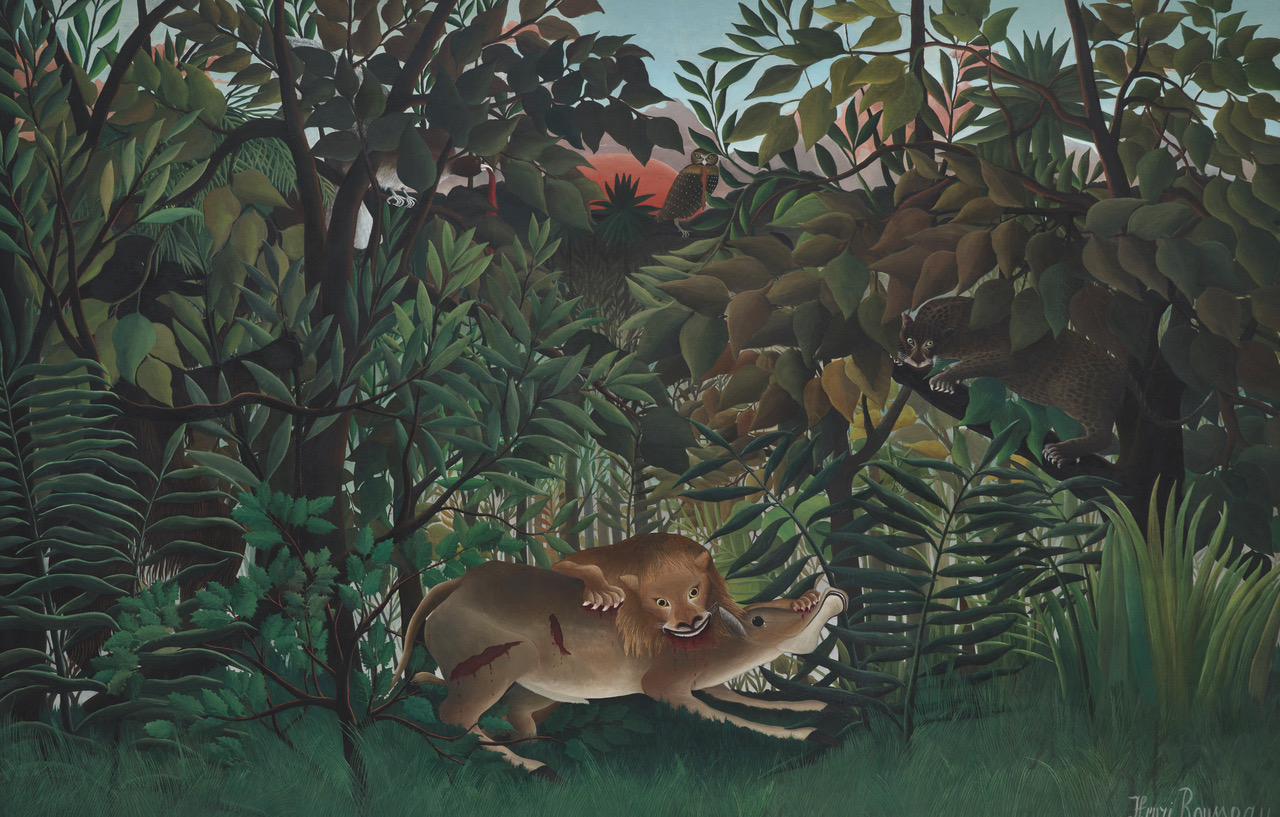 Henri Rousseau, Le Lion, ayant faim, se jette sur l’antilope (The Hungry Lion Attacking an Antelope) (1898/1905) Oil on canvas, 200 x 301 cm Riehen/Basel, Fondation Beyeler, Beyeler Collection
The Ambition of Painting exhibition substantially fulfills my need for the weird sincerity of art—for Le Douanier’s paintings, when taken together, form an archaic stylistic wilderness that can be described as in contrast with the common painting style(s) of whatever time-frame they are viewed within.
Rousseau’s awkward pipedream paintings remind me that art is one manifestation of the broader human capacity to consciously reshape our image through deliberate whimsy. If only in order to explore our own capacity to do so.

Joseph Nechvatal
Joseph Nechvatal is an American painter/writer currently living in Paris. His book of essays Towards an Immersive Intelligence (2009) was published by Edgewise Press. He has also published three books with Punctum Press: Minóy (ed.) (2014), Destroyer of Naivetés (poetry, 2015) and Styling Sagaciousness (poetry, 2022). His book of art theory, Immersion Into Noise, was re-published in 2022 in a second edition by Open Humanities Press. In 2025, Venus Voluptuous in the Loins of the Last God, his sequel novella to ~~~~~~~~~~~~~~~~~venus©~Ñ~vibrator, even (1995/2023) was published by Orbis Tertius Press. In 2025 his art exhibition Information Noise Saturation was presented at the Magenta Plains in New York City and in 2026 he exhibited a series of new paintings called Le Bateau ivre (The Drunken Boat) at Galerie Richard in Paris.
view all articles from this author