Whitehot Magazine
August 2026
"The Best Art In The World"
"The Best Art In The World"
August 2026
Shamanic Artists: The artist appears in every culture mankind has ever produced.
By HARRISON LOVE August, 17th, 2026
The artist appears in every culture mankind has ever produced. In many ways, the artist is one of the most beautiful remnants carried forward from the old world into our marvelous obsessions with meaning. Across antiquity we stare in awe, wondering what kind of devotion or faith could compel generations of people to build the great cathedrals of Europe or dedicate more than a century of labor to the ongoing construction of Antoni Gaudí's Sagrada Família.
It is not simply our capacity for disciplined devotion that inspires future artists. Every successive work humanity has made contributes to an ongoing conversation stretching across history; a conversation inseparable from mystery itself. We may never know what first inspired the paintings at Lascaux, or what compelled Homer to compose his epics, and that gap in our knowledge is itself enchanting. Yet we can be certain of one thing: there has never been a moment in recorded history without art. An unbroken chain of making continues through every civilization, driven by an insatiable desire to create, remember, and tell stories.
That realization gradually reshaped my own understanding of artistic practice. I began to think of the artist less as a manufacturer of objects and more as something akin to a monk or perhaps a shaman. There is something unmistakably mediumistic about the creative act. Nearly every artist, after enough years, has uttered the same bewildered phrase: "I'm not entirely sure where that came from."
The Abstract Expressionists spoke openly about surrendering to forces larger than themselves. Jackson Pollock described himself as "being in" the painting. Wassily Kandinsky believed abstraction revealed spiritual realities beyond material appearances. Carl Jung proposed that symbols emerge from a collective unconscious older than the individual mind. Different languages, perhaps, but all circling the same mystery: that creation often feels less like invention than reception.
Few artists embody this more clearly than Hilma af Klint. Long before abstraction became fashionable, she insisted that many of her paintings were guided by unseen intelligences. She believed she was translating forms rather than inventing them. By her own instruction, her work remained hidden from public view for decades after her death because she believed the world was not yet prepared to understand it. Time has proven her intuition remarkably prescient.
Art has always functioned as ritual, memory, identity, and a people's relationship with both the visible and invisible world. Again and again, these practices become inseparable from prophecy, healing, divination, and spiritual inquiry. The artist and the medium have occupied neighboring ground for far longer than modern culture tends to admit.
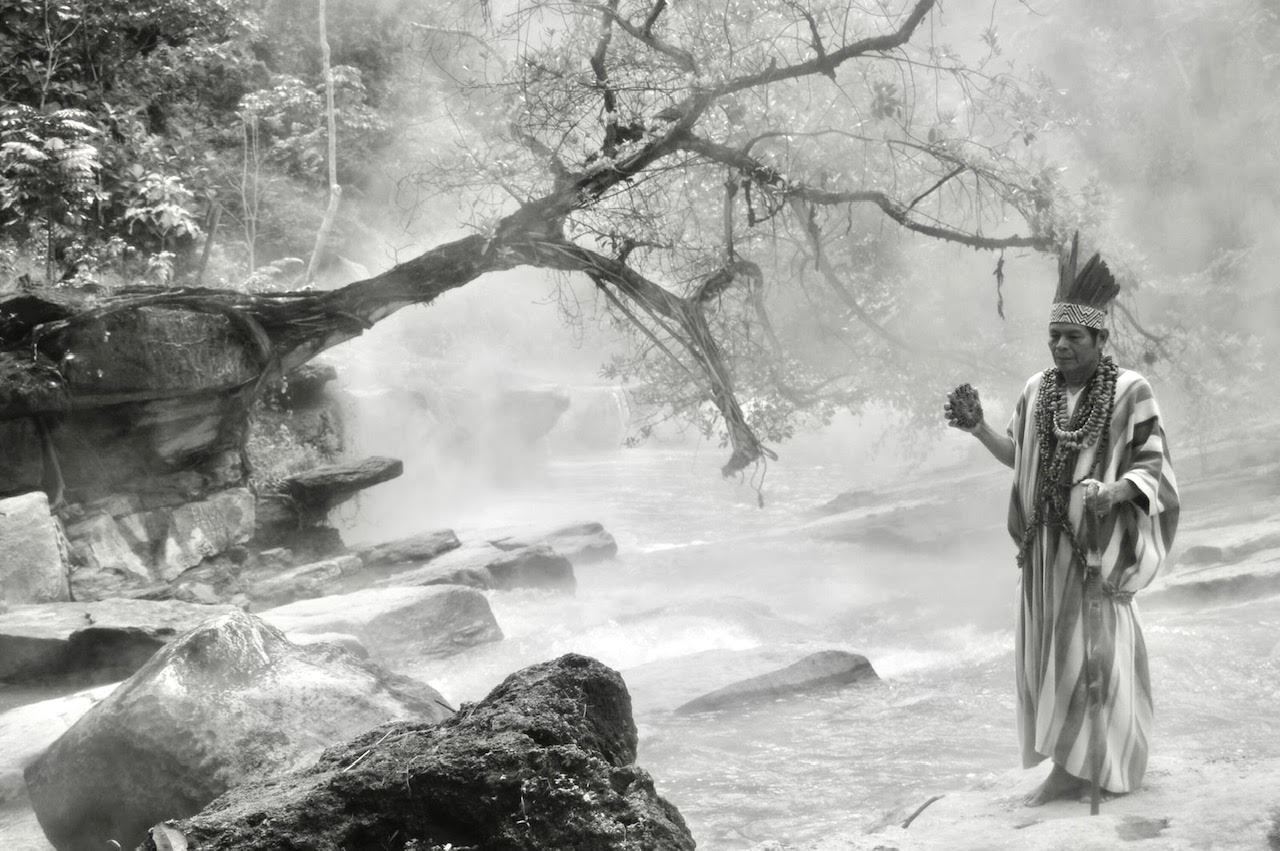
During my years living among Indigenous communities in the Amazon, I encountered this relationship firsthand. There, the distinction granted to artists was profoundly different from the commercial understanding that dominates much of the contemporary West. Removed from the assumptions of galleries, markets, and collectors, artistic practice revealed itself as something fundamentally necessary; a means of preserving memory, transmitting knowledge, and giving shape to a people's cosmology.
Every society has had its artists, architects, musicians, poets, and master craftsmen. But in the Amazon, the artist is often regarded not merely as skilled but as entrusted with something sacred. Creation is understood as participation in the divine order rather than simply the production of objects. Alongside this reverence comes responsibility. A temple is not merely stone without those who tend it. Likewise, artistic ability without purpose is only technique. If the artist is to serve as a kind of contemporary diviner, then technical mastery alone is insufficient; the work must still carry the spark that first compelled it into being.
Artists and shamans occupy remarkably similar positions within society. Neither stands entirely inside nor outside the tribe. Both live at the threshold between the known and the unknown, serving as historian, counselor, translator, and guide during periods of uncertainty. Their role is profoundly practical. They venture into territories of perception, emotion, and imagination that others have not yet entered, returning with symbols capable of helping communities navigate suffering, transformation, and change.
Contemporary culture often reduces artists to entertainers, content creators, or producers of luxury commodities. Art can certainly exist within those economies, but those definitions are too small for the role artists have historically played. Artists frequently perceive cultural shifts before they become visible elsewhere. They sense anxieties before they harden into political discourse. They explore alienation before sociology gives it a name. Through symbols rather than statistics, they reveal the emotional weather of civilization.
Perhaps this is why art has survived every empire, every religion, every technological revolution, and every economic system. Long before there were psychologists, journalists, or philosophers, there were storytellers around a fire making sense of the unknown.
Harrison Love
Harrison Love is an artist, author, and visual storyteller working at the intersection of contemporary art, cultural memory, and immersive narrative systems. As Founding Artist & Principal Cultural Advisor at Exhibit.iq, he advises on cultural direction and institutional strategy while helping build meaningful relationships between artists, museums, and the evolving art ecosystem. His personal practice synthesizes graffiti, calligraphy, and Cubist abstraction into a dynamic visual language shaped by global experience and a commitment to art as a living form of cultural enrichment.
view all articles from this author