Whitehot Magazine
September 2026
"The Best Art In The World"
"The Best Art In The World"
September 2026
At The Sue Tear, “Concessions to Impurity” Makes Room for the Mess of Becoming
By Sherly Fan, May 31st, 2026
You bow down and climb through a steep, narrow staircase into an underground tunnel that looks like it leads nowhere. At the end of the tunnel, you enter a magical place called The Sue Tear, where “Concessions to Impurity” is currently on view from May 9–31, 2026.
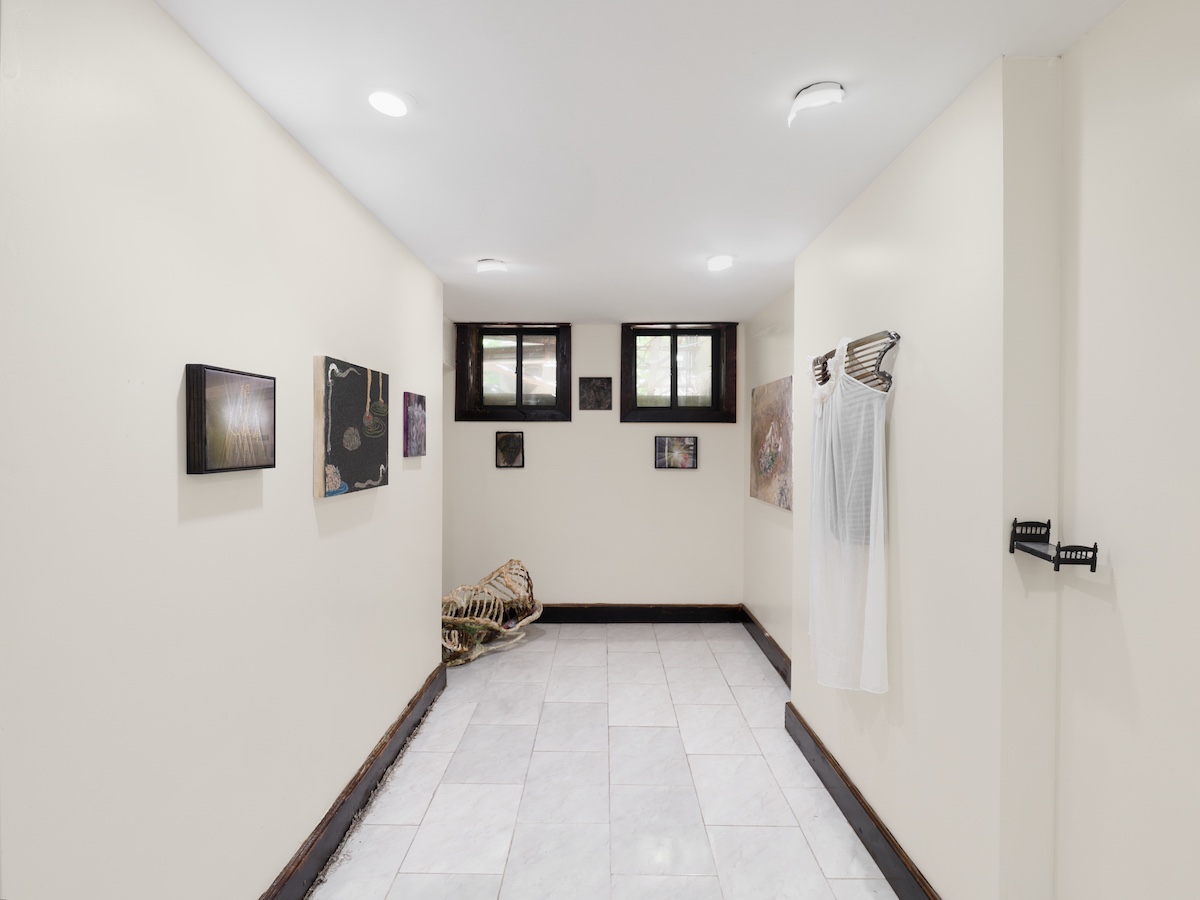 Concessions to Impurity, 2026. image by New Document
Curated by Shirley Lai, “Concessions to Impurity” presents twelve artists — Harrison Atwater, Gabrielle Benak, Jonah Dillon, Naomi Hawksley, Jihyun Hong, Maya Man, Maverick Mura, Pajtim Osmanaj, Rosa Sittig-Bell, Rei Xiao, Cass Yao, and Ketty Haolin Zhang — who together create a world of growing pains, lingering grief, and a wistful desire to grasp onto nostalgic purity.
Lai puts together the show from a deeply emotional and reflective place, drawing from her own personal experience and the changes she has noticed in herself. Her press release almost reads like an excerpt from a personal journal, where she opens up about the burdens of daily life and the growing pains of trauma, heartbreak, responsibility, and loneliness. But instead of simply presenting these feelings as sadness, she uses them as a way to reflect on her own journey and connect with the audience through the universal experience of growing up, changing, and longing for a time when things felt safe, pure, and beautiful.
She presents a bittersweet world woven from visceral pain, fragile hopefulness, shame, fantasy, and survival — not because suffering is beautiful, but because the messy, embarrassing, painful parts of becoming also deserve a place to be seen. One of the largest pieces in the show brings you close to your inner shame. Harrison Atwater’s Return to Clay depicts three red-skinned figures lost in a gloomy, dark forest. One figure pins another down in muddy water, while the third anxiously looks back, as if they are trying to pin you, the viewer, down too — inviting you to sit in your own muddy pool of reality where shame quietly surfaces.
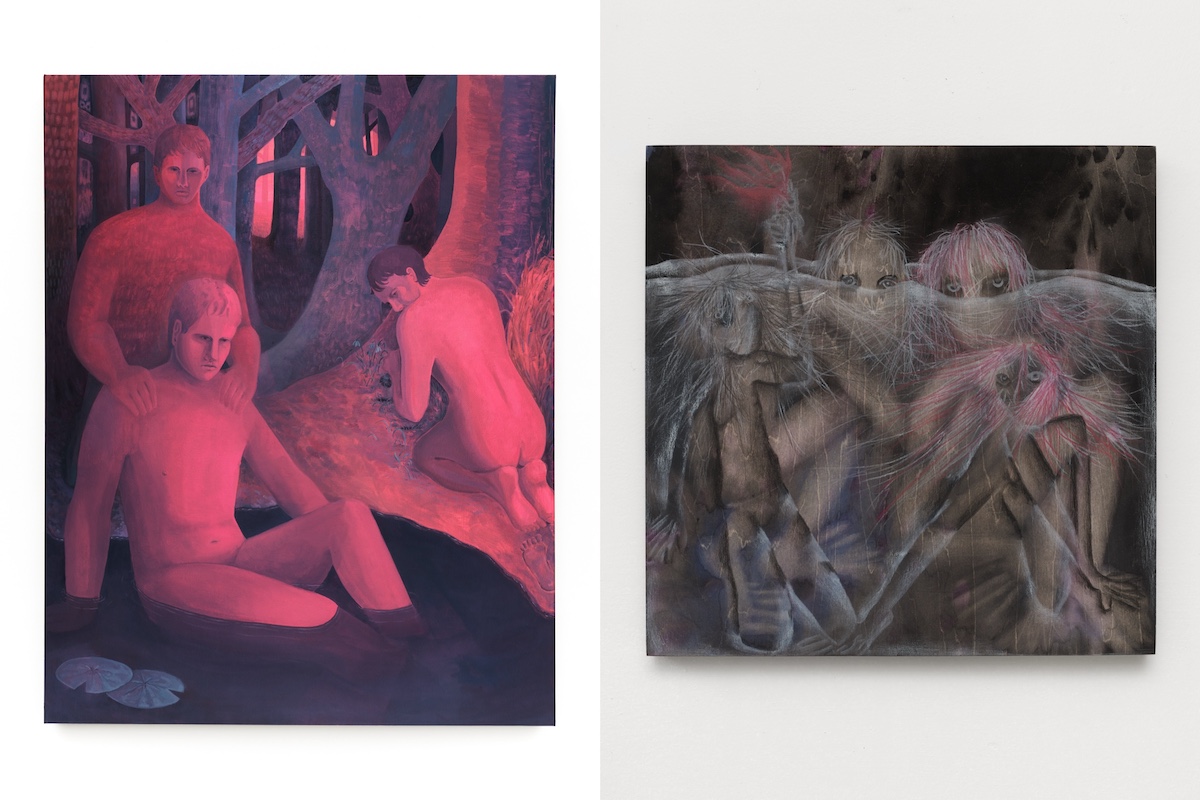 Left: Return to Clay, Harrison Arwater, 2026; Right: Kangaroo, Gabrielle Benak, 2026. image by New Document
Gabrielle Benak explores the dark, scary feelings of existence through her meticulous, shadowy depictions of figures with wild, light hair battling tigers, or struggling to keep their heads above water while intentionally trying to stay submerged. You can’t really tell if they are having a great time or living through their worst nightmares. The contradiction between the dark color schemes and the figures’ wide, innocent eyes challenges you to find a place between the hard battles they are fighting and a longing to grasp onto nostalgic purity.
Jonah Dillon’s works embody similar contradictions. He uses found materials and composes them into uncomfortable new objects—piercing a drop light into a prosthetic hand, or hanging a delicate sheer nightgown from a harsh, masculine Chevrolet truck grille. The unusual combinations of found objects create a haunting yet visceral nostalgic experience for the audience.
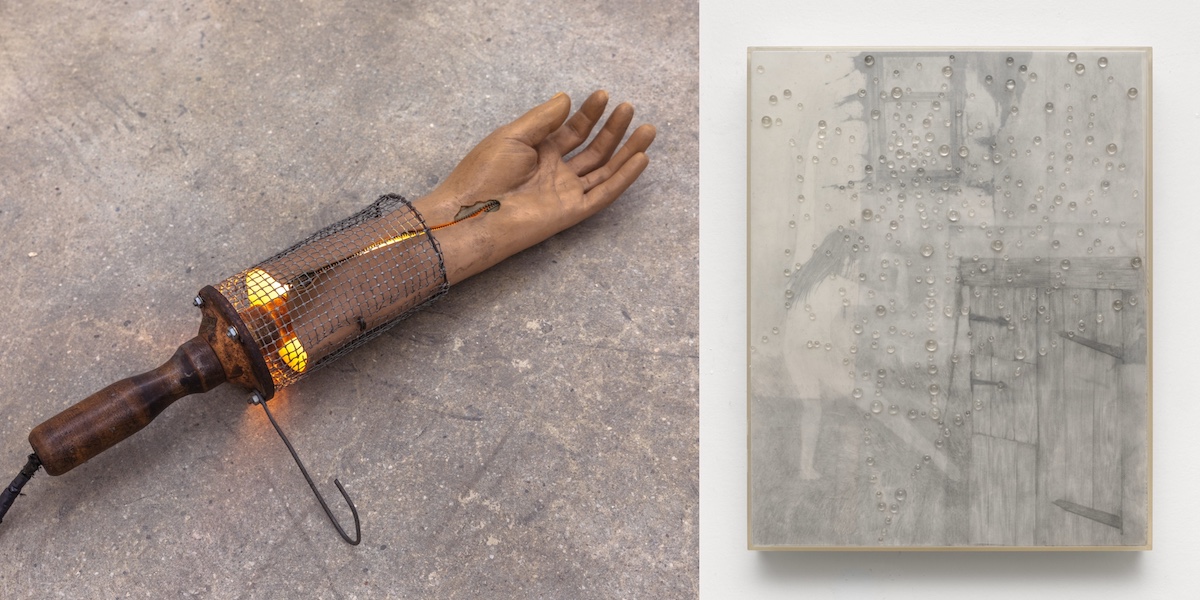
Left: Untitled, Jonah Dillon, 2023; Right: Untitled (Amy), Naomi Hawksley, 2026. image by New Document
Naomi Hawksley reiterates this point with a much more subtle touch. She brings in quiet graphite-gray paintings alongside doll bed-frame toys, or hides them behind tears.
Jihyun Hong’s works, on the other hand, fully demonstrate heartbreak. Her pieces are made of mosaic glass and porcelain fragments, as if her memories have shattered into a million pieces and she is picking them up, piece by piece, trying to put her broken heart back together. Just when you think the show cannot sink deeper into its emotional weight, you are confronted with Maverick Mura’s imagery of a dog burial, as if you were quietly led to the feeling of burying your childhood away.
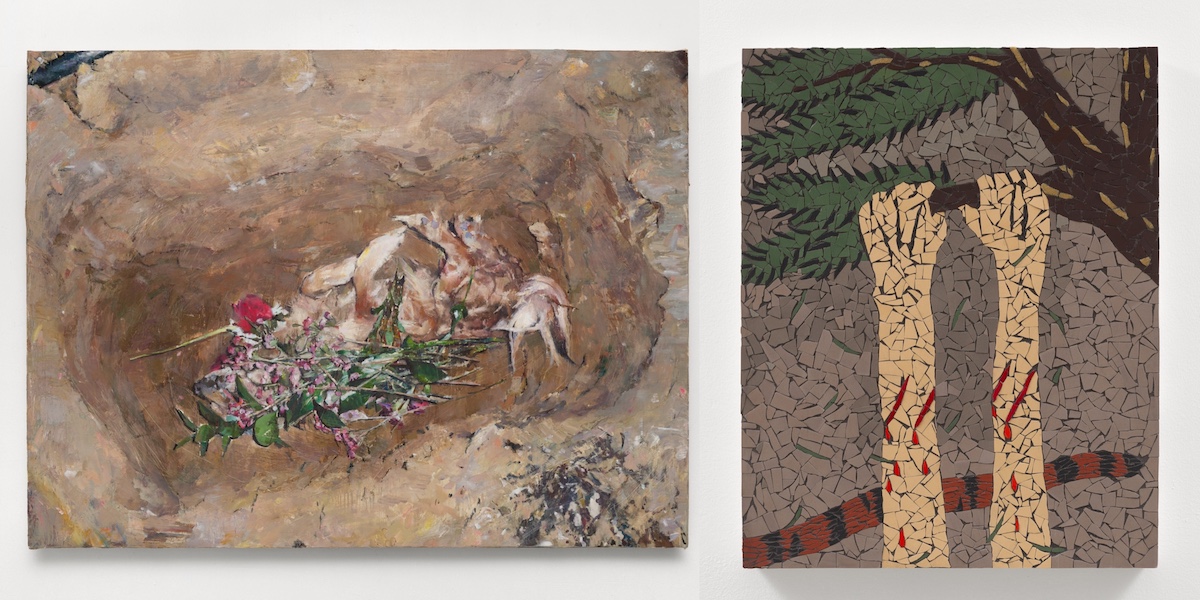 Left: Bugsie, Maverick Mura, 2026; Right: Needlefall, Jihyun Hong, 2025. image by New Document
Rei Xiao and Cass Yao’s works confront your existence and make you question whether you should have been birthed, or whether you should have a physical body at all. Xiao’s painting depicts a fetus hanging out of a mother’s body, trapped in a spider web, while Yao bluntly presents a tangled skeleton right in front of your face.
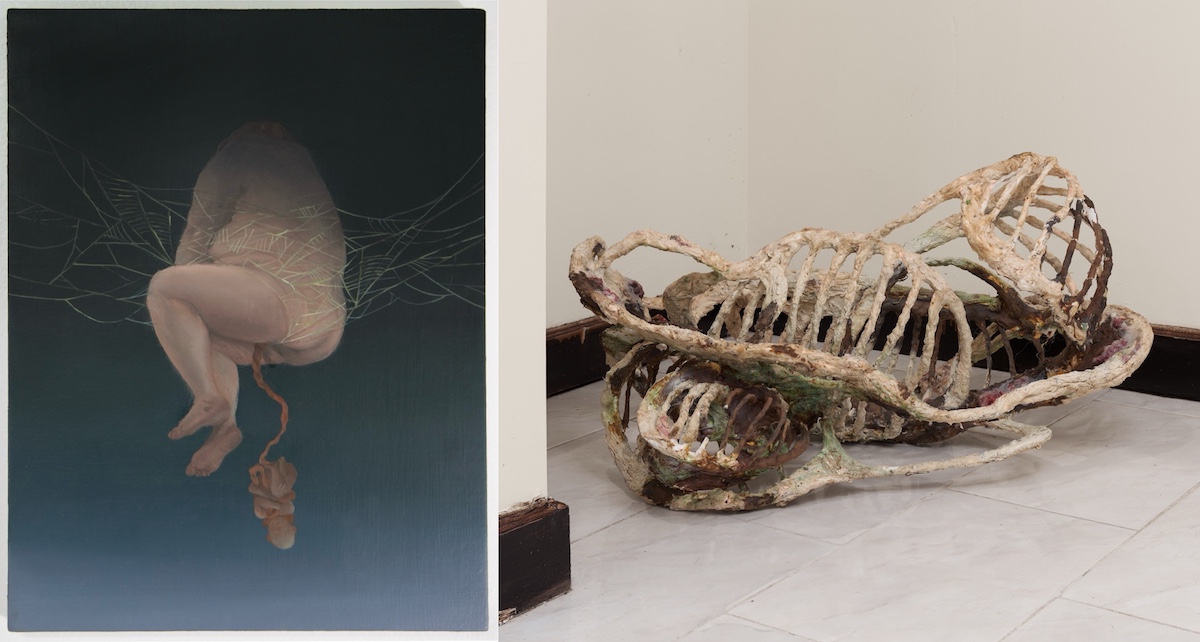 Left: itsy bitsy spider, Rei Xiao, 2026; Right: Plucked, The Engorged Dream;
And Spores They Laid, Birthing Those Mercy, Brought To Me, Cass Yao, 2026. image by New Document
Luckily, you won’t walk away completely trapped in a never-ending dark tunnel. Lai makes sure you can walk through the tunnel and still see the light at the end. Pajtim Osmanaj’s paintings are light sources themselves, glowing with prismatic sparkles, even though they refer to the painful childhood memory of bombs exploding in the sky. You wish this part could simply be light—but of course, even light here carries memory. Still, they serve as an invitation for us to cross through the darkest part of the tunnel and finally walk to the other side, where even the most painful memories can become a benevolent, ethereal presence.
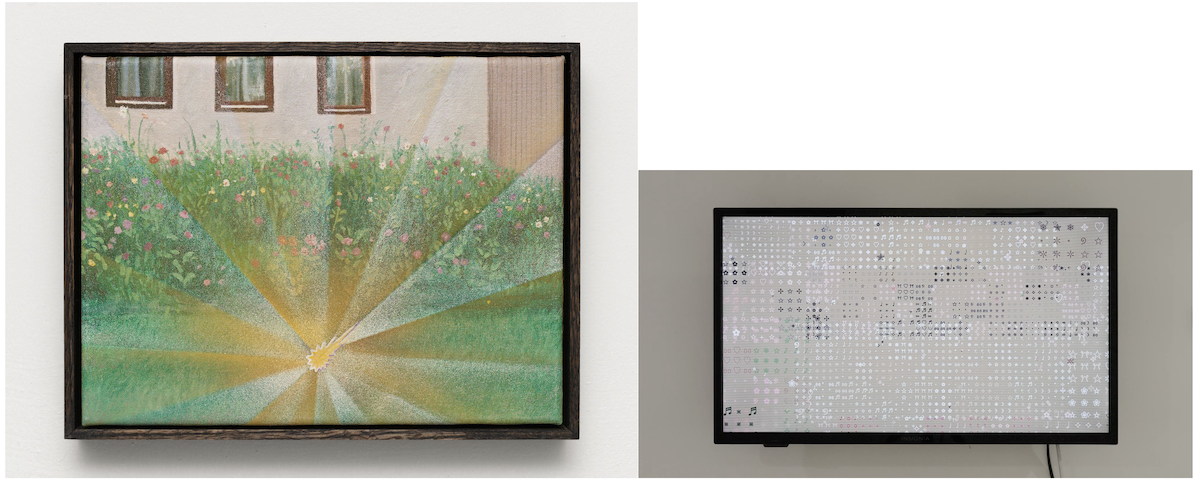 Left: Like a Star That’s Felt by the Flowers, Pajtim Osmanaj, 2023; Right: shift reality instantly ~ {very powerful}, Maya Man, 2022. image by New Document
Lai also surprises and challenges you with the question: what comes after the tunnel? She weaves manifestation into the equation by including works by Maya Man, who is inspired by online subliminal culture and creates a sparkling, colorful webpage full of whimsical characters like ☆༚✧⁎⁺˳ ⊹ ࣪ ˖ ୨୧. It is as if you could fully escape, get everything you wanted, and shift completely out of this world simply by staring at this website, while all your troubles melt away.
But no no no — even if you achieve the “ultimate American dream,” like Wendi Deng Murdoch, with money, education, and a billionaire husband like Rupert Murdoch, could you still be okay? Could you still be happy? Ketty Haolin Zhang’s works serve as a portal for us to examine obscured realities and stories through archival print and blurred, burnt acrylic glass. And just when you think you can finally end this whole painful trip with a cute, whimsical view of a dreamy amusement park, Rosa Sittig-Bell turns the lens back at you and tells you that you are now looking at unprotected surveillance footage. So, how about that?
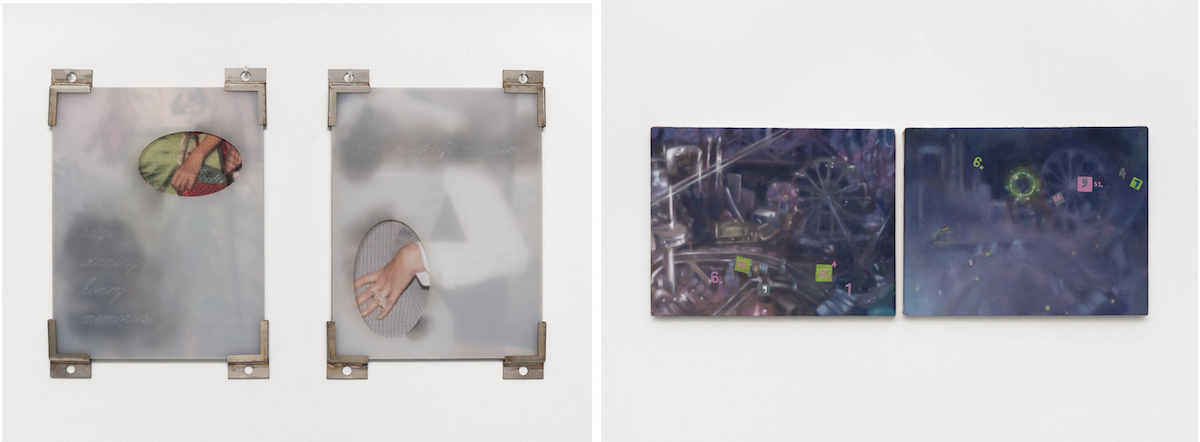 Left: prize winning honey memories, and love will keep me alive, Ketty Haolin Zhang, 2026; Right: shift webcamXP5_krefeld_multi_MiniaturPark_20_16, 2025; and webcamXP5_krefeld_multi_MiniaturPark_16_41, 2026, Rosa Sittig-Bell, image by New Document
Lai really takes her time to create this visceral and emotionally honest experience for the audience. The show comes from such a genuine place of reflection on the toll life inevitably takes on us, and how universal it is to carry these complicated, bittersweet feelings. It successfully portrays the complexity of growing pains — the pain itself, but also how we deal with the pain, how we try not to run away from it, and how we can still allow ourselves to feel everything honestly. She invites you into the basement of someone’s house and asks you to sit with your fear, shame, anger, grief, and longing, not necessarily to solve them, but to recognize them as part of living and becoming. And of course, this has to take place at a venue called The Sue Tear.
Hopefully, after the experience, the parts of you that you also don’t like feel slightly seen and understood. If you are going through something painful, just so you know: you are allowed to feel all those feelings at The Sue Tear.
The Sue Tear, located under 834 Hart St, Brooklyn, NY,11237
“Concessions to Impurity” runs through May 31st, 2026
Sherly Fan
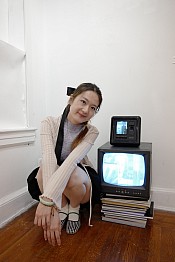
Sherly Fan is a writer and artist who received her MFA from Duke University. Drawing from her background in experimental documentary, performance art, and her ongoing exploration of “cute studies,” she approaches the art world with directness, honesty, and a sense of openness. Her writing is guided less by answers than by questions—philosophical, rhetorical, and reflective—inviting multiple ways of seeing and
understanding.