Whitehot Magazine
October 2026
"The Best Art In The World"
"The Best Art In The World"
October 2026
“Audrey Amiss on her own terms:” A conversation with curator Madeline Kennedy about The Surviving Exhibitions
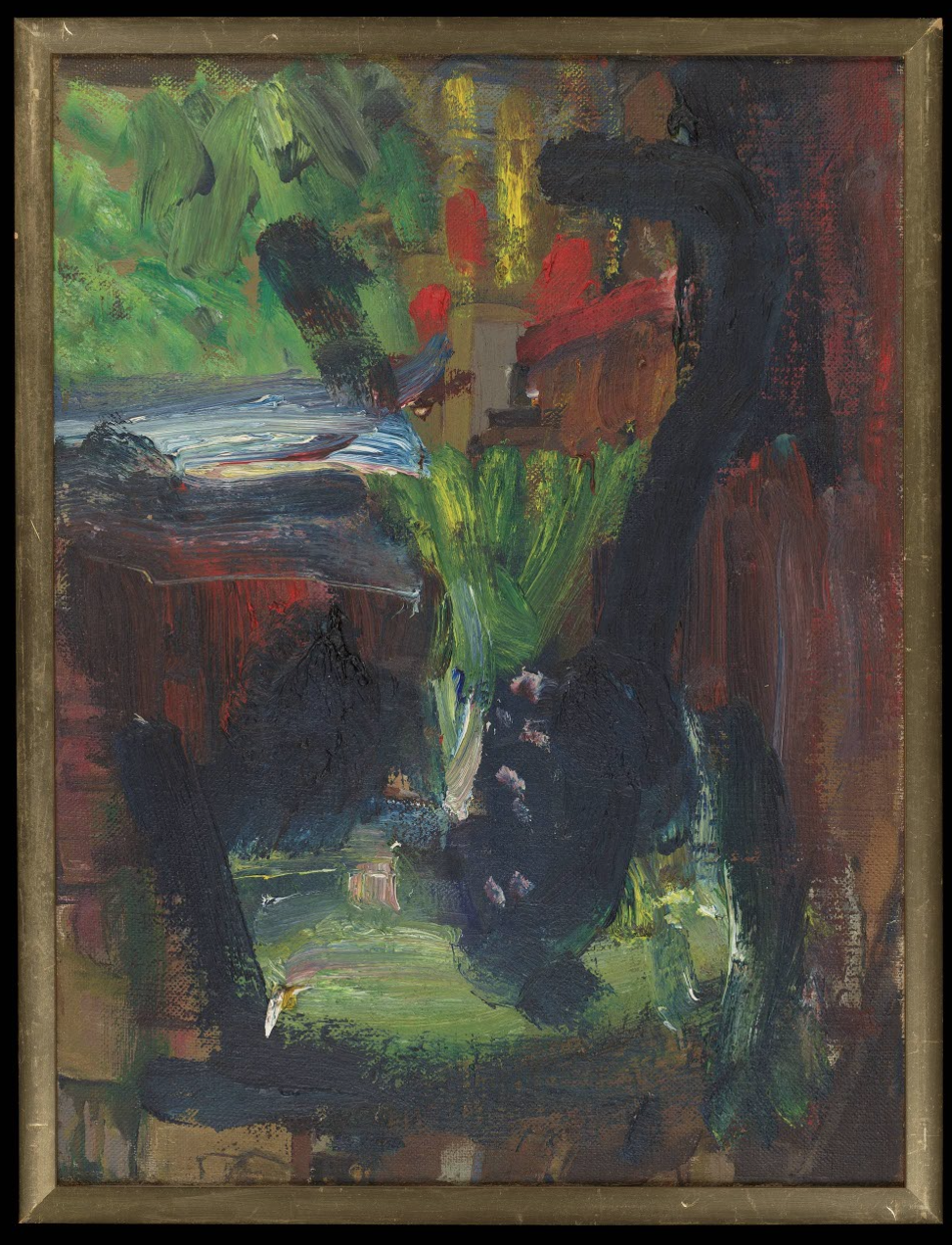
Audrey Amiss, Vase of Flowers, 1981. Courtesy Wellcome Collection © Wellcome Collection
By EMMA CIESLIK September 6th, 2026
This past July 10th, the Wellcome Collection opened Audrey Amiss: The Surviving Exhibitions. This groundbreaking exhibition is the first one dedicated solely to artist Audrey Amiss who passed away in 2013. Born in Sunderland, Amiss won a scholarship to the Royal Academy of Arts in the 1950s where she studied painting until a mental health crisis and treatment stopped her studies. Throughout her life, she continued to create, exhibit, and sell art while working in the Civil Service but the full appreciation of her work, like many artists, did not come until after she passed.
In this exhibition, which attempts to restage three of the solo exhibitions she had during her life, the Wellcome Collection examines her artistic and advocacy work organizing against and uncovering the harm perpetuated against people with mental illness in the Medical Industrial Complex. After the exhibition’s opening, I sat down with the curator Madeline Kennedy.
Emma Cieslik: Would you mind please introducing yourself?
Madeline Kennedy: I’m a curator currently based in London. I'm particularly interested in the many possible intersections of anti-ableism and exhibition-making, and in creative practices that invite us to imagine the world otherwise. That’s actually what attracted me to join Wellcome Collection last year: one of the pillars of their mission is to platform a radical imagination of what health is and what it could be. The Surviving Exhibitions is the first show I’ve curated at Wellcome, along with the parallel exhibition by Rudy Loewe, Intimacies of Care – Spaces of Grief and Possibility.
Cieslik: What was your framework behind curating this exhibition?
Kennedy: Audrey Amiss was a formally trained artist and a mental health survivor who often used her practice to highlight survivors’ experiences. She was dedicated to advocating for survivors’ expertise being listened to, respected and acted upon, and honoring that principle was a key part of the framework we developed, working with Wellcome Trust’s Mental Health Lived Experience advisors from the earliest stages of the research, with external consultants Micha Frazer-Carroll and Stefanie Lyn Kaufman Mthimkhulu, and with people who knew Amiss, including peers from when she was most active in survivor networks. There’s an ethical responsibility inherent to curating work by an artist who experienced so many infringements of her agency during her lifetime and isn’t here to speak for herself in the making of her first institutional show, so a principle we established from the outset was to only show material that there’s evidence Amiss herself wanted to be seen publicly, and to find out as much as we could about her intentions for exhibiting her work, so that they could become the guide for how we show it – amplifying her aims rather than overlaying our own.
So, the curatorial research focused on learning as much as we could about her exhibiting history, which led to a really exciting realization early in the archival research that she had made her own solo exhibitions. That wasn't previously part of the mythology about Audrey Amiss, but thankfully she kept price lists and posters from them that left us a trail of clues to start reassembling the shows she made. In terms of their aims, they of course varied from project to project, but towards the end of her career Amiss explicitly described an intention to challenge the public perception that the use of coercion in mental health systems ended with deinstitutionalization, using her work to highlight that was not a thing of the past.
Cieslik: I love that you situate her art alongside her protest signage. Why was it important to contextualize her art alongside her advocacy--and art as a form of protest and creative resistance?
Kennedy: The simple answer is because Audrey Amiss herself put her art and protest material together. I mean, the first thing to say about her protest signs is that she framed them as artworks. And I mean that literally. She wrote about her ‘graffiti’ signs, which included slogans like Psychiatrists Are Mad, that she framed and exhibited them in her 1989 solo show Fireworks: A Protest Exhibition. So at that point, her artistic work and her activism became intertwined, and that continued into the series of graffiti works on display from the early 2000s as well. But there’s a nuance to your question that I really appreciate, when you note that we situate her alongside her protest material, and that’s true. The only moment in the exhibition where you see an image of Audrey Amiss – given that we've not taken a biographical approach to the exhibition and she didn’t seem to exhibit self-portraits – is a life-size image of her holding those signs at a demonstration against the Mental Health Bill proposed by the UK government in 2002 that would have increased state powers to detain people without their consent.
That same year she staged Drawings from a Locked Ward (the Snakepit), an exhibition that she expressly used as a platform for consciousness-raising, to try to make sure that the harms psychiatric survivors were experiencing were understood by more people outside those systems. She was so devoted to that mission that she posted copies of her drawings from inside wards to MPs, policymakers and mental health organizations along with letters calling for changes to UK laws about mental health, so we know from that that she was treating her artwork as an advocacy tool, and as you say, creative resistance.
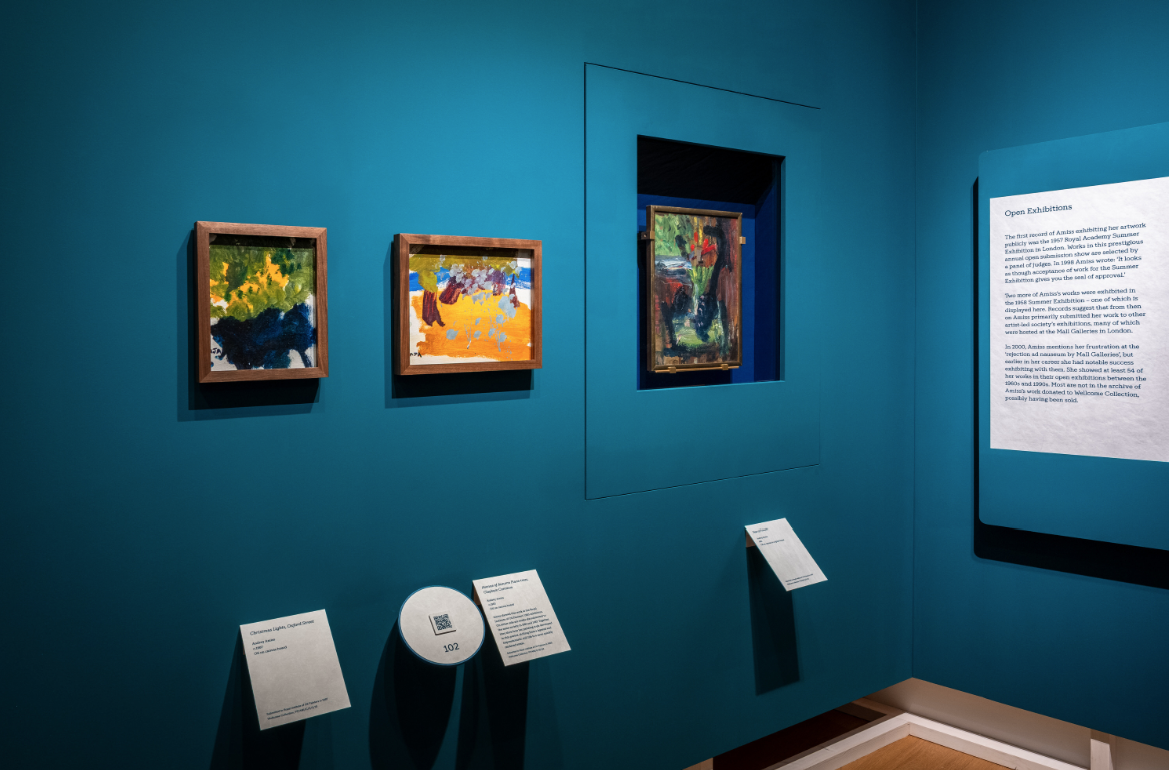
Installation view of Audrey Amiss: The Surviving Exhibitions at the Wellcome Collection. Photo: Steven Pocock / Wellcome Collection
Cieslik: I counter the assumption by reviewers that Amiss’s career was “derailed by mental illness” or that she created amazing work despite mental illness. Her mental illness was part of who she was and making her art conditional on or created in spite of her disability is inherently reductive. In your own words, how do Amiss’s work on display capture her experiences with mental illness?
Kennedy: You know, I’d prefer to answer that in Amiss’s own words. There’s a typed-up artist bio that we think she made for a solo show in the 1980s, where – between describing her work as a visual diary of her surroundings and listing her job as a typist – she simply writes ‘Suffers from mental breakdowns’. That was one of very few references to her mental health that I came across in archival material about her exhibitions, and as I understand it, she didn’t accept the diagnoses she’d been labelled with. So if we were to frame this as Audrey Amiss herself framed it, which is the goal of the exhibition, her focus didn’t seem to be her experiences of mental health itself, but rather of mental health treatment. You could say she was pointing to issues in a sociopolitical system, rather than ‘symptoms’ in the body/mind. But in developing the exhibition we’ve been really mindful of the instinct to interpret her work as somehow symptomatic of her mental health. Other historic archives in the Wellcome Collection show that for a long time that approach was sanctioned even by art therapists, who would try to diagnose people's mental states through the style of artwork they were making, for example, assuming abstraction was a sign of illness and realism a sign of health. This has since been proven wrong, and indeed Amiss used abstraction intentionally, as any artist with her training might, and it was part of her practice to experiment with different methods and mediums. She also showed works that had no stated connection to her mental health experiences, like lush oil paintings of landscapes and still-lifes, portraits of loved ones, photographs from her extensive travels, and impressions of cultural life around London, from orchestras to zoos. The Surviving Exhibitions reflects this breadth of her practice because that breadth was reflected in what she exhibited, and our aim was not to sanitize her work, or pathologize it, but take it on the terms she presented it.
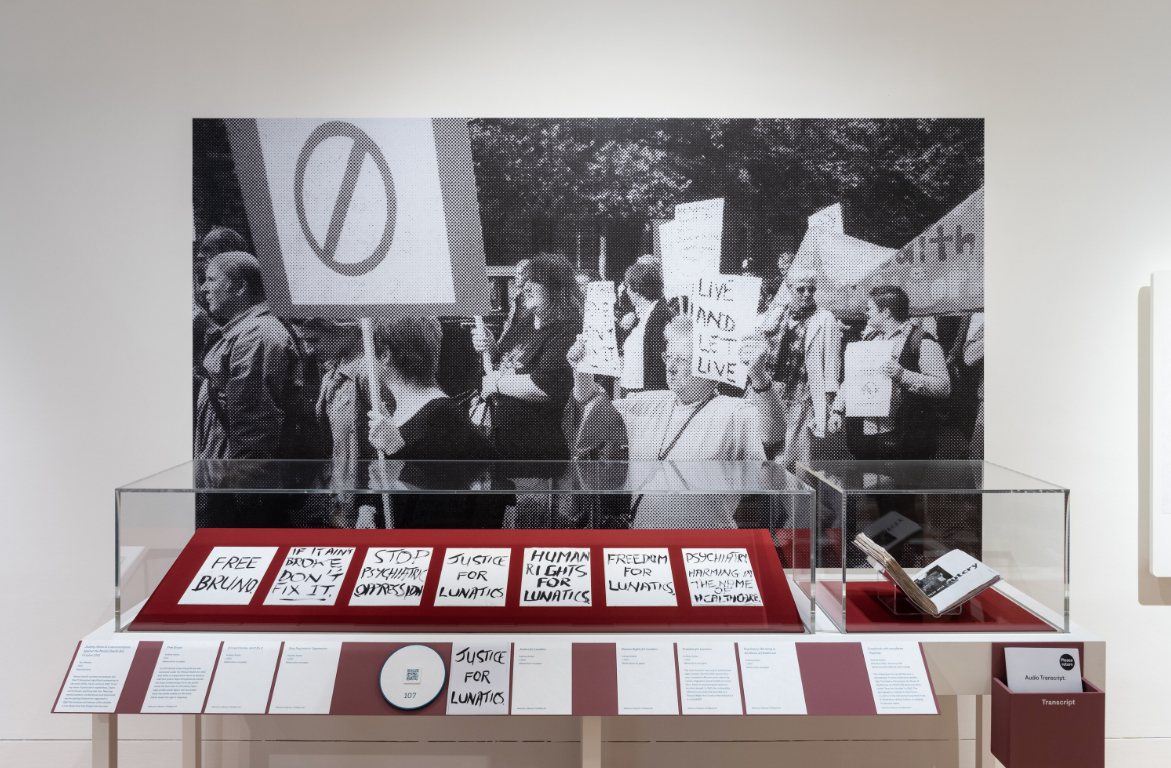
Installation view of Audrey Amiss: The Surviving Exhibitions at the Wellcome Collection. Photo: Steven Pocock / Wellcome Collection
Cieslik: This does not deny the fact that she really suffered in the mental healthcare system. How does this show highlight works that foreground the violence inside this system, both as a way to process that trauma and also hold systems accountable?
Kennedy: I think one of the key ways that Amiss highlighted the harms of the mental health systems she experienced was naming it in those terms – by not adopting the language of ‘care’ that the system itself uses to describe detention and force. It's through her graffiti sign slogans like ‘Stop Psychiatric Oppression’ and ‘Psychiatry. Harming in the Name of Healthcare’, where she makes explicit that what’s presented as care can actually do harm. In that sense her way of calling out the violence in the system finds parallels in Rudy Loewe’s project presented adjacent to hers, whose use of the term ‘carceral care’ points to the understanding that violence isn’t just present in the physical acts of restraint that happen to people in custody, it’s woven into the structures by which people can end up funneled towards detention in the first place. And Amiss’s way of trying to hold the system accountable was similarly multipronged. It did include collective forms of resistance like joining other survivors in peer-led organizing and protests, but it also included using her artistic skill to make really tender observational drawings from inside wards to show people what her own experiences of psychiatric detention were like. Those works are really powerful to spend time with.
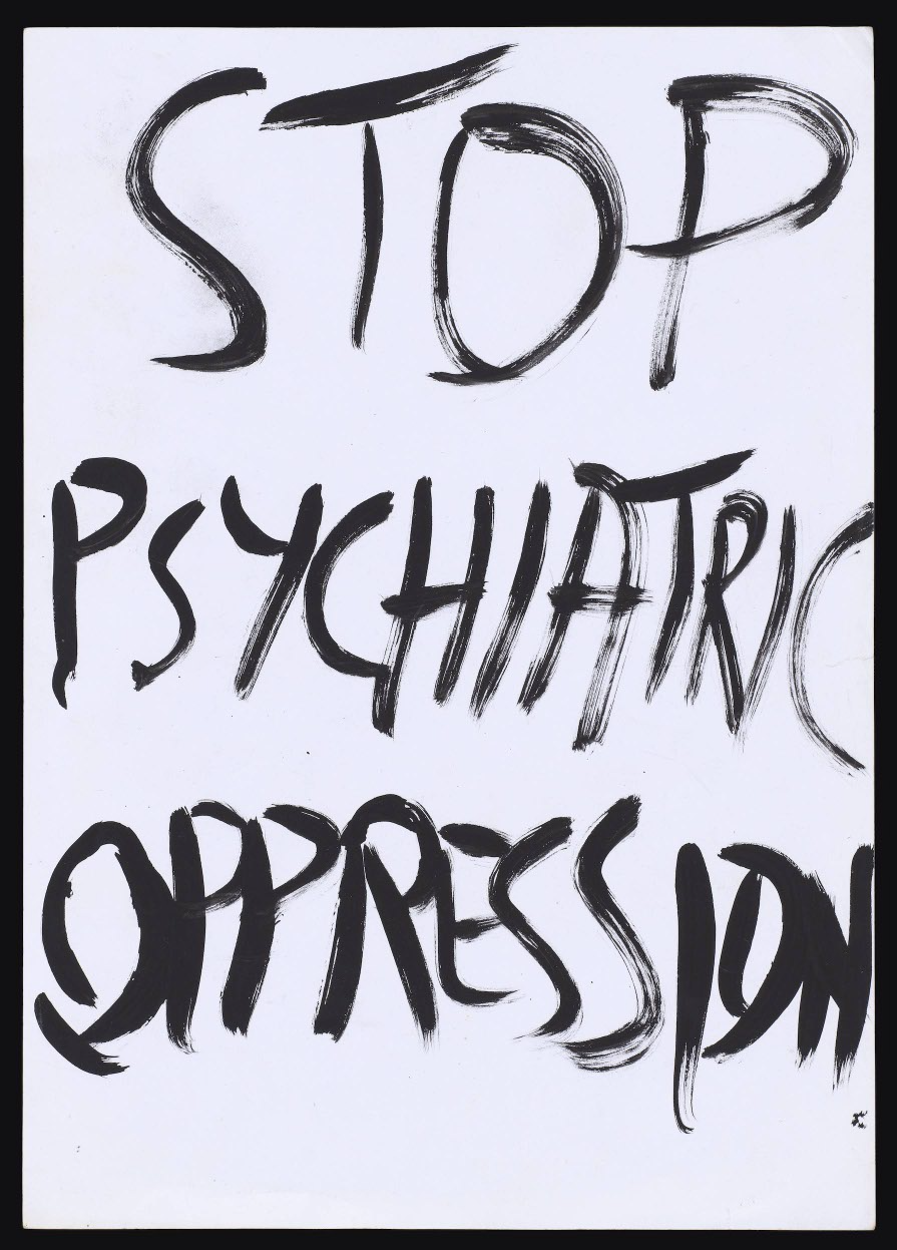
Audrey Amiss, Stop Psychiatric Oppression, 2002. Courtesy Wellcome Collection © Wellcome Collection
Cieslik: I know that recent exhibitions foregrounding disabled artists engage critically with crip studies, a growing field exploring disabled culture and liberation. Similarly, Mad studies which explore the experiences and cultures of people with mental illness have grown over the past decade. Do you consider this exhibition in conversation with Mad studies?
Kennedy: Yes I’d say so. Some of the works on display touch on Amiss’s own relationship to the idea of being mad, both in the pejorative sense of the term and the way it’s been reclaimed by Mad Pride movements. Whilst she generally resisted the label ‘mad’, and seemed to use the term in its derogatory sense in her work ‘Psychiatrists are Mad’, by the early 2000s she was really engaged with peer-led organizing by the likes of Survivors Speak Out and Mad Pride. She read books by self-proclaimed ‘mad’ authors, including Mad Pride: A Celebration of Mad Culture, and said she wanted to contribute a book of her ward drawings to what she called this ‘new literary genre’ of ‘mad memoirs’. And next door in Rudy Loewe’s exhibition they’ve included the Mad Youth Organise Manifesto among the books and resources available for visitors.
Cieslik: What do you hope people visiting the exhibition walk away with? How are exhibitions that explore the work of artists with mental illness important, especially amid continued ableism in the art field?
Kennedy: Part of what I hope people come away with is an understanding of Audrey Amiss on her own terms. And that creates an interesting duality with regards what I hope the show can mean for fellow mental health survivors. Because in order to understand Amiss on her own terms, we can’t reduce her to a figurehead for a wider group of people. However, Amiss herself was so committed to supporting fellow survivors, and in seeing her respected, celebrated, and taken seriously for her insights and talents, I hope that does speak to survivors today. Actually, there's a really beautiful article written by the artist and activist Dolly Sen in anticipation of this exhibition which describes Amiss as ‘ready to fight for your justice at the drop of a hat’, and concludes ‘I hope her legacy inspires and comforts today’s survivors, that one of our cultural ancestors is a woman called Audrey Amiss.’ That really resonated with me.
And to pick up on your second question about making exhibitions like this amidst ableist culture, I think some of the imaginaries of what ableism means that are beginning to gain mainstream understanding in our field – to the extent that that's happening – don’t always recognize ableism’s relationship to sanism, but they are deeply entangled. Showing work by artists who have experienced mental health challenges means those artists having space to speak for themselves rather than be spoken for, and that’s so fundamental to anti-ableist work – the principle of ‘leadership of those most impacted’, in the words of Sins Invalid.
Cieslik: And how can we communally as members of the public and cultural institutions support disabled artists to receive recognition and financial support during their lifetimes rather than after death?
Kennedy: As a curator, the greatest teachers I’ve had have been disabled artists, whether through direct collaborations or learning from them from afar. I think about Johanna Hedva sharing their Disability Access Rider as a template for anyone who could benefit from using it as a model to write their own, but also for curators and institutions to show the kinds of access considerations we should be accommodating anyway. Since reading that I’ve come to think of collaborators’ access riders – whilst confidential in themselves – as a powerful collective manifesto yet to be assembled, of all the things that the sector should be doing to enable artists. And obviously there's no one-size-fits-all solution to access barriers, in cultural institutions or wider society, but as a disabled curator myself, I feel fortified seeing how disabled artists identify and articulate what they need, and the networks of ingenious mechanisms by which they make living and creating under ableism survivable through the adjustments they’ve designed on their own or with peers. So my hope is that as the sector gets better at understanding how to remove barriers for people, we can build processes that aren’t just fed by disabled people teaching us how to do our work better, but where the flow of support can shift more meaningfully towards supporting them, with institutions creating systems that empower disabled artists without them always needing to show us how. That’s something my colleagues at Wellcome Collection have been working towards for years, and occasionally I’ve seen that result in offering someone an access accommodation that they hadn't yet imagined to be possible, which feels really profound.
I think this will become more and more possible the more disabled people we see in leadership and decision-making roles in institutions, and the more we extend the same access considerations towards audiences too, not least out of the recognition that if disabled people aren’t made to feel welcome in these spaces they’re far less likely to end up bringing their expertise to working in them. That's something that has been really beautiful to witness whilst collaborating on the parallel exhibition with Rudy Loewe: to see how as a disabled artist they embed anti-ableism and accessible practice in every facet of their work. So my short answer to how to support disabled artists is to follow their lead. They’re envisioning the kind of world in which Amiss would have got the recognition she deserved during her lifetime and been able to make a show of this scale herself, which I would’ve loved to see.
Audrey Amiss: The Surviving Exhibitions will be on display until February 7, 2027.

Emma Cieslik
Emma Cieslik (she/her) is a queer, disabled and neurodivergent museum professional and writer based in Washington, DC. She is also a queer religious scholar interested in the intersections of religion, gender, sexuality, and material culture, especially focused on queer religious identity and accessible histories. Her previous writing has appeared in The Art Newspaper, ArtUK, Archer Magazine, Religion & Politics, The Revealer, Nursing Clio, Killing the Buddha, Museum Next, Religion Dispatches, and Teen Vogue
view all articles from this author