Whitehot Magazine
September 2026
"The Best Art In The World"
"The Best Art In The World"
September 2026
Exhibition Review: Thomas Houseago's "Collages (for a world gone mad)" at the Rubell Museum DC
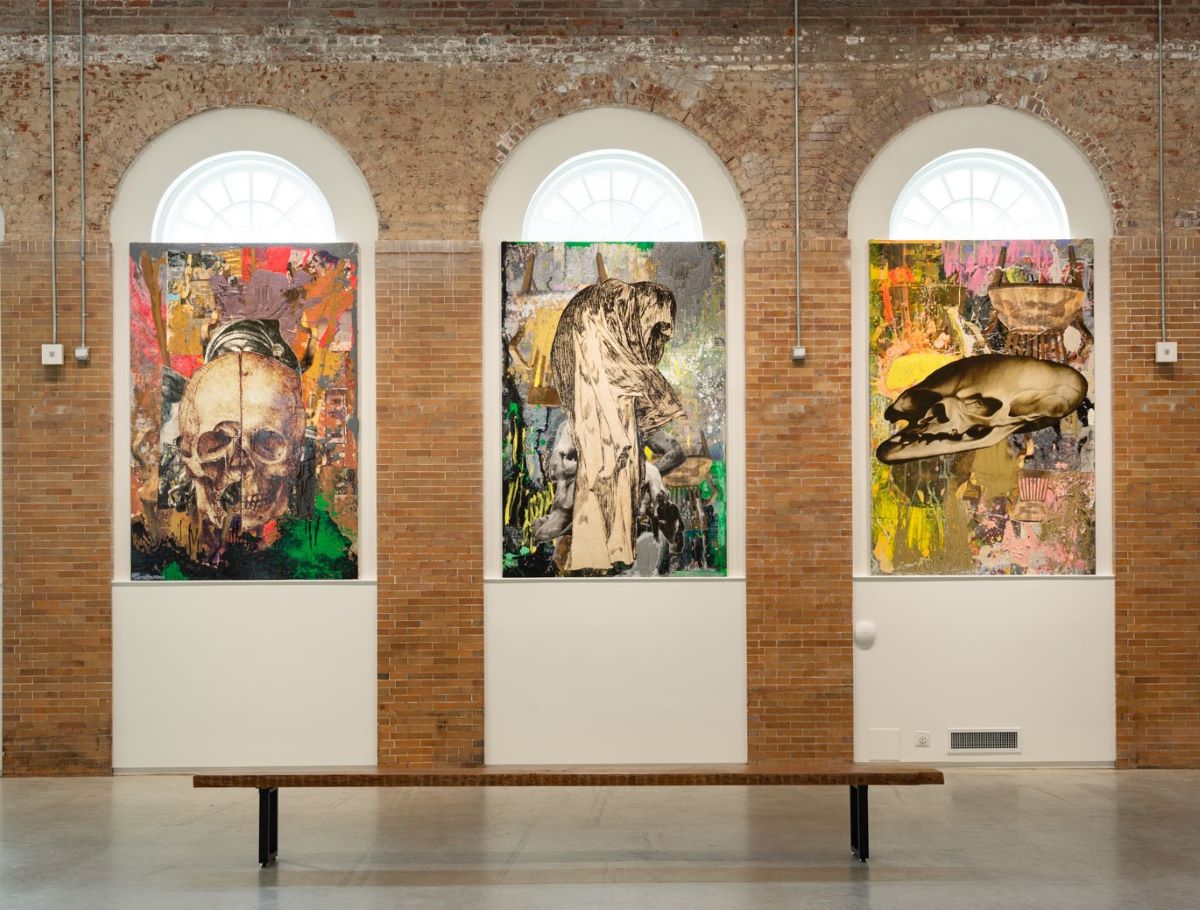
"Antiamnesia I, II, III," acrylic, oil, paper, and glue on canvas, 108 x 72 x 2 1/2 in., 2025. (Photo Courtesy of the Rubell Museum, Miami and Washington, DC.)
By NATE HESTER September 21st, 2026
For starters, I love the sculptural work of Thomas Houseago. I love the larger school of "Neo-Primitivism” or the “Contemporary Grotesque” in which his work is commonly categorized under the same rubric as artists such as Huma Bhabha, David Altmejd, Robert Nava, Thomas Schütte, Folkert de Jong, Paul McCarthy, Matthew Monahan, Daniel Silver and Nicole Eisenman. I love the Rubell family and the way that they go about collecting by supporting living, or emerging artists. I love the space that the Rubells have created in Washington DC on the occasion of their fifth anniversary in the Navy Yard. The space is in the shadow of the United States Capitol, in a repurposed school which originally educated a primarily Black community at the turn of the last century. I love the larger exhibition now on view, “Friends, Lovers and Me.” I even deeply resonate with the powerfully evocative, albeit horrific, mixed media on wood pieces in the basement by Houseago which address his pre-verbal trauma revisited after the death of his father from 2023. They are raw and vulgar and fully inhabited.
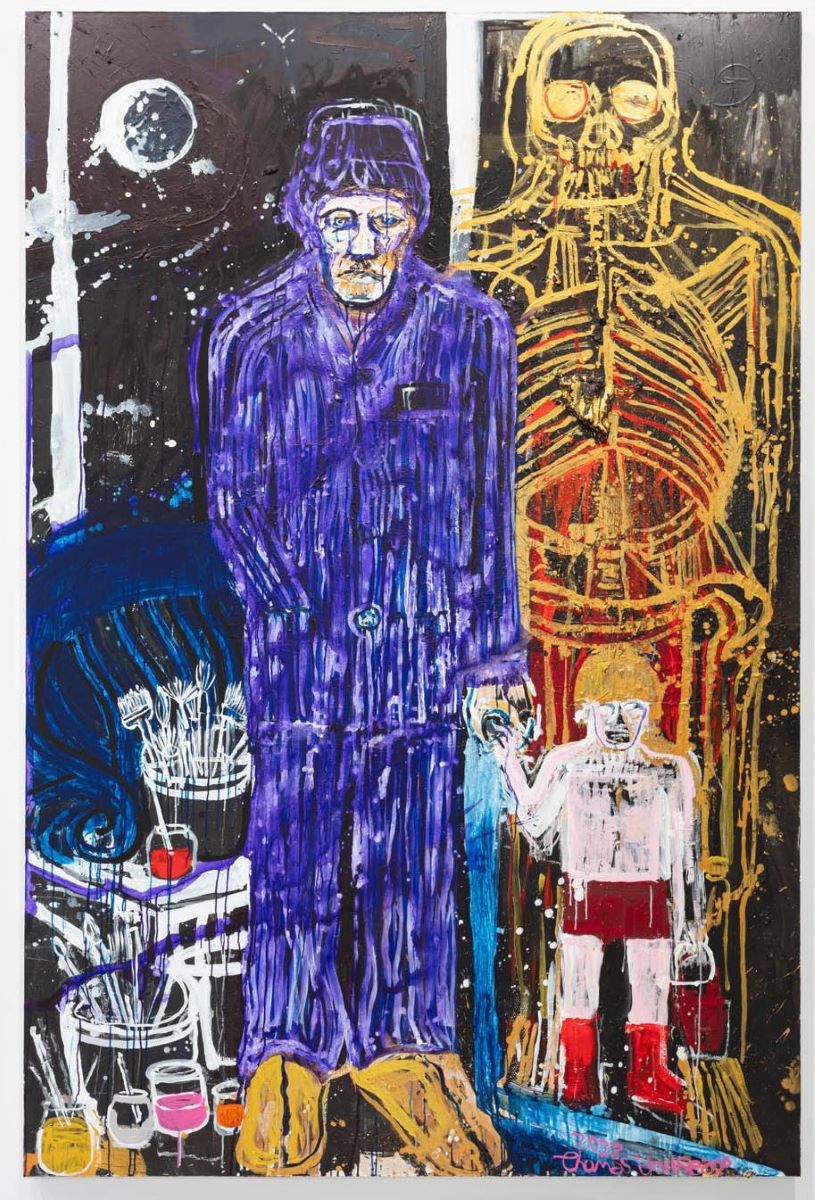
"Stage 3 - Mirror in Studio - living with not in," mixed media, 108 x 72 x 3 1/2 in., 2023 (Photo Courtesy of the Rubell Museum, Miami and Washington, DC.)
But, upstairs, in the main gallery, “Collages (for a world gone mad)” is a swing and a miss. The computer paper printouts are coming unglued and curling up at the edges on several of the pieces. The two square works on the north wall which are centered in a series of six arched niches are wider and shorter than the window that they cover creating an awkward architectural conjunction. Houseago is a maestro of dynamically activating spaces with his hulking yet vulnerable three-dimensional creations; and yet these 21 wall-mounted works, for all of their purported audacity, get gobbled up by the room - the coy flashes of neon pink, yellow, and green tempera fade too easily into the noise of the orange glow of the federally-mandated “EXIT” sign over the doorway.
And, for a scion of materiality in his wider sculptural opus, with stark, grim and severely minimalist juxtapositions with a sprinkle of whimsical playfulness, these seem overwrought, sloppy, ill-considered and worst of all decorative. The five largest pieces are organized spatially with little to no imagination as a distorted, black-and-white photocopy of a medieval etching occupies roughly a third of the total surface area in the dead center of the bottom half of the rectangle exactly on the vertical axis. The layered imagery itself builds locally piece-to-piece but doesn’t relate visually or tonally to the entirety; oftentimes, the straight edge of the 8.5 x 11 in. sheet remains. The colored elements are merely additive and are often only deployed to fill in the gaps between zones of upcycled pop-culture noir imagery.
So, what one is left with is more of an experience of viewing a “mood board” or a creepy Pinterest page. Cue 'The Rocky Horror Picture Show’s' version of Julie Andrews’ “Sound of Music”: “These Are a Few of My Favorite Things.” This is not necessarily a bad thing. Houseago is one of our living geniuses! A peek inside his brain is still a peek inside his brain. It just could have been so much better. The interpretive literature for the show calls them “psychologically intense.” I disagree. I believe that they are collections of illustrations of the concept of “psychological intensity,” but they lack the tooth or soulful presence to back that up. The same wall signage calls them “self-excavations.” I disagree. Instead of going deep within the artist, they, sadly, stay on the surface. By showing so much, they reveal far too little. This is the brochure for a ghost tour; it is not an encounter with the ghost.
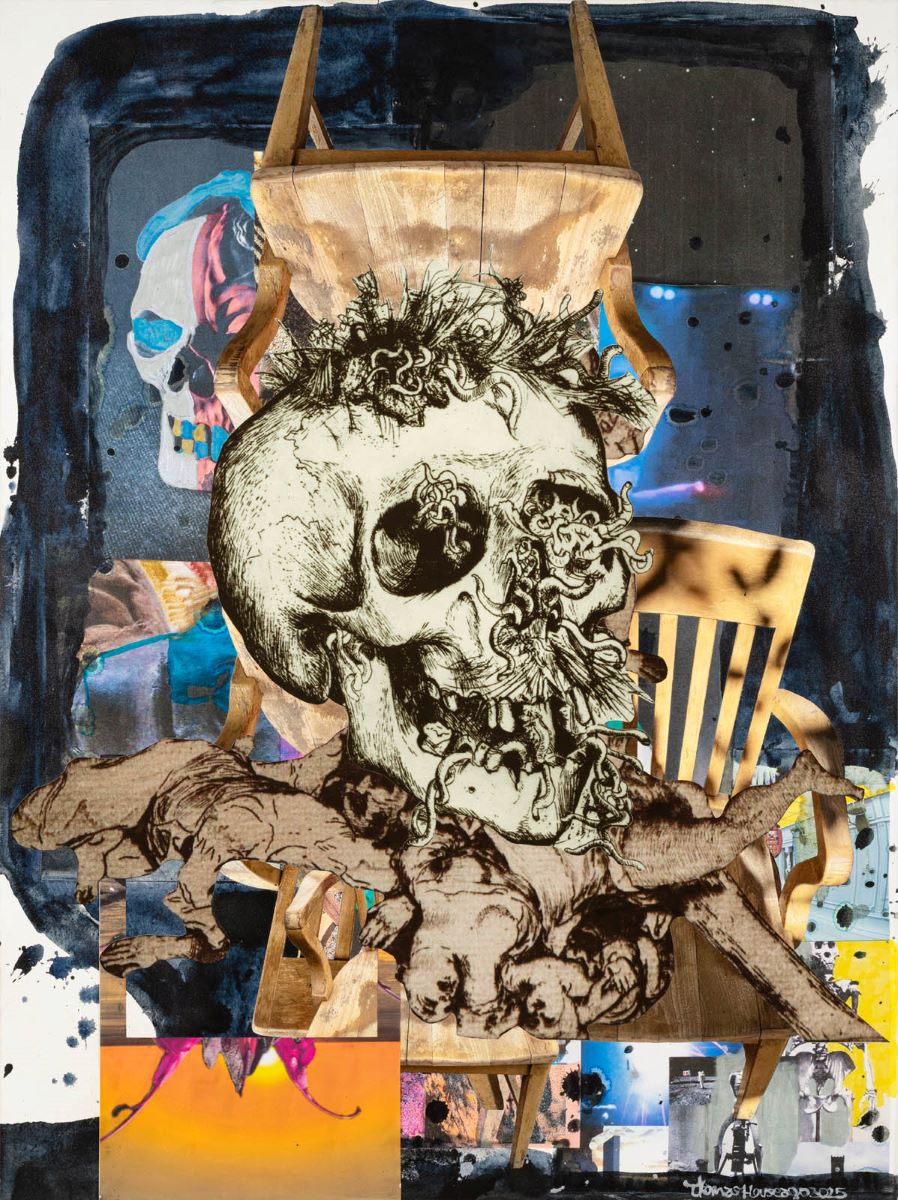
"Cortex- Vortex Painting I," acrylic, oil, paper and glue on canvas, 96 x 72 x 2 1/4 in., 2025 (Photo Courtesy of the Rubell Museum, Miami and Washington, DC.)
Don’t get me wrong: I had a lot of fun nerding out while looking at them. It is cool to walk through the Hall of Fame of Western Art History’s “dark side:” Goya’s “Saturn Eating His Children” and “Disasters of War,” Ingres’ “Jupiter and Thetis,” Van Gogh’s studio chair, Picasso’s “Demoiselles d’Avignon,” Rodin’s “Burghers of Calais,” Dürer’s “Riders of the Apocalypse” and the Japanese yōkai monsters. It is cool to see menacing flowers and dismembered eyeballs and skulls and owls and horses and U-Haul boxes alongside tabloid pictures of Epstein, Trump and Prince Andrew ducking in the backseat behind his chauffeur. I also always love a good David Bowie sighting. But, I am just not buying the artist’s description of their larger relevance as cinematic consciousness - “how the mind moves through time and references” - unless the conclusion is that we move through the nightmare of life casually, callously and indifferently.
This all leads me to a final question. What is the value of the “aesthetics of ugliness?” On the one hand, the world can be ugly. If an artist is a spiritual filter, taking the pulse of the globe, it would be disingenuous to paint a pretty picture amidst all the atrocities. Truth is beauty! At some point in the show, Houseago highlights Courbet’s “The Meeting” of 1853. Courbet considered himself a realist - painting commoners like the poorly clad villagers in the “Burial at Ornans” with thick, palette-knife paint - neither like the Beaux Arts idyllic nymphs of Bouguereau nor like the scientific exactitude of the daguerreotype camera. I think Houseago might see himself in this “realist” tradition. He holds us underwater to shock us out of our illusion of a safe, hygienic world. The other real value of visually processing personal trauma is that haptic and visible grief might be inspirational to others who are hurting. It might ignite courage. It might help someone face their own demons and find their own way through or out of life’s ugliness. Or, maybe, better still, to embrace the awfulness as a destination--getting comfortable with or transcending suffering à la Marina Abramović.
The main danger in critiquing and exposing the worst abominations of a narcissistic culture - is that you might just end up photographing yourself staring into your own reflection in the same pool of water as Narcissus and posting it on Instagram. Hate so easily begets hate; frivolity engenders further frivolity. So, then, how do we maintain our own sanity, wholeness and well-being in a “world gone mad?” How do the arts assist with that process? Escapism? Exorcism? Justice advocacy? I am glad that this question is being asked by the Rubell Collection so unflinchingly in this political climate with the removal of modernist, avant-garde sculpture and the proposed erection of imperialist, triumphal arches in and around Washington DC. But, the jury is still out on whether or not this body of work of Thomas Houseago gives us much of a roadmap for the best way to move forward.
“Collages (for a world gone mad)” Through fall 2027, Rubell Collection, Washington,DC
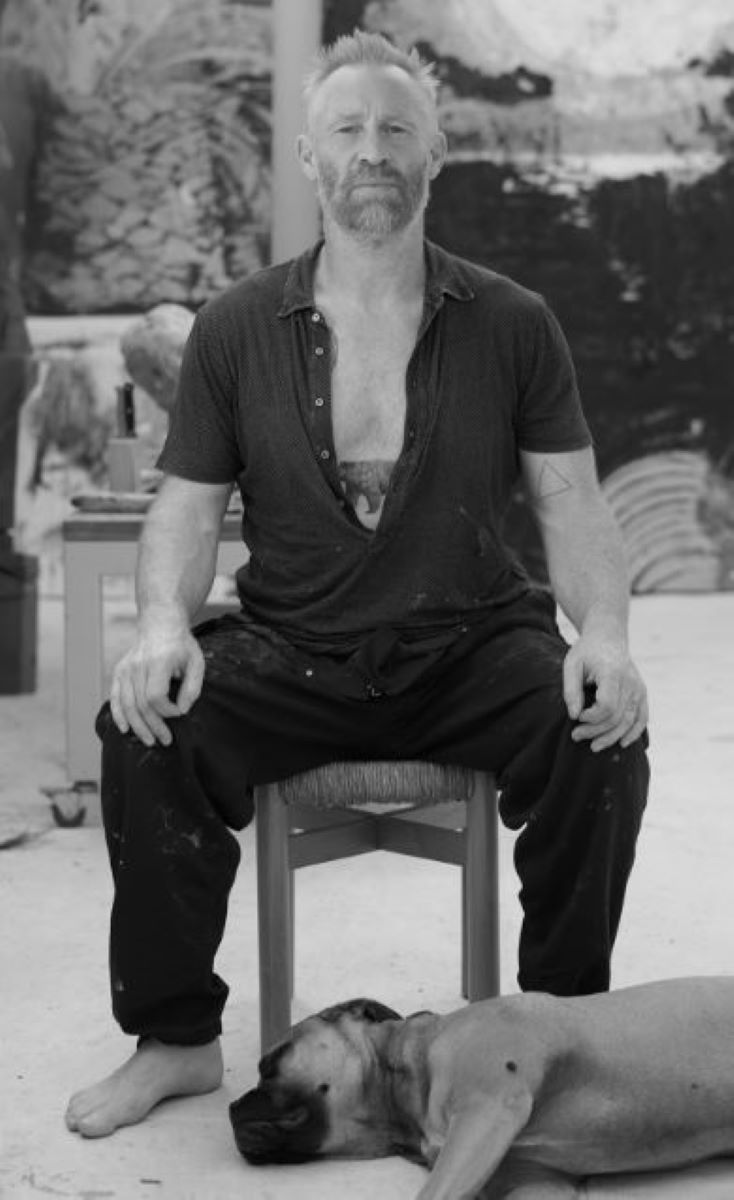
Photo of the Artist, Courtesy of Amanda Demme & Gagosian Gallery
Houseago was born in 1972 in Leeds, England. He studied at Jacob Kramer College, Leeds, England from 1990 to 1991, received a BA in 1994 from Saint Martin’s School of Art, London, and studied at De Ateliers, Amsterdam, from 1994 to 1996. Recent exhibitions of Houseago’s work include Stedelijk Museum Bureau, Amsterdam (1996); Thomas Houseago, I Am Here, Selected Sculptures 1995–2003, Stedelijk Museum voor Actuele Kunst, Ghent, Belgium (2003); A Million Miles Away, Modern Institute, Glasgow (2007); There’s a Crack in Everything, That’s How the Light Gets In, Contemporary Fine Arts, Berlin (2009); The Artist’s Museum, Museum of Contemporary Art, Los Angeles (2010); What Went Down, Modern Art Oxford, England (2010, traveled to Ashmolean Museum, Oxford, England; Museum Abteiberg, Mönchengladbach, Germany; and Centre International d’Art et du Paysage de l’Ile de Vassivière, Beaumont-du-Lac, France, through 2011); Amy Bessone and Thomas Houseago, Rennie Museum, Vancouver, Canada (2010); Beat of the Show, Inverleith House, Edinburgh, Scotland (2011); The World Belongs to You, Palazzo Grassi, Venice (2011); Where the Wild Things Are and Hermaphrodite, Sainsbury Centre for Visual Arts, Norwich, England (2012); Striding Figure/Standing Figure, Galleria Borghese, Rome (2013); As I Went Out One Morning, Storm King Art Center, Cornwall, New York (2013); Studies ’98–’14, Gemeentemuseum Den Haag, Netherlands (2014); Lovers, Académie Conti, Vosne-Romanée, France (2015); Royal Academy, London (2019); Almost Human, Musée d’Art Moderne de la Ville de Paris (2019); Vision Paintings, Royal Museums of Fine Arts of Belgium, Brussels (2021). His work was included in the 2010 Whitney Biennial. Houseago has collaborated with the New York Public Art Fund on two public sculptures: Statuesque (2010) and Masks (Pentagon) (2015).

Nate Hester
Nate Hester is a transdisciplinary artist (Boston University, New York Studio School) whose work explores technology's impact on the psychopolitical dynamics of the American home and our collective memories through a practice rooted in anti-racist discourse and family systems theory. He lives and works on an ancestral farm in rural North Carolina. When not building surreal ecosystems, Hester enjoys fresh fruit pies around sing-along campfires with his young daughter and the occasional spa day a luxury hotel.
view all articles from this author