Whitehot Magazine
October 2026
"The Best Art In The World"
"The Best Art In The World"
October 2026
Mark Whalen & Salomon Huerta: LUMBRE at Ruttkowski;68 Paris
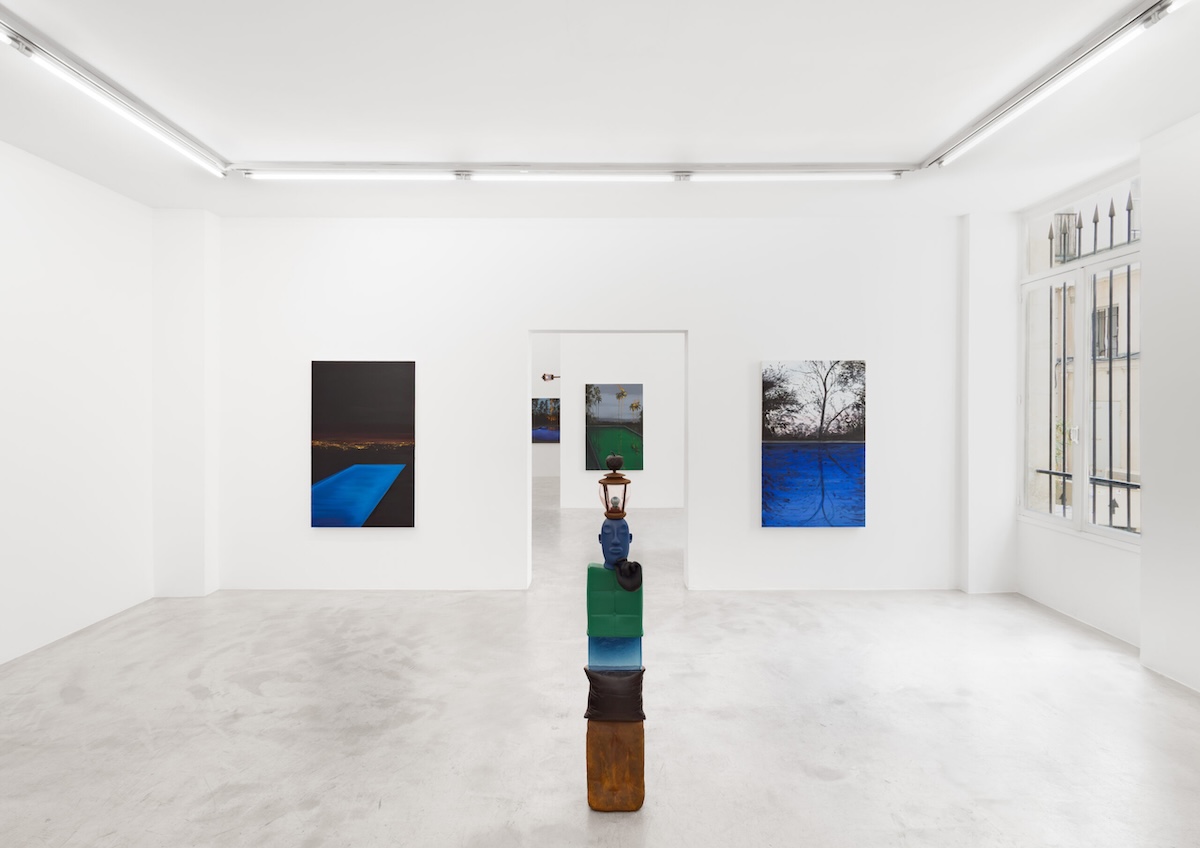
Installation view, Mark Whalen & Salomon Huerta: LUMBRE, Ruttkowski;68, Paris, 2026. Courtesy of the artists and Ruttkowski;68.
By ISABELLE ADA BERGMANN July 8, 2026
Ruttkowski;68 welcomed us to Paris on Saturday evening for the opening of LUMBRE, the first duo exhibition by Mark Whalen and Salomon Huerta.
Their practices converge around a shared question: how might we trace the relationship between people and the spaces they inhabit?
The exhibition unfolds in the wake of California’s devastating 2025 wildfires, in which both artists lost their homes.
In Huerta’s new body of work, the painter retrieves the swimming pool as a site of memory. These scenes are inhabited only by water reflecting flames, a solitary chair, and a handful of palm trees on the horizon. Without the slightest trace of those who once occupied these places, I find myself suspended between catastrophe and its aftermath. Time itself remains indeterminate: in the dusty light, I cannot tell whether these are the first hours of the day or the last. The pool becomes the only enduring clue, a recurring motif drawn from Huerta’s adolescence, when he cleaned swimming pools in affluent neighborhoods, now punctuated by flames drawn from photographs he received as the fires unfolded.
Huerta tells me that each painting was completed in a single gesture, the brush pulling paint horizontally across the canvas in one uninterrupted sweep, shifting from black to fluorescent turquoise. I enter these works as though entering a still life. I never know whether the flames have already reached his own home.
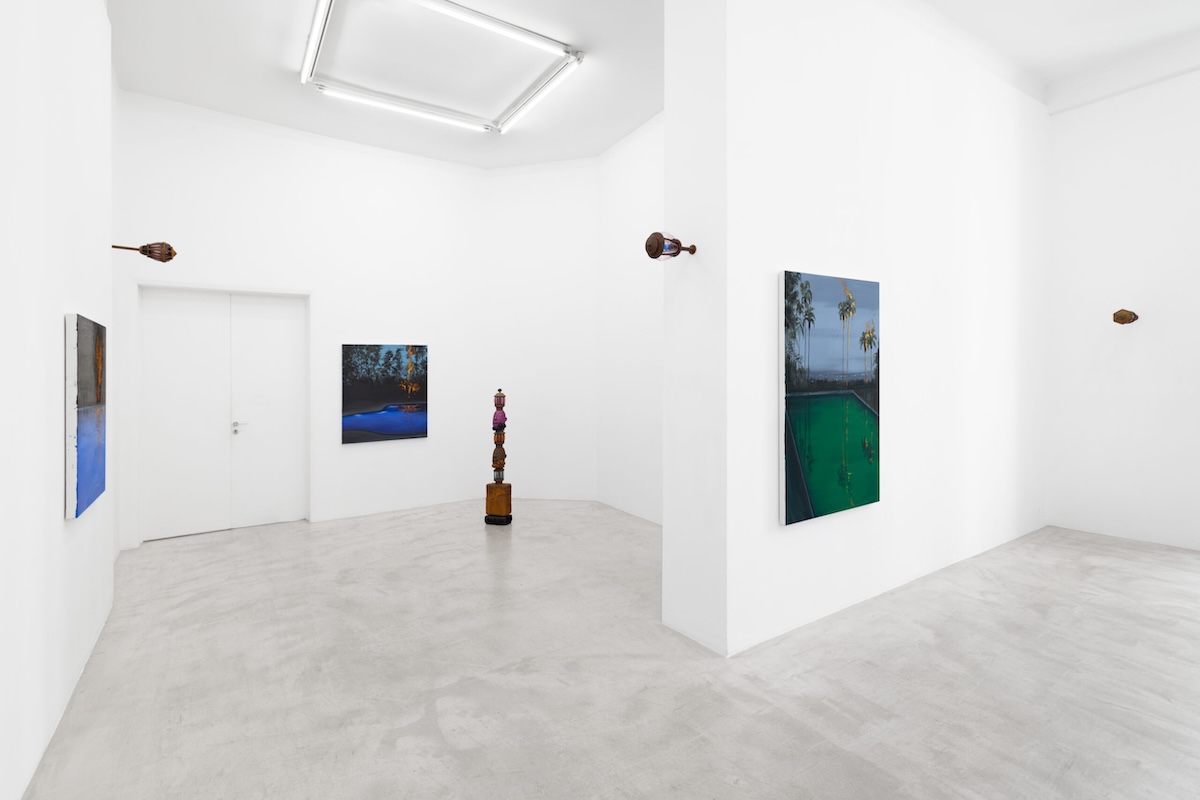
Installation view, Mark Whalen & Salomon Huerta: LUMBRE, Ruttkowski;68, Paris, 2026. Courtesy of the artists and Ruttkowski;68.
Moving among Whalen’s sculptures, the exhibition opens onto another register of witness.
Known for his stacked sculptural forms, Whalen has conceived for LUMBRE a series of totems in glass, bronze, aluminum, and steel. Installed alongside lamps that lift our gaze to their height, each sculpture culminates in casts of burnt fruit recovered from his neighbor’s property after the fires.
I find myself returning to two works at the entrance, mounted on solid blocks of glass whose reflections quietly echo the shifting surfaces of Huerta’s pools.
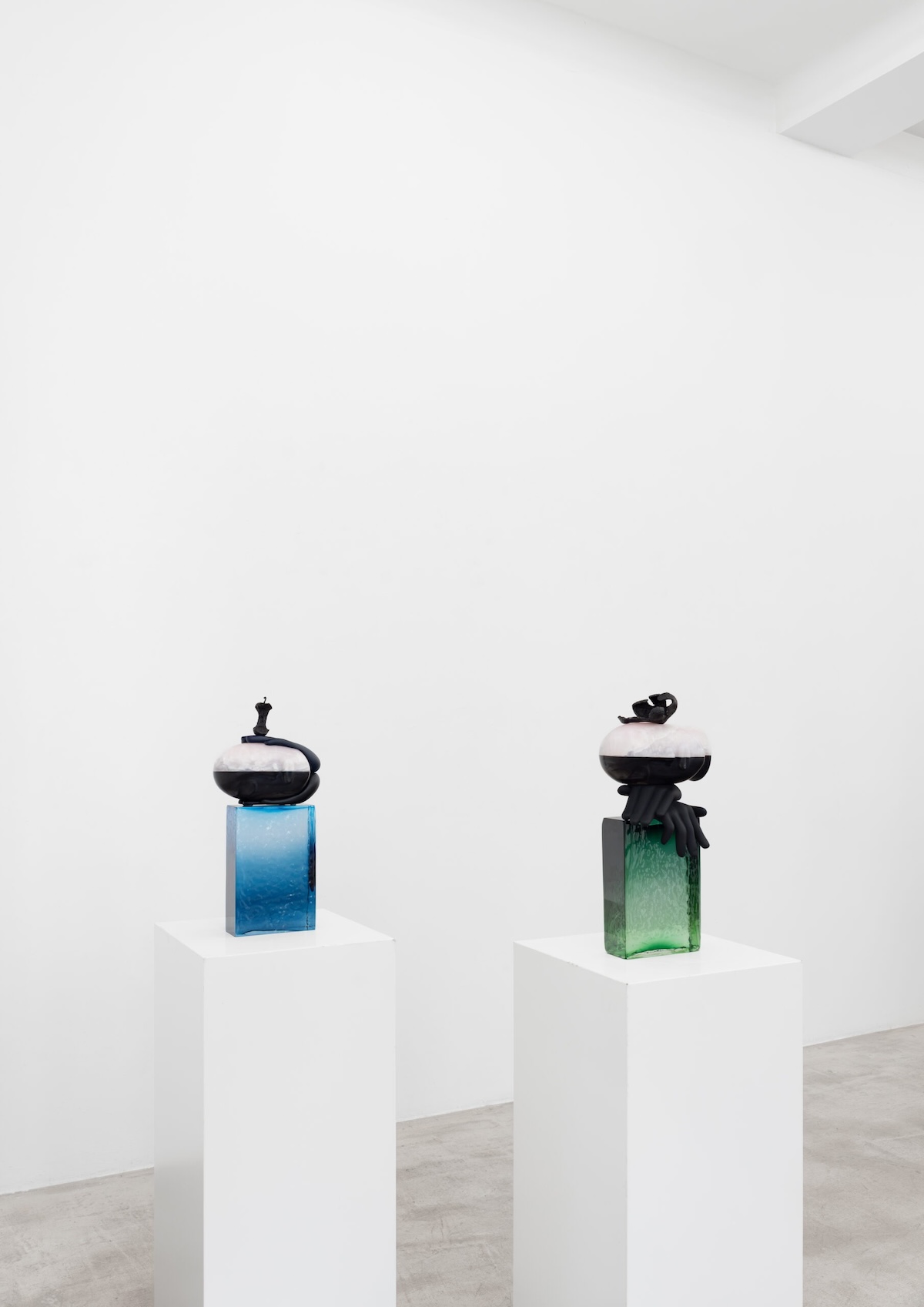
Left: Mark Whalen, One Day at a Time, 2026, glass, bronze, aluminium and steel, 49.5 x 22 x 15 cm, 19½ x 8⅝ x 5⅞ in, unique. Right: Mark Whalen, Quietly Waiting, 2026, glass, bronze, aluminium and steel, 50.5 x 22 x 15 cm, 19⅞ x 8⅝ x 5⅞ in, unique
Where Huerta leaves the landscape deserted, Whalen gathers what survives. His objects become relics of the uninhabited spaces that linger throughout the paintings.
Huerta tells me that he and Whalen spoke only once while preparing the exhibition, and only about the number of works each would produce. Yet despite the absence of any further formal dialogue, Lumbre arrives with remarkable cohesion. Far removed from the fluorescent palette that has long defined Whalen’s practice, the exhibition unfolds through a restrained chromatic register that quietly binds the two bodies of work within the space of Ruttkowski;68.
Through their singular approaches to memory, Huerta’s vast poolside horizons and Whalen’s vertical accumulations begin to speak the same language. Familiar motifs gradually detach themselves from autobiography to become forms of witness. Standing before these works, I feel unexpectedly fragile, lifted by the rounded silhouettes of the totems before finding myself suspended beneath skies consumed by rising flames.
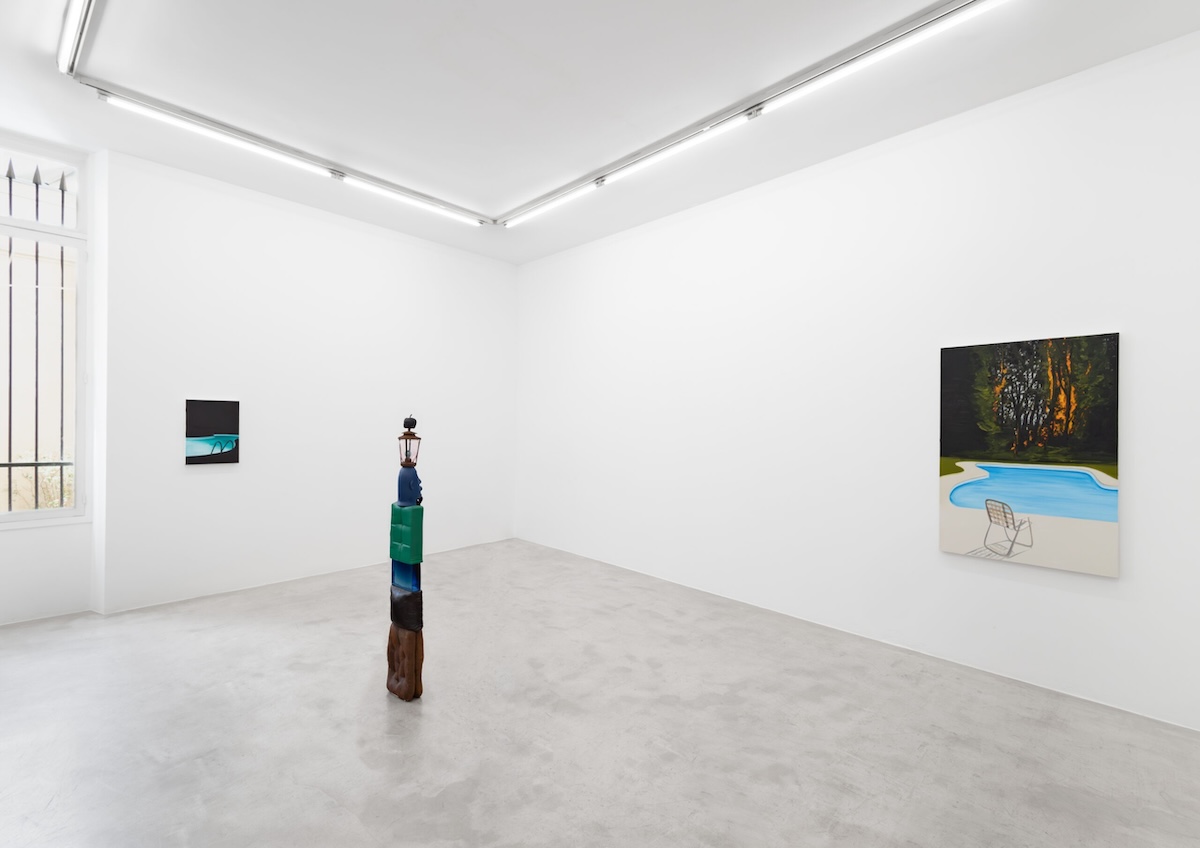
Installation view, Mark Whalen & Salomon Huerta: LUMBRE, Ruttkowski;68, Paris, 2026. Courtesy of the artists and Ruttkowski;68.
How does one recount catastrophe when the first necessity is simply to have borne witness to it?
LUMBRE is on view through August 1 at Ruttkowski;68, 8 Rue Charlot, 75003 Paris.

Isabelle Ada Bergmann
Isabelle Ada Bergmann is a writer and former student of the Cooper Union, currently based in Paris.
|
view all articles from this author