Whitehot Magazine
October 2026
"The Best Art In The World"
"The Best Art In The World"
October 2026
Lucy McKenzie: Orchestrion fjk3, Vienna
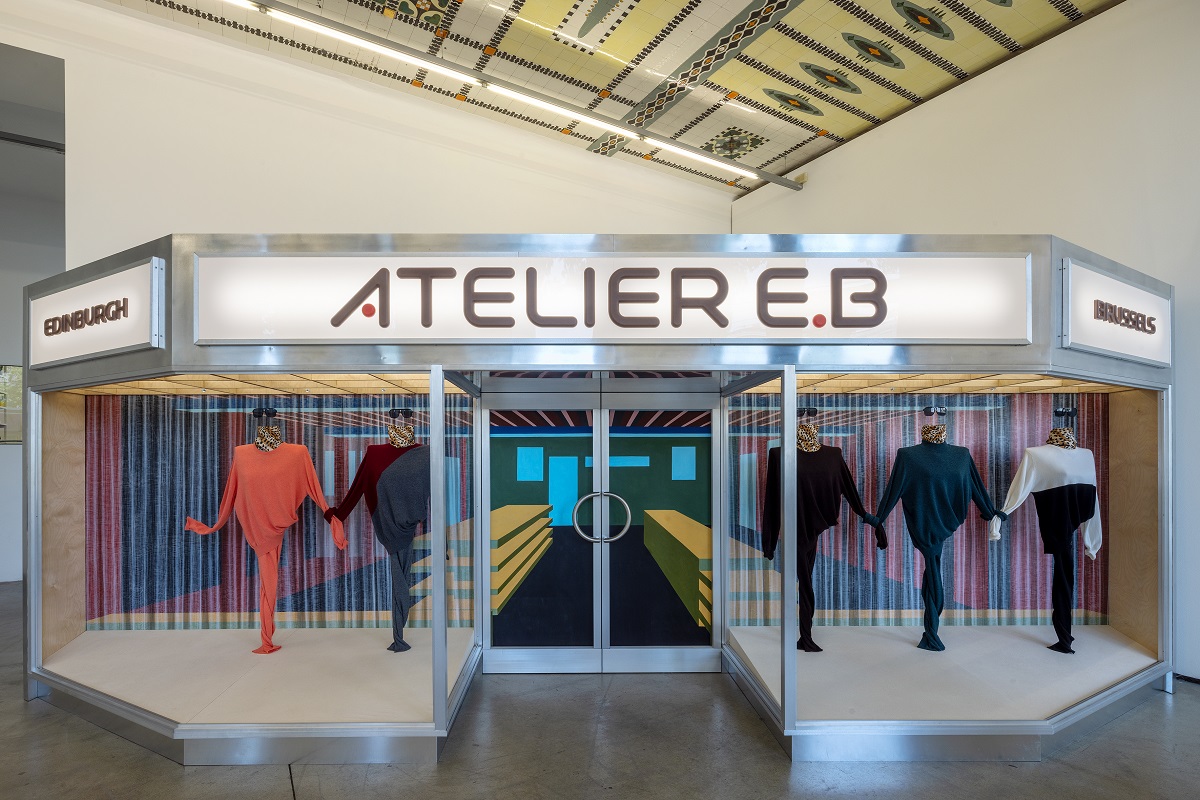 Atelier E.B (Beca Lipscombe & Lucy McKenzie), Faux Sports Shop, 2024, Acrylic and oil on canvas, steel, wood, Perspex, aluminum and textiles, 700 × 100 × 230 cm Courtesy of Atelier E.B and Galerie Buchholz Berlin/Cologne/New York, Photo: Lisa Rastl, Lucy McKenzie, Orchestrion, fjk3—Contemporary Art Space, 2025.
By CHRIS CLARKE October 24th, 2025
The Viennese immigré Frederick Kiesler, in his 1930 book Contemporary art applied to the store and its display, advised prospective designers: “First: make the window look like an entrance and the entrance like a window. Second: make the store interior a showroom instead of a stock room.” It’s a lesson that Lucy McKenzie has adopted, as the first thing you notice in her solo exhibition at fjk3 is seen through the window facing the street. A life-sized installation of a storefront, entitled Faux Sport Shop (2024), stretches across the atrium, advertising the wares of the fashion label Atelier E.B., co-founded by McKenzie and the designers Beca Lipscombe and Bernie Reid. The signage gleams over a trompe-l’oeil painting of glass double doors, while actual windows contain mannequins clad in various designer garments, propped against an illusionistic depiction of a diaphanous curtain. The gallery entrance thus offers up another interior façade.
Incidentally, Kiesler, prior to making his name by designing shop displays for Saks Fifth Avenue in the late 1920s, had briefly collaborated with the Austrian architect Adolf Loos. And it is the figure of Loos that recurs, both directly and implicitly, throughout McKenzie’s exhibition; rather surprisingly, given his distaste for ostentatious decoration and its apparent “immorality”. While his stringent views, proclaimed in the 1913 manifesto Ornament and Crime, would have an abiding influence on modern architecture and design, McKenzie redirects these criticisms right back at him. Loos was convicted as a pedophile in 1928, and it is this genuine act of criminality, rather than his high-minded aestheticism, that she repeatedly emphasises here. As such, there is a seedy, sordid aspect to several works which belie their surface elegance. In Orchestrion, this dichotomy plays out across several, interconnected encounters, cumulatively encompassing notions of artifice and authenticity, austerity and opulence, and, yes, ornament and crime.
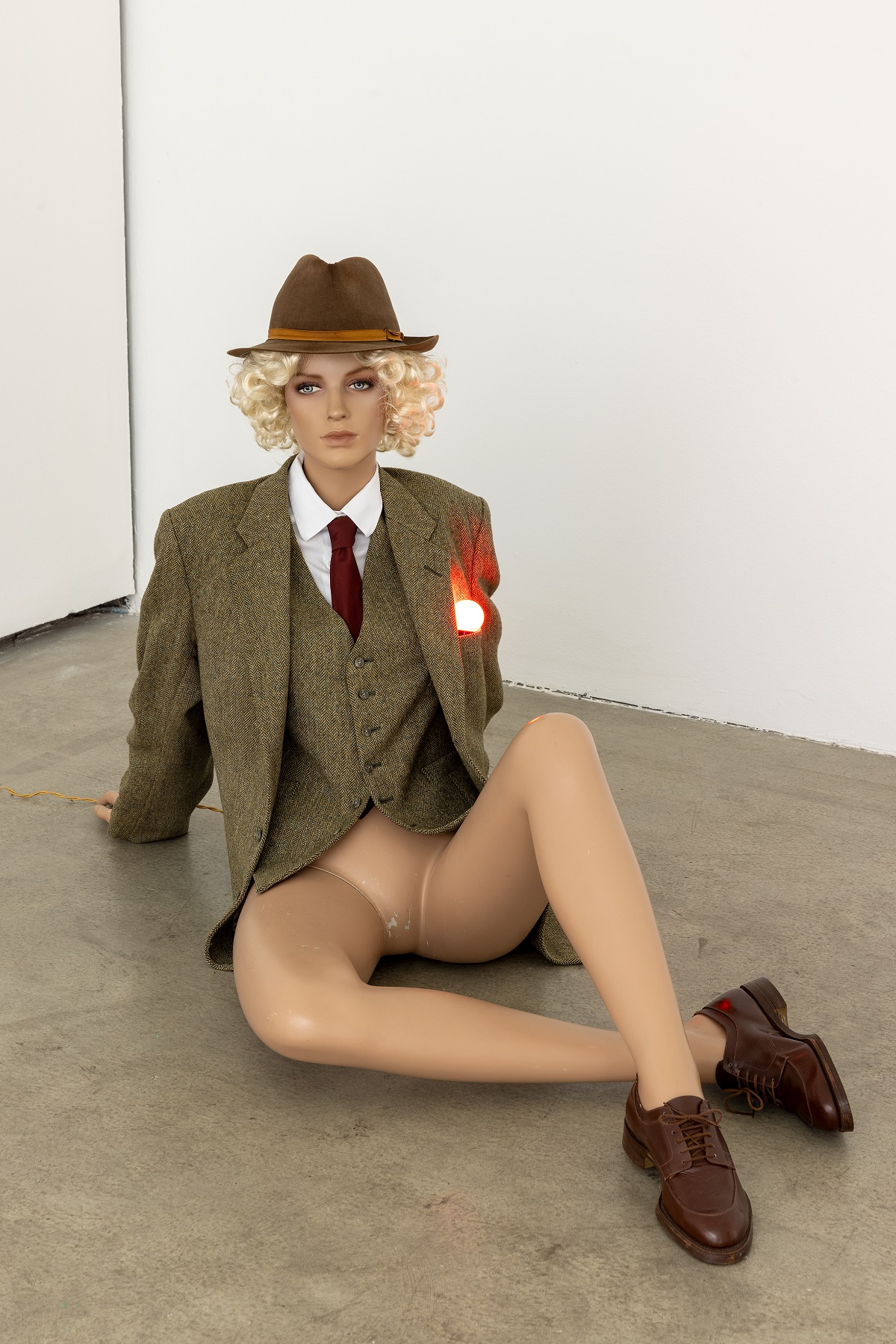 Lucy McKenzie, Duchamp Mannequin (1938), 2025, Fiberglass mannequin, clothing, wig, electric lamp 160 × 90 × 60 cm, Courtesy of Cabinet Gallery, London, Photo: Lisa Rastl, Lucy McKenzie, Orchestrion, fjk3—Contemporary Art Space, 2025.
In the downstairs gallery, a 1904 photograph of Loos has been reproduced, large-scale, from a drawing by the artist and dominatrix Reba Maybury. Inset into this image is a framed business card, bearing Loos’ handwritten address, given to a child he met in the Vienna Prater. This district, which houses the Wurstelprater amusement park, was familiar territory for Loos: his indictment accused him of approaching underaged girls there. McKenzie also juxtaposes this assemblage with a vitrine of pornographic magazines, featuring nude photographs of herself as a teenage model. Their inclusion offers an uncomfortable complement to Loos’ predilections and, in baring her own personal experience, imbues the installation with a sinister, voyeuristic tone. Another allusion to the Prater, and its secret rendezvous sites, is found in Moving Panorama (Kärntner Bar) (2025), a walk-in train cabin, replete with wall lamps, curtains and soft seating. A concealed drum with a painted canvas, hidden behind the carriage, rotates slowly, audibly creaking, to create the illusion of a landscape passing through the window. The work conflates the 19th-century panorama, an object of delightful spectacle and childlike wonder, with the semi-private, dimly-lit enclosure of the train compartment. Under these circumstances, it might just as easily be a crime scene.
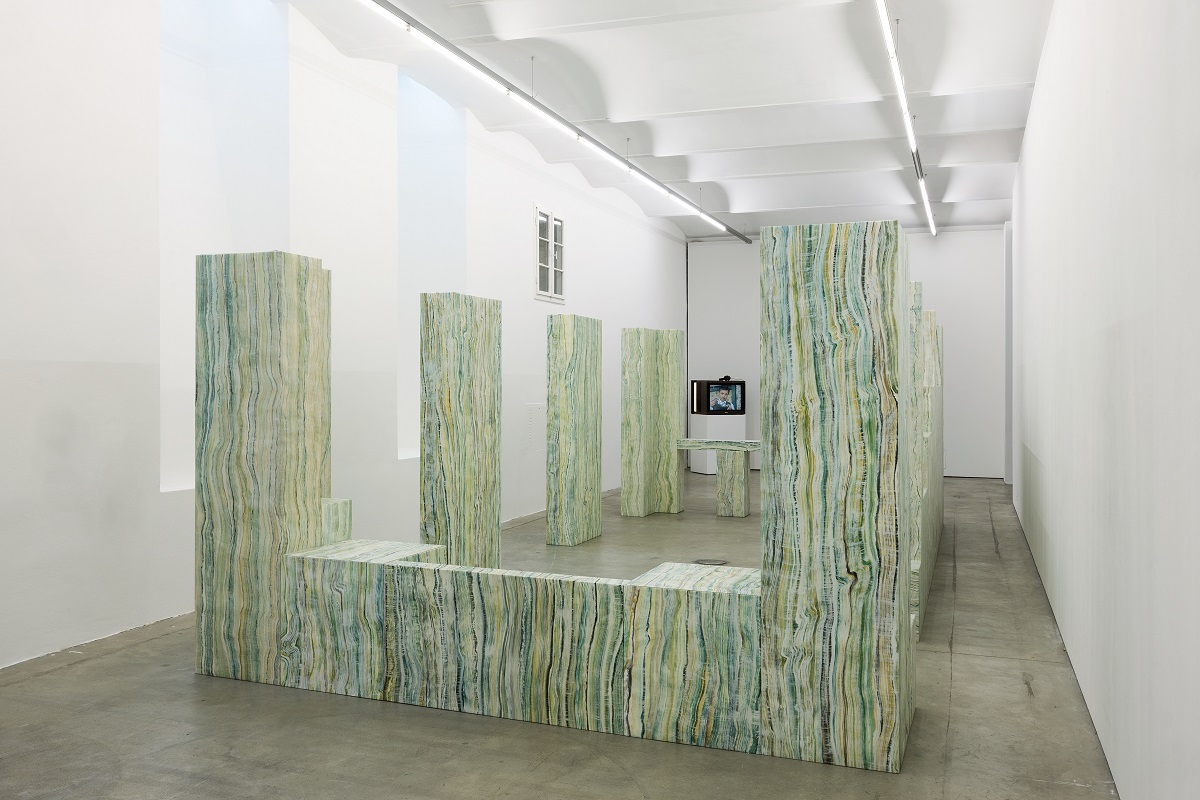 Lucy McKenzie, Loos House, 2013, Oil on canvas on wooden structure, 692 × 322 × 200 cm, Courtesy of Cabinet Gallery, London, Náhrdelík (Necklace) II (Loos’ dream), 2024, Digital film, 17.38 minutes Courtesy of the artist, Photo: Lisa Rastl, Lucy McKenzie, Orchestrion, fjk3—Contemporary Art Space, 2025.
Loos House (2013) comprises a reconstruction of the living room from his Villa Müller in Prague, its original marble finish rendered in meticulous oil painting. McKenzie had enrolled at the prestigious École Van Der Kelen in 2007 to learn such decorative techniques, including, in her words, “faux wood and marble, advertising lettering, illusion painting, patinas, stencilling and gilding,” and there is a perverse satisfaction in seeing these skills applied to Loos, considering his insistence upon the truth of materials. Furthermore, McKenzie pairs the installation with a subtitled film excerpted from the Czech television drama series Náhrdelník II (Loos’ Dream), set within the same building. In one scene, a group of museum directors gossip about his arrest while appraising the architecture - “The priority now is to strip out this marble for our exhibition” - as his third, and much younger, wife Claire eavesdrops on their conversation. Yet another level of artifice and speculation, a polished veneer plastered over an abject underbelly.
Other, less immediately related, works likewise evoke this duality. For example, upon turning a corner, one glimpses a female mannequin, casually lounging on the floor and wearing a blond wig, tweed jacket, waistcoat and felt hat. It only gradually becomes apparent that this figure is otherwise naked, her open legs revealing a smoothed fibreglass pubis, while a glowing red lightbulb peeks from her breast pocket. Although ostensibly a homage to Marcel Duchamp’s similarly fashioned 1938 self-portrait, the work conjures an aura of shopworn decadence, of clandestine affairs and illicit activities. Duchamp himself returned in 1966 from his self-imposed “retirement” with a sculptural tableau - visible only through two peepholes - depicting an anonymous, nude woman, thighs spread and holding a gas lamp. Is there an intentional allusion in McKenzie’s piece to this later, grand finale, or did Duchamp’s last installation simply incorporate those selfsame aspects of his earlier practice? And what about the nearby towering Monumental Street Lamp (2017-24), an edifice of upstanding marbelised slabs plastered with drawings based on Duchamp’s cross-dressing alter-ego Rrose Sélavy? Its illuminated crimson beacon elicits the atmosphere of a derelict red-light district. There is a palpable sense of trespass for the unwitting spectator, as if they’ve just stumbled into the wrong alley.
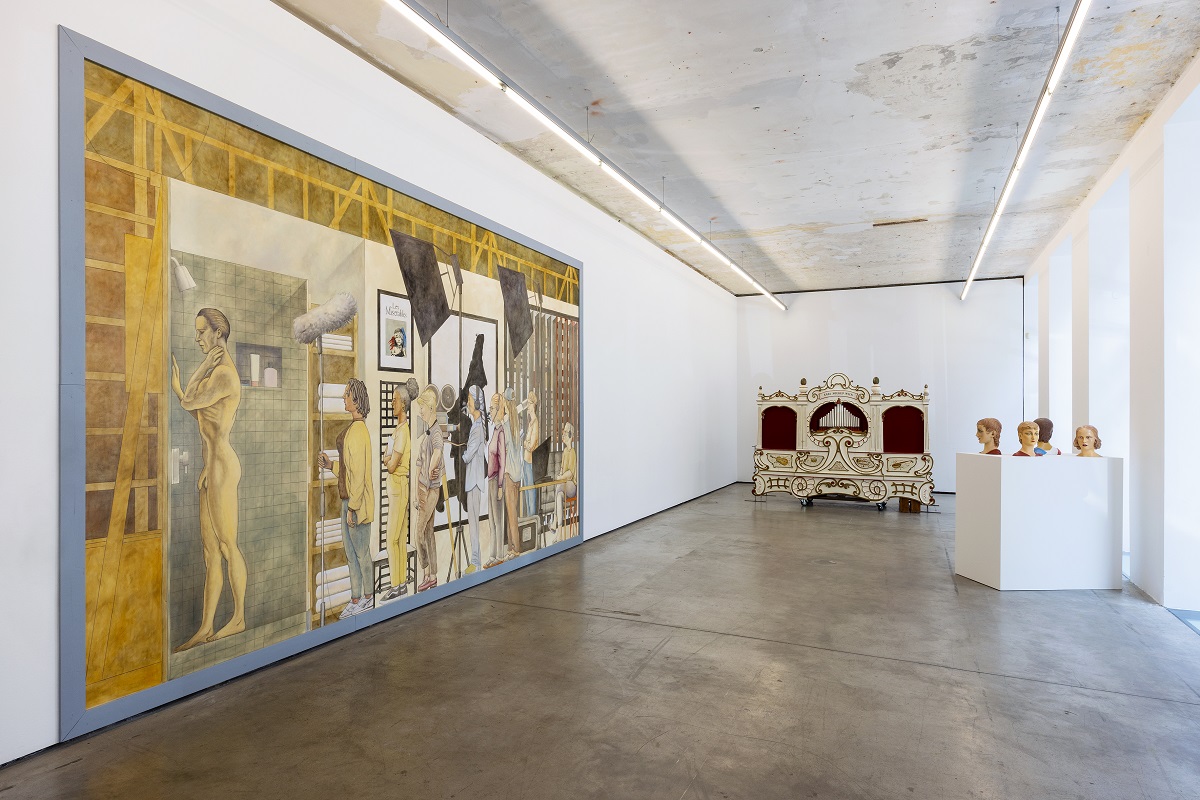 Lucy McKenzie, Mural Proposal for Jeffrey Epstein’s New York Townhouse (Filming of American Psycho), 2024 Oil and acrylic on canvas, 302 × 507 cm Courtesy of Cabinet Gallery, London Photo: Lisa Rastl Lucy McKenzie, Orchestrion, fjk3—Contemporary Art Space, 2025.
Even more strikingly, in the large-scale oil and acrylic painting, Mural Proposal for Jeffrey Epstein’s New York Townhouse (Filming of American Psycho) (2024), an all-woman movie crew is pictured alongside the actor Christian Bale, watching him shower in a vast penthouse apartment. This mise-en-scène is shown in profile, as a row of hieroglyphic figures indifferently observing the proceedings with all the detachment of Bale’s sociopathic film character. Intriguingly, during my second visit to the exhibition, the work had been replaced by another painting, a triptych of louche dilletantes (including the artist Francis Bacon) drinking and playing roulette, with the third panel portraying downcast windowcleaners excluded from the reveries inside. A startling substitution, certainly, and a conspiracy worthy of the non-appearance of Epstein’s incriminating black books. As it happens, the reason is all too mundane; the earlier mural was on loan and, by the time the exhibition dates were extended, it had already been sold. Nevertheless, McKenzie’s multifarious practice, with its dense array of reference points and historical anecdotes, has a tendency to encourage such suspicions. There is generally a different story, an alleged version that’s been covered up, a rumour that changes in the telling.
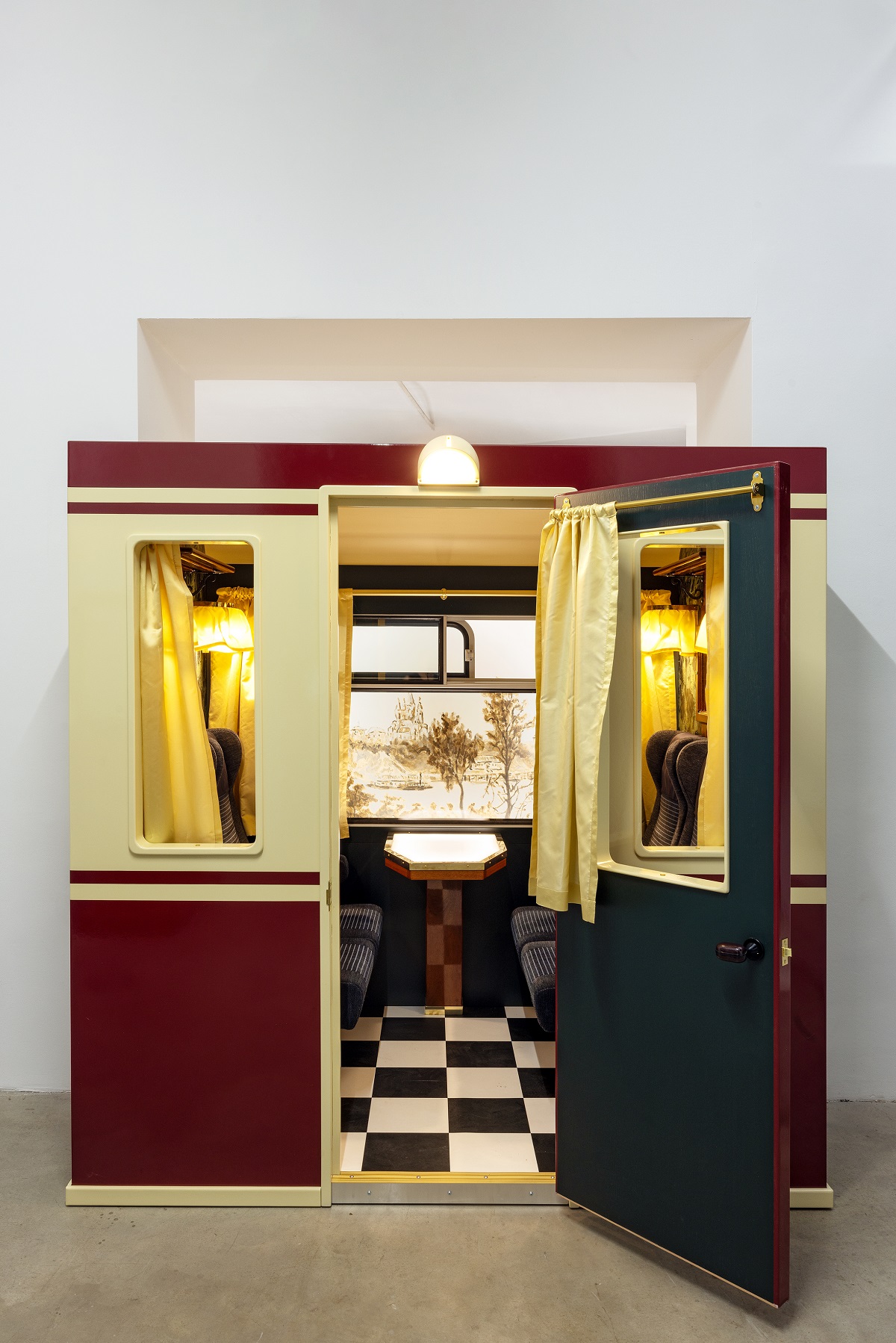 Lucy McKenzie, Moving Panorama (Kärntner Bar), 2025, Wooden and metal structures, train furniture, glass, textile, motor, acrylic and oil on, canvas, Train carriage, 200 × 220 × 120 cm / Painted panorama drum diameter 150 cm, Courtesy of Galerie Buchholz Berlin/Cologne/New York, Photo: Lisa Rastl, Lucy McKenzie, Orchestrion, fjk3—Contemporary Art Space, 2025.
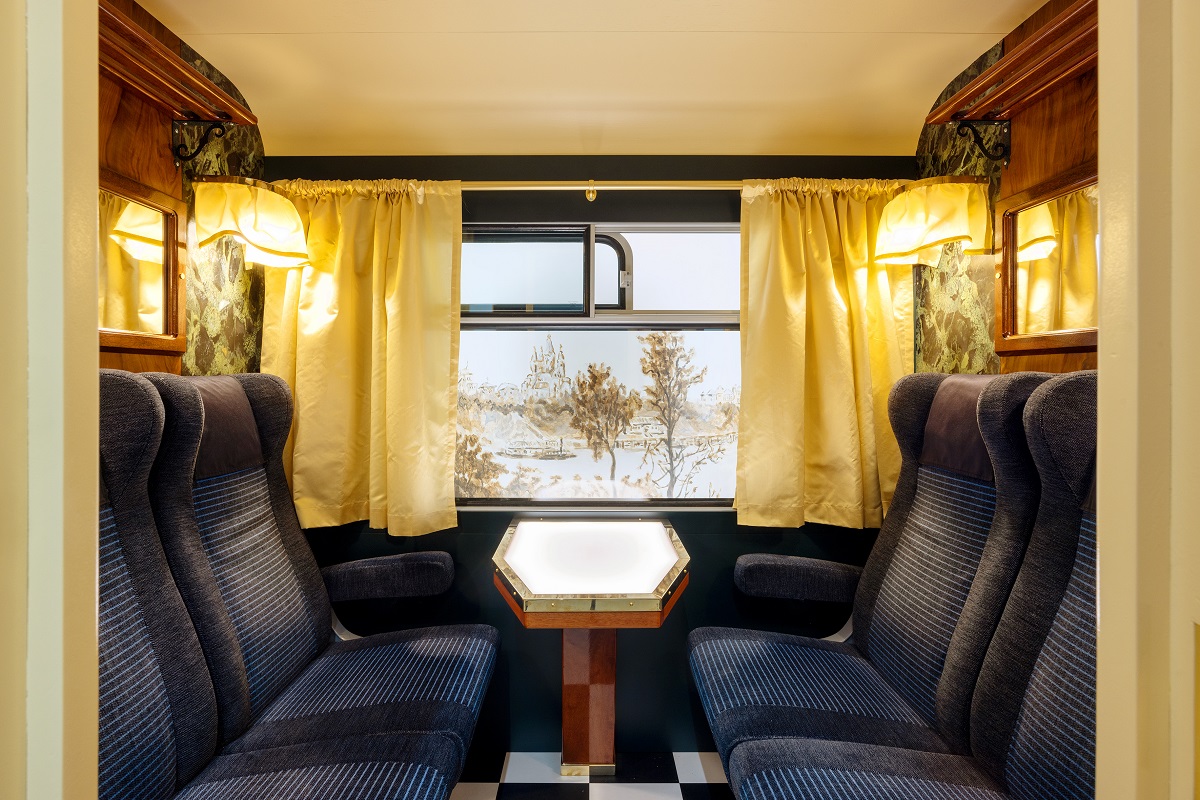 Lucy McKenzie, Moving Panorama (Kärntner Bar), 2025, Wooden and metal structures, train furniture, glass, textile, motor, acrylic and oil on canvas, Train carriage, 200 × 220 × 120 cm / Painted panorama drum diameter 150 cm, Courtesy of Galerie Buchholz Berlin/Cologne/New York, Photo: Lisa Rastl, Lucy McKenzie, Orchestrion, fjk3—Contemporary Art Space, 2025.
Even the exhibition title Orchestrion hints at subterfuge; this 19th century mechanical object was engineered to imitate the instruments of a full orchestra (McKenzie includes an example from the Wien Museum Collection), pointing to a wider public fascination with the ersatz or the unnatural. Yet the term also implies a calculated arrangement of component parts, of bringing together different elements in order to achieve an unified, harmonic effect. The two definitions are not mutually exclusive: one can be simultaneously moved and manipulated, willingly submitting to the overall composition, even when its mechanisms are right in front of your eyes. WM
Lucy McKenzie: Orchestrion
fjk3, Vienna
6 June 2025 - 18 January 2026
Chris Clarke
Chris Clarke is a Newfoundland-born critic based in Vienna. He has been a curator with Innsbruck International since 2018 and was previously senior curator at the Glucksman, Cork, Ireland from 2009-2016 and visual arts education and publications officer at Cornerhouse, Manchester, UK from 2006-2008. He has previously written for Art Monthly, Circa, Photography & Culture, Source, Spike Art Magazine, and VAN.
view all articles from this author