Whitehot Magazine
October 2026
"The Best Art In The World"
"The Best Art In The World"
October 2026
Henry Moore/ Lucian Freud: Monumental Intimate Truths
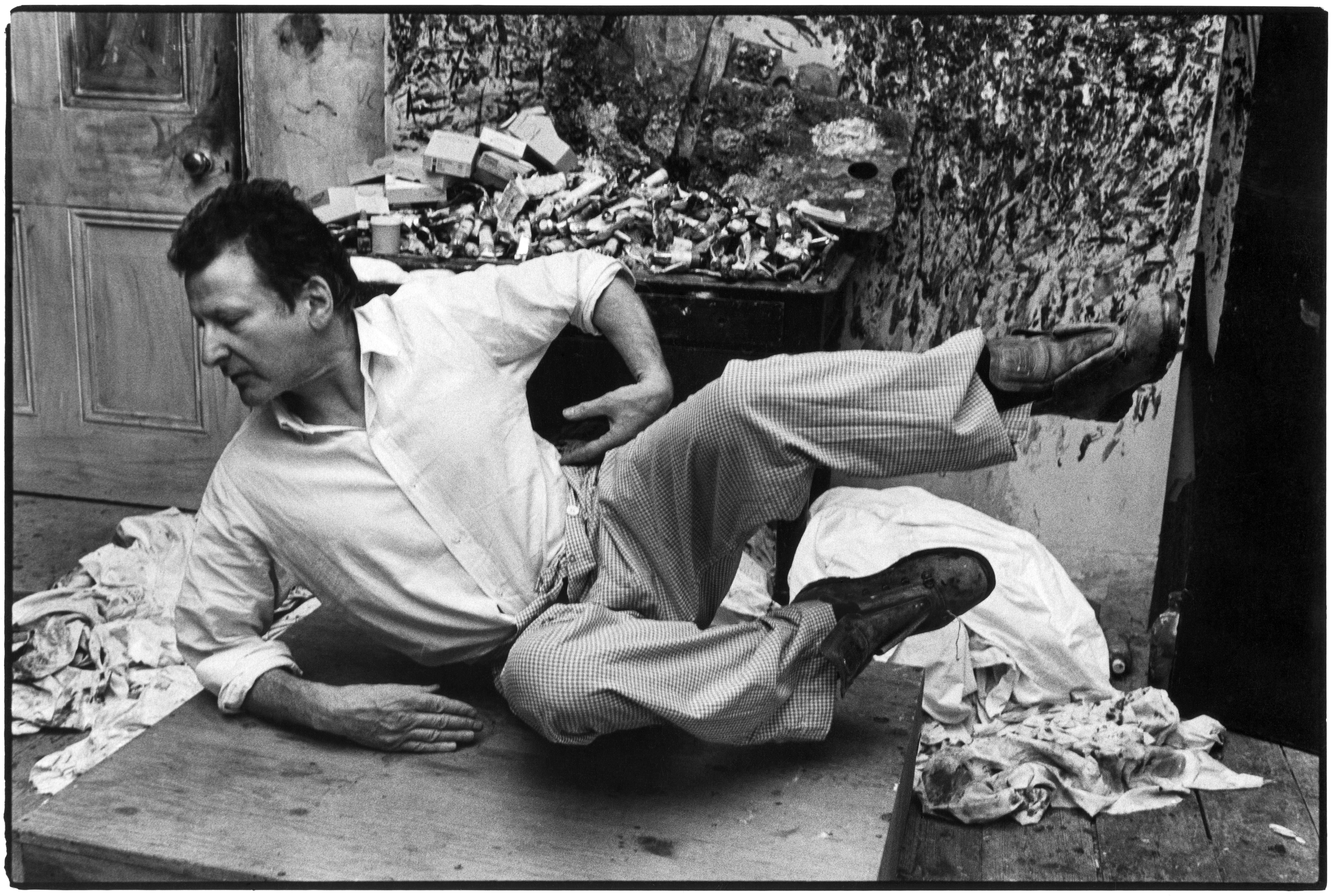 ‘Lucian Freud posing as a Henry Moore’, 1983 by Bruce Bernard
© Estate of Bruce Bernard, courtesy Virginia Verran
By Delia Cabral, June 25th, 2026
HASTINGS CONTEMPORARY: MOORE / FREUD
Curated by Kathleen Soriano
13 June – 13 September 2026
This exhibition opens with a curious photograph of Lucian Freud posing as a Henry Moore, taken by Bruce Bernard in 1983. In this image, Bernard's lens depicts Freud physically inhabiting Moore's sculptural language; he embodies the familiar pose, the painter becoming the object. Freud morphs into Moore's universal form — "Man."
It was this image that inspired Kathleen Soriano, the director and curator of Hastings Contemporary, to bring these two British luminaries together on the subject of family. Moore and Freud's careers overlap for nearly half a century (1940–1986), and even though they both moved in the post-war British art circles that included influential and celebrated artists, the likes of Francis Bacon, John Minton, Graham Sutherland, and David Sylvester, they were not known to be friends. They each had very different approaches to the subject of family. Moore depicted relationships through universalism, whereas Freud used specificity to explore these close human bonds. They were on different ends of British modernism, an art movement ushering in the 20th century with new ideas and aesthetics — abstraction, fragmentation, and new materials that depicted a changing world sensibility. Now, as we embark on the 21st century and relationship dynamics continue to evolve, revisiting how intimacy becomes art makes this exhibition compelling and timely. Moore and Freud explored the tension between intimacy and distance, public myth and private family, and abstraction versus psychological realism.
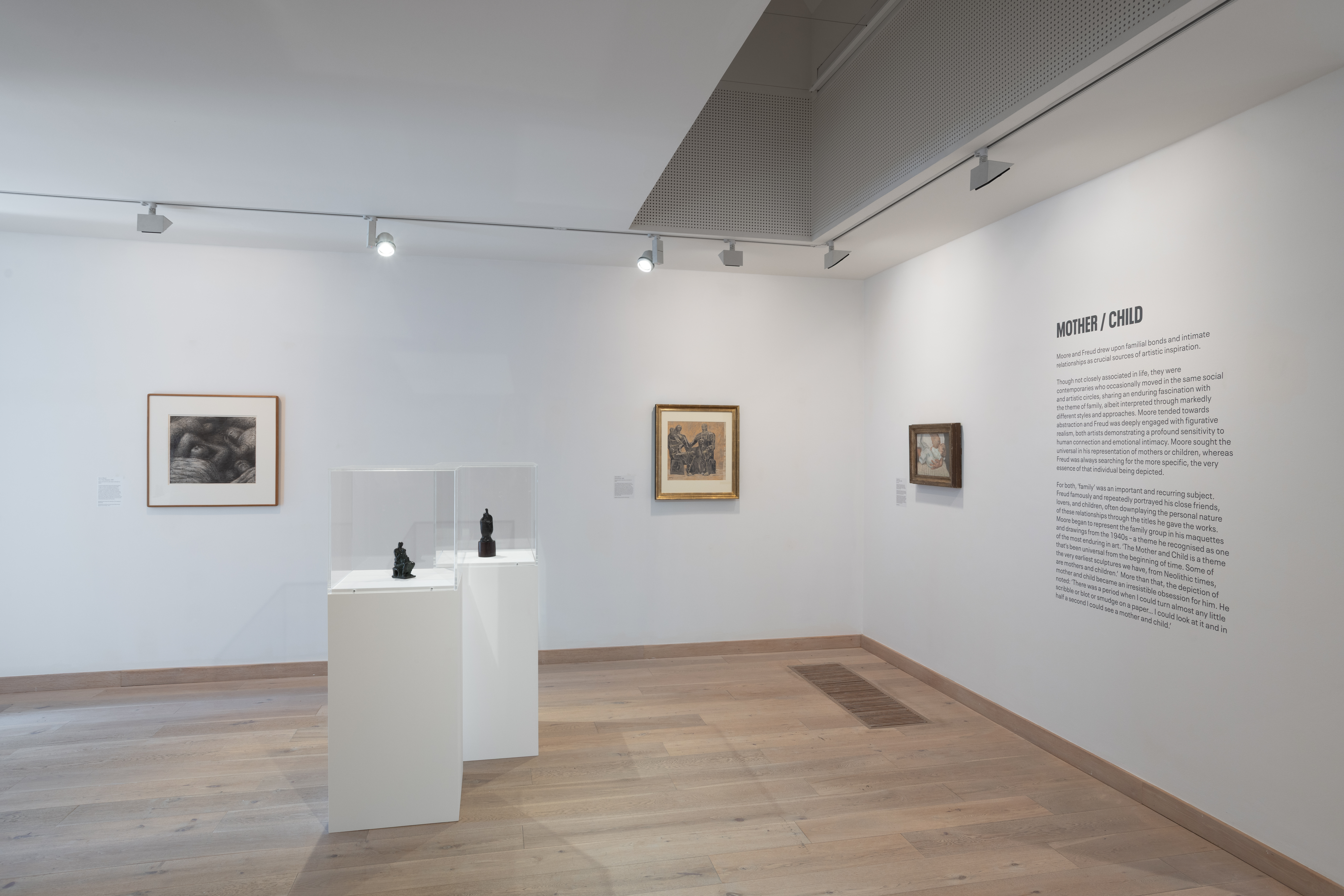
Installation view: Mother/Child room, Hastings Contemporary, photograph by Rob Harris
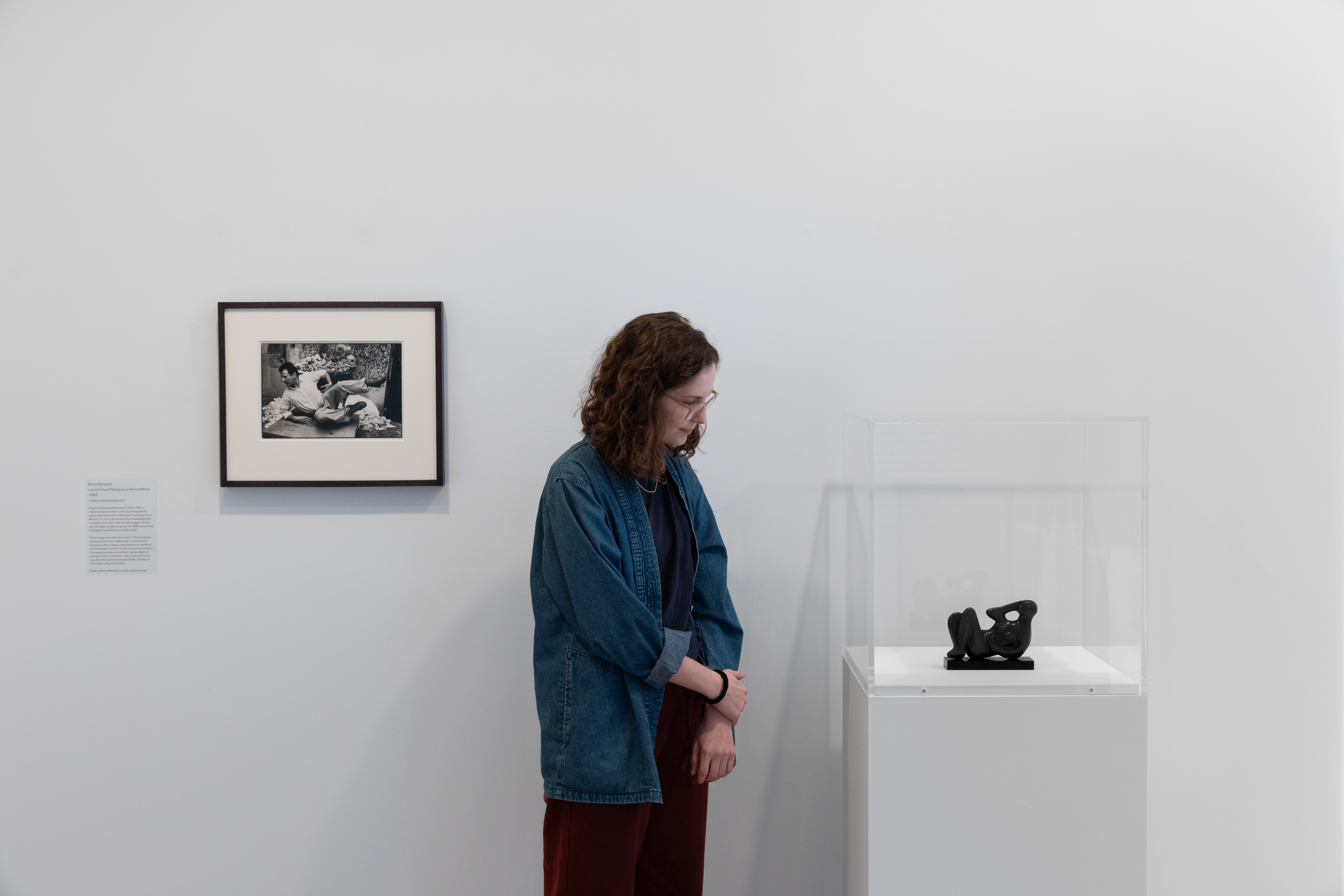
Installation view: Mother/Child room, Hastings Contemporary, photograph by Rob Harris
The Moore / Freud exhibition contains 20 works, ranging from maquettes and works on paper to etchings and paintings, curated across the gallery rooms. It's an intimate look at Moore and Freud's opposing perspectives, addressing family and relationships. Each room focuses on a different aspect: Mother and Child, Family, and Friends/Muses, though Moore and Freud may not have had in-depth debates on these topics, their works engage in a visual conversation moderated by Soriano. Each room successfully captures the psychological tension of the human condition, the personal extrapolated to the general, with surprising intimacy, given that both artists are known for their monumental work customarily displayed on expansive museum walls and in great open landscapes. The works in this exhibition are personal and even diminutive. Soriano curates a personal conversation about universal truths.
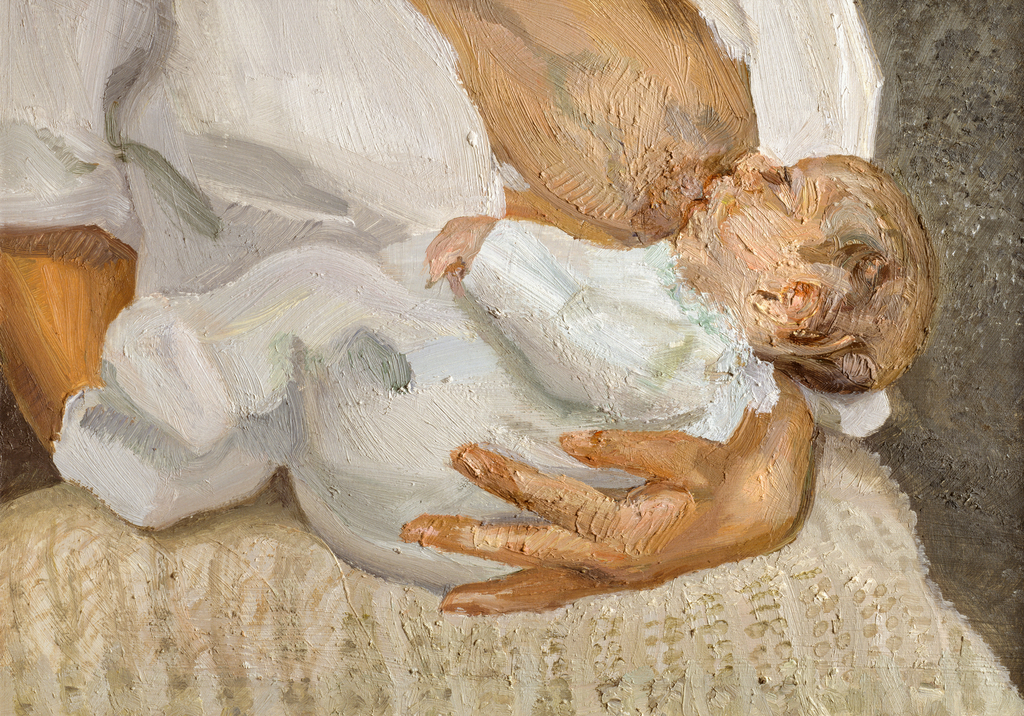 Esther and Albie, 1995 (oil on canvas), Freud, Lucian (1922–2011) / Private Collection / © The Lucian Freud Archive. All Rights Reserved 2026 / Bridgeman Images.
Starting with a gallery dedicated to the theme of Mother and Child, the origin of both life and relationship, family as myth and archetype, Soriano opens with a small oil painting by Freud titled Esther and Albie, 1995, depicting a tightly cropped torso, a breast engorged with blue veins, and a sleeping newborn. The title is precisely specific: Freud's daughter and grandson. However, the execution of this portrait extrapolates to a universal mother-and-child. It's a deeply personal scene, to the point of discomfort. Viewing a naked breast is not something that is openly portrayed in our society, and to name who the breast belongs to creates a disconcerting familiarity. This is at the core of many of Freud's paintings, deeply personal and specific. Moore's approach is diametrically opposed; his abstracted human forms are drawn from trees, rock formations, fossils, and bones. His small bronze sculptures and drawings bind his figures together into a single object, in the case of Mother and Child, a single organic form with a larger head and a smaller head. The viewer infers relationship from shape alone. Moore's universal shapes demonstrate relationship without pointing to a specific human. His familiar, rounded, minimal shapes have become iconic.
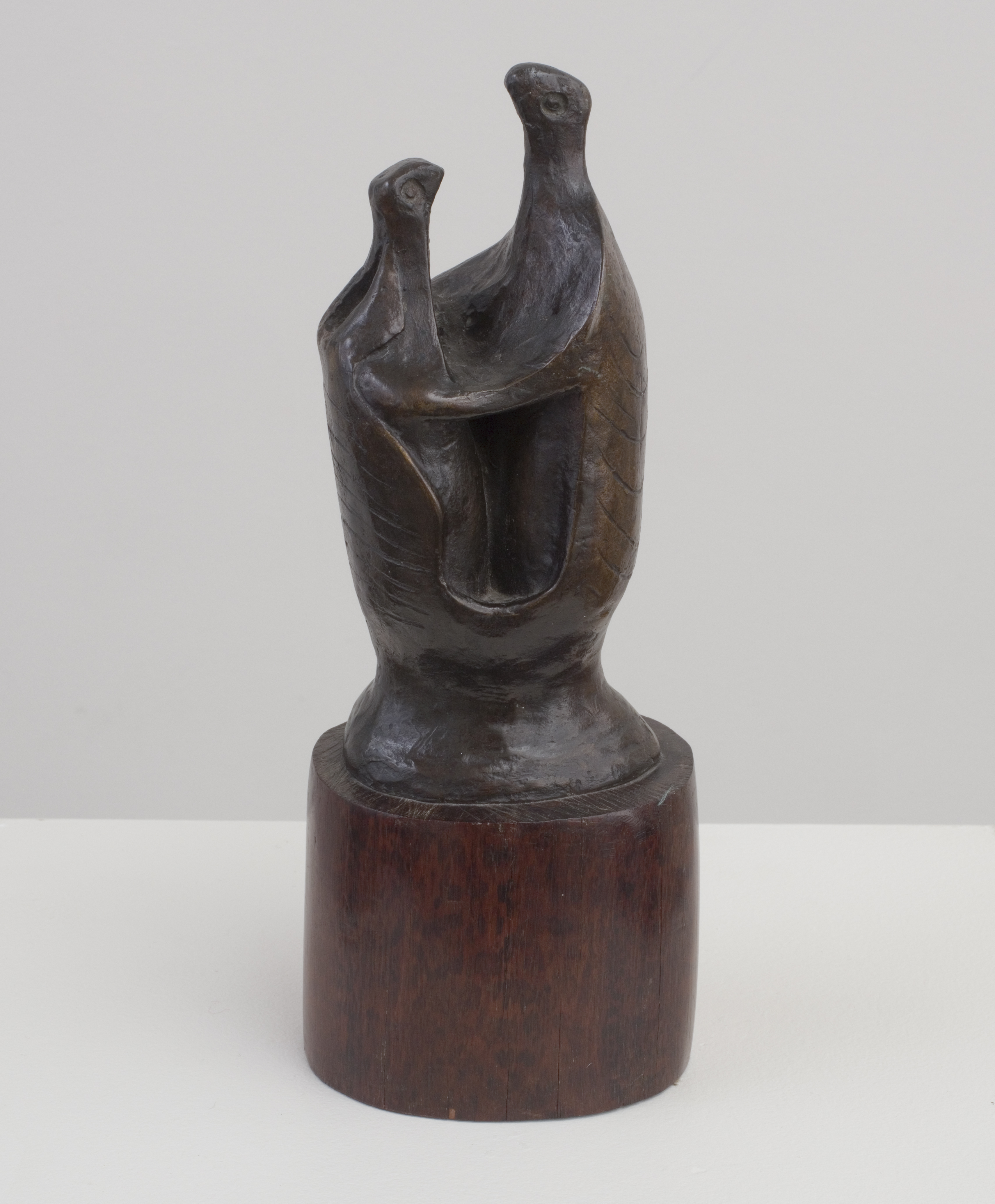 Henry Moore, Mother and Child, 1956 (cast 1965), bronze, 17cm
(height) © 2026 The Henry Moore Foundation. All Rights
Reserved, DACS / www.henry-moore.org Image courtesy Piano Nobile, London.
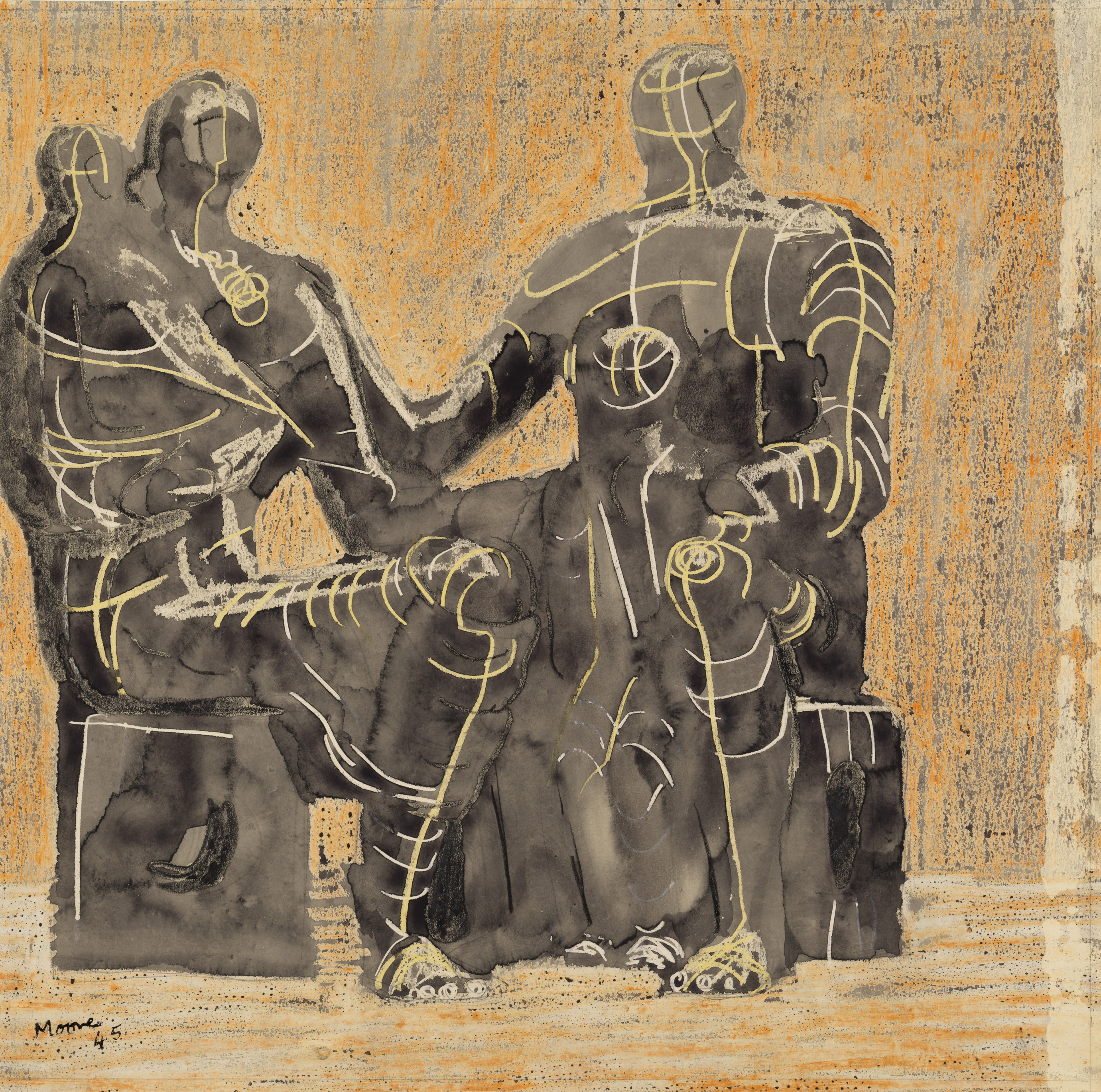 Henry Moore, Family Group, 1945 © 2026 The Henry Moore
Foundation. All Rights Reserved, DACS / www.henry-moore.org
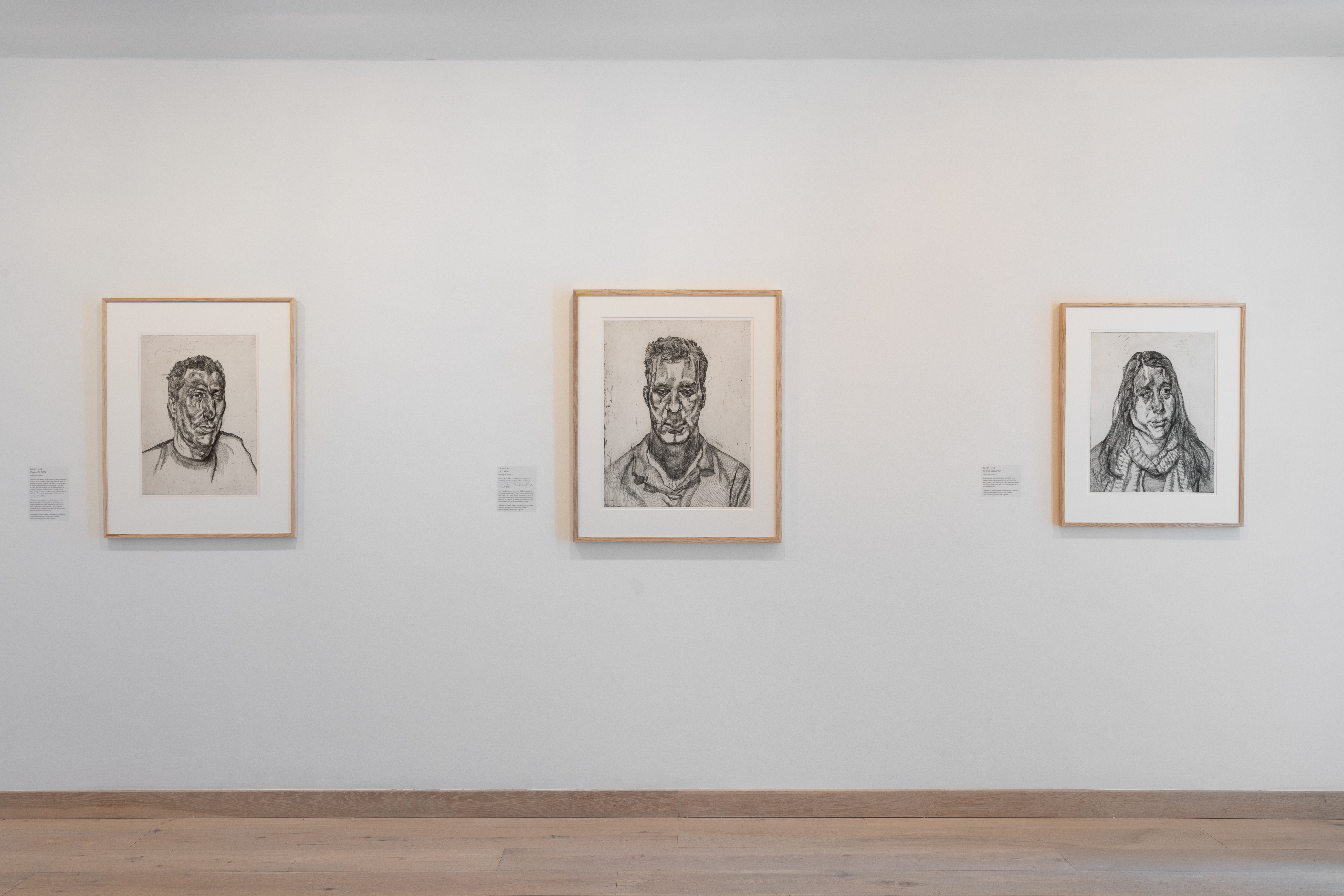 Installation view: Family room, Hastings Contemporary, photograph by Rob Harris
The room titled Family, primarily filled with Freud's portraits of his family members, brings the viewer into the rawness and vulnerability inherent in his distinctive, angular marks, illustrating the effect of his practice of carving directly onto copper plates for his etchings. Freud scrutinised and amplified every line worn by his beloved family members, life's markings on their faces. Freud fathered 14 children by 6 women; he was a famously difficult and distant father. As the exhibition notes, Freud remarked: "It's nice when you breed your own models." For his children, sitting for a portrait became the way to experience Freud's paternal love. It was through painting that Freud was able to connect with and relate to his relatives. His powerful psychological portraits are as much about his subjects as they are about his longing to connect. From angular lines to rounded organic forms, Moore's contrasting perspective can be felt even from across the room. Moore had one wife, Irina, and one child, Mary, a much-desired daughter born in 1946, after many years of miscarriages. Family was one of Moore's recurring themes throughout his oeuvre; however, his treatment of this subject drew on the language forged by Modernism and abstraction. Moore dissolves the individual into the bond; Freud names the individual and finds the universal inside the specific.
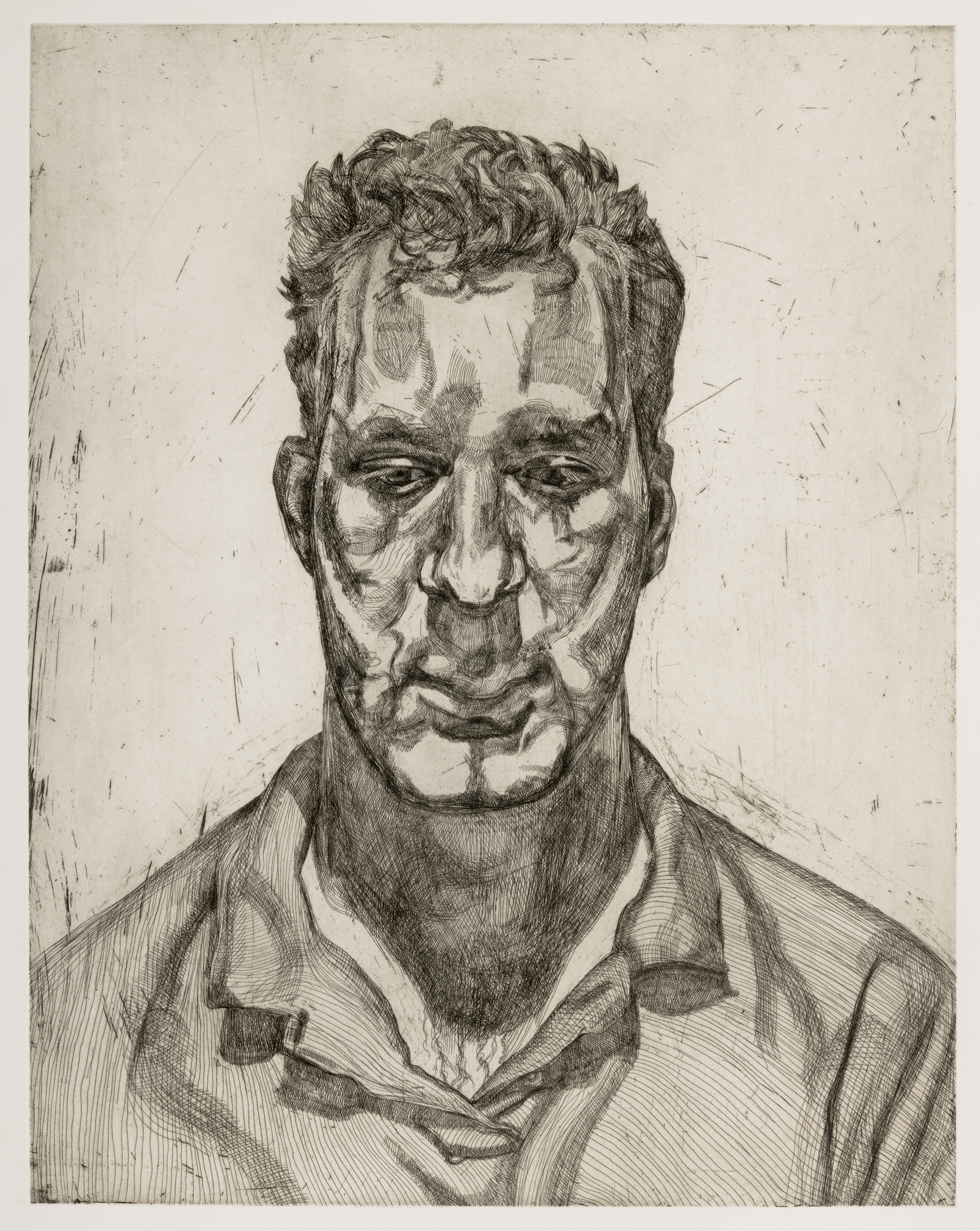
Lucian Freud, Kai, 1991-92, etching. The New Art Gallery
Walsall, Permanent Collection. Acquired through the Cultural
Gifts Scheme, administered by Arts Council England. © The
Lucian Freud Archive. All Rights Reserved 2025 / Bridgeman
Images. Photo: Marc Heathcote.
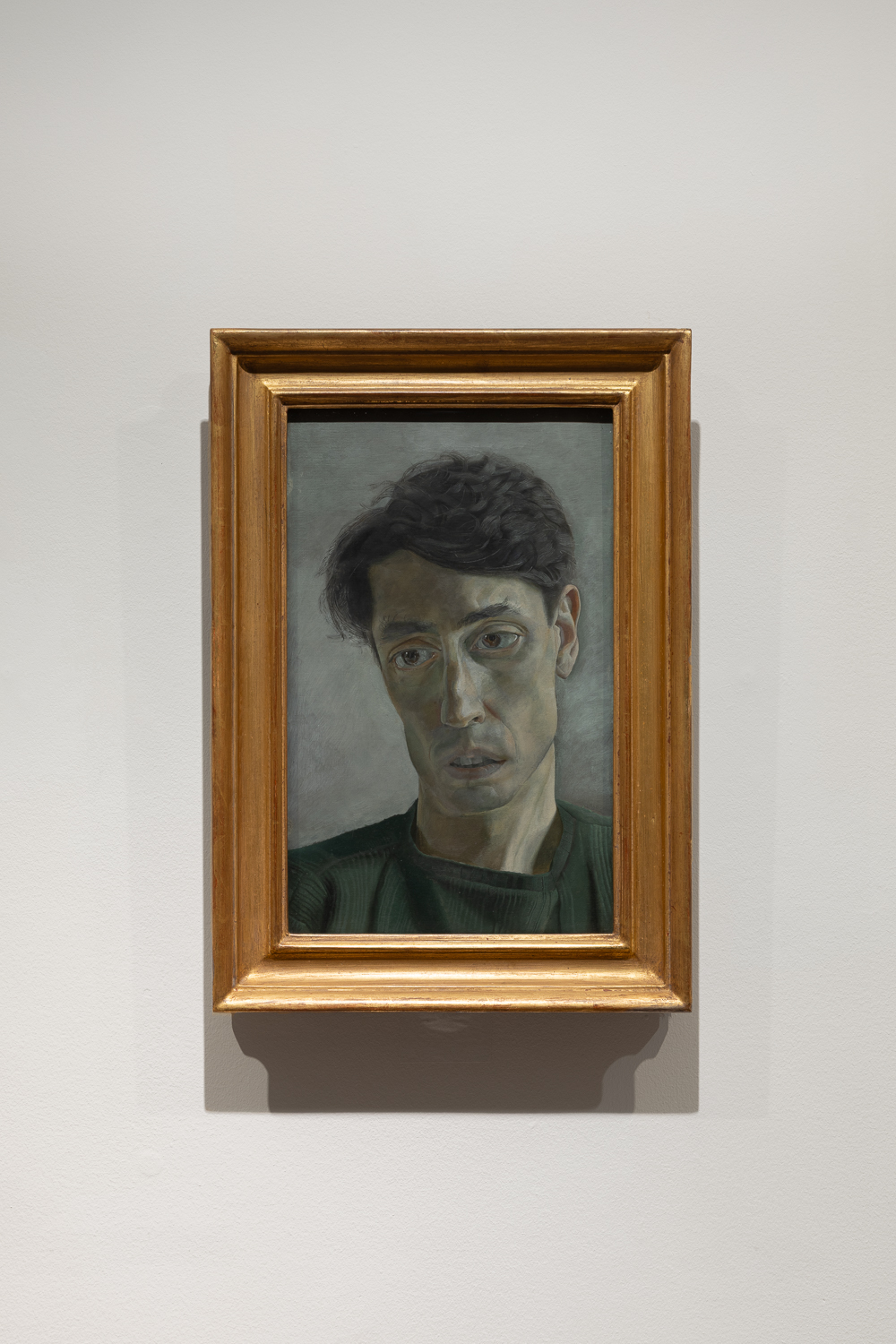 Lucian Freud, portrait of John Minton. 1952. Oil on canvas. 41 x 26 cm.
The final gallery was dedicated entirely to Freud's work and focused on Friends/Muses. The subjects were all people with whom he had very long-term relationships. The act of sustained looking and depicting the people important to him was a material manifestation of his relationships. The small oil painting, John Minton, 1952, floating in the centre of the room, draws the viewer in. It is a brutally honest depiction of this English painter, illustrator, stage designer, and teacher, painted a few years before his tragic death by suicide in 1957. It is a penetrating psychological portrait of pain, sadness, and depression, and even though it depicts a specific individual in Freud's close circle, it also serves as an unsettling look into a universal malaise.
Moore and Freud, two seminal British artists at different ends of post-war modern art movements, each had diametrically opposed ways of depicting our most important relationships. Moore, from the outside in, through generalisations that incorporated abstracted organic forms, inferring relationships through his distilled shapes, forms that became iconic: man, woman, mother and child, and family, forged through the newly developed visual language of 20th-century abstraction. In contrast, Freud explored this same emotional territory from the inside out, with psychologically intense personal portraits that revealed human vulnerabilities and frailties. He painted naked flesh, blemishes, and ageing skin with a rawness new to the 20th century, a specificity equally new to it. Both these truths exist in humanity side by side today.
Moore / Freud is an intimate look at the monumentally important role of family and relationships. The intimate scale of this exhibition is its greatest strength. 20th-century art history has immortalised these artistic voices and made their visual language accepted and iconic. However, when up close and personal, their impact still resonates. The almost one-to-one scale of Freud's portraits confronts the viewer with life and mortality; they echo our current longing for connection at the start of the 21st century. Moore's small maquettes, standing in for monumental public bronzes, reveal that our universal truths remain eternal and unchanged. Regardless of our “love language”, whether from the outside in, abstracting to relate as in Moore’s work or from the inside out, deep introspection in order to connect to our beloved. We all long for it, and art is a powerful vehicle to arrive at connection.

Delia Cabral
Delia Cabral is a curator and an international art dealer, as well as an art critic and writer. As an innovative leader in the art world for 20 years, Cabral cultivated her access to an international network of arts professionals and institutions. Having built a reputation in Los Angeles, CA as a gallery owner (Founder, DCA Fine Art), Cabral consistently gained attention for mounting dynamic and critically acclaimed exhibitions. Now based in London Cabral’s experience as an international entrepreneur informs a unique skill set which enables her to access art from global cutting edge to privately held sought after historical works. As a passionate writer and member of the British National Union of Journalists, Cabral is always looking for what’s next in art.
deliacabraluk@gmail.com
https://www.instagram.com/deliacabral/
view all articles from this author