Whitehot Magazine
September 2026
"The Best Art In The World"
"The Best Art In The World"
September 2026
Dale Lewis: Lost Illusions at Edel Assanti
By MAGGIE HORNEFF June 28th, 2026
I met Dale Lewis a couple of weeks ago, ahead of the opening of his show Lost Illusions. It’s his first UK solo exhibition in five years and it’s currently on display at Edel Assanti’s Fitzrovia gallery in London. We had a coffee and talked through his work in what turned out to be an incredibly fulfilling conversation.
My initial desire to speak to Lewis about his paintings came from the instant resonance I experienced to the distinctly suburban British iconography that emerges throughout his work. More often than not, it is imagery that, although recognisable, feels unsettling, largely because it references many subjects that are objectively somber, and even more so when they carry a sense of familiarity. I suppose I began the conversation wanting to find out whether my suspicions about the subjects depicted in his bold figurative compositions were correct.
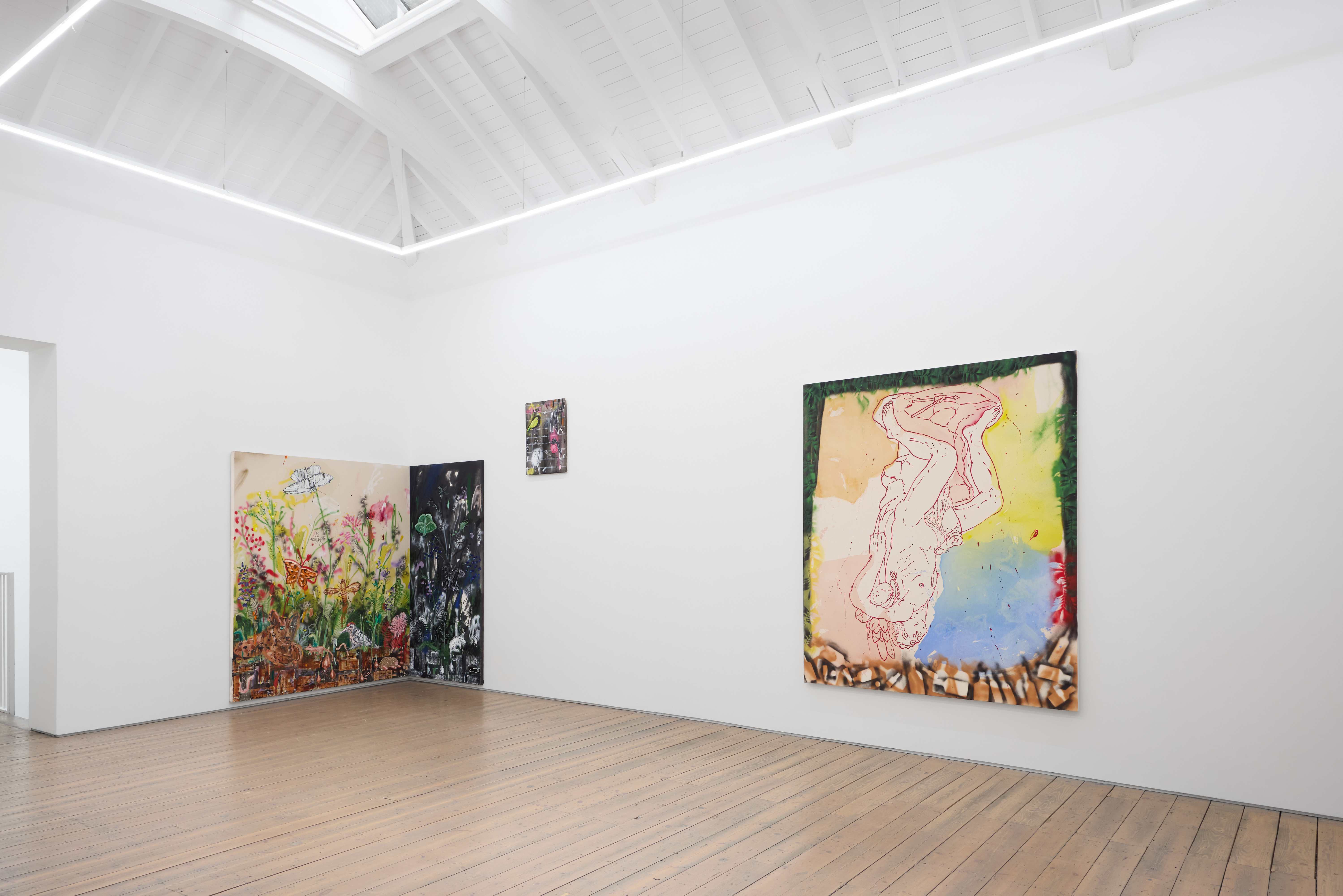 Installation Shot, 2026, © Dale Lewis. Courtesy the artist and Edel Assanti. Photo by Tom Carter.
To an extent, they were, but our meeting – and the breadth of Lewis’ work – revealed something far more complex and affecting than I had initially detected. It was, for want of a better word, relieving to unpack aspects of his work and its narratives without everything becoming overly conceptual or weighed down by artistic jargon. Lewis’ paintings are inextricably linked to his own experiences and to his observations of those around him: at times confrontational, while elsewhere nuanced and subtle. Built through the compositional layering of images within images, his densely packed details trigger a chain of associations through which his world unfolds.
I appreciated his refusal to pigeonhole the themes within his work into any single category. Like his subjects, his paintings occupy a space that is both deeply individual and collectively resonant, reflecting a British subculture navigating questions of mental health, sexuality, violence and class. What I found most impressive in Lewis’ work is the accuracy of his world-building. Through specific references, sensual consideration and an emphasis on materiality, his work becomes powerfully evocative yet vulnerable.
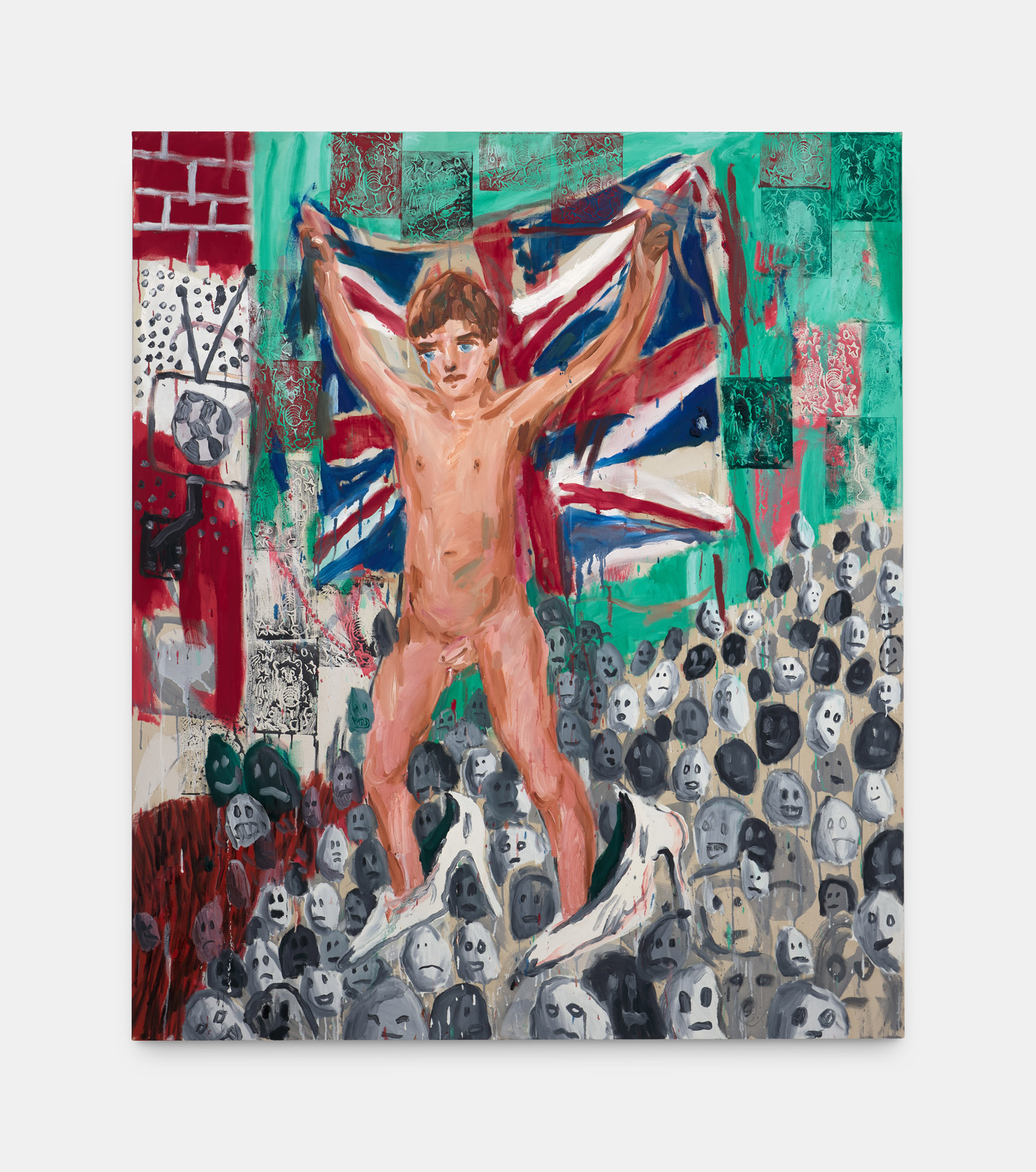 Mould, 2025, © Dale Lewis. Courtesy the artist and Edel Assanti. Photo by Tom Carter.
Emerging from a childhood memory from the late 1980s, Mould (2025) is a bleakly triumphant depiction of the artist standing amid the peeling wallpaper of his childhood council flat. Poised in his mother's white stilettos and holding a synthetic Union Jack aloft, the boy in the painting becomes a meditation on play, innocence and the unknowingness that often accompanies the earliest expressions of sexuality. Sensation is built through the materiality of the work; decay, mould and artificial materials become indicative of the fragility of the environment Lewis has created. The flag also serves as a reflection on the shifting political connotations of Britishness. Its presence bridges the personal and the political, transforming a private memory into a broader reflection on national identity when considered alongside Operation Raise the Flag.
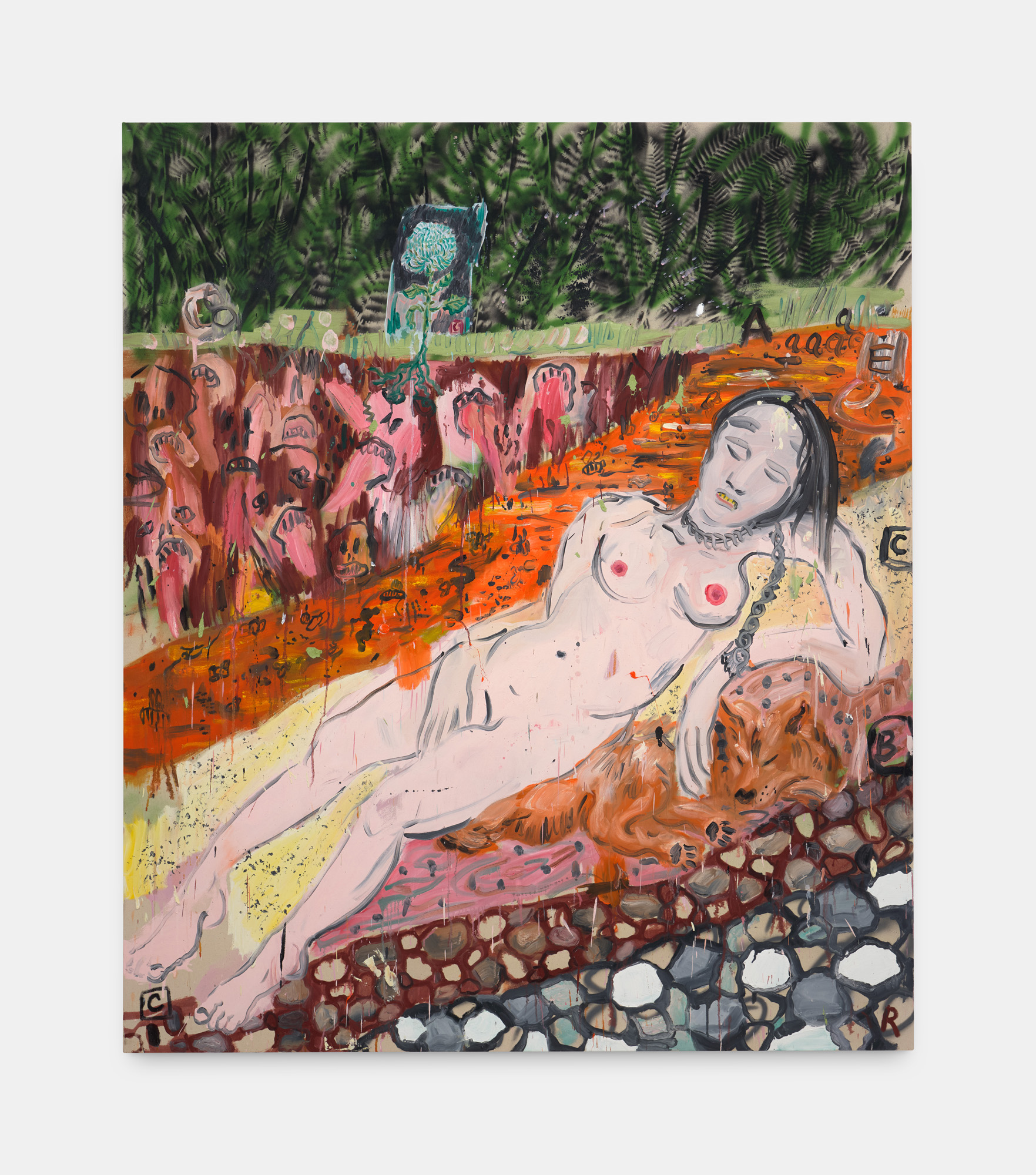
Horizon, 2025, © Dale Lewis. Courtesy the artist and Edel Assanti. Photo by Tom Carter.
The idea of decay resurfaces in Horizon (2025), a portrait of a family friend who took their own life. Submerged beneath the earth, the figure lies suspended between stratified layers of soil and rock. Their expression, reminiscent of a Japanese Noh mask, is tinged with grey undertones that orchestrate a sense of stillness and detachment. Through this imagery, Lewis articulates the inevitability of the body's subsumption into organic matter. Though overtly figurative, he asks us to consider the work also as an abstract horizon, through which the burnt, earthy tones appear to recede into one another and horizontal figure, becoming an intersecting state between life and earth.
Counterbalancing some of the heavier subject matters in his repertoire are recurring motifs drawn from Lewis’s devotion to his garden, which introduce moments of tenderness and refuge into his practice. In Night Shift and Kiss Goodbye (both 2026), the butterfly becomes a symbol for blue-collar workers and their long hours, catalysed by a memory of his parents briefly passing by one another in the night between shifts. Just as butterflies act as pollinators, nurturing and sustaining the life of a garden, Lewis draws a parallel to the unseen labour of working parents and the care they provide for their children. The imagery is layered through the velvety texture of the works and the elm wood charcoal frames, recalling the trees that attract the butterfly. Lewis successfully manages to build an unpretentious poetry across his work.
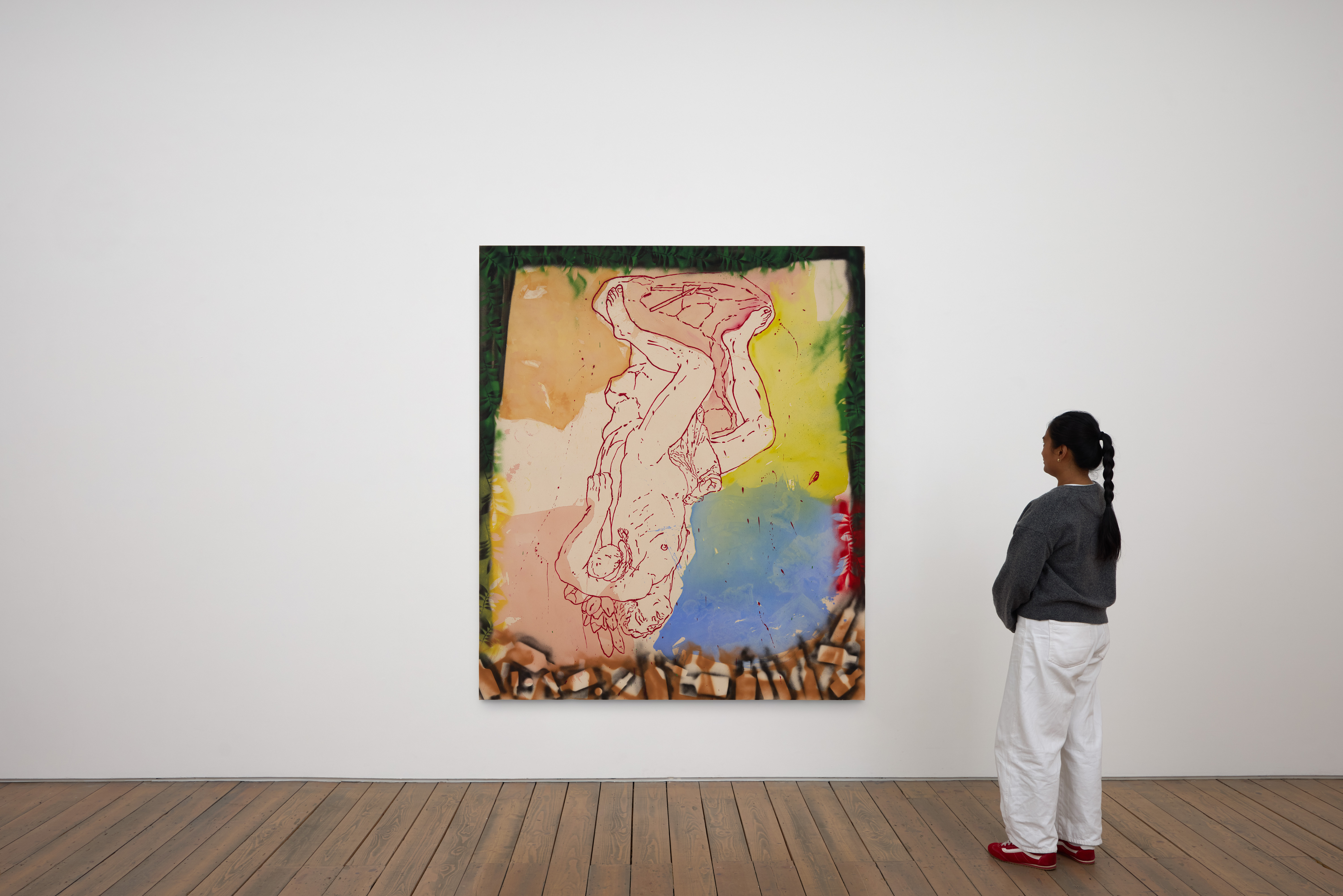
Bad Day, 2026, © Dale Lewis. Courtesy the artist and Edel Assanti. Photo by Tom Carter.
To me, the crux of the exhibition is encapsulated in a recently completed work, Bad Day (2026). The painting marks a metamorphic moment in Lewis’ practice, signalling a decisive departure from the densely populated, saturated canvases that have characterised much of his earlier work. In both composition and line, there is a striking refinement of form, centred on the silhouette of an upside-down figure suspended in freefall. Rendered in a vivid blood-red hue, the figure emerged from an experience Lewis described during a day in Rome: a sensation of relapse and loss of control. Drawing on Bernini’s St Sebastian and Blake’s Albion, the figure is inverted, transforming these symbols of transcendence and national renewal into emblems of collapse and disillusionment. The fragile body plunges towards a cluster of spray-painted wine bottles that occupy the lower edge of the canvas, while four surrounding fields of colour, representing blood, tears, vomit and piss, intensify the painting’s atmosphere of despair. A sense of inevitability permeates the work; caught in a moment of suspension, the figure appears unable to escape its descent. Through this inversion, Lewis gives form to a broader social malaise, reflecting what he describes as the uncertainty that increasingly defines contemporary Britain.
Towards the end of our conversation, we speculated on what it might mean to view Lewis’ paintings as artefacts of contemporary life in England. Given the cultural specificity that permeates his work, his paintings have come to chronicle the everyday realities of modern life – at once mundane, violent and liberating.
Dale Lewis’ exhibition Lost Illusions is on display at Edel Assanti, London, until 14 August 2026. I would highly recommend taking the time to see it.

Maggie Horneff
Maggie Horneff is a writer specialising in art and visual culture. She holds a degree in Global Humanities and an MA in Cultural Criticism and Curation from Central Saint Martins, University of the Arts London. Her writing brings together cultural history, aesthetic enquiry and contemporary critical perspectives. Alongside her editorial work, she has experience in the commercial art world.
view all articles from this author