Whitehot Magazine
October 2026
"The Best Art In The World"
"The Best Art In The World"
October 2026
Confronting the Abject; Feeding the Load, Regulated Dosage at FRISSON
 Installation shot of Feeding the Load, Regulated Dosage; Cass Yao and Echo Yan, Courtesy of Frisson Gallery, Photography by Cass Yao.
By JONAH ROMM February 27th, 2026
In the proliferation of grotesque AI imagery, brainrot, and slop media, horror and disgust are not uncommon affective registers to encounter through the mediation of the screen. In their exhibition Feeding the Load, Regulated Dosage at Frisson Gallery, artists Echo Yan and Cass Yao bring the uncanny into visceral, tangible reality. An entire ecosystem of biomorphic sculptures, which seem to breathe and continuously mutate, transform the gallery into an undoubtedly disconcerting world, which the viewer is still ceaselessly enticed into.
There is admittedly something intimidating about entering the show, curated by Rui Jiang, which stages immediate confrontation between the viewer and Cass Yao’s skeletal, multi-headed monstrosity titled Axis, 2025, which dangles from the ceiling. Reminiscent of the Hindu goddess Kali, who is associated with chaos and destruction, Axis’s vertebral network hosts seven shrunken heads fixed with false teeth and hair. As unsettling as the form may be, it demands a certain reverence, like a Lovecraftian deity. Cass Yao’s skeletal forms brush up against biological familiarity while ruthlessly deconstructing anatomical function. Their pieces titled Anatomy #1, Anatomy #2, on through #5, all made in 2025, develop and expand their own densely networked, rhizomatic language reminiscent of mechanical renderings, biological debris and neural networks. Seamlessly shifting from different materials like epoxy clay, steel, silicone, and raw silk, the work seems to have been generated rather than made.
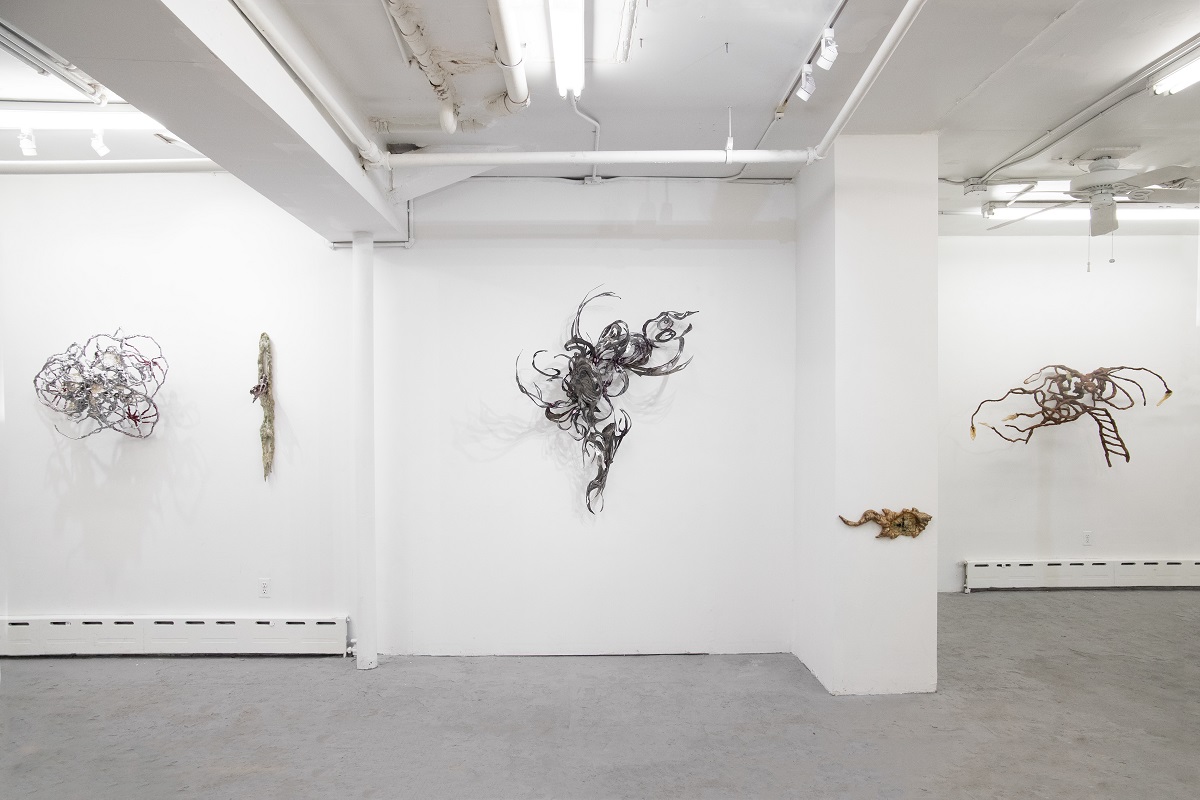 Installation shot of Feeding the Load, Regulated Dosage; Cass Yao and Echo Yan, Courtesy of Frisson Gallery, Photography by Cass Yao.
In contrast, Echo Yan’s work takes utilitarian objects as the point of departure into the grotesque and alien. Weresheep, 2025 and Mickey Mouse Clubhouse, 2024 punctuate and ground some of Yao’s Anatomies. Standing next to the door as you enter, Weresheep resembles a standing coat rack with hooves as feet and curved sheep horns for hooks. Mickey Mouse Clubhouse introduces a metal wire mouse trap onto a lump of pine wood carved into a mouse-like shape, with a green gummy bear humorously caught in its center. In the center of the gallery, You May Touch the Fence, 2025 snakes across the floor and up onto the wall like a centipede. It bisects the space, creating a boundary that the viewer must move around and through in order to see the work. These ubiquitous yet somewhat outdated household objects are given a newfound bodily autonomy, blurring anatomical form with human functionality. In tandem with Yao’s semi-human ribcage creatures, these works decenter an anthropocentric worldview by confusing what belongs to the body and what does not, what is domesticated for our use and what rebels against us.
The duo’s harmony reaches its climax in the final room of the gallery, which you must bend under the fence posts slightly to enter. In the corner sits Echo Yan’s The Spinner, 2025; an antique spinning wheel entangled by a wool tendril emerging from the wall. On the other end is Cass Yao’s Shared Meal, 2025 — a decapitated figure leaning precariously over a table towards a mirror which reflects its hollow, visceral interior. The archaic production instrument of the wheel is reborn while the spinner flees, like a twisted Rumpelstiltskin tale. The mirror acts as a screen, extending the space beyond the viewer’s optical limitations. The scene intimates a conflict between the antiquated means of production and the figure which dissolves into the virtual, leaving only an empty skullcap filled with powder; a rotted brain.
 Installation shot of Feeding the Load, Regulated Dosage; Cass Yao and Echo Yan, Courtesy of Frisson Gallery, Photography by Cass Yao.
There is a tension between the analog and digital, the biological and the mechanical, which is illustrated in the video piece by the window titled Were We Made of Swirls?, 2025. The video shows AI generated psychedelic imagery fluctuating from the technological to the organic. Translucent, multicolored insects and microbes swarm within a matrix of gears, computer microchips, and electrical processes. In contrast with its high tech content, the video is displayed on an old CRT box television. Translating the AI media into an obsolete analog device gives it a physicality and presence that demands validity in a time where the accessibility of generated images has made them lose their currency.
Feeding the Load, Regulated Dosage is born out of a posthuman imagination, rendering phantoms visible that might otherwise only be witnessed through digital tools. Cass Yao and Echo Yan take and manipulate an affect which is familiar from digital media and translate it into a physical, environmental confrontation. Rather than replicating aestheticized virality, they return abject horror into the domain of the bodily and the personal, reasserting its disorienting, world-building, and constructive potential. WM
Jonah Romm
Jonah James Romm is a multidisciplinary artist, writer and independent curator based in Ridgewood, Queens. They received a BA in Studio Arts and Art History from Bard College in 2024, and their engagement with art historical research, postmodern theory and cultural critique all inform their current practice. This past July, Jonah opened their solo exhibition The Nausea at Kaleidoscope Studios, Brooklyn, consisting of large scale works on paper illustrating Jean Paul Sartre's work of existentialist fiction. Their work has also been included in recent group exhibitions including "Backyard Critterz" at The Living Gallery, "It Is About Truth" at Idiot Machine, and "The World that Remains" at Left Bank Projects. They are a frequent contributor of critical writing to IMPULSE Magazine, and are excited to be writing for more publications in the near future.
view all articles from this author