Whitehot Magazine
October 2026
"The Best Art In The World"
"The Best Art In The World"
October 2026
Beyond the Monument: Jean Shin’s Living Memorial at Green-Wood
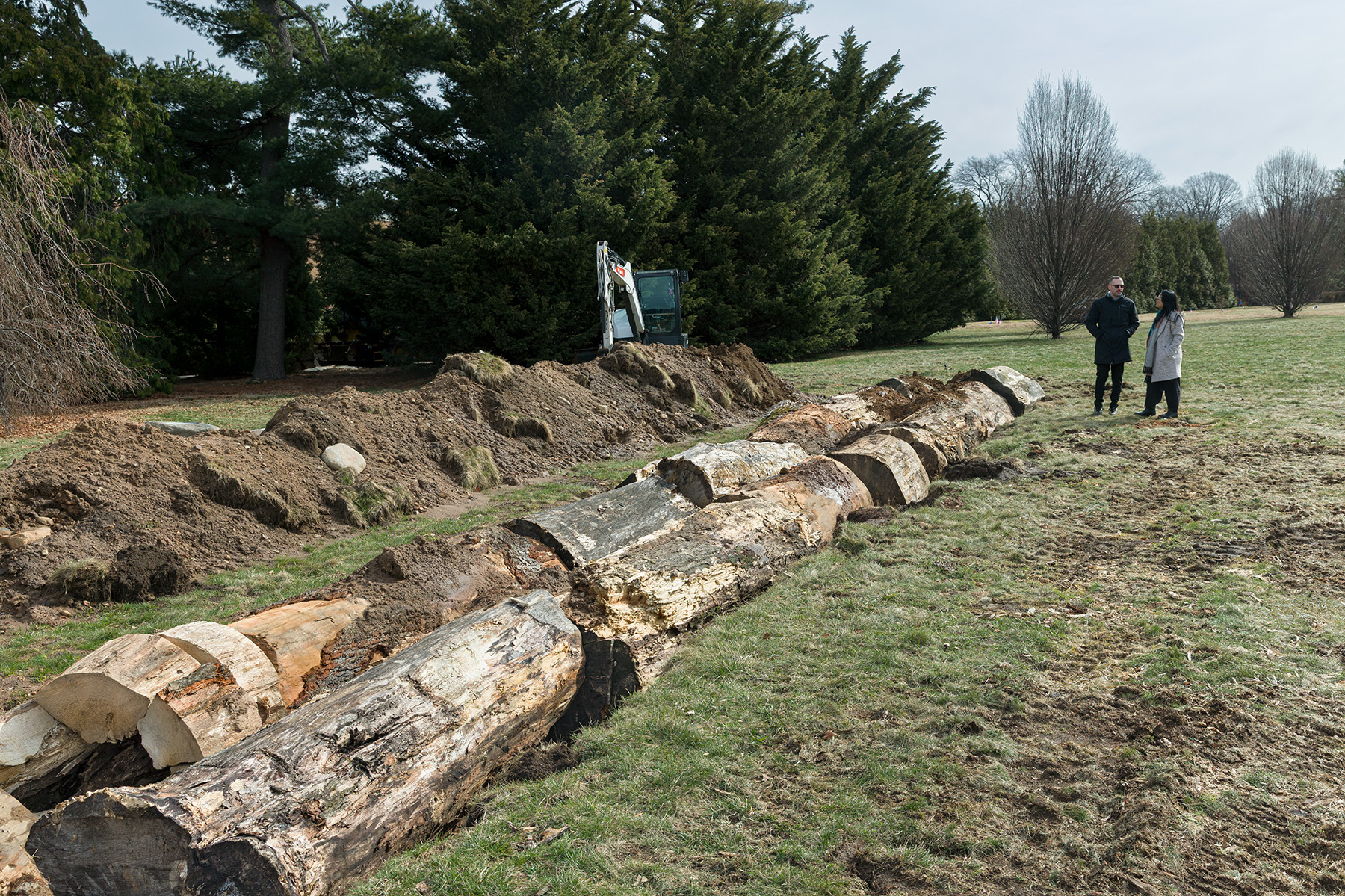 Jean Shin, Offering, installed at The Green-Wood Cemetery, Fallen red oak and pin oak prepared for burial in March 2026, Photo credit: Etienne Frossard
By SOOJUNG HYUN April 29th, 2026
Brooklyn’s Green-Wood Cemetery is one of the rare places in New York where time is no longer abstract, but felt as something tangible. Established in 1838, the cemetery holds layers of history shaped by countless lives and deaths, yet a quiet vitality persists throughout the landscape. Winding paths across rolling hills, mature trees, and the shifting qualities of light and air across the seasons transform the site from a burial ground into an expansive, living environment. While monuments and headstones anchor remembrance in material form, the surrounding natural presence reframes death not as an end, but as part of an ongoing cycle.
Within this setting, Offering (2026), a large-scale regenerative earthwork by Jean Shin, opened on April 18 at the main entrance of Green-Wood Cemetery. At the center of the project is the ceremonial burial of two fallen trees—a red oak and a pin oak that had lived out their lives within the cemetery grounds. Rather than treating them as debris to be cleared, Shin honors these trees as “tree elders,” extending to them the same dignity accorded to those interred in the cemetery. Through the construction of earthen mounds, Shin establishes a dedicated burial site for the nonhuman life that defines the cemetery’s history.
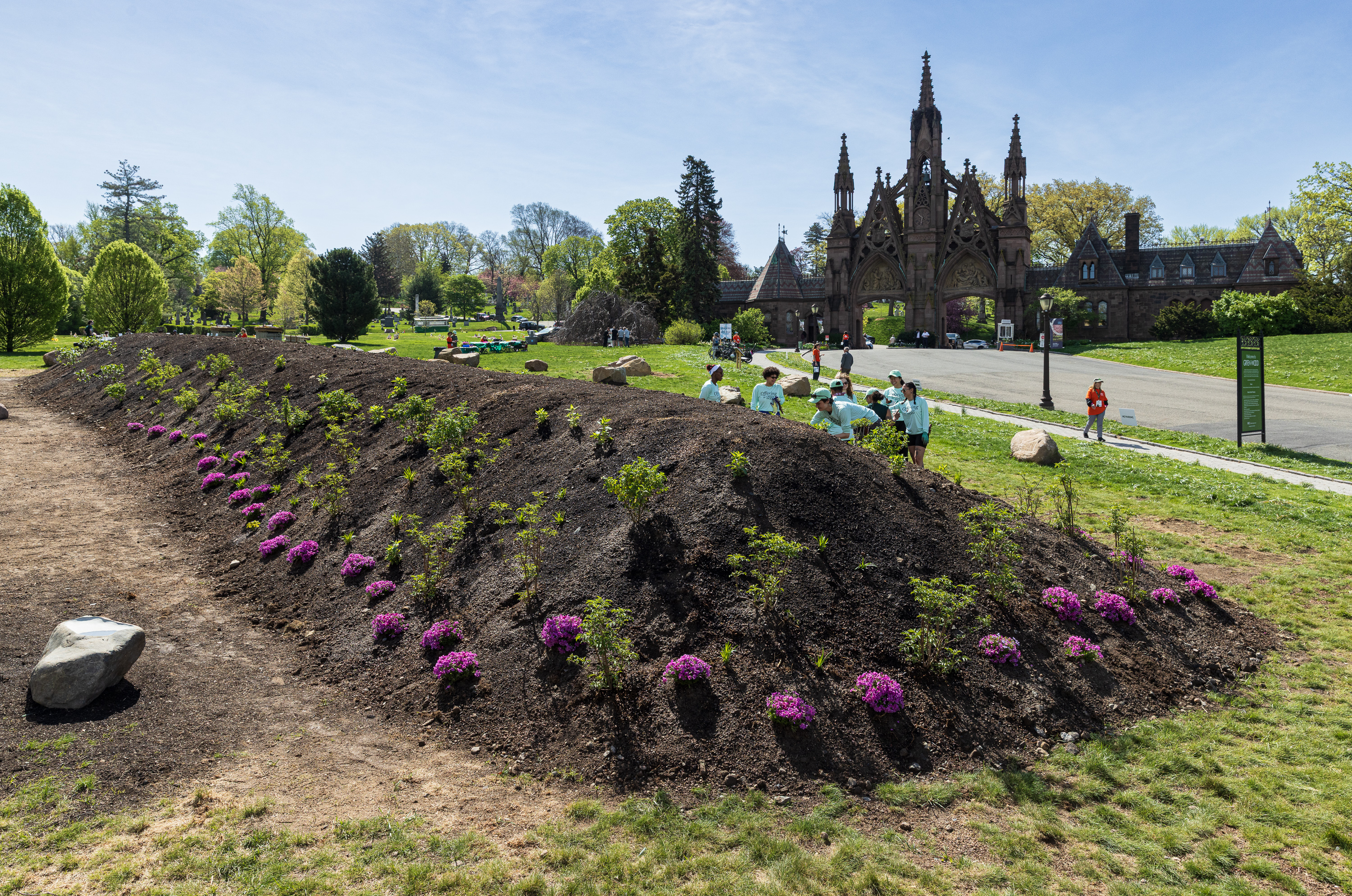 Jean Shin, Offering, installed at The Green-Wood Cemetery, Fallen red oak and pin oak buried in April 2026, Photo credit: Etienne Frossard
A critical dimension of this gesture lies in the artist’s diasporic memory. Shin has connected the making of these mounds to her experience growing up in a Korean immigrant family and visiting ancestral burial sites in Korea. Encounters with the monumental earthen tumuli of Gyeongju—the ancient capital of the Silla dynasty—left a lasting imprint. These burial mounds, at once architectural and organic, reflect a worldview in which the dead are not separated from the land but returned to it.
Participants in Offering were invited to take part in a planting ritual, placing prepared flowers directly into the earthen mounds. Drawing from Korean funerary traditions that honor ancestors, Shin extends this gesture into a ceremony not for human beings, but for trees—carefully building the soil and adding new life above what has been laid to rest. The “tree elders” buried beneath gradually decompose and enrich the ground, the planted flowers take root, generating a renewed ecological layer. What unfolds is a condition in which transformation becomes perceptible—decay and growth intertwined within the same terrain. In this way, life and death emerge not as opposing states, but as phases within a continuous cycle.
Shin further shapes this environment by placing irregular stones around the mounds. Some remain raw and unworked, while others are subtly carved to hold water, becoming quiet birdbaths. Through these gestures, the work opens itself to avian life, folding into the rhythms of the surrounding ecosystem. What emerges is not a fixed form, but a living process sustained through time, care, and participation. Rather than resolving into a stable form, the project continues to grow through maintenance and participation. In this sense, it moves beyond the traditional monument, becoming a “living memorial” shaped collectively by humans, nature, and community.
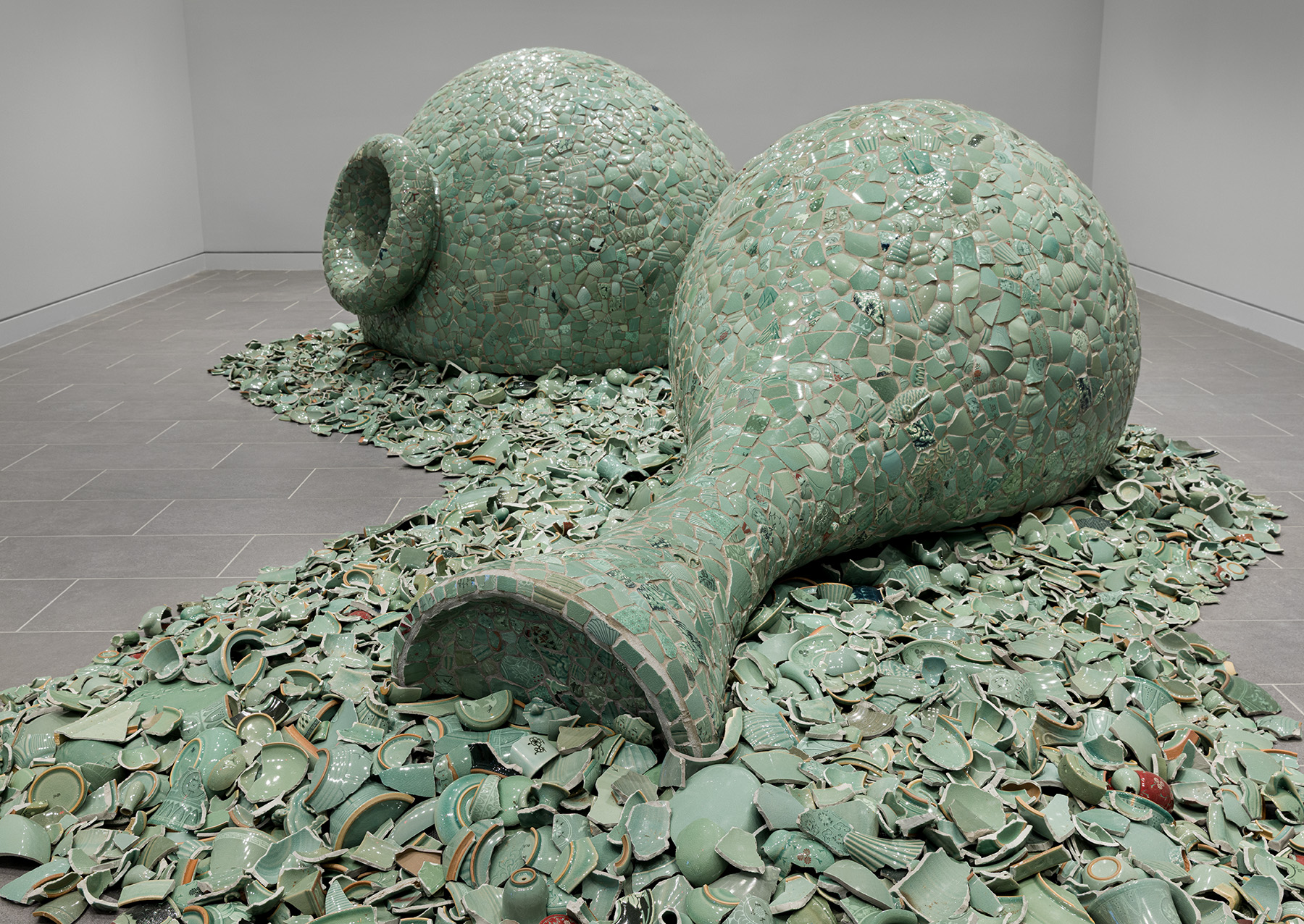 Jean Shin, Celadon Landscape, 2015/ 2026, Ceramic shards, mortar, and ESP Foam, Installation at the Green-House, The Green-Wood Cemetery, Photo credit: Etienne Frossard
Presented in parallel at the Green-Wood greenhouse, Celadon Landscape (2015/ 2026) extends this inquiry into another register. If Offering engages the cycle of life and death, Celadon Landscape turns toward the afterlives of cultural memory. Composed of thousands of discarded celadon shards collected from ceramic kilns in Icheon, Korea, the installation occupies space as though two vessels had been overturned and spilled into the room. What once stood vertically as a unified form now unfolds horizontally into a fragmented terrain. Yet each shard retains the luminous surface of celadon, carrying traces of artisanal labor, historical continuity, and cultural lineage. For Shin, these fragments become a metaphor for diasporic existence—displaced from their original context yet still bearing the imprint of origin.
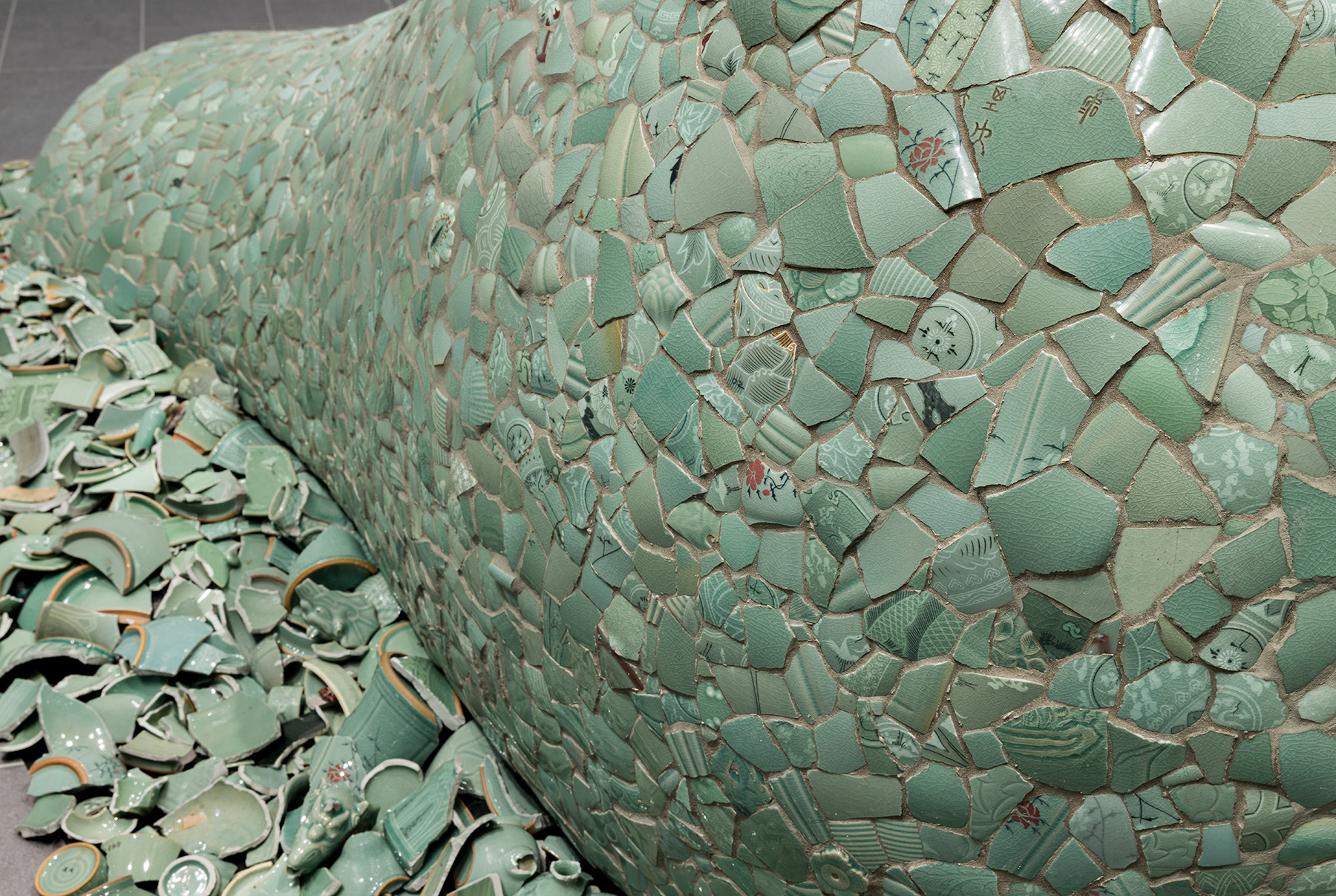 Jean Shin, Celadon Landscape, 2015/ 2026, Ceramic shards, mortar, and ESP Foam, Installation at the Green-House, The Green-Wood Cemetery, Photo credit: Etienne Frossard
Fragmentation here is not framed solely as loss, but as a condition that enables new forms of connection. In this way, Offering and Celadon Landscape together articulate a shared philosophical perspective: life and death, whole and fragment, are not opposing states but interdependent phases within a continuous process. A fallen tree becomes fertile ground for new growth; a broken shard continues to embody the presence of the whole.
This expanded understanding of continuity marks a significant development within Shin’s broader practice. For decades, she has worked with discarded materials—obsolete technologies, worn objects, and remnants of consumer culture—transforming them into installations that reveal the accumulation of memory and labor embedded within everyday life. Works such as TEXTile (2006), Sound Wave (2007, 2008), and Everyday Monuments (2009) have examined how objects carry traces of collective experience, often shifting attention from individual narratives to shared histories.
In Offering, however, this inquiry moves beyond the realm of objects toward the life cycles of living systems. The emphasis moves from material residue to ecological transformation, foregrounding processes of decomposition, regeneration, and exchange. What remains is not simply what is left behind, but what continues to circulate and renew itself.
Ultimately, “Beyond the Monument” in the title is not only a description of Shin’s work, but a proposition it embodies. Against the permanence traditionally associated with monuments, Offering proposes a different model—one rooted in temporality, care, and relationality. It invites reconsideration of how memory is held—not as something fixed, but as something sustained through ongoing interaction.
Standing within the luminous landscape of Green-Wood, one encounters not a fixed site of remembrance, but a living field of transformation. Death is no longer positioned as an endpoint, nor fragmentation as mere loss. Instead, both are understood as moments within a larger continuum—one sustained through time, participation, and the quiet persistence of life itself.
Soojung Hyun
Soojung Hyun is a New York–based curator, writer, and art historian. She has organized exhibitions at venues including the Anya and Andrew Shiva Gallery, AHL Project Space, and PS122 Gallery. She teaches Asian and contemporary art as an adjunct faculty member and contributes to the Archive of Korean Artists in America (AKAA). Her writing focuses on diasporic identity, material memory, and the intersection of Eastern and Western aesthetics.
view all articles from this author