Whitehot Magazine
September 2026
"The Best Art In The World"
"The Best Art In The World"
September 2026
Naomi Livia’s Embodied Photo-Weaves
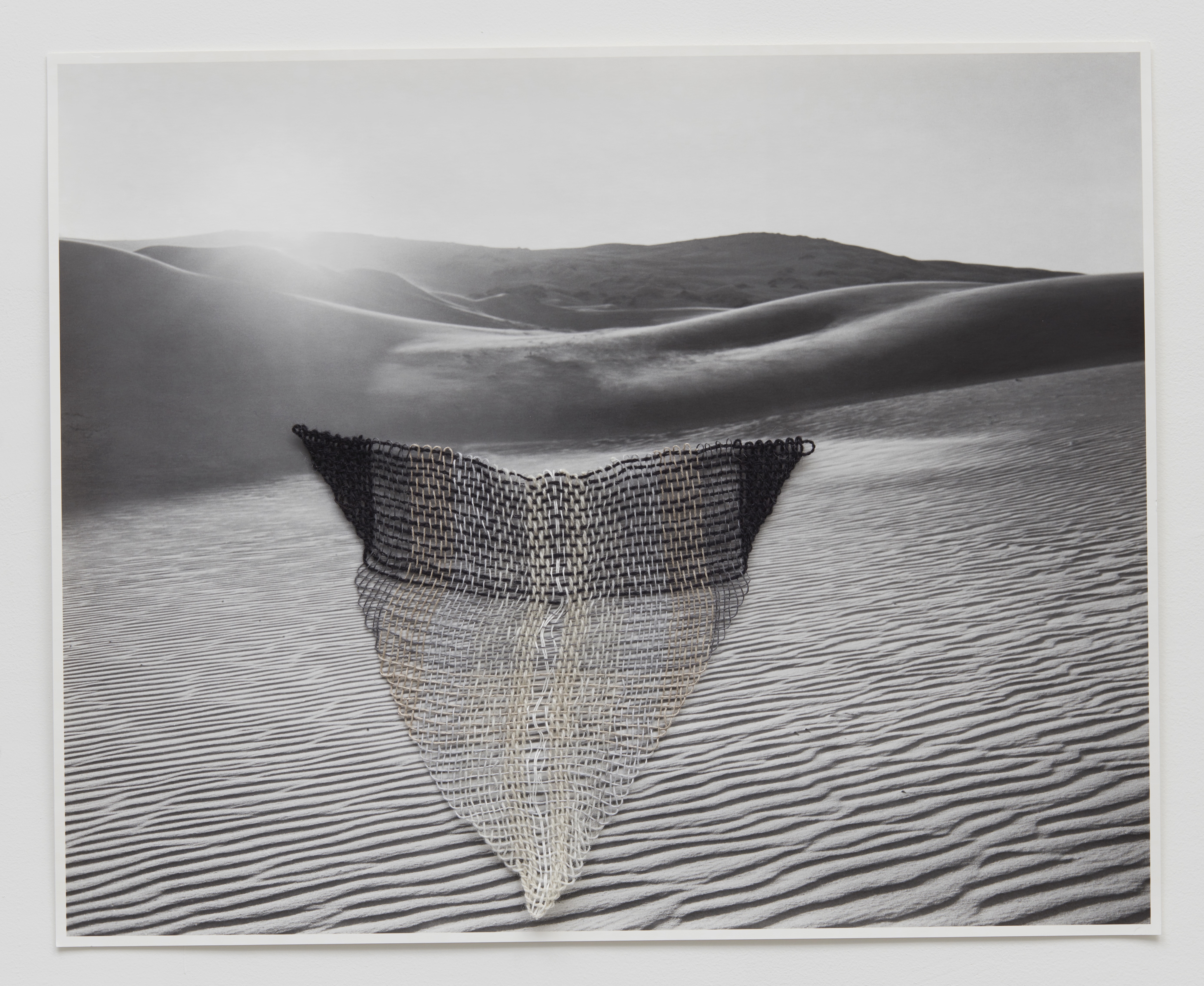
Healing Fields in Space Time Curvature (Space Lattice VI), 2024, Silver gelatin print, handmade weave (cotton, wool, linen), 20 x 24"
By Carlota Gamboa, August 4th, 2026
Now more than ever, art contends with an age of mechanical and digital reproduction: images arrive flattened on glowing screens, appearing and disappearing with rapidity. Images and their associations circulate so quickly that we rarely stop to consider them as physical objects at all. Naomi Livia's work begins by slowing that exchange down. Pairing large-format analog photographs with hand-woven constructions, she asks a deceptively simple question: what happens when photography is experienced not only through a singular medium?
“The weaving makes both the viewer and myself more aware of the image of photography and how it functions in the world in a very different way,” Livia says. "It requests embodiment from something that's not very physical." The tension between image and object has become a recurring touch-point within Livia's practice. Rather than treating weaving as a static accompaniment to photography, she uses it to fundamentally change how a photograph is encountered. The woven forms don't illustrate or aim to explicate the image; they slow it down to interrupt a relationship contemporary viewers have become desensitized to and present a dichotomy in texture, rhythm, weight, and material presence—all in order to experience the photograph as something physically made.
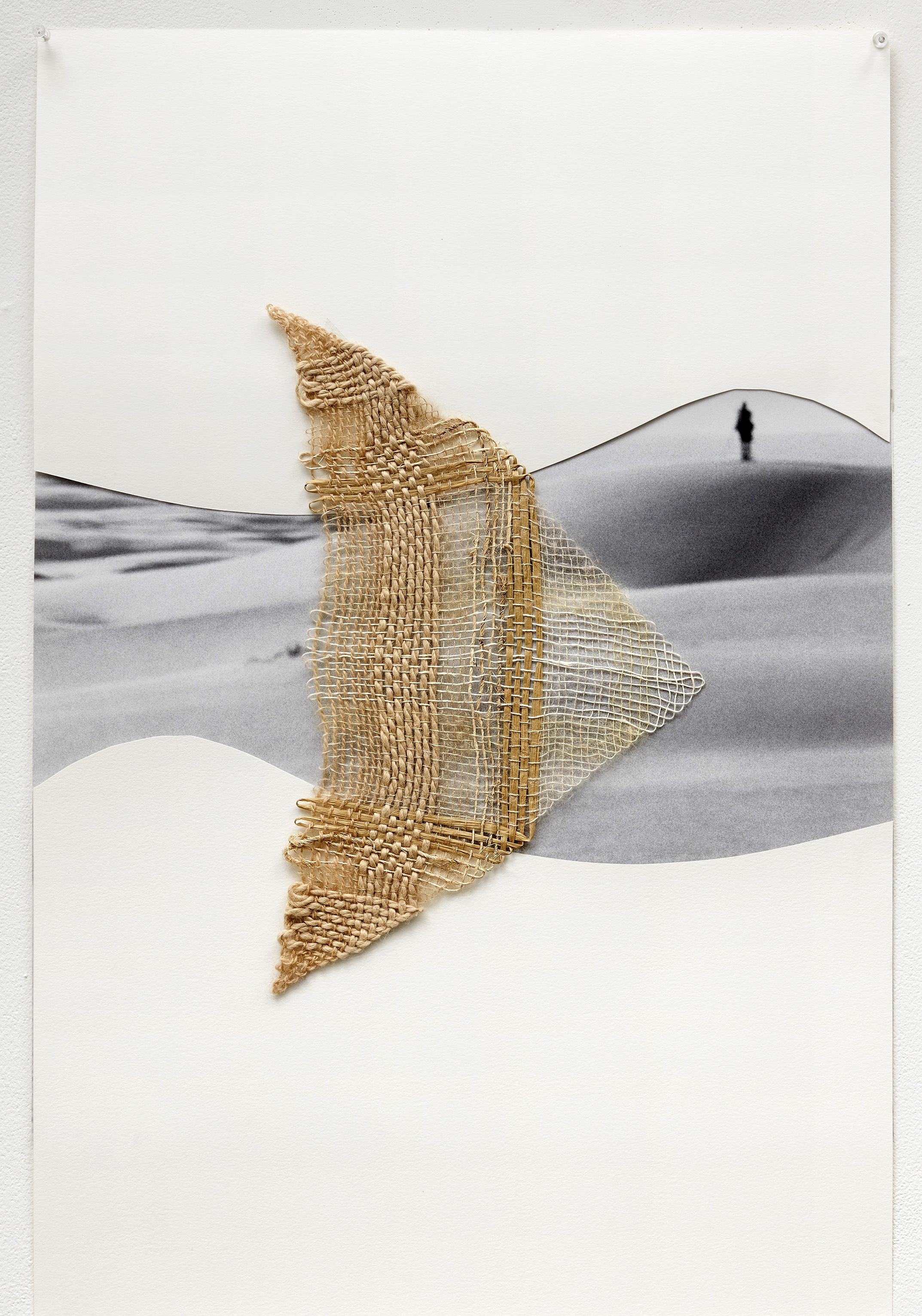 Divine Children of the Cosmos, 2024, Silver gelatin print, handmade weave (cotton, wool, linen), archival board, 36" x 20"
“I believe photographers don't take pictures,” she says. “They make them.” The distinction may feel subtle or syntactical, but it reshapes the way we as an audience can experience a work. Photography for Livia, has never been an objective record of the world, but a result of decisions, labor, and physical engagement. By bringing weaving into the work, she makes those invisible acts of construction relational again.
The impulse is deeply personal. Long before she discovered photography as a teenager through a darkroom class an artist friend had taught her, Livia had already learned to weave. “As a child, I had been weaving and doing all kinds of other crafts,” she recalls. “That's really where I started.” Those two practices developed separately for decades. After moving to New York in 1989 and earning her MFA from Hunter College, Livia established herself as both an exhibiting artist and a respected figure within photography. She worked as a picture editor and researcher, including at The New Yorker, while maintaining a studio practice that moved between photography and video.
“I had this idea that I wanted to learn about photography from all sides and be involved in it as deeply as possible,” she says. Looking at photographs became as important as making them. Editing books, researching images, meeting photographers, and studying photographic history gave Livia an expansive understanding of the medium. Yet the more photography changed, the more she found herself questioning what distinguished it from the endless flow of images that now surrounds us.
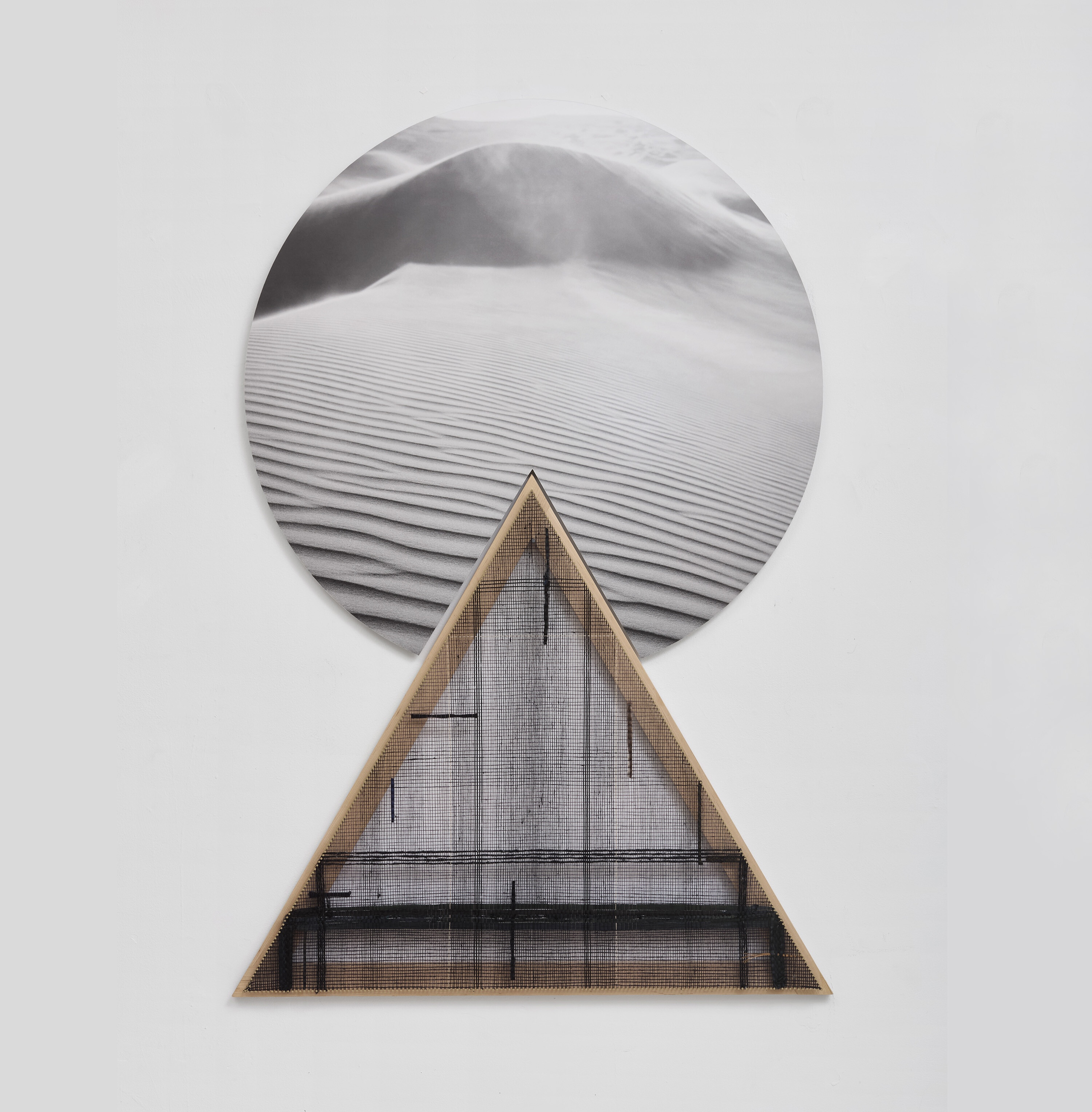 Superluminal Glitch, 2025, Gelatin silver print, handmade weave mounted on wooden loom, 5' x 3' x 2"
“It was Instagram that made everybody a photographer,” she says. “We as a culture became so saturated with images.” Her response was not to reject photography's evolution, but to ask what the medium might regain by returning to the body. “I was looking to expand the vision of what can be done with photography that's not completely digitized,” she explains.
Weaving offered that possibility. More than another medium, it introduced another way of seeing. Livia became increasingly interested in craft, not simply as technique but as a philosophy of making. Reading widely on craft theory, she found herself drawn to ideas of community, sustainability, and forms of knowledge rooted in the hand rather than the machine.
“I felt there really shouldn't be such a strong distinction,” she says of the divide between fine art and craft. “Craft is super interesting if you look at it from the perspective of its role in community, sustainability, people who work with their bodies and their hands.” That interest also brought her back to feminist art history. One of her earliest professional experiences was assisting photography historian Naomi Rosenblum on A History of Women Photographers, an experience that impacted how she wanted to relate to her own work. Influenced by artists such as Eva Hesse, whose material experimentation remains an important vehicle for Livia’s work, her multimedia aims to consciously involve a conversation of feminist practice within her physical act of making.
“It became much more conscious,” she says, “to really articulate for myself what makes a woman's perspective unique as an artist.” For Livia, that perspective isn't defined by subject matter alone. Although she works across landscape, still life, and the body, she sees those images as connected by a shared way of experiencing the world.
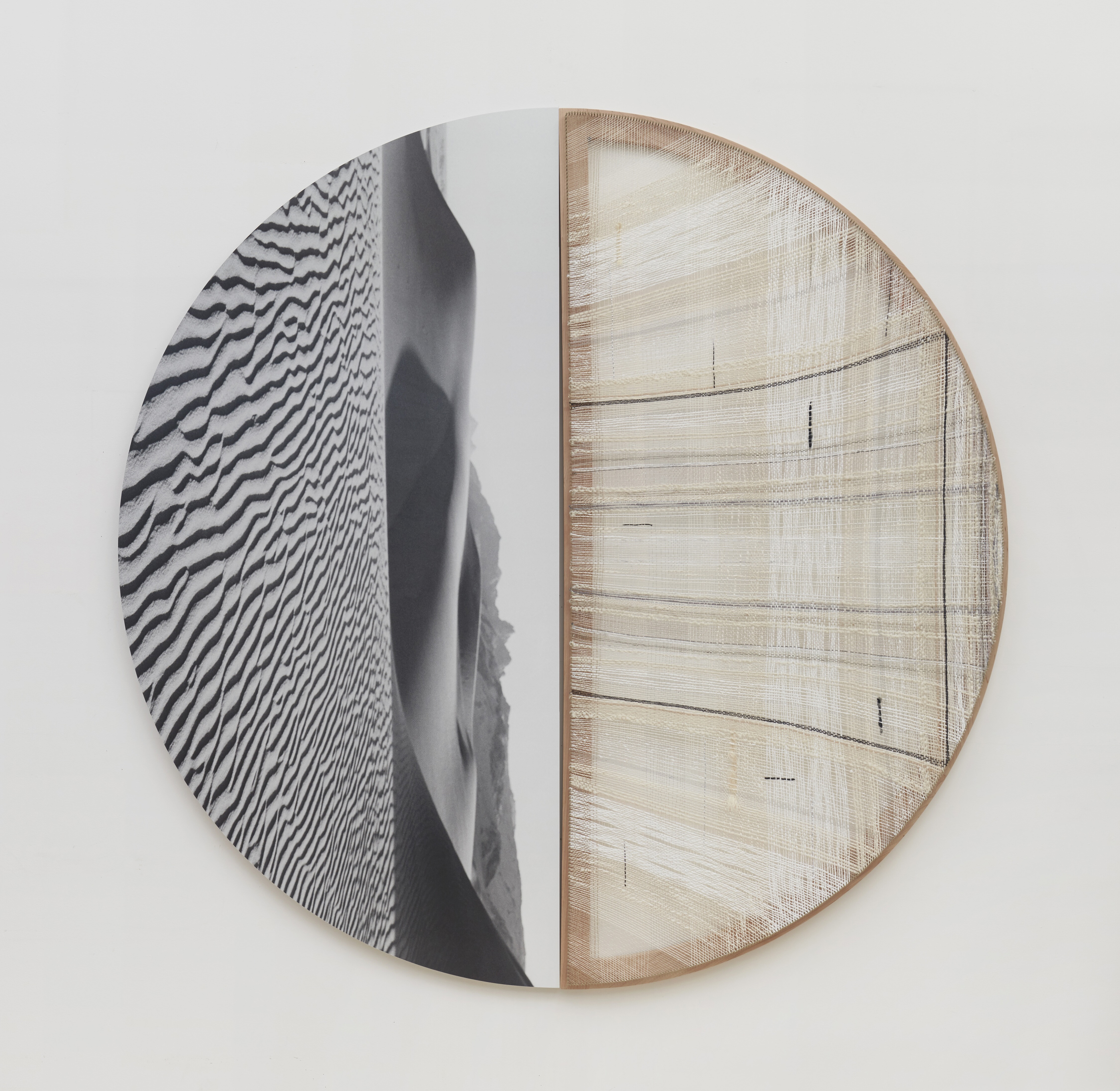 We Are the Event Horizon of Existence Itself, 2024, Gold-toned gelatin silver print mounted on aluminum, hand weave (kid silk, cotton, coconut fiber, wool, pineapple fiber, alpaca, silk, metallic yarn, kid mohair) on custom loom, 5’1” x 5’1” x 2”
This bodily awareness becomes visible in works such as We Are the Event Horizon of Existence Itself. A photograph of rolling desert dunes is interrupted by an adjacent woven structure whose fibers echo the curves and rhythms of the landscape. The weave neither explains nor decorates the image. Instead, it changes the conditions under which it is seen.
“The viewers tend to respond really strongly to the tactility of the weaves,” Livia explains. “Then you start noticing the textures and the sand in a more embodied way. People tend to want to find more in the photo.” The photograph begins to unfold differently. The woven surface encourages the eye to linger, tracing similarities between thread and terrain, between the movement of woven fibers and the contours carved by wind across sand. Each medium sharpens the other.
“A lot of people comment to me about how each part of those large constructions sheds light on the other,” she says. “It brings more awareness to the fact that photography is also an object in the world.” That observation perhaps best captures what Livia's work ultimately offers. In a culture saturated with images, she isn't asking us simply to look more closely. She is asking us to rediscover the photograph as something physical, to recognize its weight, its labor and its presence. By placing weaving and photography into conversation, she reminds us that images are not only seen. They are made. And through that act of making, they become capable of carrying care, attention, and perhaps even, as she quietly hopes, healing.
To learn more about Naomi Livia, please visit her website here and follow her on Instagram @naomilivia.studio.

Carlota Gamboa
Carlota Gamboa is an art writer and poet from Los Angeles. You can find some of her writing in Art & Object, Clot Magazine, Salt Hill Journal, Bodega Magazine, Oversound and Overstandard.
view all articles from this author